
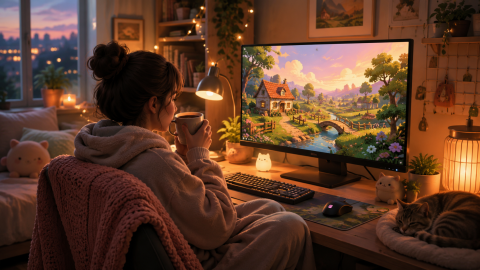
Some evenings are made for difficult boss battles, ranked matches, and complicated strategy. Others call for a warm drink, a comfortable chair, and a game that does not expect lightning-fast reactions. After a demanding day, the best cozy games provide a calmer kind of entertainment built around exploration, creativity, friendly characters, and manageable goals.
Cozy gaming is not a strict genre. A relaxing game can be a farming simulator, a decorating experience, a short adventure, a management game, or even a story about saying goodbye. What connects these titles is the way they reduce pressure. They let players move at their own pace, enjoy small accomplishments, and spend time in worlds that feel welcoming rather than exhausting.
The following games offer different versions of comfort. Some can become long-term digital homes, while others are compact experiences that fit neatly into a quiet evening.
Stardew Valley: A Small Farm With an Enormous Amount of Freedom
Stardew Valley remains one of the easiest cozy games to recommend because it allows players to decide what a good day looks like. After inheriting an old farm, you move away from an unfulfilling office routine and begin rebuilding a simpler life in the countryside.
You can grow crops, raise animals, catch fish, explore underground areas, collect resources, cook meals, decorate the farmhouse, and build friendships with the residents of Pelican Town. There is always something useful to do, but very little has to be completed immediately.
The game uses a daily clock, which can initially create a little pressure. Once you stop trying to complete every possible activity in a single day, however, the experience becomes far more peaceful. Missed crops can be planted next season. A festival will return next year. The village is not going anywhere.
Why Stardew Valley Works After a Busy Day
- Daily routines provide a comforting sense of structure;
- Progress is visible even during short sessions;
- Players can focus on farming, relationships, exploration, or decoration;
- The gentle soundtrack creates a calm rural atmosphere;
- Solo and cooperative play support different moods.
Stardew Valley can be a relaxing farming game, an efficient management challenge, or a social story depending on how you approach it. The secret is to ignore the temptation to optimize everything. A slightly messy farm is still a perfectly good farm.
Animal Crossing: New Horizons: A Holiday That Never Really Ends
Animal Crossing: New Horizons places you on a quiet island populated by cheerful animal neighbors. There is no grand mission demanding immediate attention. Instead, you slowly transform an undeveloped location into a personalized community.
The game follows the real-world clock. Morning, afternoon, evening, weather, seasons, and celebrations all change over time. This makes the island feel less like a traditional level and more like a place you visit regularly.
A typical session might include collecting shells, checking the shop, talking to neighbors, moving furniture, fishing by the river, or adjusting a flower garden. None of these activities is particularly dramatic, which is exactly the point.
Animal Crossing is especially effective for players who enjoy decorating. Houses, gardens, paths, parks, cafés, beaches, and entire neighborhoods can be redesigned. The creative tools are simple enough to understand but flexible enough to support elaborate ideas.
There are debts to repay and materials to collect, yet failure is almost impossible. Your island does not collapse because you missed a week. The residents may mention your absence, but they are usually just pleased to see you again.
Unpacking: Finding a Life Story Inside Cardboard Boxes
Unpacking turns an ordinary household task into a quiet environmental puzzle. Each level presents a collection of boxes and a new room. You remove objects one by one and decide where they belong.
The controls are simple, the sound design is wonderfully precise, and there are no dialogue-heavy scenes interrupting the process. A mug makes a soft sound when placed on a desk. Clothes settle into drawers. Books form neat rows on shelves.
What begins as organization gradually becomes storytelling. The objects reveal changes in the unseen protagonist’s age, interests, relationships, work, and living situation. A childhood toy may remain present across several moves, while other possessions disappear after a major change.
Unpacking is particularly suitable for a single relaxing weekend because it does not demand an endless commitment. It offers a complete and satisfying experience without introducing dozens of systems to learn.
Best For
Players who enjoy organization, visual storytelling, interior design, and the deeply satisfying experience of finding exactly the right place for a kitchen utensil.
A Short Hike: A Tiny Adventure With a Big Heart
A Short Hike understands that exploration does not need a giant map. Its compact island contains enough trails, cliffs, beaches, hidden objects, and friendly visitors to make every direction feel rewarding.
You play as Claire, a young bird attempting to reach the top of a mountain. The objective is clear, but there is no need to hurry. Along the way, you can swim, glide, climb, fish, search for treasures, and help other hikers with small problems.
The game’s greatest strength is how naturally movement and relaxation fit together. Gliding from a high point feels liberating, while climbing creates a light sense of progress without turning the journey into an exhausting challenge.
A peaceful evening with A Short Hike might look like this:
- Follow an unfamiliar trail instead of heading directly toward the summit;
- Stop to speak with a camper or another traveler;
- Collect an upgrade that makes climbing easier;
- Glide toward a distant beach;
- Realize you have completely forgotten the original route;
- Enjoy the detour anyway.
It is short enough to complete in a few sessions, but its small world is pleasant enough to revisit simply for the atmosphere.
Spiritfarer: Comfort With an Emotional Weight
Spiritfarer is often described as cozy, but it is not emotionally effortless. You play as Stella, the new guide responsible for helping spirits complete their final journeys. She travels across a beautiful world in a customizable boat, welcoming passengers and learning what they need before they are ready to leave.
Daily life aboard the boat is gentle. You cook food, grow plants, gather materials, build rooms, explore islands, and care for your passengers. Each spirit has preferences, memories, regrets, and a distinct personality.
The management systems create warmth and routine, while the story introduces more difficult feelings. Spiritfarer explores grief, acceptance, friendship, and the quiet work of caring for someone when their journey is nearing its end.
What Makes It Special
- Beautiful hand-drawn animation;
- A boat that gradually becomes a floating home;
- Characters with personal and memorable stories;
- Relaxed crafting, farming, cooking, and exploration;
- Local cooperative play through Stella’s companion, Daffodil.
This is not necessarily the game to choose when you want to avoid every serious emotion. It is better suited to evenings when you want something calm, thoughtful, and compassionate.
PowerWash Simulator: Cleaning Without the Actual Cleaning
Few premises sound less exciting than washing dirt from walls, vehicles, playground equipment, and public buildings. PowerWash Simulator turns that repetitive task into one of gaming’s most unexpectedly satisfying relaxation tools.
There are no complicated strategies to remember. You select a nozzle, aim at a dirty surface, and watch the original color slowly return. Each completed section produces a small confirmation sound, delivering a steady stream of tiny rewards.
The experience works because progress is immediate and visible. A filthy area becomes clean through direct, simple effort. Unlike real household cleaning, there are no wet socks, no missing sponges, and no discovery that the cupboard contains three empty bottles of cleaning product.
Levels can take a while, but they do not require constant concentration. PowerWash Simulator is ideal for listening to music, a podcast, or a conversation while your hands remain occupied with an uncomplicated task.
Cozy Grove: A Little Progress Every Day
Cozy Grove takes place on a changing island inhabited by friendly spirits. As a Spirit Scout, you complete requests, uncover memories, collect resources, and gradually bring color back to the environment.
The game is designed around short daily visits. New tasks appear over time, and the island develops as you help its residents. Rather than encouraging a long session in which everything is completed at once, it invites you to return regularly.
A Typical Visit Includes
- Checking requests from familiar spirits;
- Searching the island for hidden objects;
- Collecting fruit, wood, shells, and crafting materials;
- Decorating campsites and outdoor spaces;
- Learning another part of a character’s history.
This structure is useful for people who want a relaxing game without losing an entire evening to it. You can complete a few tasks, arrange some furniture, and leave feeling that the island has moved forward.
The hand-drawn style gives Cozy Grove the appearance of an illustrated storybook. Beneath the charming presentation, however, its characters often carry thoughtful stories about memory, identity, and unfinished business.
Dorfromantik: Building a Peaceful Landscape One Tile at a Time
Dorfromantik combines light strategy with the calming pleasure of assembling a landscape. Players place hexagonal tiles containing forests, fields, villages, rivers, and railway tracks. Matching their edges creates a growing countryside viewed from above.
There are objectives and opportunities to improve your score, but the game never needs to become intensely competitive. Its puzzle elements provide enough structure to hold your attention while leaving plenty of room for experimentation.
A carefully planned railway might cross half the map. A river may curve around forests and villages. Sometimes the perfect tile arrives. Sometimes it does not, and the countryside develops a strangely isolated field beside a railway station. Rural planning is apparently complicated.
Dorfromantik offers several relaxing qualities at once: soft music, gentle visuals, simple controls, and no characters demanding that you complete ten errands before sunset. It is a strong choice for players who find calm in patterns and gradual construction.
Disney Dreamlight Valley: Familiar Characters and Endless Decorating
Disney Dreamlight Valley combines life simulation with a large collection of familiar animated characters. The player restores a magical valley, unlocks themed regions, gathers resources, completes quests, and helps residents recover their memories.
Its structure will feel familiar to fans of farming and village games. You can cook, fish, mine, plant crops, decorate a home, design outdoor areas, and change your character’s clothing.
The major difference is the cast. Instead of meeting entirely new villagers, you build friendships with recognizable Disney and Pixar characters. They live in the valley, offer story quests, accompany you during activities, and provide themed rewards.
Reasons to Play
- A large collection of decorative items and clothing;
- Frequent character-based quests;
- Different biomes with distinct resources;
- Farming, cooking, fishing, mining, and crafting;
- Plenty of freedom to redesign the valley.
The game contains more objectives and resource requirements than some other cozy titles. It is most relaxing when treated as a long-term project rather than a checklist that must be cleared immediately.
Slime Rancher: Colorful Creatures and Gentle Exploration
Slime Rancher places you on a distant planet where cheerful gelatinous creatures bounce across bright landscapes. As a new rancher, you explore the environment, collect different slime species, build enclosures, grow food, and sell valuable resources.
The game has more movement and light danger than a traditional farming simulator, but its colorful atmosphere keeps the experience playful. Discovering a new slime variety is exciting, especially when you begin experimenting with diets and combinations.
Managing the ranch creates a comfortable routine:
- Feed the slimes;
- Collect the resources they produce;
- Sell those resources at a changing market price;
- Upgrade the ranch;
- Travel farther into the world;
- Return home with another creature that requires an entirely new enclosure.
Slime Rancher can become chaotic if too many species are placed together without planning. Fortunately, most problems look less alarming when they involve smiling blobs bouncing around a pastel-colored farm.
Lake: Delivering Mail and Reconsidering What Comes Next
Lake offers a slower and more realistic kind of comfort. The story follows Meredith Weiss, who temporarily leaves her city career to deliver mail in the quiet Oregon town where she grew up.
Most of the gameplay involves driving a postal vehicle, delivering letters and packages, and talking to local residents. The routes become familiar, the radio plays in the background, and the lakeside scenery creates a gentle sense of routine.
There are conversations and choices, but the story is intentionally understated. Meredith reconnects with old acquaintances, meets new residents, and considers whether the life she left behind is still the one she wants.
Lake is a good option for players who prefer:
- realistic environments rather than fantasy worlds;
- slow driving without competitive racing;
- character-focused conversations;
- a compact narrative with meaningful choices;
- the quiet satisfaction of completing a delivery route.
The game is not filled with dramatic events. Its appeal comes from occupying an ordinary life for a little while and discovering that ordinary does not have to mean empty.
House Flipper: Renovation Without the Dust
House Flipper turns property renovation into a sequence of clear, satisfying jobs. You clean neglected rooms, remove damaged furniture, paint walls, install fixtures, arrange decorations, and eventually sell transformed homes.
Every project begins with visible disorder and ends with a cleaner, more organized space. That before-and-after transformation provides a strong feeling of accomplishment, even during a short session.
The game also allows creative freedom. One player may design a minimalist apartment with neutral walls, while another creates a kitchen so colorful that the future owner will need sunglasses.
Some jobs involve detailed instructions, while purchased properties can be redesigned more freely. This balance makes House Flipper suitable for both task-oriented players and those who simply want to experiment with interiors.
Wylde Flowers: Farming With Magic and Fully Voiced Characters
Wylde Flowers combines farming, relationships, and witchcraft in a story-driven village simulation. The player takes control of Tara, who moves to a rural island to help her grandmother and soon discovers a magical side of the community.
The familiar activities are present: planting crops, fishing, cooking, collecting resources, and building friendships. Magic adds potions, spells, transformations, and nighttime meetings that give the game a distinct identity.
One of its greatest strengths is the cast. Characters have clear personalities, ongoing stories, and fully voiced dialogue. Relationships develop as Tara becomes more involved in both the public life of the town and its hidden magical community.
Wylde Flowers is structured more tightly than open-ended life simulators. Its narrative gives players a reason to continue, but there is still enough freedom to spend an evening gardening, preparing meals, or talking to neighbors.
ABZÛ: A Wordless Journey Beneath the Ocean
ABZÛ removes shops, farming schedules, and lengthy conversations. It focuses almost entirely on movement, color, music, and underwater discovery.
Players swim through oceans filled with schools of fish, ancient ruins, coral formations, and enormous sea creatures. The controls are fluid, and much of the experience involves simply observing the environment.
There is a narrative, but it is communicated visually rather than through detailed explanations. This makes ABZÛ a good choice when you want to stop reading menus, managing inventories, or remembering what twelve villagers requested yesterday.
The journey is relatively brief and works best as a concentrated experience. Dim the lights, use headphones, and allow the music and underwater spaces to carry the evening.
Which Cozy Game Matches Your Mood?
Not every relaxing game works for every kind of tiredness. A management system may feel satisfying after a chaotic day but overwhelming after spending hours organizing spreadsheets. The right choice depends on what your mind needs at that moment.
- Choose Stardew Valley for a long-term world filled with farming and relationships;
- Choose Animal Crossing: New Horizons for decorating and gentle daily routines;
- Choose Unpacking for a short, organized, story-rich experience;
- Choose A Short Hike for cheerful exploration without a major commitment;
- Choose Spiritfarer for emotional storytelling and compassionate management;
- Choose PowerWash Simulator for repetitive, visible progress;
- Choose Dorfromantik for calm puzzle-solving and landscape creation;
- Choose Lake for quiet driving and grounded conversations;
- Choose Slime Rancher for colorful exploration and playful ranch management;
- Choose ABZÛ when you want atmosphere with minimal reading.
How to Keep a Cozy Game From Becoming Another Job
Even the gentlest games can become stressful when players approach them as optimization challenges. Farming schedules, daily quests, seasonal events, and relationship systems can turn a peaceful hobby into a second list of responsibilities.
The solution is not necessarily to abandon the game. It is to change the way you play it.
- Ignore activities that are not enjoyable, even when they offer rewards;
- Avoid searching for the most efficient strategy before learning the game naturally;
- Accept that missing a seasonal item is not a genuine emergency;
- Choose shorter sessions when daily tasks begin to feel repetitive;
- Turn down difficulty settings when available;
- Use creative or relaxed modes instead of proving anything to an imaginary audience;
- Stop playing when the routine starts producing pressure rather than comfort.
Cozy games are at their best when they provide a space to breathe. Progress does not have to be perfect, every collectible does not need to be found, and your virtual home does not need to look like a professionally designed showroom.
A relaxing game should leave the day feeling a little lighter. Whether that means planting digital strawberries, arranging books on a shelf, delivering mail beside a lake, or cleaning an impossibly dirty playground is entirely personal. The best cozy game is ultimately the one that makes you comfortable enough to forget the clock for a while without demanding that you defeat it.