
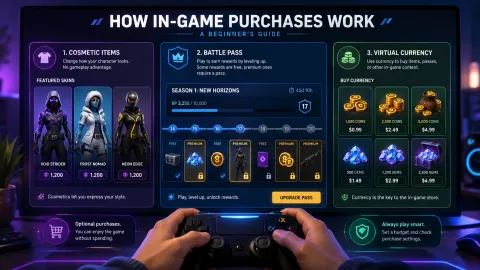
In-game purchases have become a standard part of modern gaming. They appear in free mobile games, competitive shooters, sports titles, role-playing games, and even full-price releases. Sometimes they offer harmless cosmetic extras. In other cases, they unlock characters, speed up progress, or provide access to seasonal content.
For beginners, these systems can feel confusing because games rarely use ordinary prices alone. Instead, they rely on virtual currencies, rotating stores, premium reward tracks, bundles, and limited-time offers. A costume may cost 1,500 crystals, but the store only sells crystals in packs of 1,200 or 2,000. A battle pass may look inexpensive, yet completing it can require many hours of regular play.
Understanding how these systems work makes it easier to recognize what you are buying, compare value, and avoid spending more than expected. The goal is not to treat every in-game purchase as a bad decision. It is to understand the design behind the store before pressing the payment button.
What Counts as an In-Game Purchase?
An in-game purchase is any optional transaction made inside a video game or through a store connected to that game. The player pays real money and receives digital content, virtual currency, access to a feature, or some other benefit.
These purchases are often called microtransactions, although the term can be misleading. Some transactions cost less than a cup of coffee, while premium bundles can cost as much as a complete game.
Common examples include:
- character costumes and weapon appearances;
- battle passes and seasonal reward tracks;
- premium virtual currency;
- new characters, heroes, or playable classes;
- additional levels, story chapters, or expansion packs;
- time-saving upgrades and resource bundles;
- randomized reward packs;
- monthly memberships or premium subscriptions.
The most important distinction is whether the purchase changes only appearance or directly affects gameplay. A cosmetic item may make a character look different without changing performance. A gameplay purchase might provide stronger equipment, faster progression, or access to abilities unavailable to non-paying players.
Why Games Use Microtransactions
In-game stores are a major source of ongoing revenue. They allow developers to earn money after release and can help fund servers, updates, events, customer support, and new content.
This model is especially important for free-to-play games. When a game costs nothing to install, purchases from a smaller group of players often support the experience for everyone else. A large audience may never spend money, while a much smaller percentage buys cosmetics, currencies, or seasonal passes.
Paid games also use microtransactions because development does not always end at launch. Multiplayer titles may operate for years, requiring continuous maintenance and fresh content. However, the presence of a store in a full-price release can feel more controversial, particularly when important features appear to have been separated from the original product.
Microtransactions generally serve three business goals:
- Generate recurring revenue after the initial release;
- Keep players returning for new seasons, events, and store rotations;
- Turn long-term engagement into repeated purchasing opportunities.
The system works best for players when purchases are transparent, optional, and fairly priced. It becomes more frustrating when the store creates pressure, hides the true cost, or gives paying users a major competitive advantage.
Skins and Other Cosmetic Items
Skins are visual changes for characters, weapons, vehicles, companions, or other game elements. They usually do not improve statistics or provide direct gameplay advantages. A skin might replace a standard outfit with futuristic armor, seasonal clothing, a licensed movie design, or a humorous costume.
Cosmetic purchases are popular because they allow players to express personality. In social and multiplayer games, appearance becomes part of a player’s identity. Rare or recognizable designs can also signal experience, event participation, or support for a particular team or creator.
Cosmetic stores may sell more than complete skins. They can include weapon finishes, emotes, victory poses, profile frames, voice lines, animations, banners, pets, and loading screens.
Why Cosmetic Prices Vary
Two skins in the same game may have very different prices. The difference is often based on rarity, visual complexity, new animations, custom sound effects, licensed branding, or limited availability.
A basic color variation may be inexpensive, while a premium skin can include:
- a redesigned character model;
- unique visual effects;
- special movement or elimination animations;
- custom sound design;
- new voice lines;
- an evolving appearance tied to gameplay.
The word rarity does not always mean that an item is genuinely scarce. In many games, rarity is simply a store category created by the developer. A legendary label can justify a higher price even when an unlimited number of players can purchase the item.
How Battle Passes Work
A battle pass is a seasonal progression system. Players complete matches, missions, or challenges to earn experience and unlock rewards across a series of levels.
Most battle passes have two tracks. The free track offers a smaller selection of rewards to everyone. The premium track becomes available after payment and usually contains additional cosmetics, currency, boosters, and exclusive items.
Buying the pass rarely unlocks every reward immediately. It usually provides the opportunity to earn those rewards before the season ends. This is an important detail because players are purchasing both content and a time-limited progression task.
A Typical Battle Pass Cycle
- The player buys the premium pass at the beginning or during a season;
- Regular gameplay and challenges provide battle pass experience;
- New levels unlock cosmetic items and other rewards;
- The season ends after a fixed period;
- Unclaimed or unfinished rewards may become unavailable.
Some games allow players to buy levels if they are running out of time. This can make an inexpensive pass much more costly. A player who purchases the pass but cannot complete it may feel pressured to pay again rather than lose the final rewards.
Before buying, check the season end date, the number of levels, the expected weekly commitment, and whether progress can be completed through normal play. A battle pass offers better value when you already enjoy the game and expect to play it regularly.
Virtual Currency and Why Games Use It
Virtual currency is digital money that can be spent inside a game. Examples include coins, gems, credits, points, crystals, and tokens. Some currencies are earned through gameplay, while premium currencies are usually purchased with real money.
Virtual currency adds distance between the player and the actual price. Spending 900 gems can feel less significant than spending a visible amount of real money, even when both represent the same cost.
Currency packs also create leftover balances. Suppose an item costs 1,500 tokens, but the store sells packs containing 1,000 or 2,200 tokens. The smaller pack is insufficient, so the player must buy the larger one and will have 700 tokens remaining. That balance may encourage another purchase later.
How to Calculate the Real Price
Divide the real-money cost of a currency pack by the number of units in that pack. Then multiply the result by the price of the item.
For example, if 2,000 credits cost $20, each credit is worth $0.01. An item priced at 1,400 credits has an approximate real value of $14. However, the player may still need to spend the full $20 if no smaller suitable pack exists.
Games may also offer bonus currency in larger packs. This lowers the theoretical price per unit but only creates real savings when you were already planning to spend that amount. Buying more currency than necessary is not a discount if the remaining balance is never used.
Premium Currency, Earned Currency, and Event Tokens
Many games use several currencies at the same time, each with different rules.
- Earned currency is gained through regular gameplay and often purchases basic items or upgrades;
- Premium currency is bought with real money and usually accesses exclusive products;
- Event currency is available during temporary activities and may expire afterward;
- Competitive currency is earned through ranked modes or special challenges;
- Crafting materials are used to create or unlock selected items.
The presence of multiple currencies can make the economy harder to evaluate. A store might require players to convert premium currency into event tokens before making a purchase, adding another layer between the payment and the final item.
Always check whether a currency expires, transfers between seasons, can be earned without payment, or is restricted to a specific store. Unused event tokens may lose all value when an event ends.
Bundles, Starter Packs, and Special Offers
Bundles combine several items into one purchase. A typical package may contain a skin, virtual currency, boosters, profile decorations, and extra resources. The store often presents the total as a large discount compared with buying every item separately.
That comparison is only useful when you actually want everything in the bundle. If you are interested in one costume and ignore the remaining items, the package may provide less value than the advertised discount suggests.
Starter packs are usually aimed at new players. They may offer a small amount of premium currency, a character, and several resources at a low price. These packs can be reasonable, but they also serve as an introduction to the payment system. After the first purchase, future transactions may feel easier and more familiar.
Questions to Ask Before Buying a Bundle
- Would I purchase these items separately?
- Are any of the rewards available through normal gameplay?
- Does the bundle contain temporary boosters that require immediate use?
- Is the displayed discount based on realistic individual prices?
- Will leftover currency encourage another payment?
Randomized Rewards and Chance-Based Purchases
Some games sell packs, crates, draws, or other systems that provide a random reward. The player pays without knowing exactly which item will appear.
These systems may include rarity tiers and published probability rates. A premium character might have a very low chance of appearing, while common items appear frequently. Receiving duplicates may provide crafting materials, partial refunds, or little useful value.
Certain games include a pity system. After a set number of unsuccessful attempts, the player receives a high-rarity reward or the featured item. The number of attempts may carry over to another event, reset when the banner changes, or disappear after receiving a premium reward.
Before participating, understand four details:
- The exact probability of receiving the desired item;
- The maximum number of attempts required for a guarantee;
- Whether progress transfers to future banners;
- What happens when a duplicate appears.
Chance-based systems can become expensive because every unsuccessful attempt creates the feeling that the next one might succeed. Setting a strict spending limit before starting is safer than deciding after several disappointing results.
Pay-to-Win and Pay-for-Convenience
Not every gameplay purchase has the same effect. Some provide direct competitive power, while others mainly reduce waiting or repetitive tasks.
A game is commonly described as pay-to-win when spending money provides a meaningful advantage over players who do not pay. This might include stronger weapons, higher character statistics, better competitive units, or faster access to essential upgrades.
Pay-for-convenience systems offer shortcuts instead. Players might buy additional storage, faster crafting, experience boosters, extra energy, or immediate access to content that can also be earned through play.
The difference can be unclear. A time-saving purchase may still become a competitive advantage when progression speed matters. If one player reaches powerful equipment weeks earlier because of paid boosters, the system affects more than convenience.
Consider whether the purchase changes appearance, saves time, removes frustration, or increases performance. That distinction helps determine whether the store matches your expectations.
Subscriptions and Monthly Memberships
Some games offer recurring memberships that renew every month. Benefits may include premium currency, exclusive cosmetics, daily rewards, expanded storage, special servers, or access to a rotating library of content.
Subscriptions can provide predictable value for regular players, but recurring billing is easy to forget. A low monthly price becomes a much larger annual expense when left active for a long period.
Before subscribing, review:
- the renewal date;
- the cancellation method;
- whether benefits disappear immediately after cancellation;
- whether unused monthly rewards accumulate;
- whether the price changes after an introductory period.
It is also worth checking whether the membership is tied to one platform. A subscription purchased through a console store may not transfer to a mobile or PC account, even when the game supports shared progression.
Limited-Time Offers and Store Rotation
Many in-game stores use countdowns, daily rotations, seasonal collections, or messages suggesting that an offer will disappear soon. These systems create urgency and reduce the time available for careful consideration.
Some items genuinely remain exclusive to a season. Others return later despite being presented as rare. Unless the developer clearly promises permanent exclusivity, it is safer to assume that a cosmetic may reappear.
Store rotation also encourages frequent checking. Players may log in daily because they fear missing a preferred item. That routine keeps the game active in their mind and creates more opportunities to spend.
A useful rule is to wait before purchasing whenever possible. If an item still feels worthwhile after a full day, the decision is more likely to reflect genuine interest rather than temporary pressure.
How Refunds Usually Work
Digital purchase refunds depend on the game, platform, region, and type of item. Some companies allow limited refunds for unused content, while others treat all completed transactions as final.
A refund may be unavailable when:
- the virtual currency has already been spent;
- the cosmetic item has been equipped or used;
- the purchase included consumable resources;
- too much time has passed;
- the transaction was made through a third-party platform.
Console stores, mobile stores, and game publishers may each have separate refund procedures. Purchasing currency through one company and spending it inside another company’s game can make responsibility less obvious.
Unauthorized purchases should be reported quickly. Parents can also use device-level controls, password requirements, and spending limits to reduce accidental transactions.
Practical Ways to Control Spending
The easiest way to manage in-game purchases is to treat them as part of an entertainment budget rather than as isolated small payments.
- Choose a monthly spending limit before opening the store;
- Calculate prices in real money rather than virtual currency;
- Avoid storing payment details when impulse purchases are a concern;
- Wait before responding to limited-time offers;
- Review transaction history regularly;
- Cancel subscriptions that are no longer being used;
- Do not continue spending simply because previous purchases did not provide the desired result.
Gift cards can be useful because they create a fixed limit. Once the balance is gone, additional spending requires a separate and more deliberate decision.
It also helps to compare the price of digital items with other entertainment. A premium cosmetic bundle may cost the same as another complete game, several months of a subscription service, or multiple smaller independent titles.
Helping Children Understand In-Game Stores
Younger players may not immediately understand that virtual currency represents real money. Bright animations and simple purchase buttons can make transactions feel like part of ordinary gameplay.
Parents and guardians should explain the difference between earned rewards and paid items. It is also important to discuss randomized systems, limited-time pressure, and recurring subscriptions in clear language.
Useful protections include purchase passwords, parental controls, disabled one-click payments, account spending limits, and email notifications for every transaction.
Rules work better when children understand the reason behind them. A fixed monthly allowance can teach budgeting more effectively than an unexplained ban, particularly when the child is old enough to compare prices and make choices.
When an In-Game Purchase May Be Worth It
A digital purchase can be reasonable when the cost fits your budget, the item provides lasting enjoyment, and the game clearly explains what you will receive.
A cosmetic for a game you have played for hundreds of hours may offer more personal value than a physical product used only once. A battle pass can also be worthwhile when you already plan to complete the season and enjoy most of its rewards.
The purchase is more questionable when it is driven by frustration, fear of missing out, competitive pressure, or the hope of recovering value after previous unsuccessful attempts.
Before paying, ask yourself whether you would still want the item without a countdown, flashing discount, rarity label, or social pressure. If the answer is yes and the cost is comfortable, the decision is easier to justify.
A Simple Checklist Before You Buy
- Do I know the exact real-money cost?
- Am I buying an item or only a chance to receive it?
- Does the purchase expire at the end of a season?
- Can the same content be earned through gameplay?
- Will I need to spend more to complete the set?
- Does the purchase renew automatically?
- Would I still buy it tomorrow?
- Does it fit within my entertainment budget?
In-game purchases are not automatically harmful or wasteful. They are simply products designed inside a system that encourages frequent engagement and repeated spending. Learning how skins, battle passes, virtual currencies, subscriptions, and randomized rewards operate gives players more control over that system.
The best purchase is one made with a clear understanding of the price, the reward, and the reason for buying it. When those three things are visible, virtual stores become easier to navigate without turning every new season into an unexpected expense.