
Mobile games once appeared to be moving toward extreme simplicity. A player could download a game, understand its controls within seconds, complete a few brief levels, and leave without learning complicated rules. These hyper-casual experiences became enormously visible because they were easy to advertise, quick to install, and accessible to almost anyone with a smartphone.
That model has not disappeared, but many mobile games are now becoming noticeably more elaborate. A simple sorting puzzle may include collectible characters, upgradeable rooms, limited-time events, daily missions, competitive rankings, and a seasonal reward track. A basic runner can develop into a long-term progression game with equipment, cosmetic items, and multiple currencies.
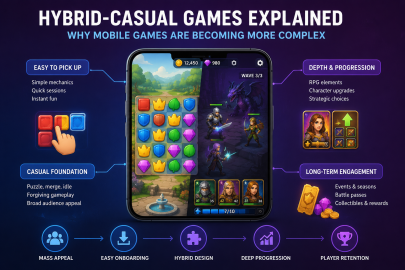
This evolution has produced the hybrid-casual model. Hybrid-casual games preserve the immediate appeal of simple mobile gameplay while adding systems designed to keep players interested for weeks, months, or even years. They are easy to begin but increasingly difficult to fully understand, master, and complete.
What Is a Hybrid-Casual Game?
A hybrid-casual game combines an accessible central mechanic with progression and monetization systems normally associated with deeper casual or mid-core games.
The basic activity is usually understandable almost immediately. Players may sort objects, merge items, guide a character through obstacles, solve a compact puzzle, manage a small production line, or control a vehicle with one finger. There is little friction between installing the game and beginning the first level.
Behind that straightforward activity sits a broader structure. Successful sessions provide coins, stars, experience, building materials, cards, or other resources. Those rewards are then used to improve something outside the core level.
A hybrid-casual game may include:
- A simple central mechanic that can be learned within seconds;
- Permanent upgrades that make future sessions easier or more rewarding;
- Characters, items, buildings, or decorative objects to collect;
- Daily tasks and login rewards;
- Seasonal events and limited-time challenges;
- Advertisements and optional in-app purchases;
- Multiple currencies with different purposes;
- Social, cooperative, or competitive features.
The player is therefore participating in two connected games. The first is the immediate activity shown in advertisements. The second is the long-term system that gives each short session a larger purpose.
Hyper-Casual, Hybrid-Casual, and Traditional Casual Games
These categories often overlap, and publishers do not always use them consistently. The easiest way to understand the difference is to compare what happens after the player learns the main mechanic.
Hyper-Casual Games
A hyper-casual game is built around speed and simplicity. It usually has minimal narrative, a small number of controls, short sessions, and a limited progression system. Revenue commonly comes from advertisements shown between attempts or offered in exchange for rewards.
The main experience is the mechanic itself. Once a player becomes tired of that activity, there may be little reason to continue.
Traditional Casual Games
A traditional casual game may still be approachable, but it usually contains more handcrafted content, stronger progression, and greater mechanical variety. Match-three puzzles, time-management games, hidden-object adventures, and social farming games often belong to this broad category.
These games may take longer to explain and can require more attention than a one-touch hyper-casual release.
Hybrid-Casual Games
Hybrid-casual games sit between the two. Their advertisements can demonstrate the main activity in a few seconds, but the installed product contains enough progression to support long-term play.
| Feature | Hyper-Casual | Hybrid-Casual | Traditional Casual |
|---|---|---|---|
| Learning time | Almost immediate | Immediate core, gradual depth | Usually longer |
| Session length | Very short | Short to medium | Medium or flexible |
| Progression | Limited | Layered and persistent | Often extensive |
| Typical revenue | Mainly advertising | Advertising and purchases | Purchases, advertising, or premium access |
| Long-term goal | Beat a score or level | Build, collect, upgrade, and compete | Complete campaigns or develop persistent systems |
The Simple Core That Attracts Players
Every strong hybrid-casual game begins with a mechanic that is easy to demonstrate. The player should understand the broad objective before reading a detailed explanation.
This simplicity is valuable because mobile users make quick decisions. They may discover a game while browsing social media, watching a short video, or viewing an advertisement inside another application. A complicated pitch creates an immediate barrier.
Consider a game about organizing colored objects. The core interaction might require players to move matching items into the same container. That is enough to create an understandable advertisement and a satisfying first level.
The installed game can then gradually introduce additional layers:
- Players complete a puzzle and receive coins;
- Coins repair part of a house or town;
- Repairs unlock new characters and locations;
- Characters provide temporary advantages;
- Daily tasks award event currency;
- Event currency unlocks a limited collection;
- Completing the collection provides permanent bonuses.
The initial puzzle has not become mechanically complicated. Its context, rewards, and relationship with other systems have expanded.
Why Mobile Games Need More Than a Fun First Minute
A simple mechanic can generate many downloads, but downloads alone do not create a stable game. Players may enjoy the first session and still uninstall the application the same day.
Mobile developers increasingly need players to return. Acquiring attention is difficult, and every abandoned game represents time and marketing resources that may never produce meaningful revenue.
Complexity gives developers more reasons to invite the player back. A daily reward creates a small routine. A building upgrade provides a medium-term objective. A seasonal event introduces urgency. A collection offers a long-term completion goal.
These layers attempt to answer three different questions:
- What should the player do during the next minute?
- Why should the player return tomorrow?
- What can keep the player interested next month?
The core mechanic answers the first question. Progression, events, and social systems answer the other two.
Meta Progression: The Game Behind the Game
Meta progression refers to development that continues beyond an individual level or attempt. The player may fail a puzzle, but the account still gains experience. A short run may end, yet the resources collected during it can improve future performance.
This creates a persistent sense of advancement. Even a session that does not achieve its immediate objective can contribute to something larger.
Common Forms of Meta Progression
- Upgrading a home, restaurant, farm, base, or city;
- Improving character statistics;
- Unlocking new tools or abilities;
- Collecting cards that strengthen units;
- Completing albums or item sets;
- Opening new regions on a map;
- Advancing through a narrative;
- Increasing an account or player level.
Meta progression changes how repetition feels. Playing the same type of puzzle repeatedly can become tiring when every attempt exists alone. When each success contributes to restoring a village or completing a collection, the activity gains an additional purpose.
The quality of this system depends on balance. Progress should feel meaningful without making the basic game seem like a minor obstacle placed between reward screens.
Why So Many Games Include Building and Renovation
Building systems are especially common in hybrid-casual design because they provide visible progress. A ruined room becomes comfortable. An empty plot becomes a colorful garden. A neglected settlement slowly develops into a busy town.
The transformation is easy to understand and emotionally satisfying. Players can look at the environment and immediately see what their previous sessions accomplished.
Renovation also creates a natural sequence of goals. Repairing a door reveals another room. Finishing that room introduces a new character. Helping the character opens a different location. The game can continue expanding without changing its central mechanic.
A Typical Renovation Loop
- Complete several short levels;
- Earn stars or tools;
- Spend them on a repair;
- Watch a brief transformation animation;
- Advance a small part of the story;
- Discover the next damaged area;
- Return to the levels for more resources.
The system is effective because every reward is both an ending and a new beginning. Fixing one object provides satisfaction while immediately revealing the next objective.
Collections Turn Progress Into a Long-Term Habit
Collecting is another important layer. A game may ask players to gather characters, decorative objects, cards, equipment, stickers, pets, or themed items.
Collections provide goals that can extend beyond the main campaign. A player who has completed many levels may continue because one rare item is still missing from an album.
They also divide players into different motivational groups. Some care about completing every set. Others want only the most attractive cosmetic items. Competitive players may focus on objects that provide useful bonuses.
A well-designed collection communicates progress clearly. It shows what has been found, what remains missing, and what reward awaits completion. A poorly designed one hides essential information or relies so heavily on random rewards that progress feels disconnected from effort.
Live Events Keep Familiar Mechanics Fresh
A mobile game cannot rely on permanent content alone. Even a strong progression system eventually becomes predictable. Live events temporarily change the rhythm by adding new goals, rules, rewards, or presentation.
An event may last for a weekend, a week, or an entire season. Some events use the standard gameplay with a different reward track. Others introduce special levels, cooperative challenges, or temporary maps.
Popular Event Formats
- Limited collections with exclusive rewards;
- Team competitions based on combined scores;
- Short tournaments with ranked leaderboards;
- Holiday-themed levels and environments;
- Special missions completed over several days;
- Temporary shops using event currency;
- Community goals shared by all players.
Events help developers reuse familiar systems without making them feel completely unchanged. A sorting puzzle may remain the same mechanically, but collecting festival decorations creates a different emotional context.
There is also a risk. When several events overlap, the game can become crowded with timers, notifications, badges, and unfinished tasks. What was designed as variety may begin to resemble administrative work.
The Rise of the Season Pass
Season passes have moved far beyond competitive console and PC games. They now appear throughout the mobile market, including puzzle, merge, idle, and simulation titles.
A season pass usually contains a sequence of rewards unlocked through regular play. The free track gives basic prizes, while the premium track offers additional currency, boosters, cosmetics, and exclusive items.
This model fits hybrid-casual games because it connects spending with continued engagement. Instead of buying one isolated product, the player purchases access to a reward path that encourages regular activity.
The apparent value can be high because the pass contains many items. However, that value depends on completion. A player who buys the pass and stops playing after a few days may receive only a small part of what was advertised.
Before Buying a Mobile Season Pass
- Check exactly when the season ends;
- Review how points are earned;
- Estimate how often you will realistically play;
- Find out whether unfinished rewards disappear;
- Compare the useful rewards with filler items;
- Confirm whether the pass renews automatically.
Advertising Has Become More Integrated
Hyper-casual games often relied heavily on advertisements shown between levels. Hybrid-casual games still use advertising, but successful designs tend to integrate it more carefully with progression.
Rewarded videos are especially common. Players voluntarily watch an advertisement to receive a benefit such as additional currency, a second attempt, faster production, or a larger level reward.
This creates an exchange that feels more active than an unavoidable interruption. The player understands what will be received and can usually decline.
Other formats include:
- Interstitial advertisements shown after selected levels;
- Advertisements that provide temporary boosters;
- Optional videos that open additional reward containers;
- Offers that reduce waiting time;
- A paid option that removes some or all advertisements.
The balance is delicate. Too few advertisements may limit revenue from non-paying users. Too many can interrupt the experience so often that players leave before developing any attachment to the game.
In-App Purchases Add a Second Revenue System
Hybrid-casual games generally combine advertising with in-app purchases. This dual model allows the same game to earn revenue from different types of players.
One person may never spend money but regularly watch rewarded advertisements. Another may purchase an ad-free option. A highly engaged player might buy a season pass, currency bundle, or limited offer.
Common Purchases
- Premium currency;
- Starter bundles;
- Extra moves or additional attempts;
- Energy refills;
- Season passes;
- Cosmetic items;
- Event bundles;
- Permanent advertisement removal;
- Progression boosters.
The most player-friendly stores clearly explain what each purchase contains and avoid making payment feel mandatory. Problems arise when the game creates unnecessary frustration and immediately sells the solution.
Failure Can Become Part of the Store Design
Many hybrid-casual games present special offers after a failed level. A player may receive the option to buy extra moves, continue with a temporary advantage, or purchase a bundle containing the exact resources currently missing.
The timing is deliberate. Failure creates an emotional moment in which the desired outcome feels close. A player who would ignore the same offer on the main screen may consider it when only one move separates success from another attempt.
This does not make every failure-based offer unfair. An optional continuation can be convenient for someone who values time more than currency. The concern appears when level difficulty is adjusted primarily to manufacture repeated frustration.
Players should notice the difference between paying for optional convenience and paying to remove a problem deliberately placed in the progression path.
Energy Systems Control the Rhythm
Energy limits how many actions or levels can be attempted before the player must wait. It slowly refills over time and can often be restored through advertising, premium currency, gifts, or purchases.
From a design perspective, energy serves several purposes. It prevents players from consuming content too quickly, creates natural return points, and introduces opportunities for monetization.
From the player’s perspective, the same system can either provide healthy stopping points or interrupt an enjoyable session.
A Balanced Energy System
Energy feels reasonable when normal players can enjoy a satisfying session before reaching the limit, failed attempts are not excessively expensive, and free recovery options are clearly available.
An Aggressive Energy System
Energy becomes frustrating when a few failures empty the entire supply, refills take too long, or events require more participation than the free allowance supports.
The design challenge is to encourage another visit without making the player feel removed from the game at the moment it becomes enjoyable.
Social Features Add Pressure and Belonging
Hybrid-casual games increasingly include clubs, teams, friend lists, shared gifts, cooperative objectives, and competitive rankings. These systems add depth without making the central controls more difficult.
A team can provide practical benefits. Members exchange energy, share resources, and work together during events. It also gives players a reason to remain active because their contribution affects other people.
Competition creates a different motivation. A leaderboard transforms an ordinary level into a comparison of speed, score, or persistence.
Social systems can improve retention through:
- Daily resource exchanges;
- Team-based event rewards;
- Friendly competition;
- Public progress displays;
- Requests for help;
- Shared milestones.
The same features can generate pressure. A player may continue participating because leaving would disappoint teammates rather than because the activity remains enjoyable. Healthy design allows people to contribute without turning a casual game into a demanding obligation.
Why Puzzle Games Fit the Model So Well
Puzzle games have become a natural home for hybrid-casual design. Their core mechanics are easy to demonstrate, levels can be produced in large numbers, and difficulty can rise gradually.
A puzzle also provides clear moments for rewards and offers. Completing a board produces currency. Failing creates an opportunity for an additional move. Winning several levels activates a streak bonus. Daily challenges reuse familiar rules with a new objective.
The puzzle does not need a complicated story to support deeper progression. It can provide resources for renovating a home, advancing across a map, developing a town, or helping characters solve personal problems.
This flexibility allows developers to test different themes around the same central mechanic. A game about sorting liquids and one about organizing passengers may feel visually unrelated while following similar progression and monetization principles.
Merge Games Create Complexity Naturally
Merge games begin with a simple rule: combine matching objects to create a higher-level item. The mechanic is easy to understand, but the board gradually develops into a resource-management puzzle.
Players must decide what to merge, what to keep, and when to use limited generators. Orders require specific objects, storage space becomes valuable, and production timers slow advancement.
This creates several connected goals:
- Generate basic objects;
- Merge them through multiple levels;
- Complete customer or story requests;
- Earn experience and currency;
- Unlock new generators and areas;
- Participate in temporary events;
- Expand storage and improve efficiency.
The complexity grows without changing the original interaction. The player is still combining two identical items, but every combination now exists within a larger economy.
Idle Mechanics Make Progress Continue Between Sessions
Idle systems allow resources to accumulate while the game is closed. A factory continues producing goods, workers generate income, or a character completes a timed task.
This design is useful for hybrid-casual games because it makes returning feel rewarding. The player opens the application and immediately collects something, creating a positive beginning to the session.
Idle progress also connects naturally with upgrades. Improving a building increases production speed. Hiring a manager automates a task. Expanding storage allows more resources to accumulate overnight.
However, excessive waiting can weaken the sense of play. When every meaningful action depends on timers, the experience becomes less about making decisions and more about checking when the next button becomes available.
Why Developers Cannot Simply Add More Features
Complexity is not automatically depth. A game can contain ten currencies, seven event icons, four progression tracks, and dozens of offers while still providing very few interesting choices.
The best hybrid-casual systems support the central activity. The worst ones compete for attention and make the interface difficult to understand.
Useful Complexity
- Gives short sessions a meaningful purpose;
- Introduces new decisions gradually;
- Provides different goals for different players;
- Makes progression visible;
- Adds variety without hiding the main game.
Unnecessary Complexity
- Creates currencies with nearly identical functions;
- Places too many temporary events on one screen;
- Requires repeated collection from multiple menus;
- Uses notifications that do not communicate real value;
- Adds upgrade systems that barely affect gameplay.
A strong hybrid-casual game feels richer over time. A weak one feels as though several mobile stores have been stacked on top of a simple puzzle.
The Importance of a Gradual Introduction
Hybrid-casual games need to protect their immediate accessibility. Presenting every system during the first session would destroy the simplicity that attracted the player.
Features are therefore introduced in stages. The first few levels may focus only on the core mechanic. After that, the player unlocks a basic upgrade. Daily tasks appear later. Events and social features arrive only after the main loop is familiar.
A typical onboarding sequence might develop as follows:
- Learn the central interaction;
- Complete several guided levels;
- Receive the first permanent reward;
- Use that reward in a simple upgrade system;
- Unlock a daily mission;
- Gain access to a temporary event;
- Join a team after understanding the economy;
- Encounter advanced collections and seasonal progression.
This gradual approach creates the impression that the game is expanding alongside the player’s knowledge.
How Data Shapes Hybrid-Casual Development
Mobile games can be adjusted after release more easily than traditional fixed products. Developers observe where players stop, which levels cause difficulty, how often rewards are claimed, and which systems receive the most attention.
Different versions of a feature may be tested with separate groups. One group might see an earlier event introduction. Another may receive a different reward amount or store layout.
This process can improve confusing features and correct progression problems. It can also be used to optimize purchasing pressure with remarkable precision.
The central question is not whether data is used. Modern online games depend on it. The more important issue is what the development team chooses to optimize.
A game built only around short-term revenue may become exhausting. A game that also measures long-term satisfaction, voluntary return, and fair progression has a better chance of maintaining a healthy audience.
Creative Advertising and the Reality of Gameplay
Hybrid-casual games are often promoted through videos that focus on a single dramatic mechanic. The advertisement may show a character choosing between two paths, organizing a crowded room, rescuing someone from danger, or completing a visually satisfying puzzle.
That mechanic may exist in the finished game, but it may represent only a small part of the experience. The installed product can include a much larger progression system, different level types, and extensive monetization.
This happens because simple ideas are easier to communicate in a brief advertisement. A complete explanation of currencies, renovation, events, energy, teams, and season passes would not produce the same immediate response.
Players should therefore evaluate the actual store page, gameplay footage, user reviews, and first sessions rather than assuming the advertisement represents the entire game.
When Hybrid-Casual Design Works for Players
The model can produce genuinely enjoyable games. Simple controls make them convenient during short breaks, while progression prevents each session from feeling disconnected.
A good hybrid-casual game respects limited time. It allows meaningful progress in a few minutes without punishing players who miss a day. Purchases provide optional value rather than access to basic enjoyment.
Positive Signs
- The core gameplay remains enjoyable without purchases;
- Advertisements are mostly optional or predictable;
- Progress continues at a reasonable free pace;
- Events provide variety without requiring constant attendance;
- Currency functions are clearly explained;
- Purchases show exact contents and prices;
- Failure feels connected to skill or strategy rather than manufactured scarcity.
When Complexity Becomes a Warning Sign
Not every layered mobile game deserves long-term attention. Complexity can conceal aggressive systems as easily as it can create depth.
Be cautious when a game introduces several paid offers before explaining its basic mechanics. Frequent countdowns, repeated failure prompts, unclear currency conversion, and constant notification badges can indicate that the store has become more important than the activity.
Other warning signs include:
- Progress slows dramatically after the first few sessions;
- Events cannot be completed without purchases or extreme playtime;
- Premium currency prices make real costs difficult to calculate;
- Paid boosters are required to maintain a competitive position;
- Random rewards lack clear probability information;
- Energy disappears too quickly after failed attempts;
- Several overlapping passes require separate payments;
- Removing advertisements does not remove most advertising interruptions.
A game can remain entertaining despite one or two of these features. The problem appears when frustration is not an accidental side effect but the central engine of monetization.
How Players Can Enjoy Hybrid-Casual Games Responsibly
The easiest way to manage these games is to separate enjoyment from obligation. Daily rewards and limited events are designed to make absence feel costly, but missing a virtual reward has no effect outside the game.
- Decide how much time you want to spend before opening the game;
- Convert premium currency prices into real money;
- Ignore events that require an uncomfortable commitment;
- Turn off unnecessary notifications;
- Use device-level spending controls when needed;
- Avoid purchases made immediately after frustration;
- Review subscriptions and season passes regularly;
- Stop when the progression loop feels like work.
Hybrid-casual games are most enjoyable when they fill small spaces in the day rather than reorganize the entire day around timers.
Are Hybrid-Casual Games Replacing Hyper-Casual Titles?
Hyper-casual games are unlikely to vanish. Their low learning barrier and immediate entertainment remain valuable, especially for players who want a brief distraction without long-term commitments.
What is changing is the economic appeal of releasing a game that depends almost entirely on rapid downloads and frequent advertisements. A deeper product can retain players longer and support a wider variety of revenue sources.
Many new games may therefore begin with a hyper-casual idea and evolve into a hybrid structure. The simple mechanic remains the entrance, while progression and live operations become the building behind it.
This does not mean every mobile release will grow equally complex. Some audiences prefer pure simplicity. Others want a deeper experience that still fits comfortably on a phone. The market has room for both, but hybrid-casual design offers developers more opportunities to extend the life of a successful concept.
What Comes Next for Hybrid-Casual Gaming?
The next stage is likely to involve more personalization, stronger social systems, and faster content production. Events may adapt to different player segments, stores may present more individualized offers, and progression paths may change according to behavior.
Hybrid-casual games may also borrow further from genres once considered too complicated for broad mobile audiences. Light role-playing systems, cooperative raids, narrative choices, character equipment, and strategic base development can all appear without changing the simple first interaction.
At the same time, players are becoming more familiar with common monetization techniques. A countdown no longer feels automatically urgent when similar offers appear every week. A large bundle loses its appeal when its contents are difficult to use. Developers will need to provide stronger entertainment rather than relying only on familiar pressure.
The future of the model will depend on balance. Games must remain simple enough to attract a broad audience, deep enough to support long-term interest, and fair enough to avoid exhausting the people they hope to retain.
Why Mobile Games Are Becoming More Complex
The change is not happening because players suddenly demanded more menus. It is the result of several forces working together. Simple games need stronger retention. Advertising alone may not support every project. Developers want longer product lifespans, while players increasingly expect regular updates and visible progression.
Hybrid-casual design attempts to satisfy all these needs at once.
Its formula can be summarized in four stages:
- Attract players with an idea they understand immediately;
- Reward early sessions with fast progress;
- Introduce long-term systems gradually;
- Support the game through advertising, purchases, events, and recurring content.
When those stages fit together, the result is a mobile game that feels accessible without being disposable. When they do not, the player sees a simple activity surrounded by unnecessary currencies and endless offers.
Hybrid-casual games are becoming one of the defining formats of mobile gaming because they can serve both short sessions and long-term habits. Their increasing complexity is not a rejection of casual play. It is an attempt to give simple interactions enough structure to survive in a crowded and highly competitive market.
For players, the important skill is recognizing which layers create genuine enjoyment and which exist mainly to encourage another payment. A colorful upgrade system, a satisfying collection, or a friendly team can add real value. The best hybrid-casual games make those systems feel like natural extensions of play rather than barriers placed in front of it.