




A Hair Salon Where Mistakes Become the Best Part
Toca Hair Salon 3 understands something many children’s games forget: experimentation is more enjoyable when the game does not immediately tell me that I have done something wrong. I can cut one side of a character’s hair too short, dye the remaining section several incompatible colors, add an enormous beard, straighten half of it, curl the other half, and finish with accessories that make no practical sense. The character may react, but the game does not grade the result or demand that I repair it.
That freedom defines this Toca Hair Salon 3 review. The game is not a realistic salon simulator and does not attempt to teach professional haircutting techniques. It is a digital toy built around touching, cutting, growing, washing, coloring, curling, shaving, styling, and decorating hair. The objective is whatever I decide it should be.
Toca Boca’s approach works especially well for younger players because the tools are visual and direct. Scissors cut where they touch. A razor removes hair more closely. Styling products change texture, while the growth tool reverses overly enthusiastic decisions. There are no complicated menus, competitive rankings, or failure screens interrupting the creative process. The third entry expands the idea through more varied hair textures, facial hair, styling options, and characters. Curly, straight, wavy, and tightly coiled hair respond differently enough to make each appointment feel distinct. Characters are not divided rigidly by gender, so any style, accessory, color, or beard can be used freely.
The game remains charming and accessible, although its open-ended structure will not satisfy every player. There is little traditional progression, no story campaign, and limited guidance for anyone who prefers clear objectives. Its age also means that compatibility and availability may vary across devices. Even with those limitations, Toca Hair Salon 3 remains one of the better examples of a children’s creativity app because it treats play as valuable without turning every action into a lesson, reward track, or sales opportunity.
Core Gameplay & Mechanics: Choose a Character and Start Changing Everything
The main loop begins with choosing a customer from a varied cast of characters. Each arrives with a different face, personality, hair length, texture, color, and general appearance. Once the character sits in the salon chair, I can move between stations and apply tools in almost any order.
There is no required hairstyle to copy. The game does not display a customer request such as “shorter on the sides” or “make this style suitable for a party.” That absence gives the experience its freedom. I can attempt a realistic haircut, recreate a recognizable style, or treat the character like a moving canvas. Hair responds directly to touch. Dragging scissors across a section removes visible length, while the electric trimmer cuts closer to the head. The tools are forgiving enough for children to use but precise enough to create recognizable shapes with patience.
The magical growth spray is one of the most important features. It restores hair after a cut, allowing mistakes to become temporary. Without it, younger players might become frustrated after removing too much. With it, cutting becomes experimentation rather than commitment.
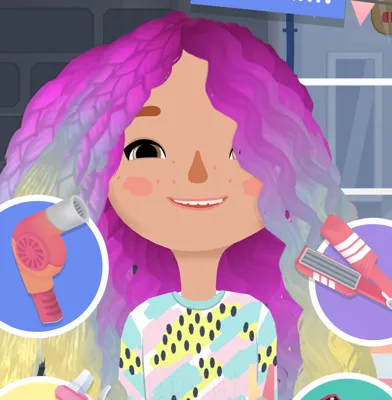
I can wash hair, dry it, brush it, straighten it, curl it, braid or manipulate sections, and apply products that affect volume or shape. The physical behavior is simplified, but it creates the impression that different tools have meaningful effects. Coloring is similarly direct. Dye can be applied to the entire hairstyle or smaller areas, depending on how carefully I use the tool. Mixing bright colors is easy, and the game has no interest in realistic salon chemistry. Blue, green, pink, orange, and multicolored combinations are all treated as ordinary creative options.
The final stage often involves accessories and presentation. Glasses, hats, jewelry, hair decorations, and clothing details can change the character’s overall look. A photo feature allows the finished creation to be captured like a salon portrait. The absence of rigid order is essential. I can return to cutting after adding accessories, regrow a beard after shaving it, or completely rebuild a style that seemed finished. Toca Hair Salon 3 behaves more like a toy box than a sequence of levels.
Hair Textures: The Most Meaningful Improvement
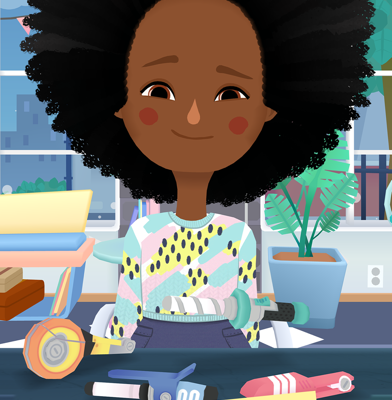
One of the game’s strongest features is its treatment of different hair textures. Straight hair falls and separates differently from curls, while tighter textures create fuller shapes and respond differently to combing, cutting, and styling. This variety matters because many older hairstyle games treated all hair like the same smooth material with different colors. Toca Hair Salon 3 makes texture part of the play rather than a decorative label.
Curly and coiled hair can produce large silhouettes, uneven shapes, and expressive volume. Straight hair is easier to arrange into clear lines or long sections. Wavy styles sit somewhere between those behaviors and can be changed substantially through tools. The simulation is not technically realistic enough to teach hair care. Protective styling, product use, heat effects, and professional methods are simplified heavily. The game should therefore be understood as creative representation rather than instruction.
Still, the inclusion of multiple textures broadens the range of styles players can imagine. Children can create characters who look less uniform, and the salon feels more interesting because every customer does not begin with the same basic hair model. My main frustration is that precision varies across textures. It can be difficult to shape dense or curly hair exactly as intended, especially near the edges of the face. The softness that makes the game child-friendly can make detailed styling harder for older or more patient players.
Facial Hair and Gender-Free Styling: Every Tool Belongs to Everyone
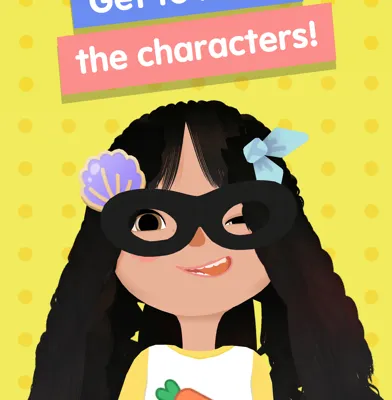
Toca Hair Salon 3 allows characters to grow and style facial hair without imposing strict gender rules. A beard or moustache can be added, cut, colored, curled, and combined with any hairstyle or accessory. This feels natural inside the game because it never pauses to explain or justify the choice. The salon tools are simply available, and players decide how to use them. That design encourages experimentation without turning representation into a separate educational feature. A character can have long pink curls, a green beard, formal glasses, and a casual outfit because the game’s only real standard is whether the player likes the result.
Facial hair also adds another layer to the mechanics. Beards can be shaped carefully or removed entirely, and the growth tool allows repeated experimentation. Moustaches and sideburns can change a face dramatically even when the main hairstyle remains untouched. The system is still limited by the available character models and accessory library. I cannot redesign facial structure, body type, or every aspect of clothing. The freedom is broad within the salon theme but not infinite. Even so, the refusal to divide tools into “for boys” and “for girls” is one of the game’s best choices. It supports creativity quietly and effectively.
Tools and Styling Stations: Simple Enough for Children, Flexible Enough for Play
The game’s interface presents tools through recognizable icons and visual stations. Instead of reading long instructions, players learn through touching and observing what happens. Scissors provide basic cutting, while the trimmer creates a shorter finish. Brushes and combs change the direction or separation of hair. A hairdryer adds movement and volume, and styling devices can straighten or curl sections.
Shampooing is one of the more playful activities. Water, foam, rinsing, and drying create a small routine that younger players may repeat even when the hairstyle does not require it. The growth tool prevents permanent mistakes, but it can also be used creatively. I can grow exaggerated sections, cut patterns into them, or build a hairstyle gradually rather than starting from the original shape. Color tools are easy to understand, though accurate sectioning can be difficult. Dye may spread wider than expected, and creating perfectly clean stripes requires patience.
Accessories provide a satisfying finishing stage. The selection supports funny, fashionable, strange, and deliberately mismatched looks. It is not enormous by modern customization standards, but there is enough variety for repeated sessions. The tools rarely require technical skill, which is appropriate for the audience. Older players may find the lack of detailed control restrictive. I sometimes wanted clearer section selection, better rotation, or a way to isolate one side without affecting nearby hair. The game chooses immediacy over precision. For most children, that is the correct decision.
Characters and Reactions: Personality Without Dialogue
The customers have expressive faces and react to the player’s actions through sounds, movement, and changes in expression. A sudden cut, spray of water, or styling tool may produce surprise, discomfort, amusement, or curiosity. These reactions give the salon a sense of life without turning the characters into demanding clients. They do not reject a hairstyle or become permanently upset after an unusual choice.
That balance is important. Reactions make the tools feel responsive, but judgment would undermine the creative freedom. The characters acknowledge what is happening without telling the player that one style is correct. The cast includes different skin tones, facial features, hairstyles, and general appearances. This variety improves replayability because each face changes how a hairstyle looks.
The personalities remain light. There is no dialogue, biography, relationship system, or story connecting the customers. They function primarily as expressive models for creative play. Younger players may invent stories around them, which fits Toca Boca’s broader design philosophy. The game provides enough visual personality to stimulate imagination without defining every detail. Players seeking character development will find very little. Toca Hair Salon 3 is about what happens in the chair, not who the customer is before or after the appointment.
Creative Freedom: No Scores, No Failure, No Correct Hairstyle
The absence of scoring is one of the game’s most important design choices. No system evaluates symmetry, color harmony, realism, or customer satisfaction. This removes pressure and allows children to discover tools through play. A strange result is not a failed level. It is simply the current version of the hairstyle. Many mobile games attach stars, coins, timers, and performance meters to every action. Toca Hair Salon 3 does not need those systems because the pleasure comes from transformation itself.
The game also avoids requiring players to unlock basic creativity through repetitive tasks. Once the app is available, its central tools are accessible without demanding daily challenges or level progression. That freedom can feel directionless. Some players enjoy having a specific look to recreate or a series of increasingly difficult salon requests. Toca Hair Salon 3 offers almost none of that structure.
Parents may need to understand that the game is closer to digital drawing or dress-up than a conventional objective-based game. Its value depends on how much a child enjoys self-directed experimentation. For imaginative players, the lack of instructions creates longevity. One session can focus on realistic cuts, another on extreme colors, and another on making every character look deliberately ridiculous.
Graphics and Art Direction: Soft Shapes and Readable Tools
Toca Hair Salon 3 uses the recognizable Toca Boca visual style: rounded shapes, simplified faces, bright colors, and expressive animation. The characters look friendly without becoming identical. Hair receives enough texture to show differences between curls, waves, straight sections, and facial hair. The strands do not behave with realistic physical detail, but the movement is readable and satisfying. The salon environment remains clean and uncluttered. Tools are large enough to recognize, while backgrounds support the activity without distracting from the character.
Animations are playful. Hair moves during drying and brushing, faces respond to touch, and water or foam behaves in an exaggerated but understandable way. The game’s age is visible in some areas. Interface transitions, model detail, and accessory variety feel simpler than newer creative apps. That simplicity is not necessarily negative, especially for younger users who benefit from a less crowded screen. The art direction has aged better than a realistic visual style would have. Because it was designed around illustration rather than technical spectacle, the characters still feel charming.
Audio and Sound Design: Reactions Carry the Experience
The sound design gives each tool a clear identity. Scissors make quick cutting sounds, trimmers buzz, water splashes, dryers produce airflow, and styling products create playful effects. Characters respond with nonverbal sounds rather than complete speech. This makes the game accessible across languages and allows children to interpret reactions freely. The audio is useful because it confirms that an action has occurred. When cutting thick hair or applying a tool near the edge of a section, the sound helps compensate for the simplified visual precision.
Background music remains light and unobtrusive. It supports a playful atmosphere without making the salon feel overly energetic. Repeated sessions can make certain reactions and tool sounds familiar to the point of repetition. The game does not contain a large soundtrack or extensive voice library. This is unlikely to bother children during short sessions, but adults playing alongside them may notice the limited variety quickly.
Technical Performance and Accessibility: Designed for Direct Touch
Toca Hair Salon 3 is built around touch interaction. Dragging, tapping, and moving tools across the screen feel natural on a tablet or phone. The large icons and limited text make it accessible to children who cannot read fluently. Most mechanics can be discovered through experimentation rather than explanation.
Performance is generally lightweight because the game does not need large environments or complex online systems. The salon loads quickly, and moving between tools is straightforward. The major technical concern is age and platform compatibility. Older apps may not receive the same support as current releases, and availability can differ by operating system, device generation, or storefront region.
On supported hardware, the experience should remain simple. There is no online matchmaking, account requirement, or network dependency at the center of the game. The touch controls occasionally lack precision. Cutting near the face, applying dye to a narrow area, or selecting one small section can produce unintended changes. The growth tool reduces the cost of those mistakes, but it does not make detailed styling fully reliable.
Safety, Privacy, and Child-Friendly Design
Toca Hair Salon 3 is structured as a contained creative experience rather than an online social platform. Children are not placed into public chat, competitive matchmaking, or interactions with strangers. The lack of advertising interruptions inside the central play experience is particularly valuable. Young players can explore without being redirected constantly toward external products. There is also no pressure to maintain a daily streak, compete on a leaderboard, or purchase random rewards. The game avoids many manipulative patterns common in children’s mobile entertainment.
Parents should still check the specific version, device permissions, and storefront information available on their platform. App availability and policies can change over time. The photo feature may interact with local device storage, depending on platform behavior. Adults may want to review how screenshots or saved images are handled. Within the game itself, the design remains calm, private, and focused on creativity.
Monetization and Value: A Paid Digital Toy Rather Than a Live Service
Toca Hair Salon 3 was designed as a premium app rather than a free-to-play service built around constant purchases. Its value comes from receiving a complete creative toy without ads, energy systems, or randomized monetization. This model suits the game extremely well. Hair styling depends on experimentation, and locking individual tools behind repeated payments would damage that freedom. The absence of competitive advantage also keeps the experience fair. There is no stronger brush, faster growth spray, or premium customer who produces better scores because there are no scores to manipulate.
The main value question concerns content depth. Players receive a set of characters, tools, colors, and accessories, but no long campaign or continuous flow of major updates. For a child who repeatedly invents new styles, the game can provide many hours of play. For someone who wants structured progression, the available content may feel exhausted quickly. Its premium model now feels unusually refreshing. The game asks for creativity rather than recurring attention.
Who Should Play Toca Hair Salon 3?
Toca Hair Salon 3 is best suited to younger children who enjoy dress-up games, drawing, character customization, pretend play, and open-ended digital toys. It is especially effective for players who like making unusual designs without being judged by a score.
Parents looking for a calm game without online competition or aggressive monetization may also appreciate it. The simple controls make it suitable for shared play, where an adult and child can invent characters or take turns adding details.
Children interested in hair, fashion, colors, or salon role-play are the clearest audience. The game can also appeal to anyone who enjoys creating deliberately strange characters. Players expecting realistic hairdressing instruction should skip it. The tools do not teach professional technique, hygiene, chemistry, or accurate hair care.
Older children and adults may enjoy the creativity briefly but could become frustrated by the limited precision and lack of goals. The game’s charm is real, but its mechanical depth is intentionally modest.
Final Verdict: A Salon That Values Imagination More Than Perfection
Toca Hair Salon 3 succeeds because it understands that children do not always need a correct answer. Sometimes they need tools, expressive characters, and permission to keep changing the result.
The cutting, coloring, washing, growing, curling, shaving, and decorating systems are simple enough to use immediately. Different hair textures and facial-hair options broaden the creative possibilities, while the absence of gender restrictions allows every tool to remain available for every character. I especially appreciate the growth spray. It changes the emotional meaning of a mistake. Cutting too much does not require restarting or accepting failure; it creates another opportunity to experiment.
The game’s cheerful art and expressive reactions make the salon feel alive without placing pressure on the player. Customers notice what is happening, but they never demand a fashionable or realistic result. The limitations are easy to see. Detailed styling can be difficult, progression is almost nonexistent, and the content may feel repetitive for older players. Device compatibility may also be a concern because the game belongs to an earlier generation of mobile releases.
For its intended audience, those flaws are manageable. Toca Hair Salon 3 remains a warm, private, and flexible creative toy that does not interrupt play with advertisements, competition, or constant purchase requests. I recommend Toca Hair Salon 3 to young children, families seeking safe creative apps, fans of dress-up play, and anyone who enjoys transforming characters without objectives or judgment.
Personal rating: 8.5/10.
Toca Hair Salon 3 earns that score for its accessible touch controls, varied hair textures, reversible experimentation, inclusive customization, charming presentation, and child-friendly premium design. It loses points for limited precision, little structured progression, repetitive audio, aging compatibility, and a relatively small amount of long-term content. The game never asks whether a haircut is beautiful, realistic, or sensible. It asks a much better question for creative play: what would happen if I changed one more thing?
Pros

- Intuitive controls make it accessible for beginners
- Wide variety of styling tools and customization options
- Vibrant and playful visual aesthetics enhance the user experience
- Strong community support with downloadable mods and cheats
- Unblocked version allows for play in restricted environments
- Creative and artistic gameplay that encourages experimentation
Cons

- Gameplay may feel repetitive for players seeking more challenge
- Limited depth compared to more advanced simulation titles
- Occasional performance issues when using multiple mods
Leave a comment
Your comment is awaiting moderation. We save your draft here
0 Comments