







A Final Battle That Feels Like Falling Into a Nightmare
Demon Slayer: Kimetsu no Yaiba – Infinity Castle does not begin like an ordinary adventure preparing me gently for another mission. It throws nearly every major fighter into a supernatural fortress where floors rotate, rooms stretch into darkness, staircases lead nowhere, and enemies can appear from impossible directions. The sense of descent is immediate. Tanjiro and the Hashira are no longer travelling toward danger with time to plan. They have been pulled directly into the center of Muzan Kibutsuji’s world, where every corridor appears designed to separate allies and expose their deepest wounds.
This Demon Slayer: Infinity Castle review focuses on the first film in the trilogy adapting the final conflict of the anime. It is not a welcoming starting point for viewers unfamiliar with the series. The story assumes I already understand Tanjiro’s bond with Nezuko, the hierarchy of the Demon Slayer Corps, the tragedy of the Hashira, Muzan’s history, and the importance of the Upper Rank demons. Rather than pausing for extensive introductions, the film turns years of character development into a sequence of confrontations that feel both physically spectacular and emotionally personal.
The result is one of the franchise’s most visually ambitious productions. Ufotable transforms the Infinity Castle into a constantly moving battlefield that seems larger every time the camera changes position. The action is extraordinary, but the film is not only interested in speed or scale. Its strongest sections slow down to examine memory, regret, devotion, and the choices that transformed human suffering into demonic cruelty.
The structure is intentionally incomplete because this is the opening chapter of a larger cinematic ending. Several characters remain separated, Muzan’s final confrontation is still ahead, and important fighters receive limited attention. That lack of complete resolution occasionally makes the film feel like an enormous middle act. Even so, the individual battles contain enough emotional movement to make the experience satisfying on its own.
The Infinity Castle as a Living Battlefield
The castle is more than a location. It behaves like an antagonist. Nakime controls the space through her biwa, shifting walls, platforms, corridors, and entire rooms whenever the Demon Slayer Corps begins finding direction. The characters are not simply fighting powerful demons; they are fighting architecture that refuses to obey normal geography.
Every wide shot emphasizes scale. Tiny figures fall between enormous structures while rooms move like pieces inside an impossible machine. Wooden interiors stretch into distant darkness, decorative screens become barriers, and gravity appears negotiable. I rarely felt that anyone understood where they were in relation to another person, which makes every reunion and separation feel uncertain.
The visual complexity could easily have made the action unreadable. Ufotable usually maintains clarity by connecting each fighter with distinct colors, movement patterns, breathing styles, and camera rhythms. Water Breathing flows differently from Thunder Breathing, while the demons’ techniques distort the environment in more aggressive ways.
The castle occasionally becomes so visually elaborate that I noticed the digital construction more than the emotional purpose of the scene. Rapid camera movement through endless rooms can feel like a technical demonstration. The best moments use the environment to increase isolation rather than simply showing how much space can be rendered.
Tanjiro Kamado: Compassion Under Greater Pressure
Tanjiro remains the emotional center even when the film divides attention among several fighters. His greatest strength has always been the ability to recognize humanity without excusing cruelty. Infinity Castle tests whether that compassion can survive when the cost of hesitation has become enormous.
Natsuki Hanae gives Tanjiro familiar warmth and determination, but the performance carries more fatigue than in earlier arcs. Tanjiro has witnessed too much loss to approach the final battle with youthful excitement. His kindness remains, though it now exists beside sharper anger and a clearer understanding of what Muzan’s forces have taken from countless families.
Tanjiro’s fighting style reflects his growth. He moves with greater control, combines experience from previous battles, and no longer appears like the least prepared person beside the Hashira. The film still avoids making him invulnerable. Stronger enemies expose weaknesses quickly, and cooperation remains essential.
His ability to connect present enemies with their forgotten human lives continues shaping the story. Demon Slayer often pauses combat to reveal tragic histories, a technique that can become repetitive when every opponent receives a final explanation. In Infinity Castle, the strongest memories deepen the conflict because they reveal how desire, humiliation, illness, or fear created paths toward Muzan.
Giyu Tomioka: Silence Finally Becomes Partnership
Giyu’s presence beside Tanjiro gives the central battle emotional continuity. He was one of the first people to recognize that Nezuko and Tanjiro did not fit the ordinary relationship between demon and hunter. His decision at the beginning of the story helped make everything that followed possible.
Takahiro Sakurai maintains Giyu’s restrained voice, but the character’s emotional distance no longer feels as complete as it once did. After the Hashira training and Tanjiro’s persistence, Giyu appears more capable of accepting partnership rather than treating himself as someone who should remain outside every bond.
His Water Breathing provides a beautiful contrast with Tanjiro’s techniques. Giyu fights with economy and precision, creating the impression that every movement has been refined through years of discipline. Tanjiro brings greater emotional urgency, while Giyu provides calm structure.
Their cooperation is satisfying because it has developed across the entire series. Giyu does not suddenly become talkative or openly affectionate. His trust appears through positioning, protection, and the willingness to fight beside Tanjiro as an equal participant.
Akaza: Strength Built Over a Forgotten Life
Akaza dominates one of the film’s most important confrontations. His return carries the emotional memory of Kyojuro Rengoku, making every exchange with Tanjiro and Giyu feel connected to the Mugen Train tragedy. Tanjiro is not confronting an unknown Upper Rank. He is facing someone whose presence has shaped his anger and growth.
Akira Ishida gives Akaza energy, pride, and an almost joyful devotion to combat. He respects strength so completely that battle becomes the only language he trusts. Weakness disgusts him, yet the film gradually reveals that this philosophy was not born from simple arrogance.
Akaza’s human history is among the franchise’s most painful stories. His earlier life contains poverty, desperation, love, and the repeated experience of losing the people who gave him purpose. The tragedy works because his demonic obsession with strength becomes an echo of promises he no longer remembers clearly.
The film allows this backstory significant time, interrupting the immediate momentum of the confrontation. Some viewers may find the transition lengthy, especially after such intense action. I found it necessary because Akaza’s identity cannot be understood through combat alone. His refusal to accept weakness is tied to the belief that greater power might have prevented earlier losses.
The emotional resolution avoids treating memory as automatic redemption. Recovering humanity does not erase the suffering he caused. It reveals that the person he became was built over wounds Muzan exploited and transformed.
Zenitsu Agatsuma: Fear Replaced by Terrifying Focus
Zenitsu receives one of the film’s most dramatic transformations. The character known for panic, shouting, and desperate attempts to avoid danger enters the Infinity Castle with an unusual stillness. His fear has not vanished; it has been concentrated into purpose.
Hiro Shimono changes the familiar vocal performance significantly. Zenitsu speaks with restraint, and that restraint becomes more alarming than another loud reaction would have been. He understands exactly whom he is seeking and why the confrontation cannot be avoided.
His conflict with Kaigaku gives Thunder Breathing a personal division. Both characters learned from the same master, but they responded to insecurity differently. Zenitsu believed he lacked talent and depended on mastering one form completely. Kaigaku resented limitation and pursued recognition through increasingly destructive choices.
The battle is visually magnificent. Lightning divides the dark castle in sudden lines, while movement becomes almost too fast for the environment to contain. Zenitsu’s techniques feel less like ordinary sword strikes and more like moments in which distance temporarily disappears.
The confrontation could have benefited from more development of Kaigaku before the film. Viewers familiar only with the anime may understand the relationship intellectually without feeling its full history. Zenitsu’s grief and anger carry the scene, but Kaigaku remains less emotionally developed than Akaza.
Shinobu Kocho: Grace Concealing Years of Anger
Shinobu’s gentle smile has always hidden one of the series’ deepest concentrations of rage. She lacks the physical strength required to defeat demons through the same methods as several other Hashira, so she developed poison-based techniques and a fighting style built around speed, knowledge, and precision.
Saori Hayami gives Shinobu elegance without softness. Her polite voice often makes threats more disturbing because the anger beneath it is carefully controlled. Inside the Infinity Castle, that control becomes increasingly difficult to maintain.
Her confrontation with Doma carries the memory of her sister Kanae. Doma’s calm behavior and casual cruelty make him an effective opposite. He performs friendliness without experiencing genuine compassion, while Shinobu performs calmness to contain overwhelming feeling.
The visual contrast is striking. Shinobu’s insect-inspired movements are light and rapid, while Doma fills the space with beautiful frozen structures that conceal lethal danger. Their battle resembles a dance whose elegance makes the emotional hatred underneath it even sharper.
Shinobu’s strategy demonstrates the intelligence that defines her role within the Corps. She understands her limitations and builds an approach around them rather than attempting to imitate stronger fighters. The film treats preparation as its own form of courage.
Doma: Beauty Without Empathy
Doma is disturbing because he appears emotionally pleasant. Mamoru Miyano gives him a warm, amused voice that rarely matches the horror of his actions. He smiles, speaks gently, and treats suffering as an interesting event rather than something morally significant.
Unlike demons driven openly by rage or ambition, Doma has difficulty experiencing authentic emotion. He imitates spiritual leadership and compassion because these performances give him access to people who trust him. His followers see comfort while he sees resources.
His Blood Demon Art is visually beautiful, using ice, lotuses, mist, and elaborate frozen figures. The elegance makes him more threatening because his techniques transform destruction into spectacle.
The film does not complete every consequence connected with Doma, leaving parts of this conflict for the next chapter. This contributes to the unfinished quality of Infinity Castle as an individual movie. Shinobu’s section still leaves a major emotional impact because it turns years of hidden preparation into one decisive strategy.
Muzan Kibutsuji: Present Even When He Is Not the Immediate Opponent
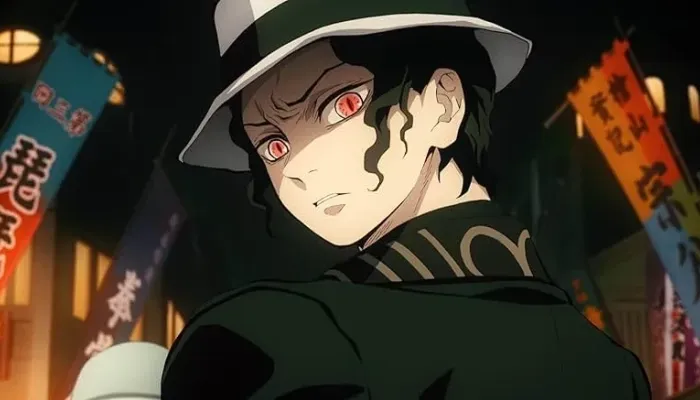
Muzan does not need to dominate every scene physically because the castle, demons, and entire final conflict exist through his influence. Every Upper Rank carries some version of his manipulation. He offers power to people at moments of desperation, then removes the freedom that might allow them to become anything else.
Toshihiko Seki gives Muzan a controlled, contemptuous voice. He rarely sounds uncertain because he views nearly everyone around him as disposable. Even powerful demons are tools whose value depends on continued usefulness.
The film positions him as the source of a system rather than only one final opponent. Human weakness does not create demons automatically. Muzan identifies pain, fear, illness, resentment, or ambition and transforms those feelings into dependence.
His confrontation with the Demon Slayer Corps remains incomplete in this first film, which may disappoint viewers expecting a complete climax. Infinity Castle is preparing the emotional and physical battlefield rather than resolving the entire war.
The Hashira as Individuals and a Broken Collective
The Hashira entered the castle as the Corps’ strongest warriors, but the environment separates them almost immediately. This prevents the film from presenting one unified team battle and instead creates several personal confrontations.
Each Hashira carries a distinct relationship with duty. Giyu struggles with survivor’s guilt, Shinobu has transformed grief into preparation, Sanemi expresses care through hostility, and Gyomei approaches battle through spiritual discipline. Mitsuri, Obanai, and Muichiro bring their own histories and loyalties into the final arc.
Not every Hashira receives equal attention in this chapter. Several are clearly being positioned for later films, which contributes to the sense that the story has stopped at a planned boundary rather than reached a natural ending. The separation works thematically because Muzan’s forces benefit from isolation. The Corps has always drawn strength from bonds, while demons are usually controlled through fear and hierarchy. The final battle asks whether connection can survive when every person is placed inside a private nightmare.
Animation: Ufotable Turns Combat Into Emotional Language
The animation is the film’s most obvious technical achievement. Sword techniques, elemental effects, facial expressions, clothing movement, particles, and shifting architecture combine without losing the handcrafted personality associated with the series.
Breathing techniques remain visual interpretations rather than simple physical effects, allowing emotion to shape how combat appears. Water flows with controlled rhythm, lightning arrives through sudden acceleration, and insect movements depend on sharp directional changes.
The camera often travels through the castle in ways impossible within live-action production. It follows characters across vertical surfaces, rotates with changing gravity, and moves from intimate facial detail to enormous architectural scale.
This freedom occasionally becomes excessive. A camera that never appears limited can reduce physical weight because every angle is available. The strongest sequences still create clear distance, impact, and danger rather than treating movement as decoration. Character acting remains essential. Small changes in eyes, breathing, and posture communicate fear or memory before dialogue explains it. The quieter animation is as important as the spectacular attacks because the emotional histories must remain visible inside the action.
Music and Sound Design
Yuki Kajiura and Go Shiina continue giving Demon Slayer a musical identity built from orchestral weight, choral voices, percussion, and character-specific emotional themes. The score understands when a battle requires momentum and when memory should take control.
Akaza’s material carries tragedy beside power, preventing his confrontation from becoming only a technical showcase. Zenitsu’s scenes use silence and sudden sound effectively, matching the difference between his usual nervous energy and current focus. Shinobu’s music reflects elegance and hidden anger. Delicate textures surround a conflict whose emotional foundation is anything but gentle.
Sound design makes the castle feel physically unstable. Doors slam across impossible distances, wooden structures shift, strings echo, and attacks move through spaces larger than the eye can measure. The film occasionally pushes the score so strongly that quiet emotion has little room to develop independently. Most of the time, the music earns its scale because the story has spent years building toward these confrontations.
Memory, Grief, and the Meaning of Strength
Infinity Castle repeatedly asks what strength is supposed to protect. Akaza pursued power until the original reason disappeared. Zenitsu once believed mastering only one form made him inferior, but complete devotion turns that limitation into identity. Shinobu cannot fight through physical force alone, so intelligence becomes her greatest weapon.
Tanjiro’s compassion also functions as strength. He does not need to deny his anger to recognize the tragedy inside an enemy’s past. The story argues that understanding suffering does not require surrendering judgment.
Grief connects nearly every major character. Some transform it into loyalty, some into discipline, and others into resentment. Muzan’s influence is strongest when a person believes pain has left only one possible path.
The repeated flashbacks can make the film feel structurally predictable. A major confrontation reaches its emotional peak, pauses for memory, and then returns with new meaning. The technique remains effective when the history changes my understanding of the opponent rather than merely asking for sympathy.
Pacing and the Burden of Being the First Chapter
The film alternates between extended battles, character memories, and short updates on the wider conflict. This creates a rhythm of acceleration and emotional interruption rather than continuous forward movement.
Individual confrontations receive enough time to feel significant, especially those involving Akaza, Zenitsu, and Shinobu. The cost is limited progress for characters waiting elsewhere in the castle.
The runtime is substantial, yet the story still ends with many unresolved paths. That is unavoidable for the first part of a trilogy, but it affects the experience. I left feeling emotionally satisfied by several battles while remaining aware that the central war had barely reached its full shape.
Viewers expecting a structure similar to Mugen Train may find Infinity Castle less complete. Mugen Train contains one main mission with a clear beginning and emotional ending. Infinity Castle is a massive final arc divided at points determined partly by production structure.
Who Should Watch Demon Slayer: Infinity Castle?
The film is essential for viewers who have followed Demon Slayer through the Hashira Training Arc and want to see the final conflict begin. Fans of Tanjiro, Giyu, Zenitsu, Shinobu, Akaza, and the Hashira receive several major developments supported by the franchise’s most ambitious animation.
It is not suitable as an introduction. The battles depend heavily on earlier losses, relationships, training, and promises. A newcomer may appreciate the visuals while missing most of the emotional meaning.
Anime fans interested in action choreography and large-scale digital environments will find exceptional craft. Viewers who dislike lengthy flashbacks during combat may become frustrated by the story’s familiar method of building sympathy and context.
The film contains intense fantasy violence, frightening demon imagery, death, grief, and emotionally heavy childhood histories. Younger viewers familiar with the series should still be prepared for a darker tone than many earlier comic sections.
My Rating
I give Demon Slayer: Kimetsu no Yaiba – Infinity Castle a personal rating of 9/10. It delivers extraordinary animation, strong character confrontations, painful histories, and a setting capable of making every fighter appear trapped inside an endless supernatural machine. The visual spectacle is impressive, but the film’s real strength comes from connecting combat with memory.
Akaza’s forgotten humanity, Zenitsu’s sudden stillness, Shinobu’s preparation, Giyu’s growing trust, and Tanjiro’s refusal to abandon compassion give the film emotional variety beyond continuous sword clashes. Not every storyline receives equal space, and the first-chapter structure prevents a fully independent resolution.
Infinity Castle feels like the moment Demon Slayer stops preparing for its ending and finally enters it. The characters fall into the fortress separately, carrying private grief that Muzan’s world attempts to turn against them. Their survival depends on more than advanced techniques. It depends on remembering why they chose to fight before the castle convinces them that they are completely alone.
Pros

- Stunning visuals that blend traditional and modern animation techniques
- Rich character development with deep emotional resonance
- Engaging storytelling that combines action with introspection
- Innovative sound design that reinforces the film's themes
- Accessible on multiple platforms with flexible streaming and download options
- Cultural nuances and symbolic elements that add depth to the narrative
Cons

- The narrative complexity may be challenging for some viewers
- Occasional pacing issues during key plot developments
- Mature themes may not be entirely suitable for younger audiences


Leave a comment
Your comment is awaiting moderation. We save your draft here
0 Comments