




A Superhero Film That Begins With a Midlife Crisis
The moment that defines The Incredibles for me does not involve a giant robot, a dramatic rescue, or a city collapsing under attack. It is the sight of Bob Parr sitting inside a small office cubicle, listening to a manager explain why helping people is bad for business. Once known as Mr. Incredible, Bob now spends his days processing insurance claims while hiding the strength that made him famous. That contrast gives this The Incredibles review its central argument: the film works because it understands that losing a sense of purpose can be more frightening than any supervillain.
Released in 2004 and written and directed by Brad Bird, The Incredibles arrived before superhero films had completely taken over popular cinema. It uses the familiar language of secret identities, colorful costumes, special powers, and elaborate villains, but its real subject is family. The action may involve aircraft, hidden islands, advanced machines, and collapsing buildings, yet the emotional stakes are built around marriage, parenthood, resentment, confidence, and the difficulty of accepting help.
My first impression was how mature the film felt without becoming inappropriate for younger viewers. The opening moves quickly through Mr. Incredible and Elastigirl’s celebrated superhero careers, their wedding, and the legal pressure that forces all heroes into retirement. Within minutes, the film has established an entire social change and shown how two people who once lived extraordinary lives have been pushed into suburban routine.
That setup allows the story to ask a question many family films avoid: what happens when a parent quietly hates the life everyone else believes should make him happy? Bob loves Helen and their children, but he also misses recognition, danger, and physical purpose. His frustration is not presented as noble. He lies, becomes emotionally distant, and chases his old identity without understanding what his secrecy could cost.
The Incredibles therefore begins less like a simple adventure and more like a domestic drama wearing superhero clothes. That choice gives every later action sequence more weight. When the Parr family finally works together, the satisfaction comes not only from seeing their powers combined, but from watching people who had become emotionally separated learn to trust one another again.
Plot & Storytelling: A Family Secret With Superhuman Consequences
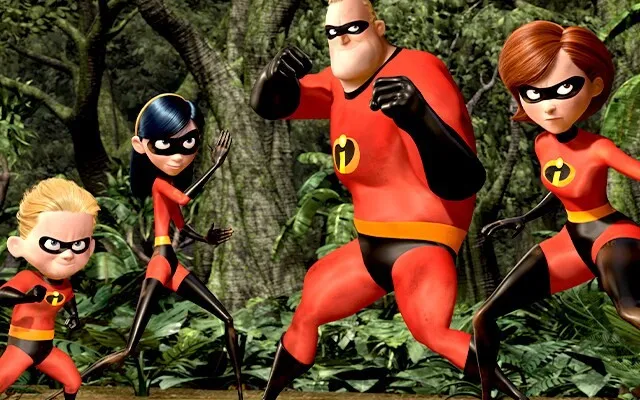
The story follows Bob and Helen Parr, formerly known as Mr. Incredible and Elastigirl, fifteen years after superheroes have been forced into civilian life. They live with their three children: Violet, a shy teenager who can become invisible and create force fields; Dash, an energetic boy with super speed; and Jack-Jack, a baby who initially appears to have no powers.
Bob struggles with his ordinary job and spends evenings secretly listening to police communications with his friend Lucius Best, the retired hero Frozone. His dissatisfaction makes him vulnerable when a mysterious woman named Mirage offers him unauthorized superhero work. The assignments promise good money, secrecy, and the chance to feel useful again.
The first missions restore Bob’s confidence. He trains, loses weight, improves his posture, and begins behaving like the heroic figure he remembers. Helen notices the changes but does not know their cause. The film cleverly presents Bob’s transformation as both inspiring and suspicious. He becomes happier because he is active again, but the happiness is built on deception.
The secret work eventually leads Bob to Syndrome, a technologically gifted villain with a personal history connected to Mr. Incredible. As a child, Syndrome admired him and attempted to become his sidekick. Bob rejected him, partly because the boy placed himself in danger and interfered during serious missions. Syndrome later interpreted that rejection as humiliation and built his entire adult identity around proving that natural superheroes are not special.
This origin gives the villain more dimension than a simple desire for wealth or destruction. Syndrome does not merely want to defeat Mr. Incredible. He wants to control the meaning of heroism. His plan is to stage a public crisis, defeat his own machine, present himself as the world’s savior, and eventually sell his technology until anyone can imitate superhuman ability.
The plot becomes especially effective when Helen discovers Bob’s secret and travels to the island with Violet and Dash. What begins as a rescue mission becomes the moment the entire family is forced into the same conflict.
The pacing is confident for most of the film. The first half spends considerable time establishing suburban dissatisfaction, family arguments, workplace frustration, and Bob’s secret missions. The second half increases the action, but it never completely abandons the family dynamics developed earlier.
Some younger viewers may find the early domestic material slower than the island sequences. I consider that patience one of the film’s strengths. The story earns its action instead of treating spectacle as the default condition.
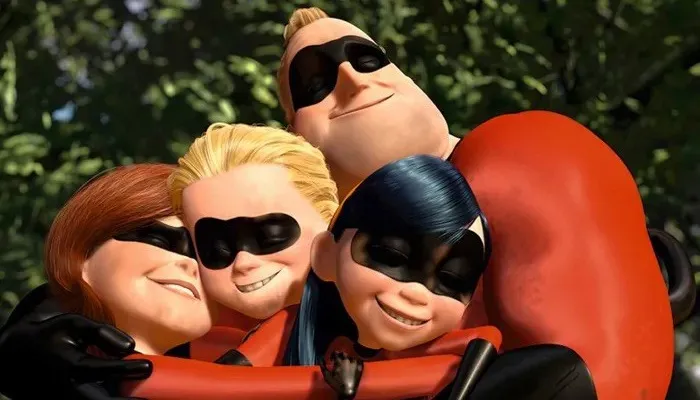
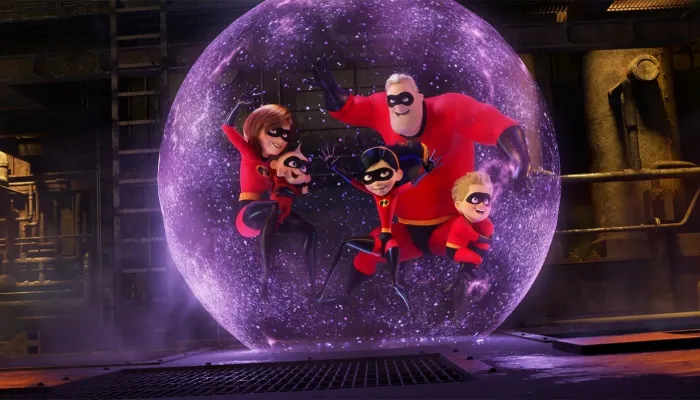
The final act brings the family into open cooperation. Bob must stop believing that protecting his family means excluding them from danger. Helen must accept that the children are capable of more than hiding. Violet and Dash must use abilities they were previously discouraged from displaying.
That progression makes the climax feel like a resolution of character conflicts rather than a separate action requirement. Every family member contributes according to both power and personality.
The Parr Family: Powers That Reveal Personality
Mr. Incredible’s super strength is the most obvious power in the family, but the film repeatedly shows that strength does not make him emotionally capable. Bob can lift vehicles and break through walls, yet he struggles to communicate honestly with his wife or admit that he needs assistance.
His physical ability reinforces his psychological problem. He believes he should carry every burden alone. When he discovers the apparent fate of other superheroes, his confidence collapses because strength offers no protection from guilt or fear.
Helen’s elasticity reflects her role within the family. She stretches between parenthood, marriage, domestic responsibility, and her former heroic identity. Her power allows her to hold people together physically, just as her emotional labor often holds the household together.
The film avoids making Helen only the responsible parent who exists to correct Bob. Once she returns to action, she is quick, strategic, and highly competent. Her rescue sequence aboard the aircraft demonstrates calm decision-making under extreme pressure.
Violet’s invisibility is directly connected to her desire to disappear socially. She hides behind her hair, avoids attention, and lacks the confidence to speak comfortably with the boy she likes. Her force fields represent another part of the same personality: she wants protection from a world that makes her feel exposed.
Her development is among the film’s most satisfying elements. Violet does not become confident through a sudden speech. She gains confidence by acting under pressure, protecting her family, and discovering that her abilities can create connection rather than isolation.
Dash’s speed reflects his impatience and excess energy. He knows he is capable of extraordinary performance but is constantly told to hide it. His frustration at school is understandable because the adults around him ask him to pretend he is less capable than he really is.
The jungle chase is Dash’s defining sequence because it is the first time he can use his full speed without restriction. His expression changes from panic to delight as he realizes what his body can do. It is one of the film’s clearest examples of action revealing character.
Jack-Jack initially appears ordinary, which gives the family one member who does not fit its established power structure. His later abilities become a comic surprise, but they also suggest that potential cannot always be identified or controlled in advance.
The family’s powers are not random decorations. Each ability translates an emotional condition into visual action. This is one reason the characters remain memorable long after the plot is familiar.
Voice Cast & Character Performances: Personality Behind the Animation
Craig T. Nelson gives Bob Parr a mixture of warmth, frustration, pride, and exhaustion. He never makes Bob’s dissatisfaction feel purely selfish, even when the character behaves dishonestly. The performance allows me to understand why Bob misses his old life while still recognizing the damage caused by his choices.
Holly Hunter’s work as Helen is equally important. Her distinctive delivery gives Elastigirl confidence without removing vulnerability. She can sound practical during a family disagreement, controlled during a dangerous mission, and genuinely frightened when she believes her children may be harmed.
Sarah Vowell brings a restrained awkwardness to Violet. The performance never overstates the character’s shyness. Violet sounds like someone who wants to avoid attention but is constantly aware of how others may judge her.
Spencer Fox gives Dash the restless rhythm needed for a child who thinks faster than most people can respond. His excitement feels natural rather than artificially cute, especially during the scenes in which he is finally allowed to use his speed.
Jason Lee’s Syndrome is theatrical, resentful, and highly entertaining. His voice carries the confidence of someone who has rehearsed every speech and planned every entrance. The performance makes Syndrome funny without weakening his threat.
Samuel L. Jackson gives Frozone effortless charisma. Lucius appears less frequently than the Parr family, but nearly every scene involving him is memorable. His calm delivery contrasts perfectly with Bob’s frustration and the absurdity of their situations.
Brad Bird voices Edna Mode, the eccentric costume designer who becomes one of the film’s most recognizable characters. Edna could have been a brief joke, but the performance gives her authority, intelligence, impatience, and genuine affection for the heroic world.
The cast succeeds because every performance fits the visual design. Nobody sounds disconnected from the animated character. The voices establish personality before the dialogue has finished explaining it.
Syndrome & the Meaning of Exceptional Ability
Syndrome is effective because he functions as both a personal enemy and an ideological challenge. He was not born with powers, but he uses intelligence, ambition, wealth, and technology to compete with those who were.
His resentment begins with rejection, yet his response becomes deeply destructive. Rather than proving that ordinary people can become heroic through discipline, he constructs a plan based on deception, murder, and control.
The film’s most debated idea appears in Syndrome’s claim that when everyone is super, no one will be. That line can sound like a defense of natural hierarchy, especially when connected with the film’s repeated suggestion that exceptional people should not be forced to hide their abilities.
However, the story does not condemn technology or ordinary human achievement. Syndrome’s problem is not that he lacks natural powers. His problem is that he treats heroism as fame, superiority, and public worship.
The Parr family succeeds because they cooperate, protect others, and accept responsibility. Syndrome builds machines to create artificial emergencies and then positions himself as the solution.
His inventions are genuinely impressive, which makes his moral failure more significant. He possesses the ability to change the world but uses it to satisfy personal resentment.
The villain also exposes Bob’s weakness. Both characters want recognition. Both are attached to the idea of being exceptional. The difference is that Bob eventually understands heroism as responsibility to others, while Syndrome views it as a performance designed to produce admiration.
Visual Design & Animation: Retro Futurism With a Human Core
The Incredibles has a visual identity that remains distinctive decades after release. Its world combines mid-century modern architecture, 1960s spy cinema, comic-book design, and futuristic technology.
The Parr family’s suburban home uses clean lines, simple shapes, and muted colors that communicate ordinary domestic life. Syndrome’s island uses sharper geometry, volcanic landscapes, hidden facilities, and advanced machines.
The contrast between these environments reflects Bob’s emotional conflict. Suburbia feels safe but restrictive. The island feels exciting but deceptive.
Character design favors strong silhouettes. Bob’s broad upper body immediately communicates strength. Helen’s elongated form supports her elastic movement. Violet appears closed and narrow, while Dash is compact and constantly active.
The animation uses those shapes creatively. Helen stretches across gaps and transforms her body into practical forms. Dash’s speed affects water, vegetation, and surrounding characters. Violet’s force fields bend under pressure rather than appearing as static walls.
Action remains readable even during complicated sequences. The camera shows where characters are located, what threat is approaching, and how each power changes the situation.
The film also understands physical comedy. Bob’s size makes ordinary spaces difficult to navigate. Edna’s small body contrasts with her overwhelming authority. Elastigirl’s flexibility allows visual jokes that remain connected to the action.
Some background textures and human character models show the technical age of the production when compared with newer animated films. Skin, hair, and minor crowd figures are less detailed than current standards.
That limitation rarely damages the experience because the art direction is stronger than the pursuit of realism. The film was designed around shape, color, movement, and composition rather than surface detail alone.
Music, Direction & Atmosphere: A Spy Score for a Superhero Family
Michael Giacchino’s score is central to the film’s identity. Brass, percussion, and jazz influences evoke classic spy movies while supporting superhero action.
The main themes are bold without sounding generic. The music can communicate excitement, secrecy, danger, family warmth, or comic embarrassment while remaining part of the same musical world.
The score is especially effective during infiltration and pursuit scenes. It turns the island into the setting of an espionage thriller rather than a standard fantasy battlefield.
Brad Bird’s direction balances several tones without allowing one to dominate completely. Domestic arguments, office satire, superhero action, comedy, and genuine danger all belong in the same film.
The action sequences are staged with unusual confidence. The aircraft attack is tense because Helen must manage both the technical emergency and the panic of her children. Dash’s chase is exciting because it represents personal liberation. The final robot battle works because the family’s cooperation has already become emotionally meaningful.
The film also allows quiet scenes to carry weight. Bob sitting alone, Helen studying evidence, Violet avoiding conversation, and the family eating dinner provide necessary space between larger sequences.
One flaw is that the later action becomes more conventional than the first half. Once the family reaches the city confrontation, the story moves toward familiar superhero spectacle.
The climax remains entertaining, but the most original material is often found in the combination of powers and ordinary family life rather than the destruction caused by the final machine.
Critical Reception & Lasting Reputation: Why the Film Endured
Critics responded very positively to The Incredibles, frequently praising its screenplay, visual style, voice performances, action, humor, and ability to address adult concerns inside a family film.
Particular attention was given to Brad Bird’s direction and the way the story used superhero conventions to examine marriage, parenthood, conformity, and personal fulfillment.
The film was also recognized during awards season, receiving the Academy Award for Best Animated Feature and another Oscar for sound editing. Its screenplay earned additional attention, which was notable for an animated action film.
Many reviews highlighted the film’s appeal across age groups. Children could enjoy the powers, machines, humor, and chase sequences, while adults could recognize the workplace frustration, marital tension, exhaustion, and fear of becoming ordinary.
Some critics and later commentators questioned the film’s treatment of exceptionalism. The repeated idea that talented individuals should not be forced to reduce themselves can be inspiring, but it can also be interpreted as dismissive of equality when separated from the film’s broader moral context.
Other criticism focused on the length of the setup, the darker implications of Syndrome’s actions, and the conventional elements of the final battle.
Even with those debates, the film developed a lasting reputation as one of Pixar’s strongest productions and one of the most successful superhero stories created outside traditional comic-book adaptations.
Its influence became more visible as superhero cinema expanded. The Incredibles had already explored secret identities, public distrust, hero regulation, family responsibility, and the consequences of exceptional power before many live-action franchises made those concerns central.
Final Verdict: A Superhero Classic Built Around an Ordinary Family
The Incredibles remains one of the finest examples of a family film using genre entertainment to discuss adult anxieties. It understands that superhero powers are most interesting when they complicate ordinary relationships.
I enjoyed the action, but the moments that stayed with me were usually smaller. Bob struggling inside a tiny car, Helen recognizing the signs of deception, Violet hiding behind her hair, Dash being asked to finish second, and the family failing to complete a peaceful dinner all reveal the cost of pretending to be normal.
Brad Bird’s screenplay gives the story unusual confidence. It trusts viewers to understand disappointment, resentment, secrecy, fear, and ambition without removing the humor or adventure.
The voice cast gives every member of the family a distinct emotional rhythm. Craig T. Nelson and Holly Hunter make the marriage convincing, while Sarah Vowell and Spencer Fox ensure that the children feel like characters rather than simple collections of powers.
Syndrome remains a memorable villain because his plan grows from emotional injury and a distorted understanding of heroism. He does not want only to win. He wants to control who receives admiration.
The film’s visual style has aged better than many technically newer productions because it relies on strong design rather than realism. Its architecture, costumes, silhouettes, colors, and animation continue to feel deliberate.
The score gives the entire production additional confidence. Michael Giacchino turns family activity into spy adventure without losing warmth.
The film is not perfect. Its discussion of exceptional ability can be interpreted too broadly, Helen deserves more narrative attention, and the final city battle is more predictable than the earlier material.
Those limitations do not weaken the central achievement. The Incredibles is funny, emotionally intelligent, visually coherent, and exciting. It works as a superhero adventure, a marriage story, a family comedy, and a warning about the consequences of building identity entirely around public recognition.
Personal rating: 9.5/10.
The Incredibles earns that score for its intelligent screenplay, memorable family, excellent cast, confident direction, inventive action, outstanding score, distinctive visual style, and lasting thematic depth. It loses half a point for an occasionally uncomfortable treatment of exceptionalism, limited development for some supporting characters, and a final act that becomes more conventional than the brilliant setup.
The film’s greatest accomplishment is not convincing me that the Parrs are superheroes. It is convincing me that their powers would mean very little if they never learned how to function as a family.
Pros

- Compelling storyline that blends family dynamics with superhero action
- Well-developed characters with human flaws and relatable struggles
- Innovative animation that combines retro aesthetics with modern techniques
- Outstanding voice acting that breathes life into every character
- A multi-layered narrative that offers both thrilling action and emotional depth
- A memorable musical score that enhances every scene
Cons

- Some plot elements can feel dated compared to modern narratives
- Pacing may seem slow during certain reflective scenes
- The complexity of themes may be challenging for younger viewers to fully grasp

Leave a comment
Your comment is awaiting moderation. We save your draft here
0 Comments