






A Pop Fantasy That Understands the Power of Performance
I expected KPop Demon Hunters to entertain me with polished songs, colorful supernatural action, and a few playful jokes about idol culture. I did not expect its most effective moments to come from a heroine who is terrified that the people closest to her will discover what she has been hiding. The film’s premise is deliberately extravagant: a globally successful K-pop girl group secretly protects humanity from demons through music, choreography, and enchanted weapons. Yet beneath the sparkling costumes and packed arenas, the story is about shame, identity, friendship, and the exhausting pressure to appear perfect.
This KPop Demon Hunters review begins with that contrast because it gives the film more emotional weight than its title suggests. Directors Maggie Kang and Chris Appelhans build a world where performance is not merely entertainment. Music creates a protective barrier between the human world and the demonic realm, which means every concert carries literal importance. The concept sounds ridiculous when reduced to one sentence, but the film presents it with enough confidence, style, and musical energy that I accepted the rules almost immediately.
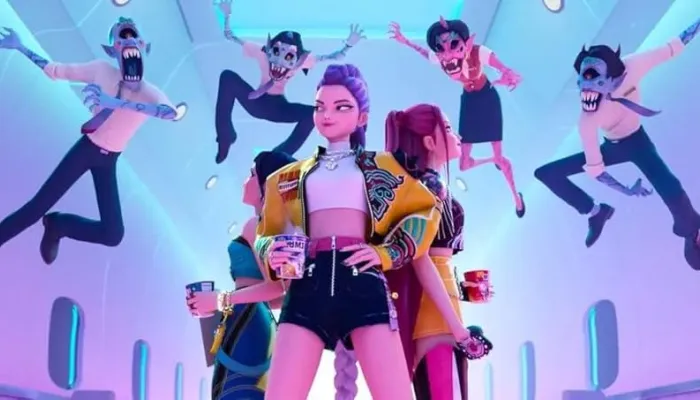
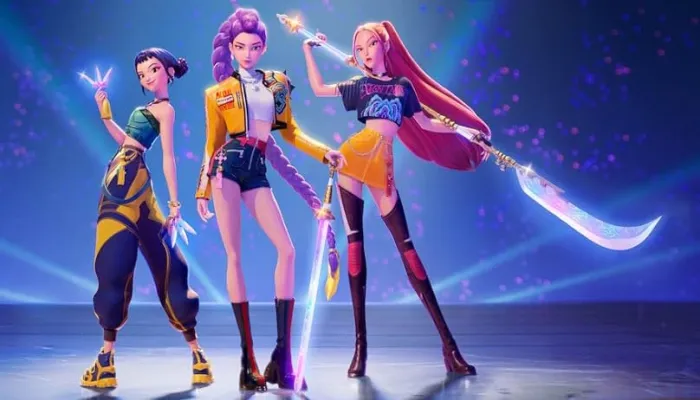
The story follows HUNTR/X, a superstar trio consisting of Rumi, Mira, and Zoey. Their public lives involve rehearsals, concerts, fans, interviews, and the constant expectation that they remain flawless. Their private responsibility is far more dangerous: they use their voices and specialized weapons to fight demons attempting to feed on human souls. The arrangement becomes unstable when a rival demon group called the Saja Boys enters the music industry, attracts an enormous audience, and begins weakening the bond HUNTR/X has built with its fans.
The setup gives the film permission to combine concert spectacle, fantasy combat, comedy, romance, and personal drama without treating any one genre as an interruption. A song can advance the plot, reveal a character’s fear, and become part of a supernatural confrontation at the same time. That integration is the film’s greatest strength.
Rumi: A Heroine Trapped Between Two Identities
Rumi is the emotional center of the film and the character who gives its fantasy conflict a personal cost. She is the leader and primary vocalist of HUNTR/X, carrying herself with the confidence expected from someone performing before enormous crowds. Behind that confidence is a secret she believes could destroy everything: she is part demon.
Her demonic markings spread across her body as the story progresses, creating a visual representation of the identity she has spent years trying to suppress. She does not view this part of herself as complicated or misunderstood. She sees it as contamination. That belief shapes the way she approaches her friends, her voice, and the possibility of failure.
Arden Cho gives Rumi a controlled public presence and a much more fragile private one. The vocal performance captures the difference between a person who knows exactly what to say on stage and someone who cannot explain the truth in an ordinary conversation. Rumi’s fear is not simply that Mira and Zoey will be surprised. She believes they may see her as one of the creatures they have been trained to oppose.
The film uses her damaged voice effectively. Singing is the source of her public identity and supernatural power, so losing control over it threatens every part of her life at once. She cannot solve the problem through greater discipline because the real cause is emotional. The more aggressively she rejects herself, the less stable her performance becomes.
I appreciated that Rumi is allowed to make damaging decisions. She lies, withdraws, and attempts to carry the entire burden alone. Her mistakes do not make her unsympathetic; they make the film’s message about honesty feel earned. Acceptance does not arrive because another character gives her one inspiring speech. It requires Rumi to stop treating love as something available only to a carefully edited version of herself.
Mira and Zoey: More Than Supporting Voices
Mira and Zoey could easily have become simple personality types positioned beside the more dramatic lead. Mira is sharp, direct, and physically confident, while Zoey is energetic, expressive, and often responsible for the group’s lighter moments. The film gives both enough individuality that HUNTR/X feels like an actual trio rather than one protagonist accompanied by two colorful assistants.
Mira’s confidence often appears effortless, but her loyalty to the group is serious. She notices when Rumi is withdrawing and reacts strongly because secrecy threatens the trust holding them together. Her frustration is not only about being excluded from information. She believes the three members are supposed to face pressure together.
Zoey brings warmth and comic timing without becoming incapable during serious scenes. Her enthusiasm helps establish the group’s public chemistry, yet she is also sensitive to emotional changes within the trio. The humor works because she remains a complete participant rather than someone included solely to deliver jokes.
The friendship among the three women is the film’s real love story. Their synchronized performances and coordinated combat show technical unity, but the emotional conflict asks whether that unity can survive imperfection. Rumi assumes the group depends on her maintaining a flawless image. Mira and Zoey gradually demonstrate that the relationship depends more on honesty than on perfection.
I would have welcomed more time with Mira and Zoey outside their connection to Rumi. Their personalities are distinct, but their personal histories and private fears receive less attention. The film’s pace keeps moving toward the central conflict, leaving some supporting character depth unexplored.
Jinu and the Saja Boys: Pop Idols Designed as Temptation
The Saja Boys are clever antagonists because they do not challenge HUNTR/X only through physical force. They compete for attention. Their music, image, and carefully designed charm attract the same audience whose support maintains the protective Honmoon barrier.
The group functions as a playful parody of polished boy-band appeal, but the joke never completely removes their threat. Their performances are designed to create immediate obsession, using synchronized movement, flattering camera angles, and lyrics that sound sweet while hiding predatory intent. The result is funny and unsettling at the same time.
Jinu, the group’s leader, gives the conflict greater complexity. He is a demon serving Gwi-Ma, but his history contains guilt, ambition, and self-deception. Ahn Hyo-seop voices him with enough restraint that the character does not become a simple seductive villain.
His connection with Rumi works because both characters are divided by shame. Rumi fears her demonic identity will make her unworthy of love, while Jinu has accepted a destructive role because he believes his past has already defined him. They recognize the hidden parts of one another before either is ready to reveal those parts to anyone else.
Their scenes provide a quieter rhythm between concerts and action sequences. The romantic element remains restrained enough that it does not replace the central friendship among HUNTR/X. Jinu is important because he gives Rumi a possible future based on continued secrecy and surrender. He understands her pain, but understanding alone does not make his choices healthy.
The remaining Saja Boys are visually memorable and amusing, though they receive limited individual development. Their names, poses, and exaggerated personalities make them effective as a group, but I rarely felt that each member existed beyond the performance concept. The film clearly prioritizes Jinu, and the shorter treatment of the others is understandable even if it leaves some comic potential unused.
Music as Storytelling Rather Than Decoration
The soundtrack is not placed around the story; it carries the story. Each major song has a dramatic purpose connected with character, conflict, or public identity. The film understands that a convincing musical number needs to reveal something beyond the fact that the performers can sing.
“How It’s Done” introduces HUNTR/X as disciplined, confident, and completely capable of managing danger without interrupting their professional schedule. The sequence establishes the film’s rhythm immediately, moving between performance and supernatural action with no need to apologize for the combination.
“Golden” is the emotional centerpiece of the group’s public image. It expresses aspiration, unity, and the belief that the trio can become something untouchable. The song’s brightness makes Rumi’s private instability more painful because the lyrics represent the perfect version of herself she is struggling to maintain.
“Soda Pop” is intentionally irresistible. The Saja Boys need to convince both the fictional audience and the viewer that their sudden popularity makes sense. The song succeeds by sounding playful and harmless while the visuals constantly suggest manipulation.
“Your Idol” pushes the antagonist concept further. It turns fan devotion into something darker, presenting celebrity worship as a form of surrender. The sequence is one of the film’s strongest because the music, choreography, costume design, and demonic imagery become one idea rather than separate attractions.
“Free,” performed through the emotional connection between Rumi and Jinu, provides vulnerability without abandoning the polished musical style. It gives both characters space to imagine identities not completely controlled by their pasts. The hope inside the song becomes more effective because the story has already shown how difficult that freedom would be.
The soundtrack occasionally works almost too well. Several songs are so immediate and polished that the narrative sections between them can feel like preparation for the next major track. This is not a severe weakness, but it reveals where the film’s creative energy is most concentrated.
Animation and Visual Design: Every Frame Performs
The animation combines polished three-dimensional character work with graphic effects, exaggerated expressions, anime-inspired movement, hand-drawn accents, and music-video editing. The result feels flexible rather than visually uniform. Concert scenes can become glossy and controlled, while comedy allows faces and bodies to stretch into deliberately ridiculous shapes.
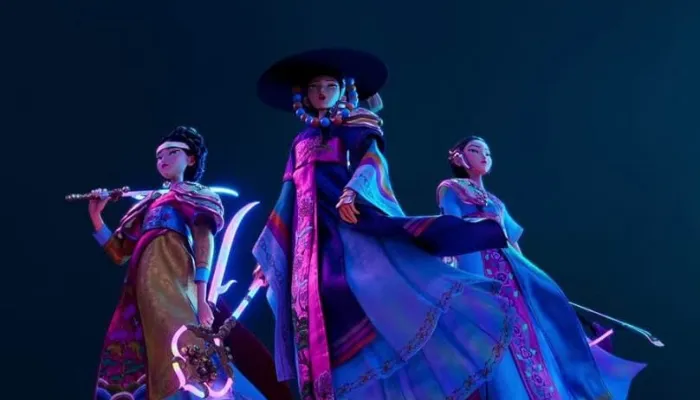
HUNTR/X has a strong visual identity built around fashion, color, movement, and weapon design. Each member remains recognizable during fast choreography because her silhouette and personality affect how she moves. Their stage presence and combat style feel connected; they fight like performers who have trained to understand spacing and rhythm.
The Saja Boys use softer colors and carefully managed beauty before their demonic nature becomes more visible. Their designs understand that attraction is part of the threat. They need to look desirable enough that the audience accepts their rapid rise before the horror elements become dominant.
Seoul is presented as a heightened urban playground filled with light, signs, stages, rooftops, narrow streets, and supernatural spaces hidden inside ordinary life. The film is not attempting a realistic city portrait. It builds a version suited to pop fantasy, where a concert can become a battlefield without losing visual coherence.
The action is readable despite rapid editing. Weapons leave strong trails, character colors remain distinct, and the choreography uses musical timing to clarify movement. A few larger confrontations become visually crowded, particularly when multiple powers, demons, and environmental effects overlap. Even then, the energy remains easy to follow emotionally.
Comedy That Supports the Characters
KPop Demon Hunters is consistently funny, but most of its humor comes from behavior rather than isolated references. The contrast between glamorous idols and exhausted young women eating, arguing, or reacting badly to unexpected problems gives the group personality.
Bobby, the group’s manager, contributes enthusiastic incompetence without becoming malicious. Ken Jeong’s delivery makes him sound completely committed to solving situations he only partially understands. His presence helps maintain the entertainment-industry side of the story while the heroines manage a secret supernatural crisis.
Healer Han provides another form of comedy through eccentric confidence and unusual methods. The character could have felt like a random interruption, but his scenes fit a world where ancient supernatural knowledge exists beside modern celebrity culture.
The film also uses visual exaggeration effectively. Characters shift from polished beauty to chaotic cartoon expressions within seconds. These changes do not damage the emotional scenes because the animation establishes early that style can react to mood. Not every joke lands. A few gags repeat their energy, and some secondary characters are introduced mainly to create immediate comic noise. The overall balance remains strong because the film knows when to reduce the humor and allow Rumi’s fear to become sincere.
Themes of Shame, Perfection, and Public Identity
The supernatural story works because it reflects the pressure placed on performers. HUNTR/X must appear coordinated, confident, grateful, beautiful, and emotionally stable regardless of what is happening privately. Their responsibility as hunters exaggerates that pressure, but the underlying expectation is recognizable.
Rumi believes protection requires purity. She treats her demonic heritage as evidence that she is fundamentally compromised, even though her choices repeatedly demonstrate loyalty and courage. The film challenges the idea that identity can be divided neatly into acceptable and unacceptable pieces.
Gwi-Ma gains influence through shame and isolation. His power becomes stronger when characters believe their secrets must remain hidden. This makes emotional honesty part of the fantasy logic rather than a lesson added after the main conflict.
The relationship between artists and fans is also handled with surprising care. Music can unite people, but devotion can be manipulated. The Saja Boys treat attention as a resource to consume, while HUNTR/X eventually learns that authentic connection is stronger than a perfect image. The message is direct and accessible, occasionally becoming more explicit than necessary. Several scenes explain feelings the visuals and songs have already communicated. Younger viewers may benefit from that clarity, though I preferred the moments when the film trusted performance and imagery.
Pacing and Story Structure
The film moves quickly, introducing the group, its supernatural responsibility, Rumi’s secret, the rival band, and the central emotional conflict without a long opening act. This momentum keeps the musical fantasy exciting and prevents the mythology from becoming heavy.
The cost is limited breathing room. Mira and Zoey deserve more individual material, the Saja Boys could support additional comic scenes, and the rules surrounding demons and the Honmoon barrier are sometimes explained only as much as the current sequence requires.
Jinu’s past is emotionally important, but parts of it arrive through concentrated exposition. More time observing his earlier choices would have made his internal conflict even stronger. The final act contains several rapid emotional reversals, musical developments, and action beats. Most are satisfying because they resolve ideas established throughout the film, though one or two transitions happen with enough speed that I wanted another quiet scene before the next spectacle. These pacing issues never made the story confusing. They made me aware that the world could support more time than one film provides.
Voice Performances and Character Chemistry
Arden Cho gives Rumi the emotional control required for a character constantly performing confidence. May Hong makes Mira’s directness feel protective rather than simply aggressive, while Ji-young Yoo gives Zoey enough warmth and speed to support both comedy and sincerity.
The singing voices blend convincingly with the spoken performances. The transition from dialogue to song rarely feels as though an entirely different character has appeared. That continuity is essential in a musical where vocal performance reveals private emotion.
Ahn Hyo-seop gives Jinu charm without removing the character’s sadness or danger. Lee Byung-hun makes Gwi-Ma sound commanding and invasive, turning the antagonist into a presence capable of exploiting insecurity rather than merely issuing threats.
Yunjin Kim brings authority and emotional distance to Celine, Rumi’s foster mother and mentor. Her approach to protection has shaped Rumi’s shame, making her more complicated than a purely supportive guardian. Ken Jeong, Daniel Dae Kim, and the wider cast contribute comic energy without overwhelming the central trio.
Who Will Enjoy KPop Demon Hunters?
KPop Demon Hunters is an easy recommendation for viewers who enjoy animated musicals, supernatural action, K-pop aesthetics, female friendship, fast comedy, and stories about characters learning to accept hidden parts of themselves. The film is accessible without requiring detailed knowledge of the K-pop industry, although familiarity with idol groups, fandom culture, choreography, and promotional imagery adds another layer to the jokes.
Younger viewers can enjoy the music, characters, demons, and physical comedy, while older audiences may connect more strongly with the pressure surrounding public identity and emotional concealment. The darker imagery remains stylized rather than graphic, though some demonic transformations and threatening sequences may unsettle very young children.
Viewers who dislike frequent songs or highly energetic animation may find the film exhausting. Its emotional sincerity is surrounded by bright visuals, rapid jokes, and constant musical momentum. Anyone expecting a restrained fantasy drama should prepare for a story that expresses nearly every major emotion at concert volume.
My Rating
I give KPop Demon Hunters a personal rating of 9/10. The film combines infectious music, emotionally expressive animation, memorable characters, supernatural action, and a sincere story about the damage caused by hiding behind perfection. Its supporting cast could use more room, and the pace occasionally rushes material that deserves another scene, but those limitations did not weaken my attachment to HUNTR/X or the emotional force of Rumi’s journey.
What stayed with me most was not the scale of the concerts or the creativity of the demon battles. It was the idea that a voice becomes stronger when it stops trying to hide the person using it. KPop Demon Hunters builds an enormous pop fantasy around that simple truth, then delivers it with enough confidence to make glowing weapons, rival demon idols, emotional duets, and friendship feel like parts of the same song.
Pros

- Stunning, high-quality animation with stylish design
- Soundtrack that enhances emotional and action scenes alike
- Strong central characters with distinct voices and growth
- Balanced tone with satire, emotion, and spectacle
- Effective world-building with hints of deeper lore
- Inventive fusion of pop music and fantasy storytelling
Cons

- Side characters occasionally underdeveloped
- Pacing lags slightly in exposition-heavy moments
- Some predictable beats in the third act

Leave a comment
Your comment is awaiting moderation. We save your draft here
1 Comments
Your reply is awaiting moderation. We save your draft here