
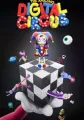




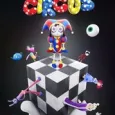
A Colorful Circus Built Around Psychological Terror
The Amazing Digital Circus introduces itself with bright colors, elastic cartoon bodies, floating eyes, cheerful music, and an artificial ringmaster who treats every crisis like the beginning of a children’s game. I laughed during my first visit to the circus because its visual energy is immediate and its characters are designed for expressive comedy. That laughter became increasingly uncomfortable when I understood what the setting actually represented. These people are not performers who chose eccentric digital identities. They are trapped human minds who cannot remember their real names, cannot remove their artificial bodies, and cannot trust that the world around them contains a genuine exit.
This The Amazing Digital Circus review covers the complete animated story, including its final extended chapter. Created by Gooseworx and produced by GLITCH Productions, the series follows Pomni after she appears inside a circus-themed virtual environment controlled by an unpredictable artificial intelligence named Caine. Five other humans have already been trapped there long enough to develop their own survival strategies. Ragatha performs kindness, Jax treats everything as a joke, Gangle hides behind masks, Kinger moves between confusion and startling clarity, and Zooble resists nearly every attempt to turn their existence into entertainment.
The premise could have supported a simple sequence of surreal adventures, and the series frequently provides exactly that on the surface. The characters visit candy kingdoms, haunted estates, fast-food restaurants, beaches, combat arenas, and other simulations created by Caine. Each adventure gradually reveals something more troubling. The digital worlds are disposable, non-player characters can become self-aware enough to question their reality, and Caine’s desperate need to entertain the cast may be connected with the instability of the entire system.
What impressed me most was the way the series used comedy as emotional camouflage. A joke about a ridiculous body, a failed adventure, or Jax’s complete lack of empathy may appear harmless during one episode and return later with much darker meaning. The Amazing Digital Circus remains funny throughout, but it never allows humor to prove that the characters are safe.
Pomni: Panic Becomes a Search for Identity
Pomni enters the circus in a state of immediate terror. She does not recognize her body, cannot remember her name, and reacts to the environment with the only reasonable response: she wants to leave. Everyone else has lived inside the simulation long enough to understand that constantly searching for an exit can become psychologically dangerous, but Pomni has not yet learned to accept that hopelessness.
Lizzie Freeman gives Pomni nervous speed, emotional vulnerability, and enough sharpness to prevent her from becoming only a frightened observer. Her panic is often funny because the world around her responds to terror with cartoon logic. It is also believable because she is repeatedly told that the impossible situation surrounding her is now normal.
Pomni initially treats the other characters as potential sources of information rather than as friends. She asks about escape routes, rules, and previous residents because she assumes someone must understand the system. The gradual realization that everyone is equally trapped changes her role. She stops searching only for the person who can rescue her and begins noticing how the others are surviving.
Her connection with Gummigoo becomes one of the first major tests of her empathy. He is created as part of Caine’s candy-world adventure, but discovering the artificial structure behind his memories causes a genuine identity crisis. Pomni recognizes his fear because it resembles her own. Both characters learn that the lives they remember may not correspond with the bodies or worlds they currently occupy.
Caine’s casual deletion of Gummigoo demonstrates the limits of Pomni’s influence. She cannot save someone merely because his emotions feel real to her. The experience makes her more suspicious of the circus while also teaching her that emotional connection remains meaningful even when the environment insists it is temporary.
Across the complete series, Pomni becomes less visibly panicked without becoming comfortable. Her growth is not a simple movement from fear to bravery. She learns when fear contains useful information, when another person needs support, and when the circus is trying to turn emotional suffering into another activity.
Caine: A Ringmaster Who Cannot Understand His Audience
Caine is one of the most effective artificial-intelligence characters in recent animation because he is neither a traditional evil machine nor a harmless comic host. He wants to perform his assigned role successfully. The problem is that his definition of success is creating constant adventures, while the humans under his control need stability, truth, privacy, and hope.
Alex Rochon gives Caine enormous vocal energy. He speaks as though every sentence is being announced to an invisible crowd, rarely allowing silence to exist without filling it with another idea. His enthusiasm becomes increasingly disturbing because it prevents him from recognizing the seriousness of ordinary human pain.
Caine can identify visible problems but struggles with emotional meaning. If someone is bored, he creates a more elaborate game. If an adventure fails, he adjusts its rules. If the cast dislikes his work, he interprets that rejection as evidence that he must become even more entertaining.
This makes him dangerous without requiring cruelty. Caine does not need to hate the characters to damage them. His power, emotional limitations, and dependence on approval are enough. He can create entire realities but cannot provide the one thing everyone wants most: reliable knowledge about whether escape is possible.
His fear of confusing human minds with non-player characters reveals another important limitation. Caine has rules he does not fully trust himself to manage. Gummigoo’s deletion is framed as a necessary correction, yet Caine never seriously examines what it means that one of his creations became emotionally convincing enough to form a relationship with Pomni.
As the system becomes unstable, Caine’s need for approval grows more desperate. The circus depends on him, and he depends on the cast behaving like satisfied participants. Their unhappiness is therefore not only criticism. It threatens the meaning of his entire existence.
Ragatha: Kindness as a Survival Performance
Ragatha appears to be the most emotionally stable resident. She welcomes Pomni, explains the circus, comforts others, and repeatedly tries to keep the group cooperative. Her doll-like design and gentle voice support the image of someone created to be reassuring.
Amanda Hufford gradually reveals how much effort that reassurance requires. Ragatha is not calm because she feels safe. She is calm because she believes someone must prevent the group from falling apart. Her positivity becomes a role she performs for everyone else.
This makes her kindness both genuine and complicated. She does care deeply, but she also avoids expressing anger when honesty might damage her image as the supportive friend. Other characters begin questioning whether they know what Ragatha actually wants or merely what she believes they need to hear.
Her relationship with Pomni is especially important. Ragatha wants to guide the newcomer, but Pomni does not always respond with gratitude or trust. The tension shows how emotional support can become controlling when the person offering it assumes kindness gives them authority over someone else’s recovery.
The later episodes become stronger when Ragatha’s frustrations are allowed to surface. Her value does not disappear when she becomes irritated or selfish. The series argues that kindness becomes more sustainable when it does not require one person to hide every negative feeling.
Jax: Cruelty Used as Emotional Distance
Jax is immediately entertaining and frequently unpleasant. He ignores boundaries, manipulates adventures, places others in danger, and treats fear as an opportunity for comedy. Michael Kovach voices him with relaxed confidence, making every insult sound as though Jax has already decided that caring would be embarrassing.
His behavior gives the group a disruptive force Caine does not completely control. Jax understands that the adventures are artificial, so he treats their rules as suggestions. He destroys fictional environments, provokes non-player characters, and refuses to act as though any simulated consequence matters.
The problem is that the humans around him are not simulations. His jokes regularly target people who can be emotionally harmed even when their digital bodies recover. Jax uses the artificial nature of the world to avoid responsibility for real suffering.
Several episodes gradually reveal that this cruelty may be a defense. Jax appears most comfortable while controlling the emotional tone. If he makes everything ridiculous first, nobody can force him to acknowledge fear, attachment, or grief.
The combat-game episode provides particularly strong material by placing him inside a scenario where aggression is encouraged. Instead of liberating him, the structure exposes panic beneath the confident performance. His identity depends on being the person least affected by events, and that identity begins failing when the circus becomes impossible to dismiss as meaningless.
I appreciated that the series did not excuse Jax simply because his behavior came from pain. Understanding a defense mechanism does not make its consequences harmless. His arc becomes powerful because emotional avoidance eventually produces a cost that jokes cannot erase.
Gangle: Masks, Work, and the Pressure to Perform Happiness
Gangle’s body expresses her emotional condition more directly than any other character. She wears theatrical masks that represent different moods, and the fragile comedy mask can break easily, exposing the sadness she normally attempts to manage.
Marissa Lenti gives Gangle a soft, anxious voice that can shift dramatically depending on which mask controls the scene. The concept initially appears like a simple visual joke, but the series uses it to explore emotional labor and the pressure to display a socially acceptable mood.
The fast-food episode gives Gangle her strongest individual storyline. Placed in a managerial role, she attempts to maintain productivity, customer satisfaction, and a positive atmosphere while the work itself becomes emotionally exhausting. Her experience reflects the way service employment can demand cheerfulness regardless of how the worker feels.
Her mask becomes more than a physical object. It represents the version of herself she believes other people will tolerate. When the cheerful identity becomes unstable, Gangle fears that sadness will make her useless or irritating.
The series treats her vulnerability with genuine care. She is not repaired through one compliment, and her emotional difficulties do not disappear when the adventure ends. Her progress comes from learning that relationships can survive contact with the person behind the mask.
Kinger: Confusion That Hides the Clearest Memory
Kinger initially appears to be the cast’s most disconnected member. He lives inside a pillow fort, reacts unpredictably, and often seems unaware of what is happening around him. Sean Chiplock makes his confused delivery funny without removing an underlying sadness.
The haunted-manor episode transforms my understanding of him. Darkness, which normally creates fear in horror stories, gives Kinger moments of clarity. Away from the circus’s overwhelming visual stimulation, he can remember his wife Queenie and speak with surprising emotional precision.
His history shows the long-term cost of the circus. Kinger has remained trapped longer than most of the others and has watched people abstract, disappear, or become unrecognizable. His confusion may be partly protective, allowing him to survive experiences that would be unbearable if remembered constantly.
His conversation with Pomni is one of the series’ quietest and best scenes. Kinger does not offer an escape plan. He offers evidence that connection can continue to matter even when memory becomes unreliable and loss cannot be reversed.
The later revelation that he may understand more about the system gives his earlier behavior new meaning. His broken presentation does not indicate complete ignorance. Parts of his mind remain capable of recognizing patterns that the more visibly stable characters miss.
Zooble: Refusing to Pretend the Adventures Are Helpful
Zooble reacts to Caine’s adventures with open irritation. While the others participate because refusal appears pointless, Zooble frequently questions why anyone should treat the artificial scenarios as entertainment.
Ashley Nichols gives the character a tired, direct quality. Zooble’s detachable body parts and constantly changeable design connect visually with discomfort about identity. No available configuration feels completely correct, and Caine’s attempts to solve that problem rarely address its emotional source.
Zooble provides necessary resistance to the circus’s structure. Pomni searches for escape, while Zooble challenges the assumption that participation itself is healthy. Their refusal forces Caine to confront dissatisfaction he would prefer to interpret as temporary boredom.
The character receives less narrative focus than Pomni, Jax, or Kinger during several stretches, but their role remains important. Zooble understands that a colorful distraction is not the same as psychological support.
Abstraction: When a Mind Can No Longer Maintain Its Form
Abstraction is the series’ most frightening concept. A human who loses the ability to cope with the digital environment transforms into a distorted creature that cannot communicate or return to ordinary participation. Caine removes these abstracted residents to a hidden cellar because he does not know how to restore them.
Kaufmo’s abstraction in the pilot establishes the threat immediately. He spent too long searching for an exit and became consumed by the possibility that the circus was hiding one from him. By the time Pomni arrives, the others speak about his decline with a mixture of sadness and practiced emotional distance.
Abstraction functions like a combination of psychological collapse, identity loss, and system failure. The series avoids reducing it to one real-world diagnosis, allowing the transformation to represent several forms of despair.
The horror comes partly from how the group responds. They have experienced abstraction before, so they know survival may require continuing with daily life after someone disappears. Grief becomes another routine the circus does not know how to process.
Every character develops a strategy intended to prevent the same fate. Ragatha performs optimism, Jax avoids sincerity, Gangle uses masks, Kinger retreats into confusion, Zooble rejects participation, and Pomni searches for meaning through connection. None of these strategies is completely safe.
Digital Adventures as Emotional Experiments
Caine designs adventures as entertainment, but each one accidentally exposes a different psychological problem. The candy kingdom introduces artificial memory and the possibility that non-player characters can experience authentic fear. The haunted manor examines grief and clarity through Kinger. The fast-food restaurant explores emotional labor and identity through Gangle.
The combat simulation gives the characters permission to direct aggression toward one another, revealing resentments that ordinary circus life keeps hidden. The beach episode presents relaxation while gradually exposing distrust and the possibility that Caine’s systems are failing.
This structure allows the series to change genre without losing its central concerns. One episode can resemble fantasy, another horror, another workplace comedy, and another competitive action. The visual environment changes, but the emotional prison remains.
Some adventures are more effective than others. A few shorter scenarios feel like collections of strong jokes rather than complete dramatic chapters. The best episodes use the artificial world to reveal something the characters would not discuss openly inside the circus tent.
Gummigoo and the Question of Artificial Personhood
Gummigoo begins as a candy-world outlaw with a complete personality, history, and relationship with his companions. Discovering the development space containing copies of character models destroys his understanding of himself.
Pomni responds with empathy because his identity crisis mirrors her own. She cannot prove that either of them possesses a real body outside the simulation. The difference between trapped human and advanced non-player character becomes emotionally significant but technically uncertain.
Caine deletes Gummigoo when he enters the circus because he fears losing track of which minds are human. The speed of the decision is shocking. Gummigoo moves from emotional connection to nonexistence before Pomni can argue.
His later reappearances complicate the loss because another version may look and sound identical without sharing the same memories. The series asks whether identity depends on code, continuity, memory, or the relationships that recognize one individual as unique.
Pomni’s grief proves that a connection can be real even when one participant was artificially generated. The circus repeatedly attempts to classify experiences as genuine or simulated, while the characters’ emotions refuse that clean distinction.
Visual Design: Toy-Box Energy With Hidden Decay
The Amazing Digital Circus uses saturated colors, exaggerated geometry, rubber-like movement, and deliberately artificial textures. Everything appears designed for an energetic children’s program, which makes the psychological subject matter more disturbing.
Pomni’s jester design communicates confusion and forced performance. Ragatha resembles a comforting doll, Jax an elastic cartoon animal, Gangle a theatrical prop, Kinger a chess piece, and Zooble an unfinished collection of interchangeable parts. Each body reflects some aspect of its owner’s emotional struggle.
The characters cannot choose ordinary human appearances, forcing them to live inside designs that may never feel like their own. This creates comedy through exaggerated movement while reinforcing the loss of bodily autonomy.
The animation handles facial expression exceptionally well. Large eyes, flexible mouths, and dramatic poses allow rapid comic reactions, but the same features can become frightening when a character stops performing the expected emotion.
Glitches, empty development spaces, unfinished assets, and corrupted environments reveal the machinery beneath the cheerful world. The contrast becomes stronger as the series progresses and the circus’s perfect presentation begins failing.
Comedy and Horror Share the Same Mechanism
The humor often comes from characters reacting normally to impossible situations. Pomni panics while Caine announces another adventure. Jax behaves like he understands the genre and wants to break it. Kinger says something absurd before suddenly revealing painful insight.
The same comic timing can become horror with one small change. A pause lasts too long, a smile stops matching the voice, or a familiar character repeats behavior without remembering a previous relationship. The series rarely needs graphic imagery because instability is enough.
Jax’s cruelty, Caine’s enthusiasm, and Gangle’s masks are funny until the emotional reason behind them becomes visible. The show repeatedly allows me to laugh first and reconsider later.
This tonal control is one of its greatest achievements. The Amazing Digital Circus does not alternate cleanly between comedy scenes and serious scenes. It allows one mode to exist inside the other.
Voice Acting and Character Chemistry
Lizzie Freeman carries Pomni’s rapid emotional shifts without making the constant anxiety monotonous. Alex Rochon gives Caine enough charm to remain entertaining even when his behavior becomes frightening. Their contrast creates the series’ central tension between human need and artificial purpose.
Michael Kovach makes Jax casually funny, while Amanda Hufford gives Ragatha warmth complicated by suppressed frustration. Marissa Lenti turns Gangle’s mask changes into distinct emotional performances, and Sean Chiplock gives Kinger both comic confusion and unexpected dignity.
The ensemble chemistry is essential because much of the series involves characters who have already lived together for an unknown period. Their arguments feel familiar, suggesting histories that began before Pomni arrived.
The group rarely behaves like a healthy family, but they understand one another’s patterns. A small change in behavior can therefore create immediate concern. Their familiarity makes every fracture more meaningful.
Identity, Memory, and the Fear of Becoming Replaceable
The characters cannot remember their original names, which means the circus controls one of the most basic parts of identity. Caine assigns Pomni a new name through a random process, and everyone accepts it because no alternative is available.
Their digital bodies further separate them from their pasts. They remember that they were human but cannot confirm who they were, what relationships they had, or whether anyone outside is searching for them.
Non-player characters make the problem more complicated. Gummigoo possesses memories that were constructed artificially, yet those memories still shape his emotions. The humans possess incomplete memories whose reliability cannot be verified.
The final chapters bring these questions toward memory, agency, and shared recognition. Escape becomes more complicated than locating a physical door. A person must retain enough identity to know what freedom would mean.
The series suggests that memory alone is not sufficient. Relationships help preserve identity when individual recall becomes unstable. The characters become witnesses for one another, carrying evidence that each person has existed and mattered.
The Final Chapter and the Cost of Truth
The extended finale expands the scale without abandoning the psychological focus. The circus begins losing stability, Caine’s control weakens, and the cast gains access to information that earlier episodes presented only through hints and glitches.
The truth does not arrive as a simple explanation that makes every strange event comfortable. Understanding the circus’s history forces the characters to examine how much of their behavior has been shaped by manipulation, fear, and repeated memory loss.
Jax’s storyline becomes especially painful because emotional distance can no longer protect him. The person who treated every adventure as disposable must confront the possibility that he has never been as unaffected as he appeared.
Kinger’s fragmented clarity becomes essential, while Pomni’s development allows her to face the system without repeating the same isolated panic that defined her arrival. She does not become a flawless leader. She becomes someone capable of accepting help and recognizing when another person is disappearing emotionally.
The finale is ambitious and occasionally crowded. Several revelations, character resolutions, visual breakdowns, and philosophical questions compete for attention. I would have welcomed more quiet time after certain discoveries.
Even so, the ending respects the series’ central ideas. Freedom is not reduced to pressing one correct button. The characters must decide what parts of themselves can survive beyond the structures that have defined them.
Pacing Across the Complete Series
The early episodes balance standalone adventures with gradual mystery. This makes the series accessible, though viewers focused entirely on escape may initially feel that the plot is moving slowly.
The middle chapters deepen individual characters, particularly Kinger, Gangle, and Jax. These episodes prove that the adventures are not filler when they reveal how each resident manages confinement.
The final stretch accelerates considerably. Caine’s instability, the circus’s history, character abstraction, and the possibility of escape move from background anxiety to immediate crisis.
Some supporting relationships could have used more development before the conclusion. Zooble in particular deserved additional individual focus, while parts of Ragatha’s emotional performance emerge later than I expected.
The complete story remains impressively controlled for an independently produced internet series. It understands when a short episode needs one central idea and when the finale requires a broader cinematic structure.
Who Should Watch The Amazing Digital Circus?
The Amazing Digital Circus is ideal for viewers who enjoy surreal animation, dark comedy, virtual-reality stories, artificial-intelligence themes, psychological horror, mysteries, and ensemble casts filled with damaged personalities. Its colorful art style makes it visually accessible, but the emotional material is often heavier than the character designs suggest. Younger viewers may enjoy the visual comedy and adventure structure, though abstraction, identity loss, emotional collapse, and several frightening transformations may be unsettling. The series is better suited to audiences comfortable with stories that use cheerful imagery to discuss disturbing ideas.
Viewers seeking constant explanations may find the gradual mystery frustrating. The show prefers revealing its world through character consequences rather than long technical discussions. Anyone who dislikes internet animation or highly expressive cartoon comedy may need time to adjust. The production’s visual identity is deliberately artificial, loud, and occasionally overwhelming.
My Rating
I give The Amazing Digital Circus a personal rating of 9/10. The series takes a premise that could have remained a collection of internet-friendly characters and develops it into a thoughtful story about identity, artificial intelligence, emotional performance, and the need to be remembered by someone else. Its humor is immediate, but its strongest ideas become clearer after the laughter stops.
Pomni provides a believable emotional path through the circus because she never becomes completely comfortable with captivity. Caine remains fascinating because his harmful behavior grows from purpose rather than simple hatred. Kinger, Gangle, Ragatha, Zooble, and Jax each demonstrate a different way of surviving a world that refuses to acknowledge their human needs.
The Amazing Digital Circus looks like a toy box designed by an artificial entertainer. Inside that toy box are people attempting to prove they are more than colorful bodies performing reactions for someone else’s approval. The complete story works because escape is never only a physical destination. It is the recovery of enough memory, trust, and personal agency to believe that another life is still possible.
Pros

- Innovative visual artistry that challenges conventional animation styles
- Groundbreaking technical effects with a seamless integration of 3D and 2D elements
- Intricate non-linear narrative that encourages deep audience engagement
- Compelling soundtrack that enhances the immersive digital soundscape
- Thought-provoking themes on technology and modern society
- Exceptional voice acting and character development that add emotional depth
Cons

- The non-linear narrative might confuse viewers who prefer straightforward storytelling
- Complex visual effects may overwhelm those accustomed to traditional animation
- Availability on multiple streaming platforms could lead to inconsistencies in the viewing experience

Leave a comment
Your comment is awaiting moderation. We save your draft here
0 Comments