







A New Geralt Enters a Story Already Divided
The Witcher Season 4 begins with a challenge larger than any creature Geralt has faced: convincing the audience that the White Wolf can continue with a different face, voice, and physical presence. Henry Cavill’s departure placed Liam Hemsworth in an almost impossible position. He is not introducing a new fantasy hero inside a fresh adaptation. He is stepping into a role that already shaped three seasons, developed familiar relationships, and became closely associated with another actor’s controlled voice and imposing silhouette.
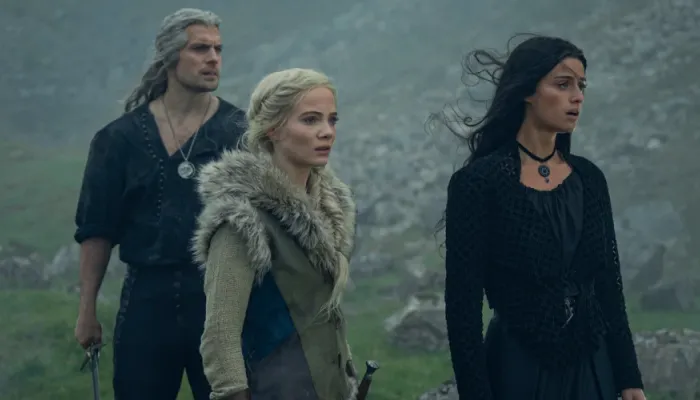
I spent the opening episode watching Hemsworth more closely than the story, noticing every difference in posture, expression, and delivery. That distraction gradually weakened as the season established its real structure. Geralt, Yennefer, and Ciri remain separated after the events at Aretuza, each following an increasingly dangerous path across a Continent damaged by war. The season is less about accepting a replacement immediately and more about watching three isolated characters build temporary families while trying to return to one another.
This The Witcher Season 4 review examines a season that is ambitious, uneven, and easier to appreciate when I stop treating the recasting as its only important issue. Hemsworth’s performance requires adjustment, but the larger problems come from crowded political storylines, inconsistent pacing, and an adaptation that often places its most interesting characters inside separate narrative worlds. The strongest scenes involve Geralt’s new companions, Ciri’s moral deterioration, Yennefer’s attempt to rebuild magical resistance, and several quieter conversations where the fantasy spectacle finally allows the characters to breathe.
The season rarely reaches the confidence of the show’s best earlier episodes. It remains watchable because the cast, production design, and central emotional objective provide enough momentum. Everyone is trying to find Ciri, control Ciri, impersonate Ciri, protect Ciri, or use her bloodline. The real Ciri, meanwhile, is becoming less certain that she wants to be found by anyone.
Liam Hemsworth’s Geralt: Different Rather Than Completely Wrong
Liam Hemsworth does not attempt a precise imitation of Henry Cavill. His Geralt is more openly reactive, physically looser, and occasionally more willing to reveal irritation or humor. The voice is still low and controlled, but the performance does not carry the same heavy stillness that defined the earlier version.
The first few scenes feel unfamiliar because Hemsworth’s face and movement alter the balance of every interaction. Geralt once appeared like the largest and most dangerous presence in almost any room. Hemsworth’s version remains physically capable, yet he feels more like a weary traveller moving through a group than an isolated force allowing others to follow him.
That difference becomes useful as Geralt assembles a new company. Season 4 pushes him away from the fantasy of the solitary witcher. He needs information, friendship, medicine, and people willing to challenge his decisions. Hemsworth’s more accessible energy supports this development because his Geralt appears capable of becoming part of a community even while pretending he would prefer to travel alone.
The performance is less convincing during moments demanding mythic authority. Certain threats and declarations lack the weight I expected, and the revised vocal approach occasionally sounds too deliberate. Geralt’s dry humor also varies in effectiveness, depending on whether the scene allows natural interaction or uses a familiar grunt as a reminder of the character’s previous portrayal.
Hemsworth improves across the season. Once the episodes stop presenting him as an event and begin treating him as Geralt, I found it easier to accept his interpretation. He does not erase the memory of Cavill, but he provides a workable central performance for the final stage of the story.
Geralt’s Company: The Season’s Strongest New Dynamic
Geralt’s journey becomes more entertaining when it transforms into a reluctant fellowship. Jaskier remains the familiar emotional bridge, challenging Geralt’s isolation while providing humor that is more effective when it emerges from friendship rather than exaggerated panic. Joey Batey understands how to make Jaskier irritating and necessary at the same time.
Milva brings practical skill and direct criticism to the group. She refuses to treat Geralt’s reputation as a reason to accept every decision without question. Her presence helps prevent the company from becoming a collection of followers orbiting one famous warrior.
Zoltan adds another connection with the wider world of The Witcher. Danny Woodburn gives him confidence and blunt warmth, making the character feel immediately suited to Geralt’s expanding group. His inclusion also brings some of the rough companionship associated with the novels and games, even when the season has limited time to develop every relationship fully.
The most valuable addition is Regis. Laurence Fishburne plays him with calm intelligence, quiet amusement, and the unsettling confidence of someone who has survived long enough to understand how temporary most human crises are. Regis is introduced as a barber-surgeon with a hidden nature, but the performance makes his mystery feel personal rather than merely decorative.
His conversations with Geralt are among the season’s best scenes because they slow the narrative down. Regis does not need to prove himself through constant demonstrations of power. He observes, questions, and occasionally reveals more compassion than the supposedly human characters surrounding him.
The group gives Geralt’s storyline a sense of forward movement. Even when the journey itself becomes repetitive, the changing relationships create interest. The season would have benefited from spending even more time around fires, roads, and temporary camps instead of returning so frequently to crowded royal strategy rooms.
Ciri and the Rats: Freedom That Gradually Becomes Another Cage
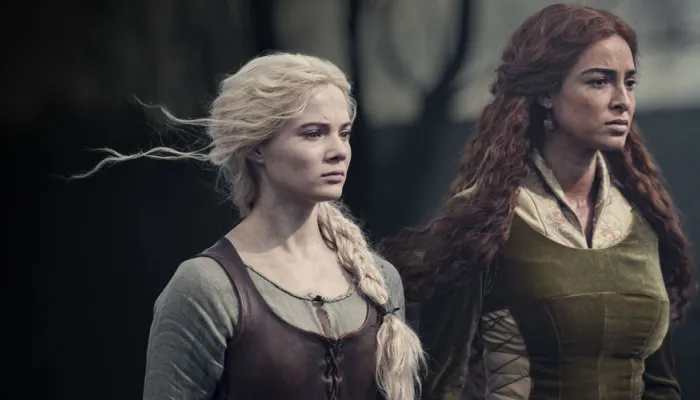
Freya Allan receives the season’s darkest material. Ciri has adopted the name Falka and joined the Rats, a young outlaw group offering the belonging, excitement, and freedom she cannot find among rulers or mages. For the first time, she lives among people who do not treat her primarily as a princess, prophecy, or political resource.
The attraction is understandable. The Rats accept aggression, theft, and danger as ordinary parts of survival. They allow Ciri to transform fear into action and provide a group identity at the exact moment she feels abandoned by everyone who once promised to protect her.
Allan plays this change with a mixture of exhilaration and emotional numbness. Ciri smiles more freely around the Rats, but that freedom often appears connected with refusing to think about consequences. Violence becomes easier when she treats Falka as a separate identity capable of doing what Ciri would once have resisted.
Her relationship with Mistle is affectionate, unstable, and shaped by trauma. Mistle offers intimacy without demanding that Ciri explain every part of her history. The connection also contributes to Ciri’s separation from her earlier values, particularly when loyalty to the group becomes more important than empathy toward outsiders.
The Rats themselves have distinct appearances and roles, though the season struggles to make all of them equally memorable. They are effective as a collective representation of young people shaped by war, but several members remain thinner than the story requires. Their confidence occasionally feels repetitive because too many scenes emphasize attitude before revealing vulnerability.
Ciri’s storyline becomes more compelling when Leo Bonhart enters it. The Rats believe they have created a world where their boldness protects them from ordinary power structures. Bonhart demonstrates how fragile that confidence really is.
Leo Bonhart: A Human Threat More Disturbing Than Most Creatures
Sharlto Copley gives Leo Bonhart an unpredictable combination of amusement, cruelty, and professional focus. He does not need magical abilities to dominate a scene. His danger comes from experience and the complete absence of hesitation.
Bonhart treats violence as performance and reputation as a weapon. He studies people, allows them to believe they understand the encounter, and then changes the rhythm suddenly. Copley’s lightness makes the character more disturbing because he rarely appears burdened by what he does.
His pursuit of the Rats gives Ciri’s storyline a necessary consequence. The group has spent much of the season behaving as though danger exists mainly to provide excitement. Bonhart arrives as someone who has survived far longer by understanding exactly how overconfidence can be used against them.
The season could have introduced him earlier or used him more consistently. His presence immediately sharpens the narrative, but the crowded structure limits how much time he receives before the finale. Even with that restriction, Bonhart emerges as one of Season 4’s most memorable figures.
Yennefer: Turning Grief Into Political Purpose
Anya Chalotra remains one of the show’s strongest performers. Yennefer begins the season carrying the consequences of Aretuza’s collapse, the loss of fellow mages, and uncertainty about Ciri’s survival. Her response is not withdrawal. She attempts to organize resistance against Vilgefortz while navigating a magical community fractured by fear and competing interests.
Yennefer’s storyline gives her authority beyond her relationship with Geralt. She becomes a strategist, organiser, and public figure attempting to persuade other mages that neutrality is no longer protection. Chalotra gives these scenes urgency without losing the character’s impatience or pride.
The problem is that the political material surrounding her becomes dense. Councils, alliances, portals, royal agendas, and magical disagreements accumulate rapidly. Some episodes ask me to remember which leader is cooperating with which faction while the emotional reason for Yennefer’s choices becomes buried under exposition.
Her strongest scenes occur when strategy collides with personal guilt. She wants to stop Vilgefortz, but she also wants to repair the family she formed with Geralt and Ciri. These goals are related but not identical. Every political decision may move her farther from the immediate search for Ciri.
The season also allows Yennefer to appear vulnerable without reducing her competence. Her grief influences her decisions, yet she remains capable of inspiring others. Chalotra has grown into the role so completely that Yennefer often feels like the true anchor of the series during Geralt’s transition.
Vilgefortz and the False Ciri
Vilgefortz continues to operate as the central magical antagonist, manipulating rulers and using the false Ciri to create political legitimacy. Mahesh Jadu gives him controlled confidence, although the character sometimes feels distant because much of his influence is expressed through plans discussed by other people.
The false Ciri plot is effective conceptually. It shows how little the political world cares about Ciri as an individual. A convincing symbol is enough for rulers who need her name, bloodline, or public image. The real young woman can disappear while a replacement performs the required role.
This storyline mirrors Ciri’s adoption of the Falka identity. One version of her is being manufactured by powerful adults, while the real Ciri is manufacturing another identity to escape them. Both transformations reduce the space available for her authentic self.
The political consequences could have been clearer. The season often moves quickly between Nilfgaard, northern rulers, mage alliances, and personal missions, making the false Ciri’s exact effect on the war feel more abstract than immediate.
Vilgefortz remains dangerous, but Season 4 saves much of the decisive conflict for the final season. This makes his storyline feel like preparation rather than a complete dramatic movement.
Emhyr, Skellen, and a Continent Ruled Through Deception
Emhyr continues to pursue control while treating family, identity, and war as parts of one imperial calculation. Bart Edwards gives him restraint suited to a ruler who rarely needs to raise his voice. His obsession with Ciri remains central, even when the season divides attention among many other players.
James Purefoy joins the political side as Skellen, bringing intelligence and quiet danger to the court. His presence helps make Nilfgaard feel less dependent on one emperor and one mage. Skellen understands that empires operate through information, compromise, and people willing to act without public recognition.
The court scenes are well performed but often slow the season’s momentum. After Geralt’s road journey or Ciri’s increasingly dangerous life with the Rats, another discussion about alliances can feel like a separate series temporarily interrupting the main one.
The political complexity is not inherently a weakness. The Witcher’s world should contain rulers exploiting war while ordinary people suffer. The problem is presentation. The season rarely gives every faction enough time for its plans to feel emotionally significant, so complexity sometimes becomes narrative noise.
Monster Encounters and Witcher Work
Season 4 includes supernatural encounters, but traditional witcher work is no longer the primary structure. Geralt’s mission to find Ciri keeps him moving toward human conflict, leaving fewer opportunities for self-contained contracts involving curses, local folklore, and morally complicated creatures.
The wraith confrontation demonstrates the revised Geralt’s physical style and use of Signs. Aard and Yrden provide clear visual action, and the creature design creates an effective early demonstration of the season’s improved confidence with supernatural combat.
These scenes reminded me why the first season’s smaller stories were appealing. A monster encounter can reveal local history, prejudice, and Geralt’s personal code within one focused chapter. Season 4’s larger war narrative often lacks that clarity.
Regis helps restore some of the series’ interest in the boundary between human and monster. His hidden identity complicates any simple belief that appearance determines morality. The season repeatedly suggests that the most frightening behavior comes from humans who consider themselves civilized.
I wanted more creature work connected with the journey. The Continent occasionally feels like a political map crossed by armies rather than a strange land filled with local legends and supernatural dangers.
Action and Fight Choreography
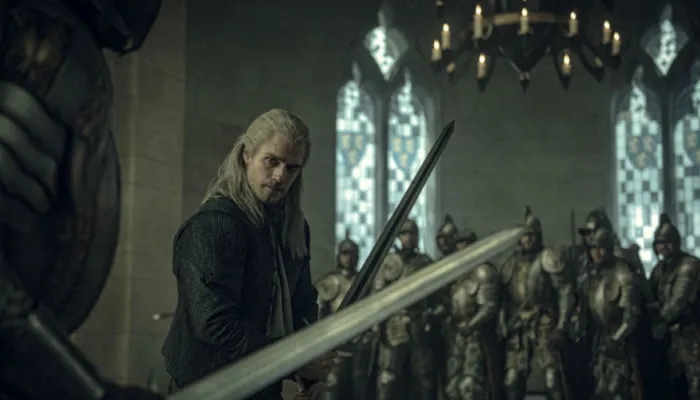
The action remains physical and generally readable. Hemsworth brings speed and strength to Geralt’s sword work, though his fighting rhythm differs from Cavill’s heavier, more precise style. The new version feels more aggressive and less like every movement has been calculated several seconds in advance.
Ciri’s combat reflects her changing identity. Her movements become more reckless and emotionally driven, matching the influence of the Rats. Freya Allan communicates that Falka is not simply a new name; it is a permission structure allowing Ciri to enjoy power she once feared.
Yennefer’s magical confrontations rely on force, portals, barriers, and coordinated mage action. These scenes can become visually crowded, but Chalotra’s physical focus helps maintain a clear emotional center.
The season’s larger encounters vary in impact. Smaller fights often feel more dangerous because I can understand the space and the immediate objective. Large battles sometimes become collections of effects, armour, shouting, and rapid cuts without enough geographic clarity.
Visual Design and the Changing Continent
The Witcher Season 4 continues using forests, ruined settlements, muddy roads, royal halls, mage chambers, and damaged towns to present a Continent being reshaped by war. The environments are strongest when they feel inhabited rather than constructed solely for a scene.
Geralt’s road storyline benefits from natural landscapes and practical camps. The changing weather and worn clothing communicate distance better than repeated dialogue about the difficulty of the journey.
Ciri’s scenes with the Rats use brighter movement and youthful energy before becoming harsher as their situation deteriorates. Their clothing and group presentation create a sense of chosen identity, almost like a travelling performance of fearlessness.
Yennefer’s magical settings are more formal and visually controlled. The contrast suits a character attempting to rebuild structure after catastrophe, although some interiors resemble familiar fantasy council rooms without enough distinctive personality.
Creature effects are inconsistent. Several designs are atmospheric and convincing, while others appear lighter or less physically integrated than the practical environments around them. The series remains visually ambitious, but budget and schedule pressures are occasionally visible.
Music and Sound
The score continues to support the Continent with percussion, strings, choral textures, and regional influences. It is most effective during journeys and quieter scenes, where the music can connect separate characters emotionally even when they remain far apart.
Jaskier’s musical role is more restrained than during the earliest seasons. This suits the darker stage of the story, though I occasionally missed the memorable simplicity of songs that could give one episode a clear identity.
Combat audio gives swords and magical effects sufficient weight. Regis benefits from quieter sound design, allowing Fishburne’s voice and pauses to dominate his scenes without unnecessary musical emphasis.
The season’s emotional themes are present, but few tracks remained in my memory as strongly as the central melodies from earlier chapters. The music serves the story competently without becoming one of Season 4’s defining features.
Pacing and Narrative Fragmentation
The season’s main structural problem is separation. Geralt, Yennefer, and Ciri follow independent storylines, each surrounded by its own supporting cast, political context, and emotional objective. The editing must constantly leave one compelling situation to return to another.
Some episodes manage this balance well by connecting the characters through shared themes of family, identity, and chosen loyalty. Others feel like several incomplete episodes placed together.
Geralt’s journey has the clearest direction: find Ciri. Ciri’s story has the strongest transformation: become Falka and face the consequences. Yennefer’s plot contains the greatest political importance but also the largest amount of exposition.
The season improves whenever it slows down. A campfire conversation, a private confession, or a tense meeting between two characters often carries more weight than a complicated explanation of military movement.
Eight episodes provide limited space for the number of factions involved. Several new characters make strong impressions without receiving enough development, while established supporting figures appear briefly to maintain continuity.
The result feels deliberately unfinished because Season 4 forms the first half of the series’ final movement. That may be structurally necessary, but it reduces the satisfaction of the season as an independent chapter.
Adaptation Choices and the Spirit of the Books
Season 4 draws from the stage of Andrzej Sapkowski’s saga where Geralt travels with an expanding company, Ciri lives among the Rats, and the Continent’s political conflict becomes increasingly severe. These elements bring the adaptation closer to some of the novels’ most important relationships.
Regis, Milva, Zoltan, Bonhart, and the Rats provide recognizable material for readers, but the show continues rearranging motivations, timelines, and character emphasis. Some changes improve television momentum, while others add complexity without producing stronger emotion.
The travelling company captures more of the books’ mixture of conversation, disagreement, and accidental family than the political storylines do. Geralt’s companions are not merely tools for reaching Ciri; they gradually become the people who define the journey.
Ciri’s Falka period remains difficult to adapt because the story must show her moral decline without losing audience sympathy. Freya Allan handles the challenge well, though the series occasionally softens or accelerates consequences in ways that reduce the discomfort of the material.
Who Should Watch The Witcher Season 4?
The Witcher Season 4 is best suited to viewers already invested in the Netflix adaptation. It assumes familiarity with Aretuza, Vilgefortz, Nilfgaard, Emhyr, Ciri’s bloodline, Yennefer’s relationships, and the emotional history of the central trio.
Fans willing to accept Liam Hemsworth’s different interpretation of Geralt will find a season with several worthwhile additions, particularly Regis, Bonhart, Milva, and the evolving travelling company. Freya Allan and Anya Chalotra continue providing strong reasons to remain invested.
Viewers primarily interested in weekly monster contracts may be disappointed by the emphasis on war and politics. Anyone frustrated by fragmented storytelling in earlier seasons will find many of the same problems here.
The season is not a useful starting point for newcomers. Its emotional objective depends on wanting Geralt, Yennefer, and Ciri to reunite after several seasons of separation, betrayal, and attempted reconciliation.
My Rating
I give The Witcher Season 4 a personal rating of 7.5/10. Liam Hemsworth is not the disaster many viewers feared, although his version of Geralt does not immediately carry the same weight as the previous performance. He becomes more convincing when the character is allowed to interact naturally with Regis, Jaskier, Milva, and Zoltan rather than repeatedly proving that he can swing a sword and speak in a low voice.
The season’s best material belongs to its damaged families. Geralt collects companions while searching for Ciri. Yennefer builds a magical resistance while trying to recover the people she loves. Ciri joins the Rats because their acceptance feels easier than returning to a destiny controlled by rulers and mages. Each storyline asks whether a chosen family can survive when its members begin creating new identities apart from one another.
The crowded political structure and incomplete ending prevent Season 4 from becoming a great chapter. Still, Regis, Bonhart, Ciri’s darker path, and the evolving fellowship give the series enough energy to reach its final season with meaningful possibilities. The White Wolf looks different, but the larger question remains unchanged: whether Geralt, Yennefer, and Ciri can find one another before the Continent turns each of them into someone the others no longer recognize.
Pros

- Visually stunning production values that enhance the mystical atmosphere.
- Intricate narrative and layered storytelling offering depth and nuance.
- Strong character development that resonates both emotionally and philosophically.
- An immersive audio experience with a rich, atmospheric soundtrack.
- Ambitious thematic exploration of fate, morality, and power.
- Balanced pacing that blends high-octane action with reflective moments.
Cons

- Occasional pacing challenges may leave some viewers disengaged.
- The complex narrative structure can be confusing for newcomers.
- The deliberate, slow build-up of tension may not suit all audience preferences.

Leave a comment
Your comment is awaiting moderation. We save your draft here
0 Comments