







A Quiet Walk That Became Total Frog Chaos
My first few minutes in Amazing Frog? did not feel like the beginning of a conventional action game. There was no urgent mission briefing, dramatic villain, or carefully directed tutorial. I was simply a strangely flexible frog standing in a cartoon version of Swindon, surrounded by streets, buildings, vehicles, and objects that looked as though they were waiting to be misused. Within minutes, my calm sightseeing trip had turned into a ridiculous sequence involving a trampoline, a moving car, several bins, and a spectacularly unsuccessful attempt to land on a rooftop. That unpredictable escalation defines this Amazing Frog review better than any checklist of features could.
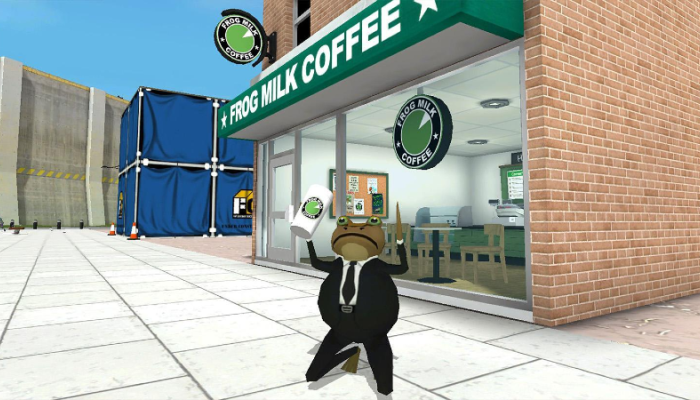
Amazing Frog? is an open-world physics sandbox developed by Fayju. It presents itself as a playful, frog-powered variation on the urban sandbox formula, complete with vehicles, weapons, costumes, challenges, creatures, hidden areas, and local split-screen play. Its official descriptions openly frame it as a chaotic “Grand Frog Auto” experience set in Swindonshire, although its tone is far more interested in slapstick comedy than criminal drama.
The immediate attraction is freedom. I can run through town, climb onto buildings, drive vehicles, experiment with objects, search for secrets, or simply throw my frog into situations that no sensible amphibian should survive. The game does not constantly point toward a single correct activity. Instead, it encourages me to touch everything, test the physics, and accept that a basic plan may collapse within seconds.
That freedom creates a strong first impression, but it also exposes the game’s unusual personality. Amazing Frog? is messy by design. Movement can be clumsy, vehicles can behave unpredictably, and the ragdoll physics frequently interrupt whatever I was attempting to do. Sometimes that produces a genuinely funny accident. At other times, it feels like I am fighting the controls rather than playing with them.
Even so, the game has a rare sense of curiosity. I kept wondering what was behind the next door, whether a vehicle could reach an impossible location, or what would happen if I combined two unrelated objects. Amazing Frog? is most enjoyable when I stop expecting polished objectives and start treating Swindonshire as a giant box of unstable toys.
Core Gameplay & Mechanics: Swindonshire as a Giant Physics Playground
The central gameplay loop is based on exploration, experimentation, collection, and physical comedy. I move through an open environment, interact with objects, discover activities, unlock content, and create my own short-term goals. The game includes skins, weapons, vehicles, challenges, additional areas, and a wider quest connected to the Magical Mystery Toilet. Official store descriptions also highlight both single-player and shared or split-screen modes, including local cooperative and competitive play.
Movement is intentionally loose. My frog can run, jump, grab objects, enter vehicles, use equipment, and collapse into a ragdoll state after a collision. The character has enough weight to make impacts feel physical, but not enough stability to make every action predictable. A jump onto a small object might work perfectly once and send me rolling across the pavement on the next attempt.
The ragdoll system is the heart of the game. It turns ordinary mistakes into comedy and allows the environment to produce unexpected chain reactions. Getting struck by a vehicle is not merely a failure state. It can launch the frog into another object, bounce the character over a wall, or accidentally reveal a route I had not considered. The system regularly transforms poor execution into entertainment.
There is also a fart-based movement mechanic, because subtlety is not one of Amazing Frog?’s priorities. Bursts of propulsion can influence movement and contribute to the game’s deliberately childish humour. This mechanic sounds like a joke—and it is—but it also fits the broader design. Almost every action is meant to feel slightly unstable, physical, and capable of causing an accident.
Driving expands the sandbox significantly. Cars and other vehicles allow me to move around Swindonshire quickly, perform reckless jumps, transport objects, or create destruction simply by losing control near a crowded area. Vehicles tend to feel more playful than precise. Steering may become awkward at speed, collisions can have exaggerated results, and a minor mistake can leave the vehicle stuck in an inconvenient position.
That lack of precision is one of the game’s first serious flaws. The physics are entertaining when I am experimenting without a fixed objective, but they become irritating when I am trying to perform a specific action. Picking up an item, placing an object carefully, entering the correct side of a vehicle, or reaching a narrow platform can require more patience than the task deserves.
Combat follows the same philosophy. Amazing Frog? includes weapons and enemies rather than limiting the experience to peaceful exploration. Swindonshire contains threats such as zombies, sharks, alligators, skeletons, and other hostile creatures, while later updates have adjusted weapon balance and enemy behaviour.
Fighting is usually chaotic rather than tactical. I can use ranged or close-range equipment, but the loose movement and physics often make encounters feel improvised. A clean plan can quickly become a frantic attempt to recover a dropped weapon while an enemy closes the distance. That unpredictability can be amusing, especially with another player, though it rarely provides the satisfaction of a tightly designed action system.
The game’s progression is largely driven by discovery. I search for objects, complete challenges, obtain costumes, find vehicles, reach hidden zones, and gradually understand how different parts of the world connect. The Magical Mystery Toilet provides a broader quest framework, while unusual items can be flushed or exchanged to unlock further surprises. Official updates have described mechanics involving vehicles, balloons, toilets, collectibles, and special unlocks.
This creates a flexible difficulty curve. Amazing Frog? is not difficult in the traditional sense because failure rarely destroys major progress. The challenge comes from understanding the environment, controlling the physics, reaching difficult locations, and solving unclear objectives. Some discoveries feel rewarding because I found them naturally. Others feel unnecessarily obscure.
The game often provides too little direction. I enjoy being trusted to explore, but there is a difference between freedom and confusion. Certain tasks, unlock conditions, or interactions are not communicated clearly enough. I sometimes understand that something important is nearby without knowing what action the game expects. Players who enjoy searching community guides may not mind. Others may feel that the game is withholding basic information.
Local multiplayer strengthens the core design because another player introduces even more unpredictability. Cooperative exploration can become competitive sabotage without warning. One player may try to complete a challenge while another steals the vehicle, launches an object into the area, or causes a physics accident. The sandbox works particularly well when no one takes the objective too seriously.
Amazing Frog? is therefore less successful as a structured adventure than as a comedy generator. Its mechanics are not exceptionally refined when judged separately. Together, however, they create situations that are difficult to reproduce in more controlled games.
Graphics, Audio, and Technical Performance: Colourful Frogs, Rough Edges
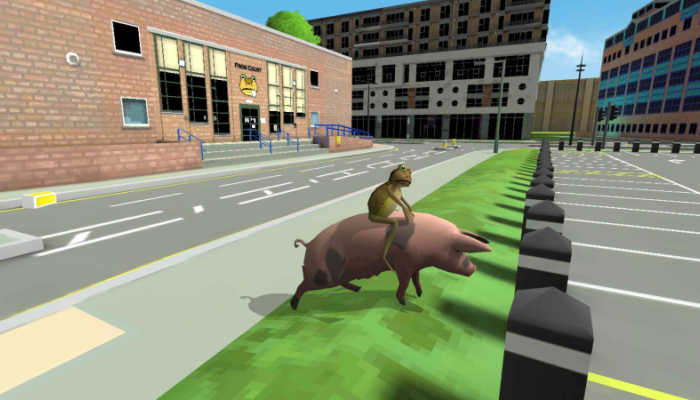
Amazing Frog? uses a bright 3D visual style with simplified characters, clean shapes, colourful environments, and intentionally exaggerated animation. Swindonshire resembles a cartoon interpretation of an ordinary British town rather than a realistic urban simulation. That contrast is part of the joke. Familiar streets and buildings become the setting for frogs, bizarre vehicles, dangerous animals, toilets, explosives, and physics disasters.
The frogs themselves are expressive despite their basic designs. Costumes and skins provide much of the visual variety, allowing me to turn the main character into increasingly absurd versions of the same floppy amphibian. The character animation works best when something goes wrong. A frog falling down stairs, folding over the roof of a car, or being launched across a street is far more visually memorable than a normal walking cycle.
Environmental detail varies. Some parts of the world contain plenty of interactive objects, secrets, and amusing props. Other areas feel comparatively empty. The game’s scale can occasionally work against it because travelling through less eventful spaces exposes how simple some textures, buildings, and environmental elements are.
The graphics are functional rather than technically impressive. Lighting, materials, character models, and effects do not compete with modern high-budget open-world games. That comparison would be unfair, but the visual roughness is still noticeable. Some objects appear unfinished, animations can look stiff before the physics take over, and collisions may cause models to clip through scenery.
The audio design supports the comedy without becoming the main attraction. Impacts, vehicle noises, weapons, environmental sounds, and bodily humour all reinforce the exaggerated physical action. A collision is rarely subtle. The sound effects communicate weight and help make even a simple fall feel more dramatic than it should.
However, the audio can become repetitive during longer sessions. The same movement noises, crashes, and comic effects appear frequently because players repeat similar actions. What sounds amusing during the first fifteen minutes may become tiring after an extended session, especially when I am struggling with one objective and triggering the same failure sounds repeatedly.
Performance is more complicated. The game’s systems regularly track moving objects, vehicles, characters, enemies, and physics interactions. That complexity can produce frame-rate drops or unstable behaviour when too much is happening at once. Player feedback on current versions, particularly mobile, has also mentioned occasional lag, even when the overall experience remains playable.
Load times are generally manageable, but transitions and larger areas do not always feel perfectly smooth. The experience can vary depending on platform and hardware. The Steam listing identifies the title as an actively developed Early Access game, while console versions have also appeared under a Game Preview label, so a certain amount of unfinished behaviour is still part of the package.
Bugs are difficult to separate from intentional chaos. A vehicle launching strangely after a collision may be a funny physics result, while an object becoming permanently trapped inside the scenery is clearly less charming. I encountered the game’s roughness most strongly when objects failed to behave consistently or when the frog became stuck in an awkward position.
This is the second major flaw: Amazing Frog? sometimes expects its humorous identity to excuse technical frustration. A bug can be funny once. It is less funny when it prevents progress, forces a restart, or makes a challenge harder for reasons unrelated to skill. The game’s rough edges are part of its character, but they are not always harmless.
Monetization & Ads: A Traditional Purchase Without Pay-to-Win Systems
Amazing Frog? is primarily sold as a premium game rather than a free-to-play service built around constant microtransactions. On platforms such as Steam and Xbox, players purchase access to the game and then explore its systems without buying stronger weapons, improved statistics, or consumable advantages after every failure. Its store listings focus on the included sandbox content, multiplayer options, unlockable objects, and continuing development.
That means Amazing Frog? is not pay-to-win. Progress depends on exploration, experimentation, completing activities, and finding the required objects or locations. I cannot purchase a more stable frog, a guaranteed solution to a challenge, or a premium physics advantage over another local player.
The absence of aggressive in-game monetization suits the design. A sandbox works best when every visible toy feels like a potential discovery rather than an advertisement for an additional purchase. I can focus on the town, vehicles, creatures, challenges, and hidden content without being interrupted by energy timers or currency bundles.
There are also no traditional mobile-style advertising breaks in the premium versions. I am not required to watch a video after crashing a vehicle or failing a challenge. That keeps the restart loop fast and preserves the game’s comic timing.
The larger concern is value rather than monetization pressure. Amazing Frog? has spent a long period in ongoing development, and the amount of polish may not meet every player’s expectations for its current price. Some people will see a large, frequently updated physics sandbox. Others may see an unfinished collection of systems that remains rough after many years.
Platform differences should also be considered. Content, performance, update timing, and available features may not be identical across PC, console, and mobile. The developers have discussed the difficulties of maintaining different versions and rebuilding systems as technology changes.
For players who enjoy open-ended experimentation, the purchase can provide many hours of entertainment. For someone expecting a polished narrative campaign, carefully balanced combat, or a predictable sequence of missions, the same price may feel harder to justify.
Who Should Play This? A Sandbox for Curious and Patient Players
Amazing Frog? is best suited to players who enjoy creating their own entertainment. The game provides tools, locations, objects, and strange systems, but it does not always provide a strong reason to use them. I need to bring curiosity to the experience. Asking “What happens if I try this?” is more useful than asking “What mission should I complete next?”
Younger players may be drawn to the silly humour, colourful frogs, vehicles, costumes, creatures, and exaggerated accidents. The game has obvious appeal for families who enjoy local multiplayer and do not mind toilet jokes, fart-based movement, or chaotic slapstick. Its Steam feature list includes local four-player support, cooperative play, competitive play, and Remote Play Together.
Fans of physics sandboxes are another natural audience. Players who enjoy Goat Simulator, Human: Fall Flat, Garry’s Mod, or other games where unstable systems produce comedy will quickly understand the appeal. Amazing Frog? is at its best when a simple experiment creates an outcome I could not have predicted.
Collectors and secret hunters may also enjoy Swindonshire. There are costumes, vehicles, unusual objects, enemies, hidden areas, challenges, and quest-related discoveries to locate. The game rewards players who inspect suspicious corners and test objects that appear unimportant.
Local multiplayer groups may get more value than solo players. The physics become funnier when another person is responsible for the disaster. Competition does not require a formal mode; it can emerge naturally from stealing vehicles, interfering with an activity, or seeing who can survive the most reckless stunt.
Players who require polished controls should skip it. The frog’s loose movement and ragdoll behaviour are central to the design, not temporary problems that disappear after practice. I can learn to manage the character more effectively, but I cannot transform Amazing Frog? into a precise platformer.
Anyone who needs constant direction may also struggle. The game offers objectives and progression, but its communication is not always clear. Long periods of exploration can pass without obvious progress, and some systems make more sense after consulting external information.
Players seeking a serious story, emotional character development, sophisticated combat, or competitive online progression will find little here. Amazing Frog? is a toy box. It can be surprising, funny, and oddly absorbing, but it does not pretend to be a tightly authored cinematic adventure.
Final Verdict: A Lovably Unstable Sandbox With Real Limitations
Amazing Frog? is difficult to judge by conventional standards because its greatest flaws are closely connected to its greatest strengths. The physics are imprecise, but they generate comedy. The world can feel unfocused, but that freedom supports experimentation. The game is technically rough, yet the roughness gives many situations an unpredictable energy.
I enjoyed the moments when the sandbox surprised me. Driving through Swindonshire, testing strange objects, discovering a hidden area, or watching a simple stunt collapse into complete chaos captures the game at its best. Few games are this comfortable with letting players waste time creatively.
The experience becomes weaker when I pursue a specific objective. Loose controls, inconsistent interactions, confusing requirements, and occasional performance problems can transform light-hearted experimentation into unnecessary work. The joke loses its power when the same technical issue interrupts progress repeatedly.
Amazing Frog? is therefore easy to recommend to a particular kind of player and difficult to recommend universally. Fans of physics sandboxes, local multiplayer chaos, silly humour, and open-ended exploration may find dozens of entertaining stories inside Swindonshire. Players looking for refinement, structure, or mechanical precision should approach cautiously.
The game has also grown over many years, adding new quests, vehicles, weapons, creatures, challenges, and systems. Its official materials make clear that development is still active and that the broader Magical Mystery Toilet quest remains central to its continuing evolution.
My final recommendation is positive but qualified. Amazing Frog? is not polished enough to be considered a top-tier open-world action game, and it is not structured enough to satisfy players who need clear goals. As a strange interactive comedy playground, however, it has genuine charm.
Personal rating: 7.5/10.
That rating reflects the game’s creative freedom, memorable physics, strong local multiplayer possibilities, and unusual personality. It loses points for inconsistent controls, technical roughness, unclear objectives, repetitive audio, and areas that still feel unfinished. Amazing Frog? can be hilarious, frustrating, confusing, and surprisingly engaging—sometimes within the same five minutes.
Pros

- Engaging storyline with quirky humor and rich world-building
- Seamless installation process across multiple platforms
- Responsive controls and intuitive gameplay mechanics
- Stunning visual art style with vibrant animations
- Customization options via mods and cheats enhance replayability
- Unblocked access enables play in restricted environments
Cons

- Difficulty levels may ramp up quickly for casual players
- Reliance on mods and cheats might detract from the intended challenge
- Occasional performance issues on lower-end or legacy devices


Leave a comment
Your comment is awaiting moderation. We save your draft here
0 Comments