







When Cheeseburgers Begin Falling From the Sky
The moment that defines Cloudy with a Chance of Meatballs for me is not the first food storm or the arrival of a spaghetti tornado. It is Flint Lockwood standing beneath a sky filled with cheeseburgers while the people of Swallow Falls finally cheer for one of his inventions. For a few seconds, every failed experiment, public embarrassment, and disappointed reaction seems to disappear. This Cloudy with a Chance of Meatballs review begins there because the movie understands that Flint’s real hunger is not for unlimited food. It is for approval.
Released in 2009 and directed by Phil Lord and Christopher Miller, Cloudy with a Chance of Meatballs loosely adapts Judi and Ron Barrett’s children’s book into a fast animated comedy about scientific ambition, family communication, and the danger of confusing popularity with success.
Flint is a young inventor living on the isolated island of Swallow Falls. The town once built its economy around sardines, but public demand collapsed, leaving its residents trapped with unwanted fish products and limited hope.
Determined to solve the food problem, Flint creates a machine that converts water into meals. After an accident launches the device into the atmosphere, food begins falling from the sky according to commands sent from his laboratory. The invention transforms Swallow Falls into a global attraction. Residents celebrate Flint, tourists arrive, and Mayor Shelbourne encourages increasingly excessive requests.
Success quickly becomes unstable. Food grows larger, weather patterns become more dangerous, and Flint must decide whether public admiration matters more than admitting his invention has become a threat. The film is energetic, visually inventive, and packed with jokes. Its exaggerated movement and unusual character designs give it an identity different from the smoother family animation surrounding it at the time.
Beneath the chaos is a sincere story about a son who cannot communicate easily with his father and an aspiring scientist who has spent years hiding her intelligence to appear socially acceptable.
The movie occasionally moves so quickly that emotional moments struggle to breathe. Its villain is deliberately broad, and some supporting characters remain one-joke personalities. Even so, Cloudy with a Chance of Meatballs remains one of Sony Pictures Animation’s strongest films because its silliness grows from recognizable insecurity rather than random spectacle alone.
Plot & Storytelling: One Scientific Breakthrough Feeds an Entire Town
Flint Lockwood begins inventing as a child. He creates spray-on shoes, a remote-controlled television that walks, a hair-unbalder, and several other devices that fail in spectacular ways.
His mother Fran supports his curiosity completely. She gives him a lab coat and tells him that his unusual mind is valuable. Flint’s father, Tim, cares about him but struggles to express that care in language Flint understands. Tim runs a fishing shop and values practical work, predictable tools, and visible results.
After Fran’s death, the communication gap between father and son becomes more painful. Flint continues inventing while Tim encourages him to abandon the laboratory and work at the shop. Swallow Falls is facing its own identity crisis. The island once promoted sardines as its defining product, only to discover that the wider world did not want them.
Mayor Shelbourne attempts to restore attention by opening Sardine Land, a tourist attraction built around the failed industry. During the opening ceremony, Flint tests his newest device: the Flint Lockwood Diatonic Super Mutating Dynamic Food Replicator, commonly shortened to FLDSMDFR.
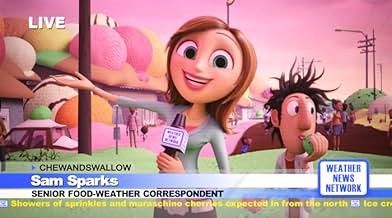
The machine requires enormous power. Flint secretly connects it to the town’s electrical system, creating a dangerous surge. The FLDSMDFR launches through Sardine Land, destroys much of the event, and disappears into the sky. Flint believes he has produced another humiliating failure. The disaster also places him in conflict with Sam Sparks, a young weather reporter sent to cover the attraction. Sam initially sees Swallow Falls as an unimportant assignment. Her live report collapses when Flint’s machine destroys the ceremony.
Soon afterward, cheeseburgers begin falling from the sky. The FLDSMDFR has reached the upper atmosphere and is using water from the clouds to create food. Flint develops a communication system that allows him to send meal requests to the machine. The invention changes the town immediately. Sardines disappear from the menu, residents request favorite foods, and Mayor Shelbourne recognizes a commercial opportunity.
Sam becomes excited by the scientific importance of food weather. Her relationship with Flint improves as she realizes he is not simply an irresponsible troublemaker. Together, they monitor the atmospheric patterns and celebrate the invention’s possibilities. Flint creates an ice-cream snowfall for the town, giving children an entire day of edible winter. He also designs a gelatin palace for Sam after learning about her childhood fascination with science. These scenes represent the invention at its best. Food becomes shared joy, creativity, and temporary relief from the town’s decline.
The danger develops gradually. The machine begins producing food larger than the original requests. Flint discovers a mutation pattern showing that continued use could create unstable weather. He attempts to warn the mayor. Mayor Shelbourne refuses to stop. The town is preparing for a major tourist event, and his own appetite for attention has grown alongside his body.
Flint also hesitates. For the first time, people respect him. Turning off the machine would mean becoming the person who ruined their happiness rather than the person who created it. The opening celebration begins, but increasingly massive food falls across the town. A giant spaghetti tornado becomes the clearest sign that the system has moved beyond control. The FLDSMDFR surrounds itself with a huge food storm capable of affecting the entire planet.
Flint, Sam, cameraman Manny, Steve the monkey, and Brent McHale travel toward the machine in a flying vehicle. Their mission is to enter the storm and upload a shutdown code. The journey passes through enormous food formations, including dangerous peanut brittle, cooked chickens, pizza slices, and other creations transformed into environmental hazards. Flint’s original shutdown device fails, forcing Tim to enter the laboratory and send the correct file manually.
The climax therefore depends on both scientific action and family communication. Tim must use technology he does not understand, while Flint must trust the father whose approval he has spent years seeking. The machine is stopped, the storm collapses, and Swallow Falls survives. Flint does not finish the story as a universally celebrated genius. He gains something more stable: honest connection with Sam and a clearer understanding with Tim.
Flint Lockwood: Genius Powered by Insecurity
Flint is an appealing protagonist because his intelligence does not make him emotionally confident. Bill Hader voices him with rapid enthusiasm, nervous pauses, sudden shouting, and complete commitment to scientific language. Flint often narrates his own actions because he has spent so much time alone in the laboratory. He explains ideas before anyone asks and reacts to setbacks as though giving a dramatic research presentation.
His inventions are imaginative, but they are not always responsible. Flint tends to become fascinated by whether something can work before asking how it should be tested. The FLDSMDFR follows this pattern. It could solve hunger and transform food production, yet Flint activates it secretly using infrastructure not designed to support it.
The film does not argue that scientific ambition is wrong. It argues that creativity without responsibility becomes dangerous. Flint’s need for approval complicates his judgment. Years of mockery have taught him to treat public praise as evidence that an invention is safe and valuable. When the town celebrates the food weather, he ignores warning signs partly because he cannot bear to lose their admiration.
This makes his mistake emotionally believable. Flint is not corrupted by money or domination. He is overwhelmed by finally receiving the acceptance he wanted as a child. His relationship with Sam helps him develop because she appreciates the science rather than only the spectacle.
Sam understands why the machine matters and is willing to tell Flint when the data becomes dangerous. His relationship with Tim is more difficult. Flint assumes his father’s practical language means rejection. Tim sees scientific failures damaging the town and believes stability will protect his son from further disappointment.
Neither understands how to communicate affection in the other person’s vocabulary. Flint’s final growth requires admitting that his invention has failed publicly. He must choose responsibility at the exact moment responsibility threatens the identity he has finally gained.
Sam Sparks: A Scientist Hiding Behind the Weather Report
Sam begins as a junior weather reporter trying to appear polished and professional. Anna Faris gives her quick intelligence, awkward excitement, and an increasingly visible relief at being understood.
Sam hides her scientific background because she learned that classmates responded negatively when she displayed knowledge openly. She changes her appearance, avoids technical language, and attempts to perform the version of herself she believes television audiences will accept. Flint recognizes her intelligence immediately. During their first meaningful scientific conversation, Sam forgets to maintain the performance. Her speech becomes faster, her vocabulary becomes more specialized, and her enthusiasm matches Flint’s.
The relationship works because attraction grows through shared curiosity. Flint does not ask Sam to become less intelligent, while Sam does not ask him to become socially conventional. Their differences also matter. Sam is more capable of reading people and recognizing consequences beyond the immediate experiment.
She helps Flint understand the dangerous weather data and refuses to support the mayor’s excessive requests. The film occasionally reduces her to romantic encouragement or physical danger during the final mission. Her peanut allergy becomes an important obstacle but also temporarily removes her from the scientific solution.
Still, Sam remains unusually active for a romantic partner in a family comedy. She investigates, interprets weather patterns, challenges Flint, and participates in stopping the machine. Her decision to wear her glasses and tie her hair back symbolizes self-acceptance clearly, perhaps too clearly, but the emotional idea remains effective. Sam does not become valuable after revealing her intelligence. She stops hiding the value that was present from the beginning.
Tim Lockwood: A Father Who Speaks in Fishing Metaphors
Tim is one of the film’s most emotionally effective characters because his love for Flint is obvious even when his communication fails. James Caan voices him with slow, practical seriousness. Tim sounds completely different from his son.
Flint speaks in technical bursts. Tim speaks through fishing comparisons and short statements. His large eyebrows cover his eyes almost entirely, making expression harder to read. This visual design reinforces Flint’s difficulty understanding him.
Tim does not dislike invention. He fears what repeated failure is doing to his son and the town. His suggestion that Flint work at the fishing shop is intended as protection. Flint hears it as proof that his father has no faith in him. The movie avoids making Tim secretly fluent in emotional language. Even during important moments, he struggles to say exactly what Flint needs to hear.
This restraint makes the final communication more satisfying. Tim must enter Flint’s laboratory and send a computer file while following instructions through a device translating his fishing metaphors. The sequence is funny, but it also forces father and son to cooperate through their differences rather than pretending those differences disappeared.
Tim finally expresses pride after Flint has accepted responsibility for the disaster. He does not praise the invention merely because it worked. He recognizes the person Flint became when the work stopped being safe.
The eyebrow reveal near the ending provides a simple visual expression of emotional openness. Tim’s eyes become visible when he finally communicates directly. It is sentimental, but earned.
Mayor Shelbourne: Public Success Without Any Limit
Mayor Shelbourne begins as a desperate local politician trying to save Swallow Falls from decline. Bruce Campbell voices him with theatrical confidence, false warmth, and growing appetite. At first, his desire to promote the town is understandable. Swallow Falls needs jobs, attention, and a reason for residents to believe the future can improve.
The food weather gives him exactly that opportunity. The mayor’s flaw is his inability to recognize enough. Every successful meal leads to a larger request.
He transforms the town into Chewandswallow, reshapes its identity around tourism, and treats Flint as a machine for producing publicity. His physical growth mirrors his ambition. The more he consumes, the larger he becomes. The metaphor is obvious but visually effective. Appetite becomes political and personal greed at the same time. Mayor Shelbourne also manipulates Flint emotionally. He recognizes the inventor’s need for approval and praises him whenever another request must be fulfilled.
When Flint presents scientific warnings, the mayor frames caution as selfishness. He suggests that stopping would disappoint everyone. This pressure works because it repeats Flint’s deepest fear. The mayor is deliberately broad and receives little complexity after the danger becomes clear. His concern for the town disappears beneath appetite and ego.
A more layered version might have shown him genuinely afraid that Swallow Falls would collapse economically without the invention. Instead, he becomes a direct representation of excess. He remains entertaining, and Bruce Campbell gives every speech enough energy to match the film’s visual exaggeration.
Brent McHale: A Former Mascot Without a New Identity
Brent was once the child star of the Baby Brent sardine advertisements. As an adult, he continues wearing the costume and expects recognition. Andy Samberg voices him with complete confidence and limited self-awareness. Brent’s entire identity depends on something he did as a baby. The town’s sardine economy has collapsed, but he continues treating old advertisements as permanent celebrity. This makes him a comic parallel to Flint. Both want public approval, though Brent received his without effort and never developed beyond it.
He initially mocks Flint and enjoys remaining the town’s familiar face. When the food weather makes Flint famous, Brent loses the only social position he understands. His participation in the final mission gives him an opportunity to become useful rather than merely recognizable.
The film transforms him briefly into Chicken Brent after he is swallowed by a giant cooked chicken. The sequence is absurd, visually memorable, and surprisingly important to his growth. Brent helps protect the group using the strange form rather than panicking about his image. His development remains simple, but it fits the movie’s theme. Identity should come from choices and growth rather than one label assigned in childhood.
Manny, Earl, Cal, and Steve: Supporting Characters With Precise Comic Jobs
Manny works as Sam’s cameraman but gradually reveals an endless list of previous professions and useful abilities. Benjamin Bratt voices him with calm competence. Manny rarely seeks attention, making him the opposite of several louder characters. Whenever the group needs a pilot, doctor, technical expert, or translator, Manny appears to possess the relevant experience.
The repeated reveal becomes increasingly funny because he treats every extraordinary qualification as ordinary. Earl Devereaux is the town’s police officer. Mr. T gives him enormous vocal energy and an intense dedication to rules, public safety, and his son Cal. Earl initially distrusts Flint because the inventor’s experiments create repeated problems. His criticism is often justified, even when his delivery is excessive.
Cal provides smaller family comedy and becomes part of the emotional stakes when the food weather threatens the town. Steve is Flint’s monkey assistant, fitted with a device that translates thoughts into a small number of spoken words. Neil Patrick Harris voices him using simple terms such as hunger, excitement, and recognition of familiar people.
Steve’s limited vocabulary produces effective repetition, especially because his immediate priorities rarely match Flint’s scientific urgency. The character is cute without becoming completely harmless. His unpredictability occasionally creates additional problems. These supporting figures make Swallow Falls feel populated without competing heavily with the main emotional story.
Humor & Comedy Style: Every Movement Contains a Joke
Cloudy with a Chance of Meatballs has an unusually elastic comic style. Characters do not move according to realistic human behavior. They stretch, collapse, accelerate, freeze, and react through extreme poses. Phil Lord and Christopher Miller use animation itself as part of the joke. A character may cross a room in one unnatural movement or hold an expression longer than expected.
Flint’s body is especially flexible. His thin limbs, oversized coat, and narrow posture make every panic visible. The dialogue is equally fast. Scientific explanations, awkward conversations, background announcements, and unexpected responses often overlap.
Visual jokes continue behind the main action, rewarding repeat viewing. Steve’s simple vocabulary contrasts with Flint’s technical speech. Tim’s fishing metaphors contrast with laboratory language. Mayor Shelbourne turns every conversation into promotion. The movie also understands silence. Several jokes become funnier because a character pauses after an absurd event instead of explaining it.
The snowball sequence is an excellent example of escalating physical comedy. Flint helps children discover snowball fights, then realizes they are far more aggressive than expected. Food provides endless visual possibilities. Ice cream becomes snow, gelatin becomes architecture, and spaghetti becomes a weather system. Some humor depends on loud reactions and repeated chaos. The final act occasionally piles jokes onto danger so quickly that neither receives full impact. A few jokes involving bodies, food, or social awkwardness may feel juvenile to adults. The film generally balances them with enough visual invention to avoid becoming crude.
Visual Design & Animation: Imperfect Shapes Give the Film Personality
The character designs reject polished realism. Heads, hands, limbs, and bodies use exaggerated proportions. Flint is narrow and angular. Tim is shaped like a large rectangle. The mayor expands into a sphere. Sam uses softer but still stylized forms. Eyes are uneven, mouths stretch dramatically, and movement often ignores physical restraint. This gives the film a handcrafted cartoon identity despite being computer animated. Swallow Falls begins with muted colors, sardine imagery, gray weather, and a tired local economy.
The arrival of food transforms the town. Colors become brighter, signs multiply, tourists arrive, and architecture incorporates edible themes. The visual change supports the story. Public excitement makes the town attractive before excess turns that beauty into danger. Food animation avoids strict realism. Cheeseburgers, pancakes, ice cream, steaks, and pasta are recognizable but designed to work as objects, landscapes, and weather. The gelatin palace is one of the most memorable environments. Its transparency, movement, and bright colors create a setting that feels playful and romantic.
The food storm becomes darker and more visually crowded. Enormous items rotate around the machine, forming a dangerous atmospheric structure. The final journey through the storm remains readable because individual food zones have distinct colors and shapes. The animation has aged well because it never attempted photorealism. Its personality comes from design and timing rather than surface detail.
Music, Direction & Pacing: A Fast Comedy With a Strong Emotional Map
Mark Mothersbaugh’s score supports scientific excitement, romantic discovery, food spectacle, and emotional reconciliation. The music uses playful orchestral movement, electronic details, and energetic rhythms matching Flint’s mind. During the invention sequences, the score turns experimentation into momentum. During quieter scenes with Tim, it becomes less complicated and more sincere. Phil Lord and Christopher Miller direct their first animated feature with remarkable confidence. The film moves quickly but keeps the main emotional conflicts clear: Flint wants approval, Sam hides her intelligence, Tim cannot communicate, and the mayor refuses limits.
The first act establishes Swallow Falls, the failed sardine economy, the family history, Sam’s arrival, and the machine efficiently. The middle allows enough time for the invention to feel wonderful before revealing the danger. This is important. The FLDSMDFR must provide real happiness, or Flint’s reluctance to stop it would feel foolish. The ice-cream day and gelatin date make the success emotionally persuasive.
The final act becomes busier and more conventional. The heroes enter the storm, face several food-based obstacles, upload the code, and escape. The action is inventive, though it temporarily pushes the father-son relationship into the background. Tim’s role in sending the file reconnects the emotional story with the technical solution. The directors maintain a tone in which sincere emotion can exist beside absurd imagery. Flint and Tim’s reconciliation works even after a fight involving cooked chickens.
Themes & Emotional Meaning: Approval Is Not the Same as Connection
The film’s central theme concerns the difference between public approval and personal connection. Flint has been mocked for years. When the food weather succeeds, he interprets applause as proof that he finally matters. The problem is that applause depends on continued performance. The town loves Flint while the meals keep arriving.
Mayor Shelbourne understands this and uses it to control him. Tim’s love is less expressive but more stable. He cares about Flint before success and remains concerned when everyone else is celebrating. Flint initially values public excitement more because it is easier to recognize. The story also examines scientific responsibility. An invention can begin with a generous goal and become dangerous through scale, misuse, or ignored evidence. Flint’s machine could address food scarcity, but the town uses it for increasingly excessive entertainment. The problem is not only the technology. It is the system of requests surrounding it.
Sam’s arc explores intellectual identity. She hides knowledge because social acceptance once required appearing less capable. Flint gives her a relationship in which enthusiasm does not need to be reduced. Their connection becomes healthy because both can express the traits other environments treated as embarrassing.
The film also criticizes fixed identities. Swallow Falls defines itself through sardines long after the industry fails. Brent defines himself through childhood fame. Flint defines himself through invention. Growth requires allowing those identities to change.
Critical Reception & Lasting Reputation: A Surprise Animation Favorite
Cloudy with a Chance of Meatballs received strong reviews for its humor, energetic animation, voice cast, visual invention, and ability to expand a short children’s book into a complete feature. Critics frequently praised Bill Hader and Anna Faris, whose performances gave Flint and Sam both comic rhythm and emotional warmth.
The direction by Phil Lord and Christopher Miller attracted particular attention. Their willingness to use exaggerated movement and dense visual comedy helped distinguish the film from other computer-animated releases. The movie performed well commercially and contributed significantly to Sony Pictures Animation’s developing identity.
Its reputation improved further over time. Viewers frequently revisit it for the rapid jokes, unusual character animation, and surprisingly effective father-son storyline. The sequel expanded the food-creature concept but divided audiences more strongly. The original remains the more focused and emotionally complete film.
Cloudy with a Chance of Meatballs is also notable for anticipating the style Lord and Miller would later bring to other projects: fast dialogue, visual experimentation, sincere character relationships, and comedy built around genre structure. Some critics found the final act overly chaotic and the mayor too broad. Those concerns remain fair. The movie’s emotional clarity allows it to survive the excess.
Final Verdict: A Scientific Disaster With a Very Good Heart
Cloudy with a Chance of Meatballs is one of the most inventive animated comedies of its era because it treats absurdity as a complete artistic language.
Flint Lockwood does not create food weather simply because the premise sounds funny. He creates it because invention is the only way he knows how to ask the world for approval. Bill Hader makes Flint’s excitement infectious while preserving the insecurity beneath it. Anna Faris gives Sam enough intelligence and emotional presence to become a genuine partner rather than an impressed observer. James Caan makes Tim’s difficulty with words touching rather than frustrating. The father loves Flint consistently, even when his attempts to protect him sound like rejection.
The food storms provide visual spectacle, but the best scenes are smaller: Sam revealing her scientific enthusiasm, Flint showing her the gelatin palace, and Tim attempting to send one computer file through a laboratory he barely understands. The film’s animation remains distinctive. Its strange bodies, elastic movement, uneven faces, and rapid poses give every character immediate personality.
The final act becomes overly crowded, and Mayor Shelbourne never develops beyond an obvious symbol of excess. Those flaws do not weaken the central emotional progression. Flint learns that being celebrated does not make every decision correct, and being criticized does not make every idea worthless. I recommend Cloudy with a Chance of Meatballs to families, animation fans, young inventors, viewers who enjoy rapid visual comedy, and anyone looking for a story about creativity with consequences.
Personal rating: 9/10.
Cloudy with a Chance of Meatballs earns that score for Bill Hader and Anna Faris’ performances, Phil Lord and Christopher Miller’s inventive direction, excellent visual comedy, memorable food-weather sequences, and a sincere father-son relationship. It loses one point for a simplistic villain, a crowded climax, underused social ideas, and emotional resolutions that arrive slightly too quickly.
Flint begins by trying to invent something impressive enough to make everyone love him. He grows when he understands that real connection is not the applause that follows success. It is the person who remains in the laboratory after the machine stops working.



Leave a comment
Your comment is awaiting moderation. We save your draft here
0 Comments