





A Perfect Home With Buttons for Eyes
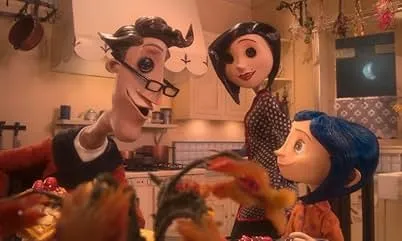
The moment that defines Coraline for me is not the first appearance of the Other Mother or the discovery of the small door hidden behind wallpaper. It is the dinner table in the Other World. The food looks richer, the colors feel warmer, the music is livelier, and every adult pays attention to Coraline as though her smallest thought deserves celebration. Then I look at the black buttons where their eyes should be, and the entire fantasy becomes uncomfortable. This Coraline review begins there because the film understands that the most dangerous trap is not obviously frightening. It is the place designed to resemble everything a lonely person believes they are missing.
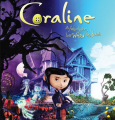
Released in 2009 and directed by Henry Selick, Coraline adapts Neil Gaiman’s novel through stop-motion animation. Dakota Fanning voices Coraline Jones, a curious and stubborn girl who moves with her parents into the Pink Palace Apartments.
Her parents are busy writing a gardening catalogue, the weather is miserable, and the strange neighbors provide entertainment without offering the attention she wants. Coraline explores the property and discovers a small sealed doorway inside the family’s apartment.
At night, the passage opens into another version of her home. The Other Mother cooks elaborate meals, the Other Father performs music, and the Other World appears built entirely around Coraline’s desires. The only immediate warning is visible in every face: the people there have buttons instead of eyes.
Coraline is frequently described as a children’s horror film, but that label does not fully explain its effect. It contains frightening creatures, trapped spirits, transformations, and a villain who wants to replace a child’s eyes.
Its deeper unease comes from emotional manipulation. The Other Mother studies Coraline’s dissatisfaction and turns it into architecture, food, entertainment, and affection.
The movie is visually beautiful, psychologically sharp, and far more restrained than many family fantasies. It allows silence, shadows, empty rooms, and uncomfortable pauses to become as important as direct danger. Its main weakness is that some supporting characters function more as memorable designs than fully developed people. The middle section also follows a familiar pattern of returning between two worlds before the stakes rise completely.
Still, Coraline remains one of the finest stop-motion films ever made because every handcrafted detail supports the same warning: attention without freedom is not love.
Plot & Storytelling: One Small Door Leads Into a Carefully Prepared Trap
Coraline Jones arrives at the Pink Palace Apartments with her parents, Mel and Charlie. The family has moved away from Coraline’s familiar life, and the new environment offers little immediate comfort. Rain limits exploration, the house feels old and divided, and her parents spend most of their time working on computers. Mel and Charlie are not cruel. They are exhausted, distracted, and under financial pressure. Their work concerns gardening, yet neither has the time or enthusiasm to engage with the actual landscape around the house.
Coraline experiences their stress only as absence. She wants conversation, entertainment, better food, and proof that her presence matters more than a deadline. She explores the property and meets Wyborne Lovat, usually called Wybie, the talkative grandson of the Pink Palace’s owner. Wybie gives Coraline a doll that resembles her. He claims to have found it at his grandmother’s house. Coraline also meets the other residents. Miss Spink and Miss Forcible are retired actresses living below her with several Scottish terriers. Mr. Bobinsky, an eccentric former circus performer, lives upstairs and trains a group of mice.
Each adult warns Coraline indirectly about danger. The warnings appear strange enough that she does not understand how seriously to take them. Inside her apartment, Coraline discovers a small door. Mel unlocks it, revealing a brick wall. Later that night, Coraline follows a mouse through the passage and finds the bricks gone. The tunnel leads to a duplicate of her home. The layout is familiar, but the colors are warmer and every object seems more inviting.
The Other Mother resembles Mel but behaves with immediate enthusiasm. She cooks a large meal, listens closely, and appears delighted by Coraline’s arrival. The Other Father resembles Charlie but performs music and treats Coraline’s curiosity as the center of the evening. Both have black buttons sewn over their eyes. Coraline is unsettled but fascinated. She returns to her ordinary home in the morning and initially assumes the experience may have been a dream.
Further visits reveal a larger Other World. The Other Bobinsky stages a mouse circus. The Other Spink and Forcible perform an elaborate theatre show. The garden reshapes itself into Coraline’s face. Wybie also exists there, but the Other Mother has removed his ability to speak because Coraline once complained that the real Wybie talked too much. That detail reveals the logic of the world. Every feature is based on Coraline’s wishes, but the wishes are interpreted by someone interested in control rather than kindness.
The Other Mother eventually offers Coraline permanent residence. The condition is simple and horrifying: Coraline must allow buttons to be sewn over her eyes. Coraline refuses and returns home. Her parents soon disappear. A message left on a mirror indicates that the Other Mother has taken them. Coraline returns through the passage, now understanding that the Other World is not an escape but a prison.
The Other Mother becomes less patient as Coraline resists. Her body grows taller and thinner, her hands become sharper, and her domestic warmth disappears. Coraline is locked behind a mirror, where she encounters the ghosts of three children previously captured by the creature. The ghost children explain that the Other Mother, whom they call the Beldam, used dolls to observe their lives. She learned what they wanted, lured them into the Other World, and gradually consumed their identities.
Coraline proposes a game. If she can find the ghost children’s stolen eyes and locate her parents, the Beldam must release everyone. The Beldam agrees because she remains confident that every part of the world belongs to her. Coraline travels through distorted versions of the theatre, garden, and circus. Each location initially recreates the pleasures offered during her earlier visits. As she finds the hidden objects, the environments collapse. Their beauty was never independent. It existed only as a temporary surface maintained by the Beldam. The Cat, who can move between worlds and speak only inside the Other World, assists Coraline while remaining suspicious of every promise.
Coraline eventually discovers that her parents are trapped inside a snow globe. She deceives the Beldam, opens the small door, and escapes with her parents and the Cat. Before closing the passage, she throws the Cat at the Beldam, allowing him to tear out her button eyes. Coraline locks the door and believes the danger has ended.
Her parents return without remembering their imprisonment. The ghost children appear in a dream and thank Coraline, but they warn that the Beldam may still seek the key. The Beldam’s severed hand enters the real world and attacks Coraline near the old well. Wybie arrives, and together they destroy the hand and drop the key into the well.
The film ends with a garden party. Coraline’s parents are more present, the neighbors gather together, and Coraline prepares to tell Wybie’s grandmother what happened to her missing sister. The resolution is hopeful without pretending the adults have become perfect. Coraline’s real world remains imperfect, but imperfection now feels alive rather than empty.
Coraline Jones: Curiosity Without Automatic Obedience
Coraline is a strong protagonist because the film allows her to be brave, intelligent, selfish, lonely, and occasionally rude. Dakota Fanning voices her with determination and emotional speed. Coraline often speaks as though she has already decided the answer and expects everyone else to catch up. Her curiosity drives the plot, but curiosity alone is not presented as flawless. She ignores warnings, returns to the Other World repeatedly, and enjoys the attention even after noticing obvious signs of danger.
This makes her behavior believable. The Other World offers exactly what her real life lacks. Coraline’s parents are busy. The Other Parents prepare performances around her. The real neighbors are strange and distracted. Their doubles transform every eccentricity into entertainment. Coraline does not enter the trap because she is foolish. She enters because the Beldam has studied her carefully. Her dissatisfaction also contains entitlement. Coraline expects the people around her to relieve boredom and interprets distraction as a statement about her value.
The story does not punish her for wanting attention. It teaches her to distinguish attention from care. The Beldam watches constantly, but her attention leaves no room for disagreement. Mel and Charlie fail to respond consistently, yet their imperfect love allows Coraline to remain herself. Coraline’s courage becomes most impressive after she understands the danger. She returns deliberately to rescue her parents and the ghost children. She does not possess magical powers, martial skill, or adult authority. She uses observation, memory, deception, and the ability to continue acting while frightened.
Her game with the Beldam demonstrates growth. Coraline cannot defeat the creature directly, so she creates rules that exploit its pride. She also learns to accept help. The Cat, Wybie, and the ghost children all contribute to her escape. At the beginning, Coraline treats other people primarily according to whether they entertain or irritate her. By the end, she recognizes that relationships require attention in both directions.
The Other Mother: Affection Designed as Ownership
The Other Mother is one of the most effective villains in modern animation because she begins as an idealized parent rather than an obvious monster. Teri Hatcher voices both Mel and the Other Mother, making the connection more disturbing. The Other Mother uses Mel’s appearance but removes everything Coraline finds frustrating. She is available, enthusiastic, skilled at cooking, and interested in every story.
Her affection feels excessive because it is never interrupted by her own needs. That is the first clue that she is not a person offering a relationship. She is a performance created for one audience. The buttons are equally important. Eyes allow people to look outward, interpret independently, and recognize realities beyond themselves. Replacing them with buttons turns faces into objects. The Other Mother does not want Coraline to see differently from her.
Her invitation to sew buttons over Coraline’s eyes is therefore an invitation to surrender perspective. The Beldam’s physical transformation reflects the collapse of her disguise. She becomes taller, thinner, sharper, and more spider-like. Domestic details transform with her. Furniture becomes hostile, wallpaper darkens, and the house begins resembling a web.
The creature’s method is psychological rather than immediate. She observes children through dolls, identifies dissatisfaction, and creates personalized temptations. Once a child agrees to remain, pleasure becomes captivity. This is what makes her frightening beyond appearance. She does not simply attack weakness. She manufactures an environment where submission can be mistaken for choice.
Her anger also reveals narcissism. The Other Mother cannot understand why anyone would reject a world she considers perfect. She believes the effort spent constructing Coraline’s fantasy gives her the right to possess Coraline. The film never explains the Beldam’s complete origin. That mystery strengthens her. She feels older than the house and connected with a pattern of hunger repeated across generations.
Mel and Charlie Jones: Imperfect Parents in a Real Household
Mel and Charlie are easy to misunderstand because the story begins from Coraline’s frustrated perspective. Teri Hatcher gives Mel tired practicality and limited patience. John Hodgman voices Charlie with softer humor but equal distraction.
Both parents are working intensely on a gardening catalogue. Their jobs create financial and emotional pressure, though Coraline sees mainly the closed office door. They give her simple food, reject requests, and repeatedly ask for quiet. Compared with the Other Parents, they appear dull and uncaring. The comparison is deliberately unfair. The Other Parents have no work, needs, or inner lives outside entertaining Coraline. Mel and Charlie are complete people trying to balance responsibility with parenthood, and they often fail. Mel can be dismissive. Charlie uses humor to avoid conflict. Neither recognizes quickly enough how isolated Coraline feels after the move. The film does not excuse these failures. It places them beside genuine love.
Mel buys Coraline the gloves she wanted after initially refusing. Charlie listens when he has enough mental space. Both attempt to create a garden once the work is completed. Their love is visible through ordinary inconsistency rather than continuous performance. Coraline’s final appreciation does not mean she decides everything they did was correct. She understands that real relationships include frustration, limits, and moments when another person’s attention must be elsewhere.
The parents’ capture also gives Coraline a chance to protect them, reversing the expected family structure temporarily. Their lack of memory after returning creates a slight emotional limitation. Coraline cannot discuss the event with them directly or receive recognition for the rescue. That choice preserves the magical secrecy but prevents a deeper family conversation.
Wybie Lovat: The Annoying Neighbor Who Becomes a Real Friend
Wybie does not appear in Neil Gaiman’s original novel, but he serves an important function in the film. Robert Bailey Jr. voices him with nervous humor, curiosity, and the tendency to keep speaking after Coraline has stopped listening.
His full name, Wyborne, becomes an immediate target for Coraline’s jokes. He responds with irritation but continues attempting friendship. Wybie provides Coraline with a connection to the Pink Palace’s history. His grandmother owns the building and refuses to rent to families with children because her twin sister disappeared there.
This history links the present story with the ghost children. The Other Wybie is silent because Coraline complained about the real one’s talking. At first, she appreciates the change. She eventually realizes that removing his voice has also removed his freedom.
The Other Wybie becomes frightened of the Beldam and helps Coraline escape, despite knowing he will be punished. His stitched smile and inability to speak make him one of the film’s saddest figures. The real Wybie later helps Coraline defeat the severed hand. His arrival prevents the final confrontation from becoming another victory achieved entirely alone.
Their friendship improves because Coraline begins respecting him as a person rather than treating him as an interruption. Wybie remains underdeveloped compared with Coraline. His feelings about his grandmother’s family history and the Other World receive limited attention. Still, his presence gives Coraline someone her own age with whom she can build a more equal relationship.
The Cat: Independence Without False Comfort
The Cat is one of the few characters who moves between the real and Other Worlds without being copied. Keith David voices him with dry intelligence, confidence, and mild contempt for human assumptions. In the real world, the Cat behaves like an ordinary animal. Inside the Other World, he speaks and explains that names are unnecessary for cats because they understand who they are without labels.
This makes him an interesting contrast with the Beldam’s creations. She defines everything according to function and ownership. The Cat belongs to no one. He helps Coraline but refuses the role of obedient companion. His support depends on his own judgment. The Cat immediately distrusts the Other Mother and understands that the world is constructed rather than natural.
He can disappear and reappear within it, suggesting that the Beldam does not control every rule completely. His relationship with Coraline contains teasing, irritation, and growing respect. He does not reassure her falsely. When danger becomes serious, he provides information and practical help without pretending the situation is safe. Throwing the Cat at the Beldam during the escape is effective but ethically questionable from his perspective. His reaction afterward makes it clear that he did not approve of being used as a weapon.
The humor preserves his independence. The Cat functions almost like Coraline’s instinct for suspicion. He notices the trap before she is ready to accept it.
Miss Spink and Miss Forcible: Performance, Memory, and Warning
Miss Spink and Miss Forcible are retired actresses who live surrounded by old theatre memories and Scottish terriers. Jennifer Saunders and Dawn French give them theatrical confidence, competitive affection, and comic eccentricity. They perform even during ordinary conversation. Every memory becomes a story, and every disagreement contains the rhythm of a rehearsed scene. Their real apartment is crowded, faded, and filled with evidence of the past.
The Other World transforms them into glamorous performers surrounded by a complete audience and elaborate stage machinery. Coraline initially enjoys the spectacle. The performance gives the women the public admiration their real lives no longer provide. The sequence also reveals how the Beldam builds temptation from private longing. She does not create only what Coraline wants.
She creates idealized versions of what everyone appears to have lost. Spink and Forcible provide Coraline with the seeing stone, a small object used to locate missing things. Their warning is vague but sincere. Like several adults in the film, they understand pieces of the danger without possessing a complete explanation. The characters are visually memorable, though their relationship with the missing children and the Pink Palace history remains limited.
Mr. Bobinsky: Absurdity With an Unexpected Warning
Mr. Bobinsky lives in the attic and claims to train mice for a circus. Ian McShane voices him with booming confidence, unusual rhythm, and a thick accent. His blue skin, long limbs, tiny torso, medals, and acrobatic movement make him one of the film’s strangest designs. Coraline initially assumes his stories are exaggerated or invented. The mice eventually deliver a direct warning: she should not go through the little door. This information comes from the one neighbor whose behavior appears least reliable, reinforcing the film’s interest in mistaken judgment.
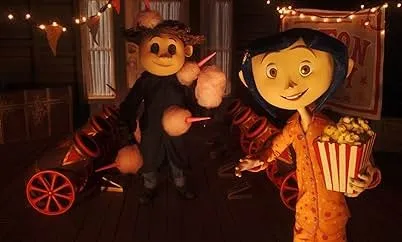
The Other Bobinsky performs with a spectacular mouse circus. The scene is colorful, musical, and slightly disturbing because the animals move with too much coordination. Later, Coraline discovers that the performers are rats controlled by the Beldam. Bobinsky’s history is suggested through visual details rather than explained. His medals, physical condition, and unusual skin imply a past connected with dangerous exposure. The mystery suits him, though the character remains primarily comic atmosphere.
The Ghost Children: Previous Victims Behind the Fantasy
The three ghost children transform Coraline’s private danger into a repeated history. They belong to different periods, suggesting that the Beldam has been hunting children for many years. One of them is connected with Wybie’s grandmother and her missing twin sister. Their forms are pale and incomplete because the Beldam has taken their eyes and gradually consumed their lives.
They explain the pattern clearly. Each child felt ignored or unhappy. The Other Mother offered personalized affection and convinced them to stay. Buttons were presented as the final step toward permanent belonging. The children now struggle to remember their names and identities. This is the Beldam’s ultimate form of control. She does not only imprison bodies. She erases the independent self capable of wanting escape.
Coraline’s decision to recover their eyes gives the game moral purpose beyond rescuing her parents. The ghost children also warn her that the Beldam will not honor the rules voluntarily. Their experience teaches Coraline that manipulation cannot be defeated through trust alone. Their final release is beautiful but brief. I wanted slightly more detail about who they were before being captured. The lack of detail is also thematically appropriate. Much of their individuality has already been taken.
Stop-Motion Animation & Visual Design: A Handmade World That Becomes a Web
Coraline’s stop-motion animation is extraordinary because texture becomes part of the psychological storytelling. Fabric, hair, wood, wallpaper, food, soil, metal, dust, and skin all appear physically present.
The real world uses muted colors, cloudy light, worn surfaces, and relatively empty spaces. Coraline’s new home feels cold without becoming completely lifeless. Small colors remain visible in her clothes, the garden, and neighboring apartments. The Other World initially increases saturation and warmth. Food shines, wallpaper moves, flowers respond, and every room appears more carefully finished. The beauty is strategic. The world must feel desirable before its artificiality becomes threatening.
As Coraline resists, the environments lose complexity. Spaces become smaller, backgrounds disappear, and the house transforms into a dark structure suspended inside emptiness. This visual collapse reveals that the Other World was never a complete reality. It was a stage built around Coraline. Character animation uses slight stiffness rather than hiding the stop-motion process. Coraline’s facial expressions remain precise, while her hair and clothing respond physically to movement.
The Beldam’s transformation is especially effective. Her body becomes angular, her fingers lengthen into needles, and her movement shifts from maternal smoothness to insect-like speed. The handmade quality makes the horror more immediate. The creature occupies physical space rather than appearing as a weightless digital effect. The tunnel between worlds also changes. At first, it resembles a soft blue passage inviting exploration.
Later, it becomes organic, narrow, and threatening, as though Coraline is moving through the body of the trap itself. One of the film’s greatest technical achievements is its facial animation. Thousands of interchangeable face pieces allow subtle expressions while preserving a crafted appearance. The result is detailed without becoming visually sterile.
Atmosphere & Horror: Fear Built From Familiar Rooms
Coraline creates fear through transformation rather than constant attack. A kitchen, bedroom, garden, or theatre becomes frightening because the film first establishes it as comforting. Buttons are ordinary household objects. Sewing is associated with repair and care. The Beldam turns both into symbols of permanent control. The movie also uses empty space effectively. Hallways remain quiet, rooms wait without movement, and characters sometimes speak while the background appears unnaturally still. The real world can feel lonely, but the Other World becomes claustrophobic despite appearing larger initially.
Sound contributes heavily. Scratching behind walls, distant mice, mechanical theatre movement, and the soft handling of sewing tools create tension before danger is visible. The film rarely depends on sudden loud surprises. Its fear develops through anticipation. The Other Father’s deterioration is particularly disturbing. He begins as a cheerful performer and later becomes a damaged servant forced to attack Coraline.
His sadness reveals that the Beldam’s creations possess enough awareness to understand their lack of freedom. The Other Wybie produces similar discomfort. Silence, stitched features, and frightened movement turn a comic complaint into evidence of abuse. The movie is appropriate for many older children, but it never treats fear as something that must be softened completely. Its respect for young audiences is one of its greatest strengths.
Music & Sound: A Children’s Choir From a World That Does Not Exist
Bruno Coulais provides a score that feels playful, mournful, and strange. The music uses children’s voices, strings, percussion, piano, and unusual vocal sounds. The choir often appears to be singing in a recognizable language, but much of the vocal material is invented.
This choice fits the Other World perfectly. The sound resembles something familiar while resisting complete understanding. Themes associated with the real world are quieter and more restrained. The Other World receives greater musical color during Coraline’s first visits. As the fantasy collapses, the score becomes sharper and less welcoming. The Other Father’s song is catchy, theatrical, and slightly uncomfortable because it praises Coraline with suspicious intensity. Music in the theatre and mouse circus sequences creates spectacle while preserving unease.
Sound design supports the materiality of stop motion. Keys turn, fabric shifts, insects move, buttons strike surfaces, and tiny mechanical parts produce clear physical noise. The Beldam’s movements become increasingly sharp and metallic. Silence is equally important during Coraline’s game. Empty rooms and disappearing environments need little music to feel threatening.
Direction & Pacing: Henry Selick Trusts the Audience to Remain Uncomfortable
Henry Selick directs Coraline with patience unusual for family animation. The opening spends substantial time establishing boredom, weather, parental distraction, neighbors, and the physical structure of the house. This makes the discovery of the small door meaningful. Coraline has already searched the visible world and found it unsatisfying. The first visits to the Other World unfold slowly enough for pleasure to become convincing. The danger is visible immediately through the buttons, but Coraline’s willingness to return remains understandable because nothing directly attacks her at first. The middle section follows a repeating pattern of crossing between worlds. This can make the plot feel temporarily predictable.
Each return adds information, however. The idealized parents become controlling, the silent Wybie reveals punishment, and the doll becomes evidence of surveillance. Once Coraline’s parents disappear, the pacing tightens. The game gives the final act a clear structure: locate three eyes, find the parents, escape. Selick allows individual environments to become distinct challenges without losing the central objective. The final hand attack functions as a useful reminder that leaving an abusive system does not always end its attempt at control immediately.
My main pacing concern is the limited aftermath. Coraline saves her family, frees the children, destroys the hand, and then moves quickly toward the garden party. A longer emotional return to ordinary life could have strengthened the contrast. Still, the restrained direction gives the film confidence. It does not need constant explanation or comedy to keep the world active.
Themes & Emotional Meaning: Love Allows Another Person to Remain Separate
Coraline is primarily about the difference between love and possession. The Other Mother provides attention, food, entertainment, and apparent devotion. Every act is designed to make Coraline dependent. The condition is surrender.
Real love is less perfect because it comes from people with limits, responsibilities, moods, and separate inner lives. Mel and Charlie cannot focus on Coraline constantly. Their love does not require her to become an extension of them. The Beldam offers continuous attention but cannot tolerate refusal. Her affection exists only while Coraline moves toward obedience. The film therefore rejects the idea that intensity proves love.
Identity is another major theme. Buttons erase sight, but they also erase individuality. The ghost children lose names and memories after accepting the Beldam’s version of belonging. Coraline survives because she continues trusting her own perception even when the Other World attempts to redefine reality. The story also examines boredom. Coraline initially treats boredom as evidence that her environment has failed her.
The Other World removes boredom completely by organizing every detail around stimulation. That abundance becomes oppressive. Nothing exists independently of Coraline’s reaction, and therefore nothing can surprise her honestly. The real world becomes more valuable when she begins participating in it rather than waiting for it to entertain her. She helps create the garden party, reconnects with Wybie, and pays greater attention to the neighbors.
Courage in Coraline is not the absence of fear. Coraline repeatedly admits internally or visibly that she is frightened. Her courage comes from continuing to observe and plan while fear remains present. The film also contains a clear warning about manipulation. The Beldam studies private dissatisfaction, isolates the target, offers idealized care, introduces a permanent condition, and punishes resistance. This pattern gives the fantasy unusual psychological realism.
Critical Reception & Lasting Reputation: A Modern Stop-Motion Classic
Coraline received strong critical praise for its animation, atmosphere, voice performances, design, music, and willingness to frighten younger audiences intelligently. Critics frequently highlighted Henry Selick’s direction and the film’s ability to preserve the emotional darkness of Neil Gaiman’s story while expanding it visually. The stop-motion work received particular admiration. The handmade sets, replacement faces, costumes, lighting, and miniature environments created a level of detail that remained impressive long after release.
The film earned an Academy Award nomination for Best Animated Feature and became one of Laika’s defining productions. Audience response grew steadily over time. Coraline developed a large following among animation fans, horror viewers, artists, and people who first encountered it as children. The Other Mother became one of modern family cinema’s most recognizable villains, while the button-eye design entered popular visual culture far beyond the film.
Some viewers found the movie too frightening for younger children. Others considered that fear essential to its honesty. The film’s reputation has remained strong because its style does not depend heavily on temporary references or technical realism. Its themes also become more interesting with age. Children may respond to the adventure and danger, while adults often recognize the manipulation, parental exhaustion, and emotional seduction more clearly.
Final Verdict: A Perfect Fantasy Is More Dangerous Than an Imperfect Home
Coraline is one of the finest dark fantasy films made for younger audiences because it never confuses visual beauty with emotional safety. The Other World looks better than Coraline’s real home. The food is richer, the performances are grander, and the adults appear completely available. Every improvement is part of the trap. Dakota Fanning makes Coraline intelligent and difficult enough to feel real. She wants attention, resents limits, ignores warnings, and still finds the courage to return after understanding the danger. Teri Hatcher gives the Other Mother a remarkable progression from domestic warmth to predatory control. The transformation works because the villain’s emotional objective never changes.
She wants Coraline permanently, whether the method resembles affection or violence. The stop-motion animation remains extraordinary. The fabrics, faces, food, tunnels, gardens, and mechanical performances create a world that feels touched, arranged, and watched. Bruno Coulais’ music gives the film a sound as unusual as its visual design. Familiar voices become unreadable, just like the Other World itself.
The movie’s supporting characters could receive more depth, and the final return to normal life is slightly compressed. Those limitations do little to weaken its emotional clarity. Coraline learns that a disappointing reality can still contain genuine love, while a perfect fantasy may demand the disappearance of everything that makes her independent.
I recommend Coraline to stop-motion fans, older children, adults who enjoy psychological fantasy, viewers interested in carefully controlled horror, and anyone drawn to stories about curiosity, manipulation, family, and self-trust.
Personal rating: 9.5/10.
Coraline earns that score for its exceptional stop-motion craft, Dakota Fanning’s strong central performance, the Other Mother’s unforgettable design, Bruno Coulais’ score, intelligent atmosphere, and a mature understanding of possessive affection. It loses half a point for lightly developed supporting characters, a somewhat repetitive middle, and an aftermath that deserves more time.
Coraline enters the small door because she believes a better family may be waiting on the other side. She survives when she understands that real love does not build a world where she can never leave.


Leave a comment
Your comment is awaiting moderation. We save your draft here
0 Comments