





A Criminal Fantasy Drenched in Neon
Grand Theft Auto: Vice City announces its personality before I complete the first serious mission. Palm trees bend against a pink evening sky, sports cars move past glowing hotels, and the radio plays music that makes even an ordinary drive feel like the opening scene of an expensive crime film. The city is bright, fashionable, and full of people pretending that wealth can hide danger. Underneath the color is a hostile world built on betrayal, ambition, and organizations waiting for one mistake.
This Grand Theft Auto: Vice City review begins with atmosphere because that remains the game’s greatest achievement. Grand Theft Auto III established the structure of a three-dimensional urban sandbox, but Vice City gave that structure a distinct identity. Its fictional version of 1980s Miami is not merely a map where missions happen. The decade influences the clothing, architecture, vehicles, radio, dialogue, businesses, criminal organizations, and Tommy Vercetti’s entire rise through the city.
Tommy arrives in Vice City after spending fifteen years in prison. His former boss, Sonny Forelli, sends him south to oversee a drug deal and expand the family’s influence. The transaction ends in an ambush, leaving Tommy without the money or merchandise he was expected to return.
Instead of accepting blame, he begins investigating the attack. That search gradually becomes a campaign to build his own criminal organization, acquire businesses, remove rivals, and control the city that was supposed to be a temporary assignment.
Vice City improves significantly on Grand Theft Auto III through a voiced protagonist, stronger characters, motorcycles, expanded interiors, more memorable mission presentation, business ownership, and a soundtrack central to the experience. Tommy has opinions, anger, humor, and visible ambition, giving the story a personality that Claude’s silence could not provide.
The game has also aged sharply in several areas. Shooting remains awkward, swimming is impossible in the original design, mission checkpoints are limited, and some objectives depend on unreliable vehicles or strict time limits. The world is smaller and less interactive than memory may suggest. Despite those weaknesses, Grand Theft Auto: Vice City remains one of Rockstar’s most memorable games. It is not the most mechanically advanced Grand Theft Auto, but few entries combine protagonist, soundtrack, setting, and progression with such immediate confidence.
One Failed Deal Creates a New Criminal Empire
Tommy Vercetti arrives in Vice City under orders from Sonny Forelli, the head of a powerful Liberty City organization. Sonny considers Tommy useful but dangerous. Sending him away creates distance while allowing the Forelli family to enter a growing southern market.
The initial deal takes place near the docks. Tommy attends with lawyer Ken Rosenberg, whose nervous energy immediately establishes the unstable nature of their partnership. Armed attackers interrupt the exchange, taking both the money and the merchandise. Tommy and Ken escape, but the failure creates a serious problem. Sonny expects the missing assets to be recovered, and his phone calls make it clear that patience will not last.
Tommy begins moving through Vice City’s criminal and political circles. Ken introduces him to Colonel Juan Garcia Cortez, a wealthy and influential figure with connections across the city. Cortez claims to be investigating the ambush and gradually provides Tommy with work. Through these jobs, Tommy meets arms dealer Phil Cassidy, British music manager Kent Paul, biker leader Mitch Baker, Cuban gang figure Umberto Robina, Haitian leader Auntie Poulet, and several other personalities competing for money or influence.
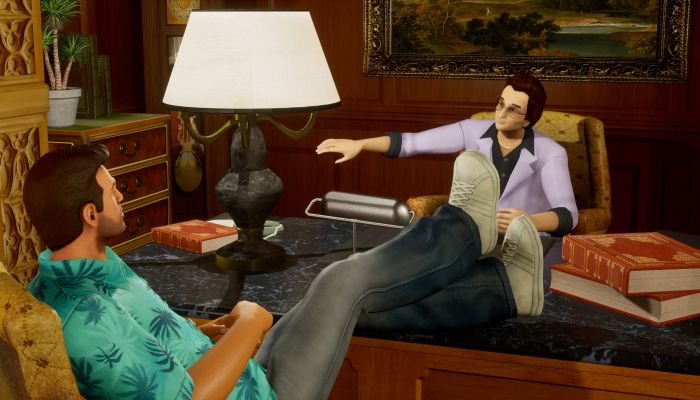
The investigation eventually points toward Ricardo Diaz, a powerful drug lord living in an enormous mansion on Starfish Island. Diaz is paranoid, aggressive, wealthy, and surrounded by armed protection. Tommy initially works for him while gathering information. Lance Vance, whose brother died during the failed deal, becomes Tommy’s ally and shares the desire for revenge. Their partnership leads to an assault on Diaz’s mansion. After taking control of the property, Tommy begins replacing Diaz rather than simply avenging the ambush.
This is the story’s most important transition. Tommy stops behaving like an employee solving Sonny’s problem and begins building something independent. He purchases businesses, completes missions to make them profitable, recruits allies, and turns the mansion into the center of a growing organization. A nightclub, film studio, taxi company, printing operation, vehicle dealership, boatyard, and other properties expand his influence.
The business structure connects narrative ambition with gameplay progression. Tommy does not become powerful only because later cutscenes say he is. The player sees his ownership spread across the map. Sonny eventually recognizes that Tommy no longer intends to remain subordinate. His arrival in Vice City brings the conflict back to the person who expected to profit from Tommy’s labor.
Lance also reveals his own dissatisfaction. He believes Tommy has taken control without giving him enough recognition, turning partnership into another hierarchy. The final confrontation therefore combines external and personal betrayal. Tommy defends the empire he created against his former boss and the ally who helped him seize it. The ending is satisfying because it completes a clear transformation. Tommy arrived as someone else’s representative. He remains as the central criminal power of Vice City.
A Protagonist With Anger, Ambition, and Presence
Ray Liotta gives Tommy Vercetti one of the defining performances of the early Grand Theft Auto era. Tommy sounds confident without being calm, sarcastic without becoming detached, and increasingly impatient with anyone who assumes he can be controlled. Unlike Claude, Tommy reacts verbally to the people around him. He questions instructions, insults incompetence, argues with employers, and makes his ambitions visible.
This creates a stronger relationship between player action and story. When Tommy takes over a mansion or purchases another business, the progression fits a character who clearly wants authority. His criminal identity is not presented as reluctant. Tommy does not dream of escaping the underworld or rebuilding an ordinary life. He wants status, wealth, security, and control. The years in prison have also shaped him. He refuses to be treated as disposable again, particularly by Sonny, who benefited from Tommy’s silence and absence.
Tommy’s anger often becomes his greatest strength. He responds quickly to betrayal, handles pressure directly, and rarely allows fear to control a conversation. It is also a limitation. His instinct is confrontation, and the story offers little evidence that he understands trust beyond usefulness. His relationship with Lance demonstrates this problem. Tommy values him as an ally but does not recognize how strongly Lance wants equal status and emotional acknowledgment.
That does not excuse Lance’s betrayal. It shows that Tommy’s rise reproduces some of the same power dynamics he resented under Sonny. Tommy’s personality makes the game memorable, although character development remains relatively direct. He becomes more powerful, not necessarily more reflective. The performance supplies enough energy that even simple mission briefings feel personal. Tommy may accept the objective, but he rarely sounds as though the person assigning it has gained authority over him.
Ken Rosenberg: Panic as a Professional Skill
Ken Rosenberg is one of the game’s most entertaining characters because he appears permanently close to a complete breakdown. He is a lawyer, fixer, contact, and nervous guide to Vice City’s criminal world. William Fichtner voices him with rapid anxiety and enough charm to make his constant panic amusing rather than unbearable.
Ken understands the city’s relationships but lacks the confidence to control them. He knows who is connected with whom, where introductions can be made, and how legal language may protect an operation temporarily. Tommy initially treats him as a useful but irritating contact. Over time, Ken becomes one of the few people who remains near him through the rise in power. Their relationship works through contrast. Tommy enters danger directly, while Ken describes every possible consequence before anything happens.
Ken is not physically capable, but he represents another kind of survival. He has learned to remain useful to dangerous people without pretending he is one of them. The game uses him mainly for humor and exposition. His personal history receives less depth than his personality suggests. Even so, his frantic presence gives the story warmth. Vice City is filled with people performing confidence, while Ken is honest enough to appear terrified.
Lance Vance: Partnership Damaged by Pride
Lance Vance enters the story with a clear reason to work beside Tommy. His brother died during the failed deal, and he wants the people responsible to suffer consequences. Philip Michael Thomas gives Lance smooth confidence, frustration, and a growing sense that he is being overlooked. Lance helps Tommy identify Diaz and participates in the operation against him. Their partnership feels important because both men are personally connected to the ambush.
The relationship begins changing after Tommy takes control of Diaz’s empire. Lance expects the victory to create equal power. Tommy behaves increasingly like the leader. Lance’s resentment is understandable at first. He contributed to the risk and wants recognition. His insecurity becomes dangerous because he responds to feeling excluded by seeking validation from another powerful figure.
The betrayal is dramatically effective but develops too quickly. The game shows Lance’s frustration, yet it could have used more missions demonstrating Tommy dismissing him or limiting his role. As written, Lance moves from ally to traitor with enough motivation to understand the direction but not enough detail to make the change completely tragic. His final position beside Sonny reveals that he has repeated the same mistake Tommy escaped. He chooses proximity to established power over building trust through uncertainty.
Sonny Forelli: A Boss Who Expects Ownership to Last Forever
Sonny Forelli represents the criminal hierarchy Tommy is attempting to escape. He sees Tommy’s years in prison as proof of loyalty and assumes that loyalty remains permanent. Tom Sizemore voices him with controlled aggression and growing disbelief. Sonny initially speaks as though Tommy’s problem is a temporary business inconvenience. As the money remains missing and Tommy gains influence, the calls become more hostile. Sonny’s greatest mistake is misunderstanding what prison did to Tommy. He assumes the experience made him manageable. Instead, it removed any desire to spend the rest of his life serving another man’s ambitions.
The conflict between them is not only financial. Sonny believes Tommy’s success belongs to the organization that sent him south. Tommy sees the empire as something he built after Sonny abandoned him with an impossible demand. The final confrontation brings this disagreement into the mansion. Sonny arrives expecting payment and obedience, only to discover that Tommy has become the authority in the room. Sonny is not the game’s most visually memorable villain, but he gives the story a strong structural opponent. Diaz controls the middle of the rise; Sonny represents the old power Tommy must finally reject.
Ricardo Diaz: Wealth Without Emotional Control
Ricardo Diaz is one of Vice City’s most exaggerated personalities. Luis Guzmán voices him with rage, paranoia, insecurity, and sudden enthusiasm. Diaz owns an enormous mansion, controls a major drug operation, and surrounds himself with employees who clearly fear his unpredictable reactions. He wants to appear powerful because he is terrified that everyone is attempting to deceive him. This makes his scenes funny and threatening simultaneously. A minor technical problem or perceived insult can trigger an explosion of anger. Diaz’s mansion becomes an important symbol. It represents the level of success Tommy has not yet reached, then becomes the headquarters proving that he has.
Working for Diaz allows Tommy to study both his organization and weaknesses. The eventual assault feels like more than another mission because it changes the player’s relationship with the city. Diaz is memorable, though he remains broad. The game does not explore his history or how he built the operation. His main function is to provide the criminal throne Tommy can seize before confronting Sonny.
Colonel Cortez: Politeness Surrounding Dangerous Influence
Colonel Juan Garcia Cortez presents himself with formal charm and international sophistication. He lives on a yacht, hosts parties, and speaks to Tommy as though every criminal request is part of a diplomatic conversation. Robert Davi gives him calm authority and a sense that he understands much more than he reveals.
Cortez helps connect Tommy with the wider structure of Vice City. Through him, the player encounters politicians, military equipment, foreign interests, and the city’s wealthy social class. He also investigates the failed deal, although his information arrives gradually and never without another favor.
Cortez differs from Diaz because he does not need visible rage to establish danger. His influence appears through contacts, resources, and the confidence that somebody else will handle physical risk. His relationship with Tommy contains a degree of mutual respect. Cortez recognizes competence and does not treat Tommy only as disposable labor.
The departure mission involving the yacht gives their association a stronger ending than many secondary storylines receive. Cortez remains morally questionable, but Vice City is not a world where moral purity determines trust. Reliability matters more.
Avery Carrington: Business Development Through Destruction
Avery Carrington represents property ambition and political corruption. Burt Reynolds voices him with southern confidence and the belief that financial opportunity justifies almost any method.
His missions involve manipulating real estate, damaging rival interests, and creating conditions where property becomes more valuable. Avery’s presence supports the game’s larger theme that organized crime and legitimate business often use similar tactics under different language. He rarely describes actions as personal. They are investments, opportunities, or market decisions.
The famous construction-site mission involving a small remote-controlled helicopter remains closely associated with him. The mission is conceptually funny but mechanically frustrating because the controls and time pressure are less forgiving than the surrounding game. Avery is memorable because he reflects the city’s culture of ambition. Tommy’s later business ownership is more direct, but both men understand that controlling property creates lasting influence.
The Businesses: Progress Measured Through Ownership
Purchasable properties are one of Vice City’s most important additions to the Grand Theft Auto formula. They give money a purpose beyond weapons, repairs, and mission expenses.
After acquiring a business, Tommy usually completes a short chain of missions to make it profitable. Once operational, the property generates income that can be collected. The Malibu Club provides some of the game’s most memorable jobs, including recruiting a team and planning a bank operation. Kaufman Cabs creates a conflict with a competing taxi company. The film studio offers absurd productions involving publicity and aerial stunts. The printing business becomes especially important because it supports the final progression toward confronting Sonny. Other properties, such as the boatyard and car dealership, connect ownership with races, collection, or vehicle-based activities.
This system makes Vice City feel increasingly personal. A location that once appeared as background becomes part of Tommy’s organization. The businesses vary in quality. Some contain substantial mission chains, while others require limited activity before generating income. Collecting revenue manually can also become tedious. The money waits at each property, encouraging repeated travel rather than automatic management. Despite these limitations, ownership creates one of the game’s strongest progression fantasies. Tommy’s rise is visible on the map.
Vice City: A Smaller Map With a Larger Personality
Vice City is divided primarily between two large islands, with smaller islands, beaches, bridges, and districts connecting them. The eastern side includes hotels, clubs, beaches, apartments, and bright tourist areas. The western side contains downtown streets, industrial zones, docks, airports, and poorer neighborhoods. The map is not enormous, but its districts have clear identities. Ocean Beach feels different from Little Havana, Downtown, Vice Point, or the airport.
The first island emphasizes the glamorous image sold to tourists. Neon hotels line the coast, sports cars move through broad roads, and clubs remain active after dark. The second island reveals more industry, criminal infrastructure, and local communities. The contrast gives the city social texture despite limited pedestrian behavior. Starfish Island sits between the larger areas and contains wealthy homes, including Diaz’s mansion. Its location makes it an effective symbol of power and isolation.
The map becomes easy to learn through repeated driving. Major roads, bridges, coastline, and skyline provide natural navigation. Water creates both atmosphere and frustration. The city’s islands and canals look beautiful, but Tommy cannot swim in the original design. Falling into the water causes immediate failure. This limitation is especially irritating because motorcycles, boats, narrow docks, and coastal roads create frequent opportunities for accidental entry. The city contains fewer interiors and side systems than later games, yet its personality remains stronger than many larger open worlds. Size is not the source of identity. Consistency is.
Mission Design: Stylish Ideas With Harsh Restarts
Vice City expands mission variety beyond the structure of Grand Theft Auto III. Jobs include vehicle chases, races, aerial tasks, targeted attacks, protection, theft, remote-controlled vehicles, business operations, and large confrontations.
The best missions use character and setting together. A nightclub operation feels different from work for the Cubans, a film-studio stunt, or a yacht defense. Music and visual identity also make ordinary driving objectives more memorable. A route across the city at sunset can feel cinematic even when the mechanical task is simple. Mission checkpoints remain one of the game’s largest weaknesses. A failure near the end may require repeating travel, vehicle acquisition, dialogue, and early stages.
Some missions are difficult mainly because their controls differ from ordinary play. Remote-controlled helicopters, airplanes, and specialized vehicles create abrupt learning demands. “Demolition Man” became infamous because the player must operate a small helicopter inside a construction site while carrying explosives under a time limit. The mission is manageable after learning the controls, but the punishment for experimentation is excessive.
“The Driver” also causes frustration because the required vehicle performs worse than the opponent’s car, turning the race into a test of route knowledge and traffic luck. Escort and protection jobs may depend on non-player characters behaving sensibly. When they do not, restarting feels unfair. The mission structure is influential and often entertaining, but modern players should expect repetition. Vice City respects perseverance more consistently than convenience.
Driving & Vehicles: Motorcycles Change the Rhythm
Driving remains the most enjoyable basic action. Cars handle with exaggerated arcade physics, allowing sharp turns, slides, collisions, and quick escapes. Vice City adds motorcycles, which transform travel. They are fast, narrow, and capable of moving through traffic more easily than cars. They are also dangerous. One collision can throw Tommy into the road, leaving him vulnerable or sending him directly into water.
The variety of vehicles supports the city’s setting. Sports cars, convertibles, scooters, limousines, taxis, delivery vehicles, boats, helicopters, and aircraft contribute to the 1980s fantasy. Vehicle handling differs enough to matter. Heavy cars absorb impacts, sports models provide speed, and motorcycles reward precise routes. The game also allows limited flight, opening the city vertically. Helicopters make travel faster and reveal how compact the map actually is.
Aircraft controls are less comfortable than ordinary driving, particularly on older input layouts. Some missions demand precision the system does not support naturally. Damage remains easy to read through smoke and fire. Learning when to abandon a vehicle is essential because an explosion can end a mission quickly. Traffic can produce wonderful unscripted moments or ruin timed objectives. Drivers stop unexpectedly, turn across routes, and create collision chains. The unpredictability keeps the city alive, though it occasionally replaces skill with luck.
Combat & Weapons: Improved Variety, Familiar Problems
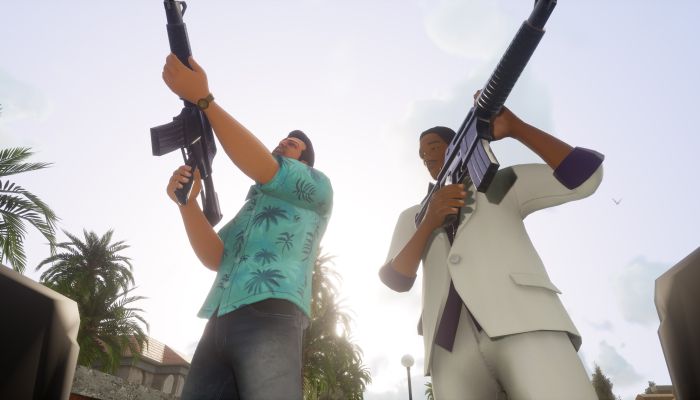
Vice City expands the weapon selection with pistols, shotguns, submachine guns, assault rifles, sniper rifles, explosives, heavy weapons, and several melee tools. The broader arsenal suits Tommy’s progression. Early jobs involve basic equipment, while later conflicts allow access to powerful weapons capable of handling groups and vehicles.
Target locking remains awkward. The system may select the wrong enemy, struggle during close encounters, or force Tommy to rotate unnaturally. Manual aiming is limited for many weapons in the original control design. Firefights often depend on entering range, locking onto targets, and attacking before the camera becomes a problem.
There is no dedicated modern cover system. I must use walls, vehicles, corners, and distance manually. Armor is extremely important because enemy damage can accumulate quickly. Preparing for difficult missions often means visiting weapon and armor pickups before beginning.
Melee weapons fit the setting and provide visual variety, though close combat lacks depth. Encounters usually depend on repeated attacks rather than timing-rich combinations. The chainsaw is one of the most recognizable additions, reflecting the game’s crime-film inspirations and exaggerated tone. Combat works adequately when supporting a larger mission. It becomes less satisfying during long direct confrontations where the aiming limitations remain constantly visible.
Police, Gangs & Street Chaos: Consequence With More Color
The wanted-level system returns, escalating from local police response toward heavily armed units and military intervention. Low-level pursuits create entertaining chases through traffic. Higher levels make ordinary travel extremely difficult as roadblocks, stronger weapons, and aggressive vehicles appear. Pay ’n’ Spray garages remain useful for removing attention, while collectible stars can reduce the wanted level directly. Police behavior remains inconsistent. Officers may ignore dangerous driving until a specific crime activates the system, then pursue Tommy with extraordinary aggression.
Gang territories create additional danger. Cubans, Haitians, bikers, and other groups occupy recognizable areas and may respond according to story relationships. The game’s portrayal of these communities often relies on broad stereotypes associated with the era and its crime-film influences. Some writing has aged poorly and lacks nuance. Mechanically, gang presence gives districts identity and makes story alliances visible in the streets.
The city’s chaos works because several systems overlap. A mission pursuit can attract police, involve hostile gang members, damage traffic, and end with Tommy stealing an entirely different vehicle. These unscripted complications remain one of the series’ defining pleasures.
Radio Stations & Soundtrack: The Game’s Most Powerful Time Machine
Vice City’s soundtrack is inseparable from its identity. The radio stations cover pop, rock, metal, new wave, hip-hop, Latin music, electronic styles, soul, and talk programming associated with the 1980s setting. Driving through the city with music playing can transform a simple route into a complete scene. The combination of sunset, vehicle, district, and song creates memories independent of mission design.
Each station has a clear personality. Hosts introduce tracks, deliver commentary, and reinforce the fictional culture of Vice City. Talk radio provides satire through political arguments, self-help personalities, public callers, and bizarre advertisements. The humor targets consumer culture, masculinity, celebrity, fear, and commercial manipulation.
The soundtrack also supports characterization. Tommy’s criminal rise feels connected with the confidence and excess of the music surrounding him. Licensing has complicated later releases. Certain songs may be absent depending on version, platform, or reissue. These removals matter more here than in many games because the soundtrack is part of the world’s architecture.
Sound effects remain less impressive. Weapon audio, vehicle impacts, and environmental sounds are functional but limited by the original technology. Voice acting provides major improvement over Grand Theft Auto III. Ray Liotta, William Fichtner, Dennis Hopper, Burt Reynolds, Luis Guzmán, Philip Michael Thomas, and other performers give the story a recognizable crime-film energy.
Graphics & Art Direction: Pink Skies, Blue Water, and Permanent Sunset Energy
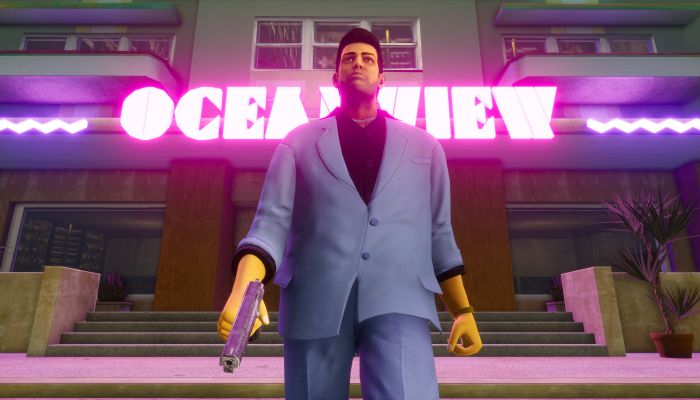
Vice City uses bright color more confidently than its predecessor. Pink skies, turquoise water, white hotels, neon signs, tropical plants, and colorful vehicles create a city that appears glamorous even when the story is violent. The visual style is not realistic. It is a compressed memory of the 1980s built from television, films, music videos, advertising, and crime fiction.
This exaggeration helps the game age better artistically than technically. Character models, animation, and environmental detail are primitive by current standards, but the color palette still communicates a strong mood. Nighttime is particularly effective. Neon lighting gives hotel streets and clubs a visual identity that remains instantly recognizable. Weather changes the city without removing its basic warmth. Rain creates reflections and reduces visibility, while fog softens distant buildings.
The beaches and water expand the visual openness compared with Liberty City. Unfortunately, the inability to swim makes that beauty mechanically hostile. Character faces have limited expression, and body movement can look stiff. Cutscenes depend heavily on voice acting and camera framing to overcome those limitations. Modern remasters may improve resolution, lighting, draw distance, and controls, but aggressive visual changes can alter the original mood. Cleaner does not always mean more faithful.
Side Activities & Collectibles: Building a Life Beyond Story Missions
Vice City includes taxi work, ambulance missions, firefighting, vigilante activities, stunt jumps, hidden packages, rampages, street races, stadium events, vehicle collection, property missions, and other optional challenges. These systems reward learning the map and experimenting with different vehicles. Taxi missions are well suited to the city’s compact geography. Ambulance activities are much more stressful because long sequences can fail after one collision.
Firefighter missions turn the streets into a route-planning challenge, while vigilante work creates mobile pursuits using official vehicles. Hidden packages provide valuable rewards by placing weapons and equipment at safehouses after enough are collected. This makes completion useful rather than purely decorative. Stunt jumps benefit from motorcycles and the city’s broad roads. Successful jumps create a satisfying combination of speed, geography, and controlled risk.
The property system provides the most meaningful side progression because it connects optional content with Tommy’s empire. Some activities lack clear tracking. Completing everything may require external notes or guides. The challenge design can also be harsh. Long uninterrupted sequences offer little protection against traffic accidents or technical problems.
Technical Performance & Versions: Choosing How to Visit Vice City
Grand Theft Auto: Vice City has been released across many platforms, including original consoles, computers, mobile devices, later console generations, and remastered collections. The experience varies significantly between editions. Original versions preserve the intended atmosphere and soundtrack more closely but may use outdated controls, resolution, and compatibility.
PC releases can benefit from community fixes, controller support, improved widescreen behavior, and performance adjustments. They may also require technical setup that casual players do not want. Mobile versions provide portable access and touch controls, though precise driving and combat can feel uncomfortable without a controller.
Remastered editions may offer improved navigation, checkpoints, aiming, lighting, or visual clarity. They have also been associated with altered art, technical issues, missing music, and inconsistent performance. The original game contains bugs involving mission scripts, vehicle behavior, camera movement, collisions, and non-player characters.
Saving remains important because the autosave systems of modern games are limited or absent depending on version. Failing to save after several activities can erase meaningful progress. The ideal edition depends on priorities. Historical authenticity, modern comfort, soundtrack preservation, portability, and technical stability may point toward different versions.
Cultural Impact & Influence: Style Became as Important as Scale
Vice City demonstrated that open-world sequels did not need only larger maps or more mechanics. They could distinguish themselves through historical setting, music, fashion, architecture, and protagonist identity. Its use of licensed music influenced how games approached period atmosphere. The soundtrack was not background decoration; it was one of the primary tools constructing the decade.
The voiced protagonist also changed expectations for the series. Tommy’s personality proved that open-world freedom could coexist with a clearly defined central character. Business ownership introduced a satisfying form of narrative progression later entries would expand through properties, territories, organizations, and economic systems.
Motorcycles and aircraft increased transportation variety, while the brighter setting showed that crime stories did not need permanently gray environments. The game’s influences are visible in its references to 1980s crime films and television. It borrows heavily, sometimes so openly that originality comes from combination rather than invention.
Certain stereotypes and jokes have aged poorly. The period setting does not excuse every representation, and modern players may notice how often communities are reduced to broad criminal identities. Its influence remains enormous because the game connected mechanics with style more completely than most open worlds of its time.
Monetization & Overall Value: A Complete Crime Story Without Live-Service Pressure
Vice City comes from an era before battle passes, premium currencies, rotating cosmetic stores, and daily challenges dominated major releases. The core game provides a complete story, city, soundtrack, side activities, properties, vehicles, and progression through one purchase.
Modern availability may involve collections, digital stores, subscriptions, or mobile releases. The main concern is choosing a version rather than avoiding in-game sales pressure. Money exists only inside the game. It purchases weapons, properties, repairs, and other practical items without any connection to real-world currency.
The property system gives financial progression a satisfying purpose. Accumulating money changes Tommy’s position in the city rather than simply increasing a number. The game’s value remains strong for players interested in classic open-world design, 1980s atmosphere, or the history of Rockstar’s series. Its age should still affect expectations. A complete package is not automatically a comfortable one.
Who Should Play Grand Theft Auto: Vice City?
Vice City is ideal for players interested in classic open worlds, crime stories, 1980s popular culture, licensed soundtracks, arcade driving, and the evolution of Grand Theft Auto. Fans of later entries may appreciate the compact map and direct progression. The city can be learned naturally without spending dozens of hours moving between distant regions. Players who enjoy business ownership will find Tommy’s rise more satisfying than a simple sequence of missions.
Those who prioritize modern shooting, generous checkpoints, swimming, detailed interiors, or realistic artificial intelligence may struggle. New players should approach difficult missions patiently and save frequently. Certain activities are easier before story changes make districts more dangerous. The game is historically important, but its strongest reason to return is not obligation. It remains worth playing because Vice City still has personality.
Final Verdict: A Neon Crime Classic That Still Knows Exactly Who It Is
Grand Theft Auto: Vice City remains one of Rockstar’s most distinctive games because every major element supports the same fantasy. Tommy Vercetti arrives with nothing, survives betrayal, takes control of a mansion, purchases businesses, and turns an unfamiliar city into his own organization. Ray Liotta gives Tommy enough personality to make the rise feel personal. He is ambitious, angry, funny, and unwilling to return to a subordinate role after losing fifteen years of his life.
The supporting cast gives the city texture. Ken Rosenberg’s panic, Diaz’s paranoia, Cortez’s politeness, Avery’s business language, Lance’s insecurity, and Sonny’s entitlement all represent different forms of power. Vice City itself remains unforgettable. The map is small by modern standards, but palm trees, neon hotels, industrial docks, clubs, beaches, mansions, and radio stations create a stronger identity than many larger worlds.
The soundtrack may be the game’s greatest achievement. Music turns travel into memory and gives the decade emotional presence beyond costumes or cars. Mechanically, the game shows its age. Combat is awkward, checkpoints are harsh, aircraft can be difficult to control, and the inability to swim is almost absurd in this setting.
Those flaws prevent Vice City from feeling completely comfortable today, but they do not erase its importance or personality. I recommend Grand Theft Auto: Vice City to fans of classic open worlds, 1980s culture, crime stories, licensed music, and players interested in Tommy Vercetti’s rise from disposable employee to citywide power.
Personal rating: 9/10.
Grand Theft Auto: Vice City earns that score for Tommy Vercetti, its iconic soundtrack, unforgettable visual style, compact city, business progression, strong voice cast, and confident criminal fantasy. It loses one point for dated combat, limited checkpoints, frustrating specialist missions, weak swimming logic, uneven technical versions, and storytelling that occasionally rushes major betrayals.
Tommy enters Vice City carrying somebody else’s problem. By the time the final confrontation reaches his mansion, the city is no longer a temporary assignment. It is the first place powerful enough to match his ambition—and the first one he refuses to leave.
Pros

- Immersive narrative and detailed 1980s setting that transports players into a nostalgic era.
- Expansive open-world design offering near-limitless exploration and creative freedom.
- Customizable gameplay through various mods, cheats, and downloadable content.
- Polished control mechanics providing smooth urban navigation and dynamic action sequences.
- Robust soundtrack and audio design that enhances the overall gaming experience.
- Cross-platform availability including PC, Mac, Android, and legacy consoles.
Cons

- Older graphics may seem outdated compared to modern standards.
- Limited online multiplayer features and community-based enhancements.
- Some technical issues and compatibility challenges when running on newer systems.
Leave a comment
Your comment is awaiting moderation. We save your draft here
0 Comments