






Branded Companions That Are Surprisingly Useful
Minecraft adidas Adventurers sounds like the kind of collaboration I would normally expect to offer a few branded outfits, colorful shoes, and a promotional building placed somewhere near the spawn point. Instead, the add-on introduces companions that can fight enemies, gather resources, locate useful places, improve movement, protect the player from environmental danger, and reward ordinary survival activities with collectible equipment.
That makes this Minecraft adidas Adventurers review more interesting than a simple discussion of cosmetic branding. This is not a standalone Minecraft game or a complete adventure map with a fixed campaign. It is a free add-on for Minecraft: Bedrock Edition that can be activated inside compatible worlds, adding three support characters known as the Coach, the Teammate, and the Mascot.
Each companion is designed around a different type of player activity. The Coach helps with exploration, mining, movement, and quest management. The Teammate supports combat and protects the player during dangerous encounters. The Mascot focuses more on gathering, farming, food management, and practical assistance around a developing base.
The add-on also introduces milestones connected with activities players already perform, including travelling, swimming, gathering, and defeating mobs. Completing these objectives provides adidas-themed lootboxes containing ordinary Minecraft items or collectible armor with useful effects.
The result is a surprisingly practical addition to Bedrock survival. I can begin a new world, recruit a companion, and receive assistance without replacing Minecraft’s core progression completely. The characters make solo play less lonely and reduce some repetitive tasks, while the quest system gives direction to players who struggle to create their own goals.
The experience still has clear limitations. Companion artificial intelligence can be unreliable, the branded equipment may feel out of place in a traditional survival world, and several abilities reduce challenges that normally give Minecraft its identity. The reward system also uses random lootboxes, even though they are earned through gameplay rather than purchased directly. Minecraft adidas Adventurers is therefore most successful as an optional convenience add-on. It improves certain journeys, but players should decide how much assistance they want before allowing the companions to solve problems that might otherwise create memorable survival stories.
Core Gameplay: Minecraft Survival With an Extra Pair of Hands
The add-on does not replace Minecraft’s ordinary survival structure. I still gather wood, craft tools, search for food, build shelter, mine resources, improve equipment, explore caves, and deal with hostile creatures after dark. The difference is that one companion can join me and provide abilities related to the activity I am planning.
This makes the add-on easy to understand because it grows around existing systems rather than introducing an entirely separate game. The companions are not controlled like traditional playable characters. I select one, interact with it, choose abilities where appropriate, and allow its behavior to support my current objective. A mining trip may become easier with the Coach, while a dangerous cave or nighttime expedition may encourage me to bring the Teammate. The Mascot is useful when I want to collect crops, search for items, or work around a settlement without managing hunger constantly.
Changing companions according to the task creates a light strategic layer. None of them is intended to replace every other option, although the Coach often feels like the most broadly useful because exploration and resource discovery are central to Minecraft progression. The active and passive effects can be powerful. Movement bonuses reduce travel time, mining assistance helps locate valuable blocks, and hunger-related support allows longer building sessions without repeated food interruptions. Combat help is especially noticeable early in a world, when a player has weak armor and limited weapons.
These conveniences make survival smoother, but they can also reduce tension. Discovering ore by reading caves, managing supplies before a long journey, and surviving alone against several mobs are important parts of Minecraft’s natural storytelling. A companion that handles too much may make the world more efficient while making the adventure less personal. I found the add-on most enjoyable when I treated the companions as specialists rather than permanent solutions. Bringing one for a difficult expedition felt useful. Keeping the strongest support active during every ordinary task could make progression feel too easy.
The Coach: Exploration, Quests, and Powerful Mobility
The Coach is the most versatile companion and the character most closely connected with the add-on’s progression system. Interacting with the Coach provides access to the Quest List, where milestones track activities such as travelling certain distances, swimming, defeating mobs, and completing other survival actions.
This system adds direction without forcing players into one strict campaign. The objectives are broad enough that I can progress while building, exploring, fighting, or gathering resources naturally. Players who already know what they want to create may treat the quests as background rewards, while newer players can use them as a list of practical goals.
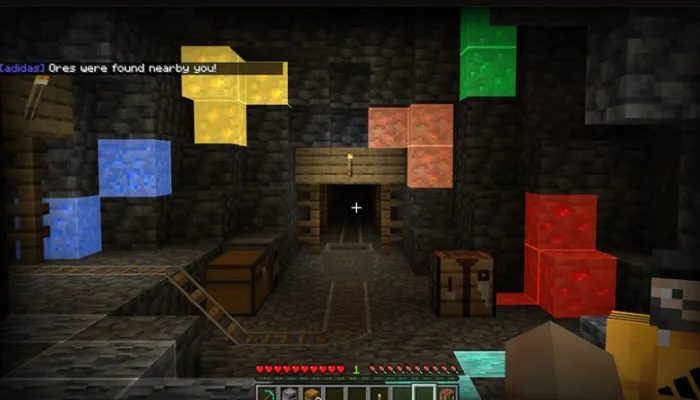
The Coach can assist with locating ores by highlighting useful blocks. This is one of the strongest abilities in the add-on because mining normally depends on cave exploration, branch mining, knowledge of resource levels, and luck. Highlighting materials reduces wasted digging and can accelerate equipment progression significantly.
Depending on the selected abilities, the Coach may also locate structures or help the player move toward useful destinations. This can reduce the frustration of searching huge procedural worlds for villages, landmarks, or other points of interest.
Movement support is another major advantage. The Coach can provide jump-related abilities and help players begin gliding when equipped with elytra. Normally, launching into flight requires height, fireworks, a hill, a tower, or another suitable starting point. A large jump can make aerial travel available from far more locations.
This is wonderfully convenient during late-game exploration. It also weakens the practical value of towers, mountain routes, and carefully designed launch platforms. The Coach occasionally feels less like a companion and more like a collection of shortcuts. I appreciate those shortcuts after many hours in an established world, but I would avoid using every ability immediately in a new survival campaign. Minecraft’s early progression works partly because resources and mobility must be earned gradually.
The Teammate: A Reliable Fighter With Familiar AI Problems
The Teammate is designed for combat. It follows the player, attacks hostile mobs, and provides support during caves, nighttime travel, raids, or other dangerous situations.
Early in a survival world, this assistance can be extremely valuable. A player carrying stone tools and limited food may struggle when several skeletons, zombies, spiders, or other enemies attack simultaneously. The Teammate divides enemy attention and creates more space to reposition. Its presence also makes solo exploration feel less empty. Minecraft companions usually come through tamed animals, villagers, or multiplayer friends. The Teammate offers a more direct version of a cooperative partner without requiring another human player to remain online.
The combat support is easy to appreciate but not always easy to trust. Companion artificial intelligence must navigate caves, cliffs, doors, water, lava, trees, structures, and player-built spaces. Minecraft pathfinding is not consistently strong enough to make every journey smooth. The Teammate may become stuck, approach enemies inefficiently, block a narrow route, or place itself in danger. A support character intended to reduce stress can occasionally become another object I must protect or locate.
Its effectiveness may also reduce early difficulty too aggressively. Minecraft combat is mechanically simple, but limited resources and enemy numbers create tension. A companion capable of handling ordinary mobs makes nighttime less threatening and may reduce the need for defensive building. The best use is during specific adventures rather than every moment. Bringing the Teammate into a dangerous cave feels like preparing for a serious expedition. Allowing it to eliminate every enemy near the first shelter can make survival progression less satisfying.
The Mascot: Farming, Gathering, and Hunger Management
The Mascot is the companion most focused on domestic survival, gathering, and long building sessions. It can help collect crops or locate useful items, and certain passive effects reduce the need to manage hunger constantly.
This makes it particularly attractive to builders. Large construction projects often require repeated interruptions for food, resource collection, inventory management, and tool replacement. The Mascot cannot remove every inconvenience, but it can reduce the number of small tasks separating the player from creative work. Hunger prevention is powerful because food is one of Minecraft’s central survival systems. Managing it is easy after a farm has been established, but early progression requires hunting, gathering, cooking, or planting crops. A companion that stabilizes hunger changes that economy immediately.
For experienced players beginning another creative survival project, this convenience may be welcome. For newcomers, it can hide the importance of farming, animal management, cooking, and food preparation. The gathering abilities are similarly useful. Collecting crops manually is not difficult, but large farms turn a simple action into repetition. Having the Mascot assist makes agricultural bases feel more efficient and gives the companion a practical place within the settlement.
Its behavior is most satisfying when it appears to participate in the world rather than merely applying an invisible bonus. Watching a companion gather or search supports the fantasy that the player has recruited help. The Mascot is less dramatic than the Teammate and less universally powerful than the Coach. That narrower role gives it better balance. It improves routine activity without transforming exploration or combat as aggressively.
Quest List & Milestones: Structure for Players Who Need a Goal
Minecraft is famous for allowing players to choose their own objectives. That freedom can also create uncertainty. A new player may build a shelter, collect some iron, and then wonder what to do next.
The adidas Adventurers Quest List provides a lightweight answer. Milestones track common actions and reward continued play. Running, swimming, exploring, defeating mobs, and other activities become visible progression rather than actions completed without acknowledgment. This works well because the quests are connected with Minecraft’s existing loop. I do not need to enter a separate minigame or abandon my world. Ordinary activity gradually completes objectives in the background.
The system can encourage experimentation. A player who rarely travels by water may attempt a swimming objective, while another may hunt mobs or explore farther from home to reach a distance milestone. Quest rewards provide a practical reason to continue, especially for children who respond more strongly to visible progression than to self-directed projects.
The weakness is that milestone systems can change how I approach a sandbox. Instead of exploring because a distant mountain looks interesting, I may run because a counter needs more distance. A personal adventure becomes progress toward another reward box. This is not automatically harmful, but Minecraft’s strongest stories often happen when the player forgets about formal objectives. The quest list should support curiosity rather than replace it.
Lootboxes & Rewards: Free Randomness With Useful Equipment
Completing milestones rewards adidas lootboxes. Blue boxes contain random Minecraft items, while gold boxes can provide collectible adidas armor. Because the boxes are earned through gameplay and are not purchased with real money, they do not create the same financial concerns as paid randomized rewards. There is still an element of uncertainty, since I cannot always choose the exact item I receive.
The random structure gives each completed quest a small moment of anticipation. A useful item may support current progression, while a duplicate or irrelevant reward can feel disappointing. Gold boxes are more desirable because the adidas armor is the main collectible feature. The equipment uses branded designs and may provide practical abilities beyond ordinary appearance.
Possible bonuses include movement improvements, environmental protection, experience-related advantages, mob tracking, water-related effects, and other specialized functions. These effects make the armor meaningful rather than a simple costume. Functional branded equipment creates a strange balance problem. On one hand, the collaboration feels more generous because the items do something useful. On the other, adidas branding becomes connected directly with power inside the game.
The armor can also reduce the value of ordinary equipment progression. If a quest reward provides a strong specialized effect, crafted or enchanted armor may become less exciting. The add-on is optional and free, so players can control how much it influences their world. I would still prefer a system allowing duplicate protection or direct selection after enough milestones. Randomness extends collection time but does not necessarily improve the adventure.
adidas Armor: Fashion With Survival Abilities
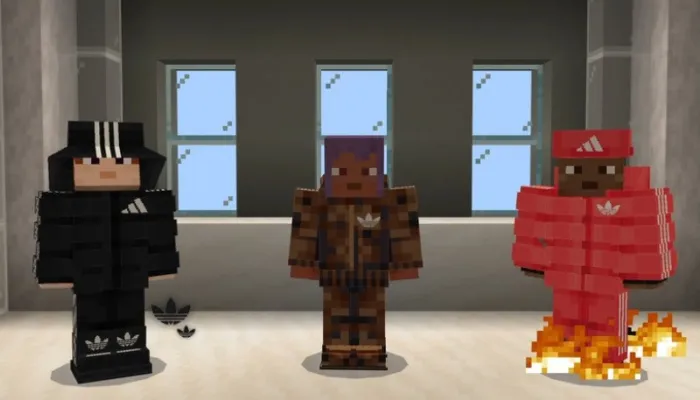
The collectible armor is visually designed around adidas branding, including recognizable stripes, sporty shapes, and color combinations connected with the collaboration. The equipment looks unusual inside a traditional medieval-style survival world, but Minecraft has never required one consistent fashion period.
Players already use skins based on robots, superheroes, modern clothing, fantasy warriors, animals, and popular media. Sportswear does not break the world more dramatically than many existing options. The important difference is that this armor is functional. Special effects can change exploration, combat, movement, or resource progression.
Lava-related protection is especially powerful in the Nether, where one mistake can destroy valuable equipment. Water-breathing effects improve ocean exploration, while jump bonuses can change terrain navigation. Experience bonuses accelerate enchanting and repair systems. Mob-tracking effects reduce surprise attacks and help locate enemies in difficult terrain.
These abilities create genuine build choices. One set may suit mining, another exploration, and another dangerous combat. Changing armor according to the adventure fits the add-on’s companion-selection structure. The designs will not appeal to every player. Someone creating a historical fantasy world may find the branding visually distracting. The armor also risks becoming more memorable as advertising than as Minecraft equipment. The strongest collaborations integrate another brand without allowing it to control the entire visual identity. adidas Adventurers generally stays playful, but the logo remains impossible to ignore.
Integration With Existing Worlds: An Add-On Rather Than a Replacement
One of the add-on’s greatest advantages is its ability to work within Minecraft: Bedrock Edition rather than requiring a completely separate map. Players can activate the content in compatible worlds and combine it with ordinary survival systems.
This is more flexible than a fixed branded adventure. I can recruit companions inside a long-term world, build a new campaign around them, or test their abilities in a temporary save before deciding whether they belong in my main settlement. The add-on works particularly well for players who prefer solo survival but occasionally want help. A companion provides some of the practical value of another player without requiring shared schedules or a server.
Compatibility with other add-ons may vary. Multiple behavior packs can change mobs, items, interfaces, world generation, or scripts in ways that produce conflicts. Players using a heavily modified Bedrock world should test carefully before adding another system. Activating experimental or marketplace content in a valuable world should always be approached with backups. Even official add-ons can behave differently after Minecraft updates.
The branded companions may also alter the atmosphere of an established world. A quiet medieval village can suddenly contain a sports-themed Coach issuing quests and awarding modern armor. This tonal inconsistency is subjective. Some players enjoy Minecraft precisely because unrelated ideas can coexist freely. Others build worlds around one coherent visual theme.
Exploration & Mining: Convenience Against Discovery
The Coach’s ore and structure assistance changes one of Minecraft’s central activities. Normally, finding valuable resources requires understanding world generation, searching caves, digging at appropriate levels, listening for open spaces, and accepting that some journeys produce little. Highlighting ore reduces uncertainty. This is useful for players with limited time, younger users, or anyone gathering large quantities for a project.
It can also remove the emotional effect of discovery. Finding diamonds unexpectedly is memorable because the player did not know they were behind the next wall. If valuable blocks are highlighted in advance, mining becomes more efficient but less mysterious. Structure-location abilities create a similar tradeoff. Searching for a village, temple, monument, or other landmark can require hours. Directional assistance prevents frustration and supports players who need one specific destination.
The journey may become less personal when the answer is provided directly. Getting lost, creating temporary shelters, discovering unrelated locations, and returning with a map full of new landmarks are part of Minecraft exploration. I found the support most appropriate in established worlds where ordinary discovery had already occurred many times. For a first playthrough, the companions may reveal too much too quickly.
Building & Farming: Less Interruption, More Creative Momentum
Builders receive some of the clearest benefits from the add-on. Hunger support, item gathering, crop assistance, movement bonuses, and resource-location tools reduce several repetitive tasks surrounding construction. A large project often requires more time gathering materials than placing them. The Coach can help find ores needed for tools, while the Mascot supports food and farming. Improved mobility makes scaffolding, towers, roofs, and distant material sites easier to manage.
This allows creative momentum to continue. Instead of stopping every few minutes to eat, search storage, or gather crops, I can remain focused on the structure. The danger is that convenience can weaken survival meaning. A castle built from materials gathered through difficult expeditions carries a different emotional history from one supported by automated assistance.
Neither approach is wrong. Minecraft supports Creative Mode precisely because not every player wants resource pressure. The add-on effectively creates a middle ground. I remain inside Survival Mode, but companions reduce selected inconveniences. Players should choose abilities according to the type of experience they want. Using the Mascot during a major build may be helpful, while disabling hunger support during a new survival adventure preserves more challenge.
Visual Style & Character Design: Minecraft Meets Sports Branding
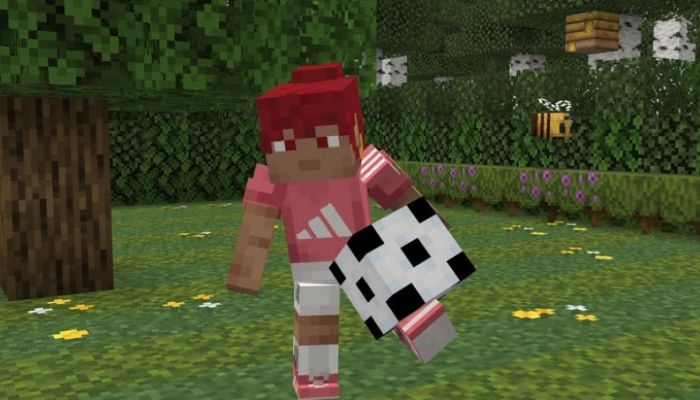
The companions use recognizable Minecraft shapes combined with modern adidas clothing, colors, and branding. Their designs are readable from a distance, which helps identify roles quickly.
The Coach looks appropriately organized and supportive. The Teammate communicates action and readiness, while the Mascot uses a friendlier design suited to gathering and domestic assistance. Animations help the characters feel like participants rather than static promotional figures. They follow, interact, gather, fight, and respond to player commands or activities.
The armor provides the most visible branding. Strong stripes and athletic styling make it immediately recognizable as collaboration content. Minecraft’s block-based art style allows unusual concepts to coexist more comfortably than realism would. Modern sportswear can appear beside diamond tools, ancient ruins, villagers, and fantasy dimensions without requiring a complete visual explanation.
The designs may still feel too promotional for players who prefer subtle marketplace content. The collaboration does not hide its commercial origin. Fortunately, the add-on does not cover the entire world in adidas advertising. The branding is concentrated on companions, equipment, rewards, and related interfaces rather than replacing ordinary blocks or creatures.
Audio & Feedback: Helpful Signals With Repetition
The companions use sound and visual feedback to communicate abilities, discoveries, rewards, and interactions. Clear cues are important because the player needs to know whether a support effect is active or a companion has located something useful.
Quest completion produces a satisfying reward signal, reinforcing the milestone structure. Opening lootboxes also uses celebratory feedback to make random rewards feel more significant. Combat sounds remain connected with ordinary Minecraft, while the Teammate adds another source of movement and attack audio during crowded encounters.
Repeated companion noises can become tiring during long sessions. A character that remains close for hours will naturally repeat reactions and activity cues. The add-on would benefit from detailed volume controls for companion dialogue or effects. Players may want practical assistance without continuous audible reminders. The overall audio remains light and suitable for Minecraft’s younger audience. It supports the branded, friendly tone without attempting to make the companions feel overly dramatic.
Technical Performance & Companion AI: Useful Until the Path Becomes Complicated
The add-on depends heavily on scripted companion behavior, making artificial intelligence and pathfinding central to the experience. Flat areas, ordinary villages, farms, and open caves generally provide suitable environments.
Problems appear around cliffs, narrow tunnels, water, lava, doors, fences, ladders, player-built machinery, and complicated structures. A companion may choose an inefficient route, become separated, or fail to reach a target. Teleportation or recall behavior can reduce permanent loss, depending on the situation, but temporary confusion still interrupts play.
Combat companions may attack the wrong enemy or enter danger without considering survival. Gathering companions can struggle when items or crops are placed inside unusual layouts. These limitations are familiar to Minecraft players who have travelled with wolves, villagers, or other non-player entities. The add-on improves companion usefulness without solving the engine’s deeper pathfinding problems.
Performance should remain reasonable in ordinary worlds, but large numbers of entities, automation systems, and multiple add-ons can increase strain. The three companions are not likely to overwhelm a world alone, yet they contribute to an already complex simulation. Bedrock updates may also change behavior. Marketplace content must remain compatible with a game receiving regular technical updates, and occasional bugs are difficult to avoid.
Monetization & Value: Free Content Connected With a Larger Product Campaign
The adidas Adventurers add-on is free through Minecraft Marketplace. Players do not need to purchase the companions, quests, lootboxes, or branded armor with Minecoins.
Minecraft: Bedrock Edition itself is required, and the player needs internet access and Marketplace availability to obtain the content. Once downloaded, the add-on can be used according to its supported world settings. The free price is a major advantage. Many Bedrock add-ons charge premium currency for less substantial content, while this collaboration provides functional companions and a progression system without a direct fee.
The reason is clearly promotional. The add-on supports a wider adidas and Minecraft partnership involving real clothing and footwear. That commercial purpose does not make the content bad. It does mean the free experience is partly designed to build familiarity with adidas products and visual branding, particularly among younger players.
Parents should understand that no gameplay purchase is required, but the content still functions as advertising. The earned lootboxes do not require money, which avoids the most serious concern associated with random rewards. Even so, teaching children to associate branded boxes with excitement deserves some awareness. From a pure value perspective, the add-on is generous. It adds enough utility to justify downloading even for players with little interest in the clothing collaboration.
Who Should Play Minecraft adidas Adventurers?
Minecraft adidas Adventurers is best suited to Bedrock players who enjoy survival but want more direction, practical companions, easier resource discovery, or reduced repetition. It is particularly useful for solo players who like the feeling of travelling with a team.
Younger players may appreciate the clear companion roles and milestone rewards. Builders can use the Mascot and Coach to reduce food and gathering interruptions, while combat-focused players may enjoy the Teammate. Experienced players beginning another survival world may find the abilities too strong during early progression. They can still use the add-on selectively or introduce it after establishing basic equipment.
Java Edition players cannot use the Marketplace add-on directly. The experience is designed specifically for Bedrock Edition. Players creating highly themed fantasy or historical worlds may dislike the modern sportswear aesthetic. Those using multiple add-ons should also consider compatibility carefully. The free price makes experimentation easy. Creating a temporary test world is the best way to decide which abilities improve the experience and which remove too much challenge.
Final Verdict: More Useful Than a Typical Branded Minecraft Add-On
Minecraft adidas Adventurers is a surprisingly substantial free add-on. Instead of providing only skins or decorative sportswear, it introduces three companions with practical roles, a quest system, random gameplay rewards, and collectible armor capable of changing movement, exploration, combat, and environmental survival.
The Coach is the strongest general companion because Minecraft constantly involves travel, mining, and searching for useful locations. The Teammate makes solo combat more comfortable, while the Mascot supports players who prefer farming, construction, and resource gathering.
The milestone system gives direction without creating a rigid campaign. It works especially well for younger players or anyone who enjoys Minecraft but struggles to choose a personal objective.
The armor is useful enough to make collection meaningful, although the adidas branding may clash with traditional worlds. Random lootboxes are less concerning because they are earned rather than purchased, but direct reward selection would still respect player time better. My main hesitation concerns balance. Minecraft’s survival loop depends on uncertainty, preparation, resource management, and occasional failure. Companions that locate ores, prevent hunger, provide lava protection, and fight enemies can remove several of those pressures simultaneously.
Used selectively, the add-on improves solo play. Used constantly from the first day of a world, it may turn survival into a guided progression route with fewer memorable accidents. I recommend Minecraft adidas Adventurers to Bedrock players, young Minecraft fans, solo explorers, builders who dislike constant resource interruptions, and anyone curious about functional companion add-ons.
Personal rating: 8/10.
Minecraft adidas Adventurers earns that score for its free access, distinct companion roles, useful abilities, clear quest system, functional collectible armor, and integration with ordinary Bedrock survival. It loses points for unreliable pathfinding, strong abilities that can weaken progression, randomized rewards, unavoidable branding, and limited value for players who prefer Minecraft’s original self-directed difficulty.
The add-on works best when the companions feel like friends helping with an adventure rather than machines completing it. The moment they solve every problem automatically, the world becomes easier—but also slightly less worth exploring.
Pros

- Innovative fusion of classic survival and modern design.
- Visually stunning with a unique Adidas-inspired design.
- Accessible across multiple platforms including PC, mobile, and cloud-based systems.
- Robust community support with continuous updates and mods.
- Flexible gameplay allowing both creative building and survival challenges.
- Optimized performance ensuring smooth gameplay on various devices.
Cons

- Steep learning curve for new features and updated interfaces.
- Potential gameplay imbalance if unverified mods or cheats are used.
- Some challenges may be too demanding for casual gamers.

Leave a comment
Your comment is awaiting moderation. We save your draft here
0 Comments