

A Free Skin, Not a Secret Gru Adventure
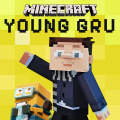
Minecraft Young Gru creates an expectation problem before I even equip it. The Marketplace name sounds like it might refer to a compact game, a character add-on, or a small adventure based on Minions: The Rise of Gru. In reality, it is much simpler: one free skin that changes the player’s appearance to resemble the younger version of Gru.
That distinction is essential to this Minecraft Young Gru review. There are no exclusive missions, special inventions, recruitable Minions, unique animations, villain abilities, custom enemies, or recreated movie locations included with this item. After equipping it, I return to ordinary Minecraft and continue mining, building, fighting, farming, or joining servers exactly as before.
Judged as a game, Young Gru would be almost impossible to recommend because it contains no independent gameplay. Judged as a free character skin, it does its limited job reasonably well. The outfit is recognizable, the design fits Minecraft’s blocky proportions, and the item offers fans a simple way to bring Gru into their existing Bedrock worlds without spending Minecoins. I can wear the skin while exploring a survival world, building a secret laboratory, playing on compatible multiplayer servers, or entering a separate Minions-themed Marketplace map. None of those activities are created by the skin itself, but the appearance can support role-playing and themed projects.
The most significant flaw is therefore not visual quality. It is presentation. Players searching Marketplace content by title may assume Young Gru includes more than one cosmetic character. The listing identifies it as a skin, but the difference between skins, skin packs, worlds, mash-ups, and add-ons is not always obvious to younger users. Minecraft Young Gru is a pleasant free bonus. It should not be mistaken for the full Minions x Minecraft experience.
What Young Gru Actually Includes
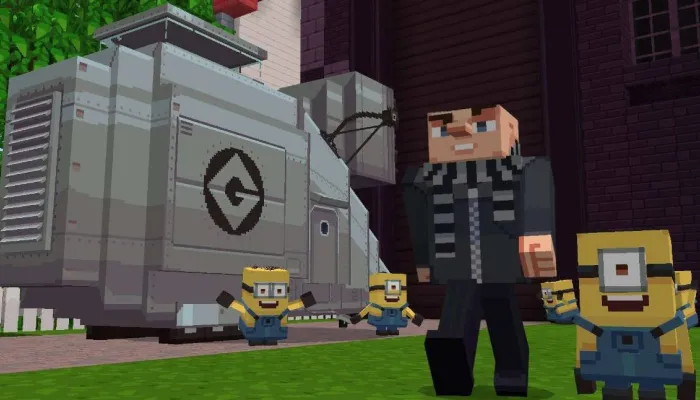
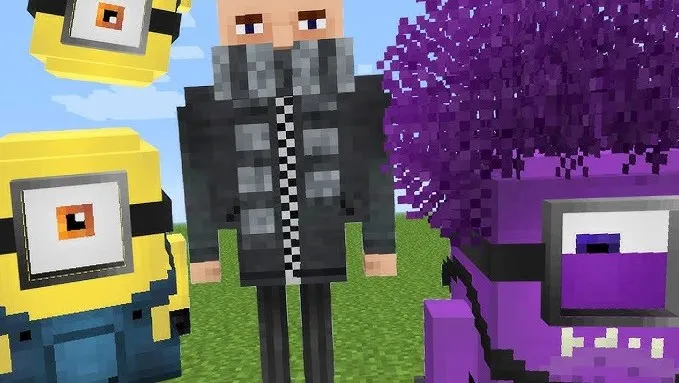
The package contains one player skin. Equipping it replaces my standard Bedrock character appearance with a Minecraft interpretation of young Gru. The design includes Gru’s recognizable head shape, dark clothing, striped scarf, and the proportions associated with his younger film appearance. Minecraft’s character model cannot reproduce every exaggerated feature of the animated character, but the silhouette and clothing make the inspiration clear.
There is no alternative costume inside the same item. I cannot switch between formal Gru, laboratory Gru, villain equipment, or different movie outfits without downloading or purchasing separate content. The skin also provides no mechanical bonuses. Wearing it does not increase speed, improve trading, unlock gadgets, protect against hostile creatures, or cause Minions to follow the player.
That is a positive point for multiplayer fairness. Cosmetic items should not give one player stronger survival abilities merely because of a licensed character. It also means that every entertaining scenario must come from Minecraft’s existing systems or the player’s imagination. I can build a laboratory with redstone doors, create a large underground base, collect villagers as confused assistants, or design strange machines. The skin contributes only the visual role. For a free item, that limitation is acceptable. The problem appears only when someone expects a downloadable adventure rather than a costume.
Character Design: Gru Adapted to Minecraft’s Geometry
Young Gru is a difficult character to translate into Minecraft because the original design depends on exaggerated animation. His head, nose, posture, expressions, and movement are more distinctive than his clothing alone. A standard Minecraft skin must fit a fixed rectangular player model. The arms, legs, torso, and head cannot reproduce the original body proportions accurately without using a completely custom entity. The designers therefore focus on recognizable colors and costume details. The dark outfit creates the main body shape, while the striped scarf provides the strongest visual reference.
From the front, the skin is easy to identify for players already familiar with the character. From a distance, it may look like a dark-clothed Minecraft avatar until the scarf and face become visible. The facial design is necessarily simplified. Minecraft skins use a small pixel grid, so subtle expressions and detailed features are impossible. Young Gru looks more neutral than the animated character, whose suspicious eyes and expressive mouth communicate much of his personality.
The design works better during third-person play, screenshots, or role-playing than during ordinary first-person survival. In first person, I mainly see the arms, and the character identity becomes much less noticeable.
Armor also covers significant parts of the skin. Equipping a helmet, chestplate, leggings, and boots can hide most of the visual design. The face may remain visible depending on the equipment, but Gru’s clothing and scarf lose prominence. This is a general weakness of Minecraft skins rather than a unique failure. Cosmetic characters are most recognizable when the player is not wearing complete survival armor.
Using Young Gru in Survival Mode
Equipping Young Gru does not change the survival loop. I still begin by collecting wood, crafting tools, searching for food, and preparing shelter before darkness brings hostile mobs.
There is something amusing about watching a future supervillain perform Minecraft’s most ordinary jobs. Gru may be known for complicated inventions, but my version begins by punching a tree and hiding inside a rough wooden box.
The skin can inspire a themed survival project. Instead of constructing a traditional cottage, I can build a laboratory beneath a mountain, use redstone for hidden doors, create potion rooms, install minecart transport, and fill storage areas with suspiciously organized equipment.
Villagers can become accidental assistants within the role-playing story. Iron golems may function as security, while snow golems or armor stands can be used to decorate laboratory spaces. Redstone is especially appropriate for a Gru-themed world. Pistons, dispensers, observers, slime blocks, rails, and command systems can create inventions that resemble the character’s exaggerated technology.
None of this content is exclusive to the skin. Another player could build the same base while using a default character. Young Gru simply makes the theme more visually coherent. The lack of special abilities preserves Minecraft’s balance but also limits the novelty. After the first few minutes, I stop noticing the character unless I change the camera or interact with other players. Players who spend most of their time in first person will gain less value than those who regularly use third-person views, record videos, or take screenshots.
Creative Mode and Role-Playing Potential
Creative Mode is the best environment for Young Gru because it removes survival restrictions and allows me to focus on themed construction.
A villain laboratory can include secret entrances, redstone traps, experimental chambers, observation rooms, aircraft hangars, escape tunnels, and storage for strange devices. Blackstone, deepslate, iron blocks, tinted glass, concrete, copper, redstone lamps, and end rods all work well for technological architecture. Purple and dark decorative elements can strengthen the dramatic villain style.
The skin also works inside multiplayer role-playing. One player can act as Gru while others use Minion-themed skins or create original assistants, rivals, agents, and citizens. Minecraft provides enough flexibility for players to invent missions. A group could hide valuable items across a city, organize a laboratory escape, build a racecourse, or create a competition involving unusual machines. Again, Young Gru does not supply scripts, dialogue, objectives, or automatic characters. The players must design everything themselves.
That can be a strength for imaginative groups. A fixed adventure eventually ends, while a role-playing skin can be reused across many worlds. It can also be disappointing for children expecting the item to make Minecraft behave like the Minions films automatically. Equipping a skin does not turn villagers into Minions or generate Gru’s home. The most successful use therefore depends on understanding what a skin is before downloading it.
Relationship With the Minions x Minecraft DLC
Young Gru is connected thematically with the broader Minions collaboration, but it should be separated clearly from the paid Minions x Minecraft content. The larger DLC provides an actual themed world with characters, locations, missions, gadgets, and structured activities. Its Rise of Gru update allows players to take on challenges associated with the Vicious 6 and build progress through villain-themed tasks. That is the product players should investigate when they want gameplay rather than appearance. Young Gru can complement that experience by providing another character option, but the free skin does not reproduce the DLC independently.
This separation reflects a common Marketplace strategy. A free cosmetic item attracts attention and gives everyone a small part of a collaboration, while a larger paid package contains the substantial content. There is nothing inherently unfair about that model when the products are labeled clearly. The free skin does not require a purchase and can be used in ordinary Minecraft.
Confusion arises because branded titles may look similar inside search results. A player may see Young Gru, Minions, or Rise of Gru references without immediately understanding which item is a skin and which is a world. Marketplace pages should make the content type and included features impossible to miss. One large label stating “ONE CHARACTER SKIN—NO GAMEPLAY INCLUDED” would prevent many incorrect expectations.
Visual Style in Different Minecraft Worlds
Young Gru’s dark outfit fits best in urban, technological, laboratory, or modern environments. It looks less naturally connected with medieval villages, fantasy castles, or peaceful farming settlements.
Minecraft is flexible enough that this contrast rarely becomes a serious problem. The game already supports skins based on robots, monsters, superheroes, animals, and historical characters. The scarf provides enough color to prevent the skin from appearing completely plain. Without it, the dark clothing would blend into many environments and become difficult to identify. Lighting affects the design significantly. Dark interiors may hide clothing details, while daylight or bright laboratory lighting makes the scarf and face clearer.
The skin’s pixel art is clean rather than highly detailed. It does not attempt complex shading that might look impressive in one lighting condition and messy in another. Players using texture packs or graphical enhancements may see slightly different results. The basic character texture remains the same, but lighting, shadows, and world art can change how well it blends with the environment. The design is unlikely to become one of Minecraft’s most visually elaborate licensed skins. Its strength is recognizability and simplicity.
Animation and Movement: Standard Minecraft Behavior
Young Gru uses ordinary player animations. Walking, running, swimming, mining, jumping, crawling, flying with an elytra, and attacking all look like standard Minecraft actions.
The skin does not introduce Gru’s posture, facial expressions, gestures, or distinctive movement from the films. This limits the character fantasy. Gru’s personality is strongly connected with the way he stands and moves, so a standard Minecraft skeleton captures only part of the design. Emotes available through Bedrock can make the character more expressive. Depending on the player’s collection, Gru can dance, wave, celebrate, or perform other animations.
These emotes are separate cosmetic items and are not included with Young Gru. The standard movement also produces humorous contrasts. Watching Gru swim rapidly, ride a pig, glide with an elytra, or carry an enormous shield creates comedy that does not need special scripting. Players should not expect custom voice lines or film audio. The skin remains silent and uses ordinary Minecraft sounds.
Technical Performance and Compatibility
Young Gru is a lightweight cosmetic item, so it places almost no additional demand on performance. It does not add mobs, scripts, world generation, particles, or complicated behavior. Once equipped correctly, it should function like another Bedrock player skin across supported devices and compatible multiplayer environments. Marketplace access requires Minecraft: Bedrock Edition. Java Edition does not use Bedrock Marketplace items directly. Availability may also depend on account settings, platform services, internet access, region, and parental controls.
Certain servers can restrict skins or replace them with default appearances. Cross-platform players may also encounter moments where a custom or licensed skin does not display correctly because of connection, privacy, or content settings. Armor covering the design is not a technical bug. It is ordinary Minecraft behavior. Because the item is free, technical risk is minimal. I do not need to test a complicated behavior pack or create a backup before using it. The download is small, and switching away from the skin is easy through the Dressing Room.
Monetization and Value: Free Means Expectations Should Stay Small
Young Gru costs nothing through the official Minecraft Marketplace. There are no Minecoins required for the skin itself. That makes the value proposition straightforward. I receive one licensed character appearance without paying, and I can stop using it at any time. There are no randomized rewards, subscription requirements created by the skin, or gameplay advantages connected with spending. Minecraft: Bedrock Edition is still required, and online multiplayer may require platform-specific services. Those are broader Minecraft costs rather than charges for Young Gru. The skin also functions as promotion for Minions-related films and the larger paid Minecraft DLC. Younger players may download the free item and then become interested in purchasing the complete mash-up.
Parents should recognize the promotional connection, but the item itself does not pressure the player through pop-up purchases during gameplay. Its value is excellent for fans who want exactly one skin. It has almost no value for someone expecting quests, maps, or new mechanics. The correct rating therefore depends heavily on category. As free cosmetic content, it is a pleasant addition. As a supposed game, it contains nothing to review mechanically.
Who Should Download Minecraft Young Gru?
Young Gru is best suited to Bedrock players who like Minions: The Rise of Gru, collect licensed skins, make themed videos, enjoy role-playing, or want to build a villain laboratory. It is especially useful for children who want to resemble Gru while playing ordinary Minecraft without purchasing a complete DLC package. Creative builders can use the character as inspiration for laboratories, cities, machines, secret bases, and film-inspired scenes.
Multiplayer groups may gain more value by combining Young Gru with Minion skins or other related characters. Players who spend almost all their time in first-person view may barely notice the change. Anyone seeking story missions, Minion companions, custom gadgets, movie locations, or battles with the Vicious 6 should skip this item and look for the complete Minions x Minecraft content instead. Java Edition players cannot download the official Marketplace skin directly through the Bedrock system.
Final Verdict: A Free Bonus That Should Not Be Reviewed as a Full Game
Minecraft Young Gru is an acceptable licensed skin that becomes disappointing only when I expect it to be something else. It gives Bedrock players a recognizable young Gru appearance at no cost, and that alone makes it easy to download for franchise fans.
The visual design captures the dark clothing and striped scarf effectively within Minecraft’s limited character template. The face and body cannot reproduce the animated proportions accurately, but the result remains identifiable. Its best uses are role-playing, themed construction, multiplayer videos, screenshots, and pairing with the larger Minions x Minecraft content. Building a secret laboratory while wearing the skin creates more entertainment than the item provides automatically.
The limitations are absolute rather than minor. There is no gameplay system to master, no story to complete, no world to explore, and no progression to evaluate. Young Gru does not change Minecraft beyond the player model. I recommend the skin to Minions fans, Bedrock cosmetic collectors, young players, and creators planning Gru-themed projects. Players looking for a complete adventure should choose the separate Minions DLC instead.
Personal rating as a free skin: 7/10.
Young Gru earns that score for recognizable styling, official licensing, easy installation, role-playing potential, and a completely free price. It loses points for offering only one costume, having no custom animations, being hidden under armor, and using a title that can be mistaken for a larger gameplay package.
Minecraft Young Gru does not turn me into a brilliant inventor or provide an army of Minions. It gives me the costume. Everything entertaining that happens afterward must be built one block at a time.
Pros

- Innovative narrative that enhances the classic Minecraft experience.
- Extensive mod and customization options for personalized gameplay.
- Visually immersive worlds with detailed biomes and dynamic urban environments.
- Dynamic audio system that adapts to gameplay and enhances immersion.
- Robust multiplayer mode fostering community collaboration.
- Broad platform compatibility including PC, Mac, Android, and cloud-based services.
Cons

- Some complex mods may lead to compatibility issues.
- Frequent updates can occasionally disrupt ongoing gameplay.
- Narrative complexities and advanced gameplay could be challenging for younger or casual players.
Leave a comment
Your comment is awaiting moderation. We save your draft here
0 Comments