







One Maze, Four Ghosts, and Nowhere Truly Safe
My first confident run in PAC-MAN ended because I became greedy. I had already cleared most of the lower maze, kept a comfortable distance from the ghosts, and positioned myself near one of the flashing Power Pellets. Instead of using it immediately, I waited for another ghost to move closer so I could earn more points. Blinky approached from one corridor. Pinky blocked the escape above. I turned too late, lost a life, and learned the rule that defines this PAC-MAN review: the game rewards appetite, but it punishes anyone who stops respecting the maze.
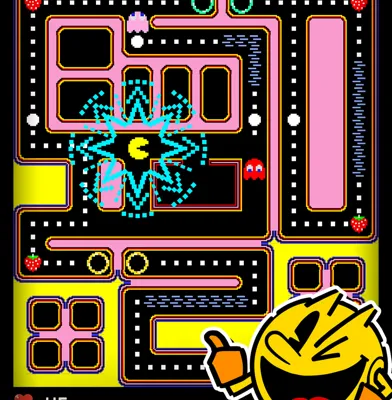
Originally released by Namco in 1980, PAC-MAN places a yellow character inside a fixed maze filled with pellets, four Power Pellets, bonus fruit, tunnels, and four pursuing ghosts. The objective is to consume every regular pellet without being caught. Clearing the maze advances the game to another round with faster, more dangerous opposition.
That description sounds almost too simple for a long review. There is one maze layout, one movement system, and no campaign filled with new environments. PAC-MAN does not provide weapons, equipment, dialogue choices, crafting, character levels, or alternate endings. It asks me to move through corridors and eat dots.
Yet the simplicity is deceptive. Every turn changes my relationship with four enemies following different behavioral patterns. Every Power Pellet creates a temporary opportunity but also removes one of the limited tools available in the round. Every cleared section of the maze reduces the available rewards while making safe routes harder to plan.
PAC-MAN’s genius is that it turns a readable board into a source of constant uncertainty. I can see the maze, the remaining pellets, and every ghost. Nothing is hidden. Still, a route that looks safe can become dangerous within seconds because the ghosts approach from different directions and react to my position in different ways.
The game also creates a rare emotional reversal. Most of the time, I am prey. After eating a Power Pellet, the ghosts turn vulnerable, and I become the hunter. That change lasts only briefly, making every chase feel urgent. I have to decide whether to pursue points, clear another part of the maze, or reposition before the ghosts become dangerous again.
More than four decades after its arcade debut, the design remains immediately understandable. That does not mean it is gentle. PAC-MAN is approachable enough for a new player to begin within seconds and demanding enough to expose careless decisions for hours.
Core Gameplay & Mechanics: Eating Dots With a Strategy
PAC-MAN uses four-directional movement. I guide the character up, down, left, or right through the maze, turning only where corridors allow. There is no jump, attack button, sprint command, or manual speed control.
The limited input makes anticipation essential. PAC-MAN continues moving in the selected direction until he reaches a wall or receives another valid command. I can often enter the next direction slightly before reaching an intersection, allowing the character to turn as soon as the path becomes available.
This input buffering is important because precise turns can create distance from a ghost. Waiting until PAC-MAN is already centered inside an intersection may cost a fraction of a second, and that fraction can decide whether I escape.
The maze is symmetrical in broad shape but filled with small tactical differences. Long corridors provide visibility but few escape options. Central intersections offer multiple routes while placing me near the ghost house. Corners can create temporary safety or become traps.
Two horizontal tunnels connect the left and right sides of the maze. Entering one side makes PAC-MAN emerge from the other. The tunnels provide emergency escapes and repositioning opportunities, while ghosts travel through them more slowly than PAC-MAN in the classic game.
The main objective is to eat every small pellet. Each one adds to the score, but its larger purpose is progress. The round ends only when the entire maze has been cleared.
This creates an interesting conflict between short-term survival and long-term efficiency. I may find a safe route through an empty corridor, but traveling through it earns nothing and leaves the remaining pellets elsewhere. Eventually, I must enter the dangerous areas I avoided.
The four Power Pellets sit near the corners of the maze. Eating one makes the ghosts temporarily vulnerable, changing their appearance and allowing PAC-MAN to consume them for increasing point values during the same power period. The first ghost is worth less than the fourth, so grouping several ghosts before activating the pellet can produce a large score.
A consumed ghost does not disappear permanently. Its eyes return to the central house, where the ghost regenerates and re-enters the maze. The Power Pellet therefore creates a temporary advantage rather than removing a threat from the round.
Using the pellets well requires judgment. Activating one as soon as danger appears may save a life. Waiting until several ghosts gather nearby can create more points. Saving a pellet for the final section of the maze may offer protection during the most difficult cleanup.
Power duration becomes shorter as the rounds advance. Eventually, the ghosts remain vulnerable for such a brief period that chasing them becomes dangerous. The game gradually transforms the Power Pellet from an offensive tool into a limited escape mechanism.
Bonus fruit appears below the ghost house after enough pellets have been cleared. Collecting it provides extra points, with later rounds offering different symbols and larger values. Reaching the fruit can be risky because its location is close to the center, where ghost traffic is often heavy.
Score is the true long-term progression. PAC-MAN does not save permanent upgrades or unlock stronger abilities during a run. Improvement comes from learning routes, recognizing ghost movement, managing Power Pellets, and surviving at higher speeds.
The extra-life rule varies across versions and machine settings, though the classic structure commonly awards a bonus life after reaching a defined score threshold. Modern reproductions may expose settings based on the original arcade options.
PAC-MAN loses a life after touching a dangerous ghost. The maze remains partially cleared, but the characters return to their starting positions. Losing every life ends the game.
That structure makes each mistake costly without erasing the entire run immediately. A death near the end of a maze is painful, but the remaining pellets stay removed. I still have a chance to recover if lives remain.
The difficulty curve comes primarily from speed, reduced Power Pellet effectiveness, and changing ghost behavior. PAC-MAN does not introduce complicated new controls. It asks me to execute the same basic movement under increasingly severe pressure.
This is one reason the game remains so effective. Difficulty does not arrive through a surprise list of new rules. It emerges from familiar systems becoming less forgiving.
Ghost Behavior and Maze Strategy: Four Personalities, One Relentless Pursuit
Blinky, Pinky, Inky, and Clyde are not interchangeable enemies. Their classic behavior gives each ghost a distinct role, turning the maze into a moving tactical puzzle rather than a simple chase.
Blinky, the red ghost, is the most direct pursuer. He frequently targets PAC-MAN’s current position and becomes especially dangerous as the remaining pellet count falls. During the final stages of a round, he can move faster and maintain close pressure.
Pinky attempts to move toward a position ahead of PAC-MAN rather than simply following from behind. This allows Pinky to approach intersections from the direction I intend to travel, creating ambushes.
Inky uses a more complicated targeting method involving PAC-MAN’s position and Blinky’s location. His movement can therefore feel unpredictable, especially when the other ghosts change position.
Clyde alternates between pursuit and retreat behavior depending on his distance from PAC-MAN. He can appear less aggressive than Blinky before turning into an unexpected obstacle near the lower portion of the maze.
The ghosts also switch between broader behavioral states. During scatter periods, they move toward their respective corners. During chase periods, they use their targeting rules to pressure PAC-MAN. These shifts can force sudden reversals in direction.
Understanding these patterns changes the game. Early in my experience, I treated every ghost as an enemy following the same logic. That led to panic whenever two approached from separate corridors.
Once I began recognizing their roles, I could make more informed decisions. A ghost behind me was not always the greatest threat. Pinky approaching a nearby intersection might be more dangerous than Blinky following at a distance.
Still, knowing the rules does not remove uncertainty. Four separate behaviors overlap inside a compact maze, and one small route change can rearrange the entire threat pattern.
This produces emergent situations despite the fixed board. The maze does not need procedural generation because the enemies continually reshape how each corridor functions.
A route may be safe during one pass and deadly during the next. The difference is not the architecture but the position, state, and direction of the ghosts.
The game rewards planned movement. High-level players can use repeatable patterns during early rounds, steering the ghosts into predictable positions. Casual play remains more improvisational, but even basic route planning improves survival.
Clearing dangerous dead ends early can help. Saving nearby pellets for later may provide flexible movement, though leaving too many scattered dots creates an awkward final cleanup.
The lower corners are useful Power Pellet locations but can become traps if a ghost blocks the route back toward the center. The upper area offers several turns, yet it places PAC-MAN close to the ghost house.
One of my biggest annoyances is that new players receive almost no explanation of ghost behavior. The visual design suggests four colorful enemies, not four different algorithms. Learning through observation is satisfying, but the early difficulty can feel random until those patterns become visible.
My second frustration is the end-of-maze cleanup. Leaving one or two pellets in isolated areas can turn a successful round into a long, tense journey through empty corridors. The task is mechanically fair, yet it can feel like punishment for forgetting a small section earlier.
Graphics, Audio, and Technical Performance: Pixel Clarity That Still Works
PAC-MAN’s visual design is one of the clearest in arcade history. The background is black. The maze uses bright blue lines. Pellets are small and visible. Power Pellets flash. PAC-MAN is yellow, while the ghosts use distinct colors.
This separation allows the entire game state to be read quickly. I can identify the player, threats, objectives, and maze boundaries without consulting a complicated interface.
The character designs are extremely simple, but they communicate function. PAC-MAN’s opening mouth makes movement look like eating. The ghosts have expressive eyes that indicate direction, helping me judge where they are traveling.
Vulnerable ghosts change appearance clearly after a Power Pellet is consumed. The reversal is immediately visible, which is essential because the power window is limited.
The animation is minimal but carefully chosen. PAC-MAN’s mouth opens and closes. Ghosts glide through the maze. Death is shown through a short collapsing animation that communicates failure without requiring realistic violence.
Intermission sequences appear between selected rounds. These short comic scenes give the characters personality and provide a break from the maze without interrupting the broader arcade rhythm.
The fixed resolution and pixel art mean modern displays may expose visual scaling differences. A faithful release should preserve sharp pixels and the original proportions rather than applying heavy smoothing.
Official modern versions, including ARCADE GAME SERIES: PAC-MAN on Steam, reproduce the 1980 arcade title and add contemporary features such as achievements and online leaderboards. PAC-MAN MUSEUM+ also includes a curated collection covering more than four decades of the series.
Performance requirements are negligible on modern hardware. The original game was built for early arcade technology, so contemporary machines can reproduce it easily. Technical quality now depends less on processing power and more on accurate emulation, responsive input, correct timing, and sensible display options.
Input delay matters enormously. PAC-MAN’s controls are simple, but quick direction changes are central to survival. A poorly implemented port can feel worse than the arcade original even while looking identical.
The sound design is as recognizable as the visuals. Eating pellets produces a repeating two-part effect that creates rhythm during movement. Power Pellets change the audio state, warning me that the ghosts are vulnerable.
The start-of-round jingle is brief and memorable. The death sound is equally distinctive, stopping the normal rhythm before the visual animation completes.
PAC-MAN uses limited audio channels and repeated effects, yet each sound communicates useful information. I can often recognize a change in state without looking directly at every character.
The repetition may become tiring during long sessions. The pellet sound accompanies almost every second of active play, and there is no broad soundtrack offering variety between rounds.
Still, replacing those effects with elaborate music would alter the experience. PAC-MAN’s audio is functional, mechanical, and closely tied to player action.
Monetization & Ads: From Arcade Coins to Modern Re-Releases
The original PAC-MAN was an arcade product. Players paid for individual attempts by inserting coins into the machine. Failure meant spending another coin to begin again.
That model influenced the design. Sessions begin quickly, difficulty rises steadily, and the score provides an obvious reason to replay. The game had to be immediately understandable while remaining difficult enough to encourage repeat attempts.
Modern premium versions replace the coin-operated structure with a single purchase. ARCADE GAME SERIES: PAC-MAN is sold separately on Steam and is also available through a broader PAC-MAN collection bundle.
PAC-MAN MUSEUM+ provides another premium option for players who want the original alongside later maze games and experimental entries from the franchise’s history.
The classic game contains no pay-to-win system. There are no stronger characters, purchasable Power Pellets, premium lives, or stat upgrades. Every run uses the same maze and rules.
Mobile editions may follow different monetization structures depending on platform, region, and current version. Some modern releases include optional purchases, advertisements, additional mazes, tournament content, or other features beyond the arcade game. These systems should be judged separately from the original design.
For players interested only in the classic maze, a clean premium release is the most straightforward choice. Paying once avoids advertisement interruptions and preserves the rapid restart loop.
The value depends on the player’s interest in score chasing. Someone seeking dozens of different levels may find the original game limited. A player who enjoys refining routes and improving a personal record can return repeatedly.
Who Should Play This? Arcade Beginners and Score-Chasing Experts
PAC-MAN is ideal for players who enjoy simple controls with demanding consequences. The game does not require previous experience, long tutorials, or knowledge of a complicated genre.
New players can begin immediately. Move through the maze, eat the pellets, avoid the ghosts, and use Power Pellets when necessary. The basic goal is clearer than in most modern games.
Score chasers will find more depth. Efficient Power Pellet use, fruit collection, route planning, and ghost grouping create a large difference between surviving a maze and mastering it.
Players interested in game design should also play PAC-MAN. It demonstrates how enemy behavior, spatial pressure, sound, color, and escalating difficulty can create depth without a large ruleset.
Short-session players may appreciate how quickly a run begins. I do not need to navigate a long story introduction or configure a character before reaching the central mechanic.
The game is also suitable for families because it contains no realistic violence. Ghosts catch PAC-MAN, PAC-MAN temporarily eats ghosts, and defeated enemies return in a stylized form.
Players seeking narrative, exploration, customization, or permanent progression should skip the original version. The maze does not change visually, and the main reward is a higher score.
Anyone who dislikes repetition may lose interest quickly. PAC-MAN asks the player to revisit the same board under increasing pressure rather than continually providing new environments.
The game can also be unforgiving. Later rounds become extremely fast, and one wrong turn can remove a life almost immediately. Accessibility of controls should not be mistaken for low difficulty.
Final Verdict: A Perfect Maze With Almost No Waste
PAC-MAN remains effective because its design wastes almost nothing. Every corridor controls movement. Every pellet marks progress. Every ghost changes the tactical picture. Every Power Pellet creates a decision between safety and scoring.
I enjoyed the shift from nervous avoidance to temporary aggression. Eating a Power Pellet and turning toward the pursuing ghosts produces an immediate emotional reward. The hunter becomes the target, but only for a few seconds.
The ghost system gives the game lasting depth. Blinky creates direct pressure, Pinky threatens future routes, Inky introduces uncertainty, and Clyde disrupts simple assumptions. Together, they make one static maze feel active.
The score system also remains compelling. Clearing a round is only part of the challenge. Collecting fruit and consuming several vulnerable ghosts create opportunities for higher-level play.
PAC-MAN’s limitations are obvious. It repeats one board, offers almost no narrative, and relies on increasing speed rather than a wide range of new mechanics. Players accustomed to constant unlocks may wonder why they should continue after seeing the maze once.
The answer is improvement. PAC-MAN does not promise a new costume after every session. It asks whether I can make a better decision at the next intersection.
Modern players can access the original through dedicated releases and collections such as ARCADE GAME SERIES: PAC-MAN and PAC-MAN MUSEUM+. The franchise has expanded through many sequels and variations, but the 1980 design remains the foundation.
I recommend PAC-MAN to arcade fans, score chasers, game-design students, families, and anyone interested in understanding why a small set of rules can remain engaging for decades.
Personal rating: 9/10.
PAC-MAN earns that score for its elegant mechanics, distinctive ghost behavior, readable presentation, responsive movement, effective risk-and-reward system, and extraordinary replay value. It loses one point for visual repetition, limited instruction, severe late-game difficulty, and its dependence on high-score motivation.
The maze never changes. My decisions do—and that is why one more attempt still feels justified.


Leave a comment
Your comment is awaiting moderation. We save your draft here
0 Comments