





A Familiar Fairy Tale Searching for a New Identity
The most revealing moment in Snow White is not the poisoned apple, the Magic Mirror, or the first appearance of the Evil Queen. It is Snow White standing before the people of her kingdom and speaking about the kind of leader she hopes to become. The scene captures the remake’s central ambition. This version does not want its heroine to wait quietly for rescue. It wants her to confront injustice, inspire a rebellion, and earn the right to rule. This Snow White 2025 review begins with that change because almost every strength and weakness in the film comes from its attempt to modernize a story while remaining visually and musically connected to Disney’s 1937 animated classic.
Directed by Marc Webb, the 2025 film stars Rachel Zegler as Snow White, Gal Gadot as the Evil Queen, and Andrew Burnap as Jonathan, a new romantic lead who replaces the traditional Prince as a more active participant in the story.
The basic ingredients remain recognizable. A jealous queen consults a magical mirror, Snow White escapes into the forest, seven unusual companions give her shelter, and a poisoned apple becomes the Queen’s final weapon.
Around that familiar structure, the remake adds political rebellion, a missing king, an oppressed population, new songs, additional history for the kingdom, and a heroine who wants to restore justice rather than simply survive.
Some of these changes give Snow White greater purpose. Others make the story feel crowded and uncertain about what kind of movie it wants to be. It is part fairy-tale musical, part political adventure, part nostalgic remake, and part correction of the original.
Rachel Zegler brings warmth and musical confidence to the title role. The production design is colorful, and several songs create genuine theatrical energy. Yet the film is repeatedly weakened by artificial-looking environments, distracting computer-generated characters, uneven performances, and a screenplay that explains its themes too often. The result is not the disaster suggested by its most hostile online reputation. It is also not the confident reinvention Disney clearly intended.
Plot & Storytelling: A Princess Returns to a Kingdom Ruled by Fear
The story begins by giving Snow White a happier childhood than the one she experiences later. She is raised by a benevolent king and queen who teach her that leadership should be based on courage, fairness, bravery, and truth.
After her mother dies, the king marries a beautiful woman who eventually reveals herself as the Evil Queen. The king disappears after leaving to confront a distant threat, allowing his new wife to take complete control of the kingdom.
The Queen increases taxes, removes resources from ordinary people, and forces many citizens into military service. Snow White is confined to the castle and reduced to working as a servant.
This expanded history gives the conflict a political dimension. The Queen is not merely jealous of Snow White’s appearance. She is a tyrant whose vanity affects an entire population. Snow White meets Jonathan when he attempts to steal food from the castle. He is part of a group of rebels resisting the Queen’s rule.
Their first interaction establishes a disagreement about leadership. Snow White believes kindness and moral example can change people. Jonathan believes the Queen will surrender nothing without direct resistance.
The conflict has potential because both characters possess incomplete views. Snow White has been isolated inside the palace, while Jonathan has witnessed the suffering outside it.
The Evil Queen continues asking the Magic Mirror who is the fairest person in the kingdom. The film broadens the meaning of “fairest” beyond physical beauty, connecting it with moral courage and leadership.
When the Mirror names Snow White, the Queen orders the Huntsman to take her into the forest and end her life. He cannot complete the command and warns Snow White to run.
The forest sequence combines fear, music, computer-generated animals, and visual references to the animated film. Snow White eventually meets seven magical beings named Doc, Grumpy, Happy, Sleepy, Bashful, Sneezy, and Dopey.
They allow her to remain in their cottage, though the relationship develops faster than it did in the original. The film has many additional plot elements to cover and cannot spend as much time on domestic comedy.
Snow White reconnects with Jonathan and his fellow rebels. She gradually understands the scale of the Queen’s oppression and decides that escaping is not enough. Her goal becomes returning to the kingdom, inspiring the guards and citizens, and restoring the values represented by her parents.
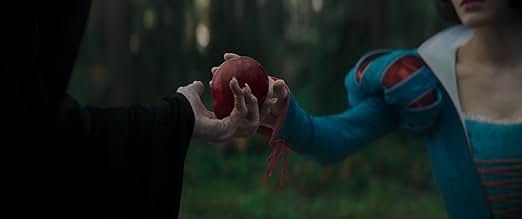
The Evil Queen responds by transforming into an elderly woman and preparing the poisoned apple. This portion follows the classic structure more closely, though Jonathan and the political conflict remain active around it.
Snow White eats the apple and falls into an enchanted sleep. Jonathan’s affection breaks the spell, but the romantic moment is treated as only one part of her return rather than the complete resolution.
The final confrontation focuses less on magical combat than public loyalty. Snow White challenges the Queen’s authority by asking the guards and citizens to reject fear. The Queen’s defeat comes through the collapse of the identity she built around beauty, control, and the approval of the mirror.
The story is easy to follow, but its structure is overloaded. The film wants to preserve iconic scenes while adding a rebellion, a romantic partnership, a missing father, new songs, and a more detailed political conflict. Some sections feel rushed because the screenplay is constantly moving between nostalgia and revision.
Snow White: Rachel Zegler Gives the Remake Its Strongest Voice
Rachel Zegler is the film’s clearest strength. She plays Snow White as sincere, curious, compassionate, and increasingly confident. Her kindness does not feel completely passive. Snow White listens to people, challenges cruelty, and attempts to understand why the kingdom stopped resisting the Queen.
Zegler’s musical performance is especially strong. Her voice has clarity and emotional control, allowing the new songs to communicate ambition even when the lyrics become overly direct. Snow White’s expanded agency is sensible. A modern feature needs more than a heroine who moves from danger to shelter while other characters determine her future.
The remake gives her political responsibility and an interest in leadership. She does not simply want the throne because she was born into royalty. She wants to restore the relationship between the palace and the people. That idea gives the character purpose, but the screenplay occasionally turns her into a collection of admirable qualities. Snow White is kind, brave, fair, intelligent, generous, forgiving, and naturally inspiring. She receives few personal flaws beyond limited experience.
Her idealism is briefly challenged by Jonathan, yet the film rarely allows her approach to fail seriously. She learns more about the kingdom, but her central beliefs are confirmed rather than transformed.
A stronger version might have shown Snow White making an ineffective decision because kindness alone could not solve a political crisis. She could then have learned to combine compassion with strategy. Instead, other characters tend to recognize her moral authority once she delivers the appropriate speech.
Zegler works against this simplicity by giving Snow White moments of uncertainty and emotional hesitation. Her expressions often suggest more vulnerability than the dialogue acknowledges.
Her relationship with the seven companions also reveals a playful side. She becomes less formal outside the castle and experiences a form of community she has been denied. The performance is warm enough to make the character likable. The writing needed to give that warmth more resistance.
The Evil Queen: A Visually Striking Villain With an Uneven Performance
Gal Gadot’s Evil Queen is designed as a glamorous authoritarian figure. Her costumes, posture, architecture, and public appearances communicate a ruler who treats government as personal theater.
The Queen is obsessed with beauty, but the film also connects that obsession with political control. She wants to be admired because admiration confirms her right to rule.
Her cruelty toward the kingdom demonstrates that vanity is not harmless. Resources are redirected toward the palace while ordinary people struggle.
This gives the villain broader consequences than jealousy alone. Unfortunately, the screenplay does not explore her political method with much depth.
The Queen gives orders, threatens servants, consults the mirror, and performs musical numbers about her own superiority. She rarely demonstrates the strategic intelligence required to maintain control over an entire kingdom. Gal Gadot is effective when the character remains still and controlled. Her appearance, measured movement, and direct gaze create authority.
The performance becomes less convincing during heightened dialogue and musical sequences. Certain line readings feel too polished or detached from the emotional intensity of the scene.
Her musical number has theatrical scale and strong visual design, but the vocal performance lacks the power needed to make the sequence genuinely intimidating. The Queen’s relationship with the Magic Mirror also feels underdeveloped. The mirror provides information, but the psychological dependence between ruler and reflection could have been far more interesting.
Does she believe the mirror defines reality? Is she frightened of aging, political weakness, or becoming irrelevant? The film offers hints without building a complete inner life. Her transformation into the elderly disguise remains one of the story’s strongest concepts. The Queen must become the image she fears in order to destroy the person she envies.
The disguise creates more personality than her royal form. She becomes physically animated, manipulative, and willing to approach Snow White directly. The final defeat is visually dramatic but emotionally simple. The Queen loses because her obsession turns against her, not because the film fully examines the insecurity beneath it.
Jonathan and the Romance: A Rebel Replaces the Traditional Prince
Jonathan is a new character created to give Snow White a more active romantic partner. He is not a prince arriving from another kingdom. He is a thief and rebel resisting the Queen.
Andrew Burnap gives Jonathan an easy, slightly skeptical charm. His grounded delivery contrasts with the formal language and theatrical behavior surrounding the royal characters. Jonathan challenges Snow White’s assumptions about the kingdom. He has seen poverty and punishment directly, while she has been confined within the castle.
Their early disagreements provide the foundation for attraction. Snow White recognizes that Jonathan’s cynicism comes from experience, while Jonathan begins to understand that her kindness is not simple ignorance.
The relationship is more balanced than the romance in the animated film. Jonathan participates in the central conflict and has reasons to care about the kingdom beyond Snow White. However, the chemistry remains pleasant rather than powerful. Their conversations are functional, moving them from disagreement to trust without many unexpected moments.
Jonathan’s group of rebels also receives limited development. They represent resistance but rarely become distinct individuals. The romance is therefore caught between two goals. The film wants to avoid making romantic rescue the center of Snow White’s identity, yet it must still preserve true love’s kiss as part of the fairy tale.
The solution works mechanically. Jonathan’s kiss awakens Snow White, but her political leadership completes the story.
Emotionally, the moment could have carried more force. The relationship has not received enough quiet time for the kiss to feel like the culmination of a deeply developed bond. Jonathan is a useful modernization, though he occasionally feels like a narrative function created to support the heroine’s new direction.
The Seven Companions: Familiar Personalities Behind Distracting Effects
Doc, Grumpy, Happy, Sleepy, Bashful, Sneezy, and Dopey remain important to the film’s connection with the original.
Their personalities are immediately recognizable. Doc attempts leadership, Grumpy resists trust, Happy provides enthusiasm, and Dopey communicates through expression rather than conventional speech. The cottage scenes offer warmth and comic relief. Snow White discovers a community in which disagreement does not automatically lead to cruelty.
Grumpy provides the most direct tension. He doubts Snow White and questions the danger created by allowing her to remain. His resistance gives the group a small internal conflict, though the story resolves it quickly. Dopey receives several visually expressive moments and maintains the innocent appeal associated with the character.
The major problem is their computer-generated design. The characters often appear caught between realistic humans and stylized animation. Their faces are detailed enough to seem physically present but artificial enough to remain visually separated from Rachel Zegler and the practical environments.
This is my first major criticism. Instead of helping the fairy tale feel alive, the digital design repeatedly reminded me that I was watching performers interact with effects. The issue becomes more obvious during group scenes. Lighting, eye contact, body scale, and physical movement do not always blend naturally.
The decision also affects emotional connection. The characters are expressive, but their artificial appearance creates distance during scenes meant to feel intimate. The original animated designs were highly stylized and could move according to cartoon logic. The remake keeps some exaggeration while placing it inside a visual world that often aims for realism.
The two approaches never combine comfortably. The voice and facial performances give the companions personality, but the digital presentation dominates discussion of their role.
Music & Songs: A Strong Lead Voice Inside an Uneven Soundtrack
Snow White combines songs from the 1937 film with new material written for the remake. Familiar music provides immediate nostalgia. The melodies connect the new production with Disney’s earliest animated feature and its place in musical history.
The new songs attempt to give Snow White stronger personal ambition. “Waiting on a Wish” functions as her central statement about identity, responsibility, and the life she wants to create.
Rachel Zegler performs it beautifully. Her voice rises naturally from quiet uncertainty toward confidence, giving the sequence emotional movement. The song is effective, though its purpose is familiar. Many modern Disney heroines receive an early number about wanting a life beyond present limitations.
Snow White’s situation is politically specific, but the musical structure resembles several previous Disney songs. The group numbers involving the kingdom and rebels expand the scale. They turn private hope into public resistance.
The Evil Queen’s song offers a more theatrical contrast. Its visual presentation emphasizes vanity, luxury, and control. Gal Gadot performs with commitment, but the number lacks the vocal authority needed to make it one of Disney’s great villain songs.
Some familiar songs sit awkwardly beside the new political story. The remake wants to preserve playful musical nostalgia while raising the stakes around oppression and rebellion.
The result can feel tonally inconsistent. A scene about public suffering may be followed by a comic cottage sequence designed to reproduce the rhythm of the animated film. Jeff Morrow’s score supports the fairy-tale atmosphere with orchestral themes, magical textures, and references to familiar melodies.
The music is most successful when it allows Rachel Zegler’s voice to carry the emotional center. It is less successful when it tries to make every narrative development feel like a major stage production.
Visual Design & Effects: Beautiful Costumes in an Artificial Kingdom
Snow White contains individual images that are genuinely attractive. The Queen’s costumes use strong shapes, reflective surfaces, dark colors, and dramatic headpieces. Snow White’s clothing preserves the recognizable blue, yellow, and red palette while adjusting the material for live action.
The castle interiors create a polished fairy-tale environment. Large halls, geometric spaces, mirrors, and elevated platforms reflect the Queen’s desire for order and admiration.
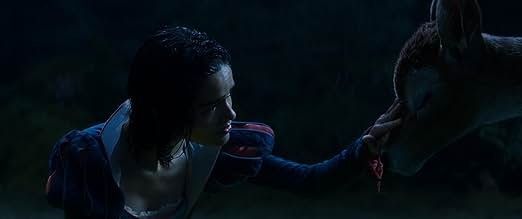
The forest uses color, glowing details, stylized animals, and controlled darkness. It is designed to feel magical rather than naturally realistic. That visual choice could have unified the film. Instead, the production frequently appears trapped between physical sets, stage-like artificiality, and digital landscapes.
Several exterior environments look too clean and weightless. The kingdom sometimes resembles a carefully rendered background rather than a place occupied by working communities. Computer-generated animals create a similar problem. Their behavior is cute and expressive, but the realistic surfaces conflict with their human-like timing.
The seven companions remain the most distracting effect. Their design makes them technically detailed but emotionally less convincing. This is my second major complaint. The film reportedly involved enormous production resources, yet many scenes lack physical texture.
Snow White occasionally appears to be standing inside a beautiful illustration rather than moving through a real environment. That may be intentional. A fairy tale does not require strict realism. However, live action creates expectations about light, weight, contact, and space.
The original animation could embrace flat color and impossible movement because every element belonged to one visual language. The remake combines several languages without finding complete harmony.
Mandy Walker’s cinematography gives musical sequences strong framing and makes effective use of the Queen’s reflective spaces.
The strongest visuals involve practical costumes, Rachel Zegler’s physical performance, and carefully controlled interiors. The weakest involve large digital crowds and characters sharing the frame with live actors.
Direction & Pacing: Marc Webb Balances Two Different Movies
Marc Webb directs Snow White as both a nostalgic musical and a modern leadership story.
His experience with character-focused romance helps the quieter scenes between Snow White and Jonathan. Their conversations feel more natural than some of the film’s larger political speeches.
The musical sequences receive movement, color, and theatrical staging. Rachel Zegler is photographed with confidence, allowing her performance to control the frame.
The difficulty comes from the screenplay’s competing priorities. The movie must introduce the kingdom’s past, explain the Queen’s rule, establish Jonathan’s rebellion, preserve familiar songs, include the seven companions, develop a romance, stage the poisoned-apple sequence, and create a new political resolution.
The pace remains active, but individual relationships receive limited room.
Snow White’s time with the seven companions feels compressed. Jonathan’s rebels appear before becoming fully memorable. The Queen’s control over the guards weakens rapidly during the climax.
The story also repeats its main message through dialogue. Snow White’s values are established by her parents, engraved on a necklace, expressed in songs, discussed with Jonathan, and repeated during her confrontation with the Queen.
The audience understands the point much earlier than the screenplay stops explaining it. Webb creates several sincere emotional moments, particularly when Snow White doubts whether she can become the leader others need. Those scenes are often followed by plot movement before the uncertainty can deepen.
The final act resolves the political conflict too easily. Years of fear and control begin collapsing after one public challenge. A more convincing rebellion would require earlier scenes showing divisions among the guards, secret support from citizens, or organized resistance beyond Jonathan’s small group.
Themes & Emotional Meaning: Fairness Is an Action, Not an Appearance
The remake expands the famous question of who is “fairest” by treating fairness as a moral quality rather than a synonym for beauty. Snow White becomes a threat because she represents compassion, courage, and responsibility. The Queen may control appearances, but she cannot create genuine loyalty.
This interpretation gives the central phrase greater thematic purpose. Beauty fades or changes, while fair leadership depends on repeated decisions. Snow White’s parents teach her that authority should serve the population. Their values become the standard against which the Queen fails.
The story also contrasts fear with community. The Queen isolates citizens and guards because divided people are easier to control. Snow White encourages them to recognize one another as neighbors rather than servants of a ruler.
Jonathan represents resistance without inherited authority. He does not trust royal promises because the monarchy has already failed the population. His skepticism forces Snow White to prove that she wants responsibility rather than status.
The film’s political message is positive but simple. Cruel rulers depend on fear, good leaders listen, and ordinary people can reject unjust authority. More complicated questions remain outside the story. Snow White inherits a claim to the throne, and the film does not examine whether royal birth itself should determine leadership.
The Queen is presented as an individual source of corruption rather than part of a political system that allowed one person to control the kingdom. Kindness remains Snow White’s defining power. The remake correctly argues that kindness is not the same as passivity.
Yet the screenplay occasionally treats kindness as an automatic solution. Snow White persuades people because her moral position is obviously correct, not because she develops a detailed strategy for rebuilding trust. The theme works best at a personal level. Snow White refuses to let cruelty determine her own behavior, even while learning that she must confront it directly.
Reimagining the Original: Modernization Without a Clear Philosophy
The 1937 Snow White and the Seven Dwarfs holds an important place in animation history, but its characterization reflects the era in which it was produced.
A modern adaptation naturally faces questions about Snow White’s agency, the Prince’s limited development, the domestic role of the heroine, and the portrayal of the seven companions.
The remake changes all of these elements. Snow White becomes a future political leader. Jonathan becomes a developed partner. The companions are presented through computer-generated fantasy. The Queen’s cruelty affects the entire kingdom.
The changes are understandable individually. The problem is that the film sometimes appears embarrassed by the story it is adapting. A successful reinterpretation should understand why the original worked before deciding what to replace.
The animated film used visual simplicity, musical charm, fear, comedy, and Snow White’s kindness to create a focused fairy tale. The remake adds agency through plot rather than exploring the dramatic power already present in compassion and resilience.
Snow White now gives speeches, organizes resistance, and challenges the Queen publicly. These actions make her active, but activity alone does not guarantee complexity.
The film is most successful when modernization grows from character. Snow White’s interest in fair leadership develops naturally from memories of her parents. It is less successful when new scenes feel designed to prove that this heroine is different from the earlier version.
The adaptation remains caught between honoring nostalgia and defending its changes. Familiar images appear, but the story frequently redirects their meaning. Neither approach is inherently wrong. The uncertainty between them creates an uneven tone.
Critical Reception & Public Response: A Film Overshadowed by Its Own Debate
Snow White received mixed-to-negative critical reviews. Rachel Zegler’s performance was repeatedly identified as the film’s strongest element, while the visual effects, inconsistent tone, computer-generated companions, and cautious treatment of the original story attracted substantial criticism.
The film also arrived after years of public controversy involving casting, story changes, comments about the animated original, the redesign of the seven companions, and political arguments surrounding members of the cast. Much of the online debate began long before general audiences could evaluate the completed movie.
Its theatrical performance was disappointing relative to its unusually large production and marketing costs. The opening weekend fell below expectations, and the film ultimately became widely viewed as a commercial underperformance for Disney.
Audience reaction was divided. Some viewers enjoyed the music, Rachel Zegler’s interpretation, and the film’s message about courageous leadership. Others objected to the visual style, narrative changes, and the sense that the remake lacked the charm of the animated film.
The scale of the backlash occasionally became disconnected from the movie’s actual quality. Snow White is an uneven remake, but it is not empty of talent or sincere creative effort.
Its reputation will likely remain tied to the larger debate surrounding Disney’s live-action remakes. Viewers who are already tired of that strategy may see the film as proof that the formula has reached its limits. Younger audiences and musical fans may respond more positively, especially to Snow White’s songs, animal companions, and clear message about kindness.
Final Verdict: Rachel Zegler Deserved a More Confident Fairy Tale
Snow White is a sincere but uneven attempt to rebuild Disney’s first animated princess story for a modern audience.
Rachel Zegler carries the movie. Her Snow White is compassionate without appearing completely fragile, and her musical performances give the film its strongest emotional moments. The decision to make Snow White an aspiring leader is reasonable. Her parents’ values provide a clear foundation for her conflict with the Evil Queen.
Jonathan also improves the romantic structure by participating in the kingdom’s resistance rather than appearing only to deliver a kiss. The film struggles because it keeps adding explanations and plot elements instead of trusting its strongest characters.
Snow White needs a rebellion, Jonathan needs a group, the Queen needs political control, the companions need digital reinvention, and familiar scenes need to appear for nostalgic recognition.
These requirements produce a movie that is constantly active but rarely elegant.
Gal Gadot looks convincing as a fairy-tale ruler, especially in the Queen’s elaborate costumes. Her performance lacks consistency when the character must move beyond visual authority. The seven companions retain their familiar personalities, but the computer-generated designs create emotional distance.
The music is strongest when Rachel Zegler performs alone. Several group numbers and villain sequences are polished without becoming truly memorable. The film’s themes about fairness, courage, and leadership are worthwhile. They are also repeated so clearly that the audience is given little room to interpret them.
I recommend Snow White mainly to Rachel Zegler fans, families who enjoy live-action Disney musicals, and younger viewers open to a brighter political fairy tale.
Fans deeply attached to the 1937 film may dislike the narrative changes and visual redesigns. Viewers tired of Disney remakes are unlikely to find enough originality to change their position.
Personal rating: 6.5/10.
Snow White earns that score for Rachel Zegler’s lead performance, strong singing, beautiful costumes, a positive leadership theme, and a more active role for its heroine. It loses points for distracting digital effects, an underdeveloped villain, uneven supporting performances, repetitive dialogue, weak political detail, and a story divided between honoring and correcting the original.
The film repeatedly asks who is fairest. Its clearest answer is Rachel Zegler, whose performance brings life to a remake that never fully decides what it wants to become.
Pros

- Strong visual aesthetics that blend traditional fairy tale elements with modern cinematography
- Innovative narrative structure incorporating non-linear flashbacks and symbolic imagery
- Re-imagined characters with added emotional depth and personal vulnerability
- Seamless integration of cutting-edge special effects to enhance magical realism
- Immersive soundscape that complements the visual elements with orchestral and futuristic tones
- Meticulous production design that reinterprets classic settings in a futuristic context
Cons

- Non-linear storytelling may confuse some viewers
- Complex symbolism could be difficult for audiences to interpret
- Occasional pacing issues arise from the heavy reliance on visual effects over dialogue

Leave a comment
Your comment is awaiting moderation. We save your draft here
0 Comments