





Anyone Can Wear the Mask
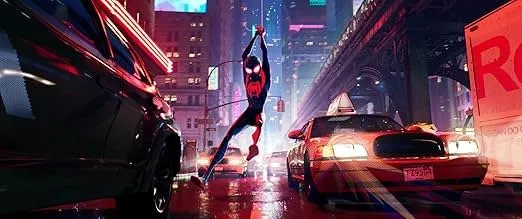
The moment that defines Spider-Man: Into the Spider-Verse for me is not Miles Morales receiving his powers or meeting alternate versions of Spider-Man. It is the leap. Miles stands high above the city, terrified but finally willing to trust himself. He jumps, and the image turns the usual falling pose upside down so that he appears to rise. This Spider-Man: Into the Spider-Verse review begins there because the film’s central idea is not that Miles becomes fearless. It is that courage begins when he acts before certainty arrives.
Released in 2018 and directed by Bob Persichetti, Peter Ramsey, and Rodney Rothman, Spider-Man: Into the Spider-Verse follows Miles Morales, a Brooklyn teenager struggling to fit into an elite school and meet the expectations of his family. After being bitten by a genetically altered spider, he develops abilities similar to Spider-Man’s.
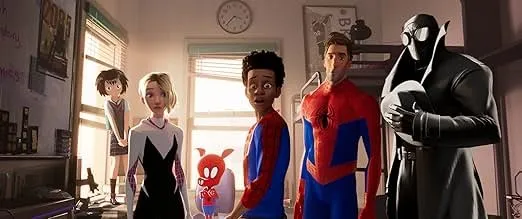
His transformation becomes more complicated when a powerful machine opens connections between parallel realities. Several Spider-People are pulled into Miles’ world, including an older and emotionally exhausted Peter B. Parker, Gwen Stacy, Spider-Man Noir, Peni Parker, and Spider-Ham.
Together, they must stop Wilson Fisk from damaging reality while Miles learns whether possessing powers is enough to make someone a hero.
The movie takes a character familiar from decades of comics, animation, games, and cinema and makes him feel new again. It does this not by rejecting Spider-Man’s history but by showing how many different people can carry its meaning.
The animation is extraordinary. Comic-book printing, hand-drawn effects, digital movement, imperfect linework, text boxes, sound effects, and shifting frame rates combine into a visual language that feels created specifically for this story.
Yet the technical achievement would mean far less without Miles. His insecurity, family relationships, artistic interests, and fear of disappointing others give the film a human center.
Into the Spider-Verse is funny, emotionally precise, visually inventive, and unusually confident. It understands that a superhero origin story does not need to ask whether the audience has seen this before. It needs to explain why this version matters.
Plot & Storytelling: A New Spider-Man Arrives Before He Feels Ready
Miles Morales lives in Brooklyn with his parents, Jefferson Davis and Rio Morales. His family loves him, but that love comes with different forms of expectation. Jefferson is a police officer who believes in discipline, responsibility, and clearly defined choices. Rio offers warmth and emotional openness, though she also wants Miles to use the opportunities available to him.
Miles has recently entered Visions Academy, an elite boarding school. He is academically capable but uncomfortable in an environment where he feels separated from his neighborhood and identity.
He intentionally underperforms, hoping failure will give him permission to leave. His teacher recognizes what he is doing and refuses to confirm the belief that he does not belong. Miles feels most comfortable with his uncle Aaron. Aaron encourages his artistic interests and gives him space to behave without constant evaluation.
During a trip into an abandoned subway area, Miles creates graffiti with Aaron. A genetically altered spider bites him. The next day, Miles begins experiencing physical changes. His hands stick to objects, his senses become overwhelming, and emotional stress activates abilities he cannot control.
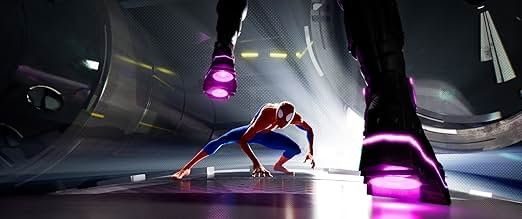
He returns underground searching for the spider and discovers Spider-Man fighting the Green Goblin near a massive particle collider. Wilson Fisk, also known as Kingpin, has built the collider to access alternate dimensions. He wants to recover versions of his wife and son, who died after witnessing his criminal life.
Spider-Man attempts to stop the machine but is defeated. Before dying, he gives Miles a device capable of disabling the collider. Miles promises to complete the mission despite barely understanding his own powers.
The death of his world’s Spider-Man changes the city immediately. Public mourning reinforces the scale of the responsibility Miles has inherited. He buys a cheap costume and attempts to train himself but repeatedly fails. His powers activate unpredictably, and the device entrusted to him is damaged. Miles then meets Peter B. Parker, an older Spider-Man pulled from another dimension.
This Peter is not the confident hero Miles expected. He is tired, divorced, physically less prepared, and emotionally damaged by years of loss and responsibility. Their relationship begins through mutual need. Miles requires training, while Peter needs Miles’ access to the collider and the replacement shutdown device. The pair later encounters Gwen Stacy, who has also arrived from another reality. Additional Spider-People gather at the home of Aunt May.
Spider-Man Noir comes from a dark 1930s world. Peni Parker pilots a robotic suit connected with a radioactive spider. Spider-Ham comes from a cartoon reality governed by exaggerated physical rules. Their different styles could have made the story feel like a collection of jokes. Instead, each reinforces the central theme that Spider-Man is not defined by one face, body, age, or universe.
Every member has experienced loss. Every member chose to continue. The group concludes that Miles is not ready for the final mission. His unstable powers and limited experience could endanger everyone. Peter restrains him in his dorm room before leaving. The decision is painful but understandable. Peter wants to protect Miles from a responsibility he recognizes too well.
Miles’ father arrives outside the locked door. Jefferson cannot see his son and does not understand what is happening, but he speaks honestly about his pride and concern. The conversation gives Miles the emotional support he needs without solving the practical problem for him. Miles then controls his venom ability, escapes, visits Aunt May, and creates his own Spider-Man suit.
The final battle takes place inside the collapsing collider. Miles joins the others, defeats Kingpin, and sends each displaced Spider-Person home. He returns to ordinary life with greater confidence, reconnects with his father, and accepts that being Spider-Man will remain difficult. The ending does not present him as complete. It presents him as ready to keep learning.
Miles Morales: A Hero Built From His Own Style
Miles is a compelling protagonist because the film never treats him as a replacement copy of Peter Parker. His personality, family, neighborhood, interests, movement, and visual design shape the kind of Spider-Man he becomes. Shameik Moore gives Miles nervous humor, intelligence, sensitivity, and believable frustration. His voice becomes more controlled as the character grows, but never loses its youthful uncertainty.
Miles’ central conflict begins before the spider bite. He does not know how to combine the different parts of his life. At home, he is a son expected to succeed. At Visions Academy, he feels like an outsider. With Aaron, he becomes an artist who can experiment without judgment.
The powers intensify this fragmentation. Miles is suddenly expected to become someone associated with confidence and public sacrifice when he cannot manage ordinary school pressure. His abilities also distinguish him from the other Spider-People. He can become invisible and produce a bio-electric venom strike. These powers are initially linked with anxiety. Invisibility activates when he wants to disappear, while the venom ability emerges during emotional overload.
Learning control therefore requires emotional development rather than physical training alone. Peter can teach web-swinging and combat principles. He cannot provide the exact moment when Miles will believe he belongs inside the role. The film states this clearly: nobody knows when they are ready. The leap comes first.
Miles’ artistic identity remains essential. He does not adopt the polished red-and-blue costume used by the city’s previous Spider-Man. He paints a black suit with red markings, creating an image that reflects his own design language. The choice matters because heroism does not require erasing individuality. Miles becomes Spider-Man by adding himself to the symbol.
His final confrontation with Kingpin also shows his development. He remembers Jefferson’s advice and uses it without copying his father’s worldview completely. Miles brings together lessons from his family, Aaron, Peter, Gwen, and the other Spider-People. None becomes his complete definition.
Peter B. Parker: A Hero After the Happy Ending Failed
Peter B. Parker is one of the film’s strongest inventions. He represents what happens when the familiar Spider-Man story continues beyond its most inspirational moments.
Jake Johnson gives him exhaustion, sarcasm, affection, and defensive humor. His Peter sounds like someone who has repeated heroic routines for years without knowing how to repair his personal life. He has saved the city many times but lost Aunt May, separated from Mary Jane, neglected his health, and withdrawn emotionally.
The character is funny because he undermines the polished image of Spider-Man. He wears sweatpants, eats during dangerous situations, and approaches training with limited enthusiasm. The comedy does not erase his competence. Peter remains highly experienced and reacts instinctively during combat.
His problem is not whether he can be Spider-Man. It is whether he still believes his personal life can improve. Miles gives Peter a responsibility he initially does not want. Teaching the boy forces him to remember that heroism includes helping another person become capable.
Peter repeatedly tries to leave emotional conversations, yet he becomes increasingly protective. His decision to restrain Miles is both compassionate and controlling. Peter believes preventing the boy from joining the mission will protect him from loss. This repeats a mistake Miles experiences elsewhere: adults decide what he can handle without allowing him to define himself.
Peter’s return to his own dimension becomes an act of renewed courage. He chooses to speak with Mary Jane and confront the fear that caused him to avoid becoming a father. The film does not guarantee reconciliation. It shows Peter taking one honest step. His arc parallels Miles’ without overshadowing it. Miles learns to begin, while Peter learns to begin again.
Gwen Stacy: A Hero Protecting Herself Through Distance
Gwen Stacy enters Miles’ school before revealing that she is Spider-Woman from another dimension. Hailee Steinfeld gives Gwen confidence, restraint, dry humor, and sadness held carefully beneath the surface. Her history explains her emotional distance. In her reality, her closest friend Peter Parker became the Lizard and died during their confrontation.
Gwen responded by avoiding close relationships. She believes attachment creates another person she may fail to protect. Her connection with Miles challenges that rule. She is interested in him, amused by him, and eventually willing to trust him. The film gives Gwen less development than Miles or Peter, but enough to establish a complete emotional direction.
She is also the first Spider-Person to arrive in Miles’ reality, though the story hides that information initially. Her movement distinguishes her visually. Gwen’s ballet-inspired style combines balance, speed, and graceful control. She appears more technically prepared than Miles, but her confidence does not mean she has resolved her grief.
The ending suggests that dimensional barriers may not prevent their friendship from continuing. Gwen’s role becomes even more important in the sequel, but this first film already establishes her as more than a romantic interest. She is another young person learning that isolation does not guarantee safety.
Aaron Davis and the Prowler: Love Hidden Inside a Terrifying Identity
Aaron is one of the film’s most important supporting characters because he provides Miles with acceptance while hiding a life that directly threatens him. Mahershala Ali gives Aaron relaxed warmth, humor, and quiet authority. He speaks to Miles without the pressure associated with school or parental expectation. Aaron encourages his art and treats his uncertainty as normal. This makes the later reveal painful.
Aaron is the Prowler, a masked enforcer working for Kingpin. The Prowler’s introduction uses sound and movement to create genuine fear. His theme is distorted, aggressive, and almost animal-like. The visual design gives him sharp shapes, glowing elements, and predatory speed.
Miles does not initially know the person chasing him is his uncle. Aaron does not know the new Spider-Man is Miles. Their confrontation becomes the film’s most personal tragedy. Aaron removes the mask and recognizes his nephew. He refuses Kingpin’s command to attack. Kingpin shoots him.
Aaron’s final words encourage Miles to continue, reinforcing the support he provided earlier while acknowledging the double life he never explained. The film does not excuse his criminal behavior. It also refuses to reduce him to the Prowler identity. His relationship with Miles was real, even if it existed beside dangerous choices.
Jefferson’s grief adds another layer. He has spent years criticizing Spider-Man and remains unaware that both his brother and son are connected with masked lives. Aaron’s death becomes part of the pain Miles must carry without allowing it to define every future decision.
Jefferson and Rio Morales: Parents Who Love Miles Differently
Brian Tyree Henry gives Jefferson a mixture of authority, humor, fear, and emotional awkwardness.
Jefferson wants Miles to succeed because he understands the risks surrounding young people in their city. His strictness grows from love, but he often communicates expectation more clearly than support. He distrusts Spider-Man because he sees masked action as unaccountable. The irony is that his brother and son both live behind masks. Jefferson’s relationship with Aaron contains unresolved conflict. He sees Aaron as unreliable and wants Miles to avoid following his example.
This concern has some basis, though Jefferson does not understand what Aaron provides emotionally. The scene outside Miles’ dorm room is Jefferson’s most important moment. He admits that he does not always know how to reach his son. He expresses pride without demanding an immediate response. This gives Miles space rather than another instruction.
Luna Lauren Vélez voices Rio with warmth and emotional intelligence. Rio offers Miles reassurance, but she is not simply the softer parent. She shares expectations for his future and participates actively in the family’s decisions.
The film gives her less screen time than Jefferson, which is one of its smaller limitations. Together, the parents create a believable household. Their love does not eliminate disagreement, pressure, or misunderstanding. Miles’ growth includes learning how to hear their support without allowing their expectations to become his entire identity.
Kingpin: Grief Turned Into Destructive Control
Wilson Fisk is designed as a massive black shape that appears to consume the frame. Liev Schreiber gives him calm menace, impatience, and emotional rigidity.
Kingpin’s motivation comes from loss. His wife Vanessa and son Richard witnessed him fighting Spider-Man and fled in fear. They died in a traffic accident while leaving. Fisk responds by building the collider, hoping to retrieve alternate versions of them.
The motivation is emotionally understandable, but his method is catastrophically selfish. He is willing to damage multiple realities and harm countless people to restore one family. This makes him a dark parallel to Miles and Peter. All experience loss, but their choices determine whether grief creates connection or destruction.
Kingpin does not want to accept versions of his family who know the truth about him. He wants to reverse the moment when his actions produced consequences. His physical design supports the theme. He appears enormous and immovable, as though his refusal to accept reality has become part of his body.
The character is effective but not highly complex. After his motivation is established, he remains a direct threat. More scenes with Vanessa and Richard might have given the loss additional emotional detail. Still, Kingpin works because the personal motive connects the collider to the film’s larger themes rather than treating it as random technology.
The Other Spider-People: Different Worlds, Shared Responsibility
Spider-Man Noir, Peni Parker, and Spider-Ham enter relatively late, but each adds visual and tonal variety. Nicolas Cage voices Spider-Man Noir with dramatic seriousness. The character comes from a black-and-white world influenced by pulp fiction and 1930s crime stories.
He treats every situation with grim intensity, making simple objects such as a Rubik’s Cube fascinating because color does not exist in his reality. Kimiko Glenn voices Peni Parker, a young pilot psychically connected with a radioactive spider inside a robotic suit. Her anime-inspired design and movement create a completely different visual language from Miles’ world.
John Mulaney voices Spider-Ham with rapid comic confidence. His reality follows cartoon rules, allowing giant hammers, impossible pockets, and exaggerated violence. The film could have used these characters only as parody. It gives each a brief reminder of loss. Their stories differ, but all know the moment when being Spider-Man became painful.
This shared experience allows the group to accept one another immediately. They do not need matching personalities or worlds. Their limited screen time prevents deeper development. Peni’s loss during the final battle is especially brief considering its emotional importance. Even so, they strengthen the film’s central claim: the symbol survives because it can be reinterpreted endlessly.
Humor & Comedy Style: Superhero History Becomes Part of the Joke
Into the Spider-Verse uses character humor, visual timing, comic-book references, physical mistakes, genre parody, and repeated origin-story language. The repeated “Let’s do this one last time” introductions are especially effective. Each new Spider-Person presents a familiar structure with different details. The joke acknowledges how often audiences have heard Spider-Man’s origin while turning repetition into rhythm.
Peter B. Parker provides much of the verbal comedy. His exhaustion clashes with Miles’ expectation of a perfect mentor. Miles’ early power problems create physical humor. He sticks to Gwen’s hair, cannot control his hands, and struggles to release objects. The scenes remain funny because they also communicate panic and embarrassment.
Spider-Ham introduces the broadest comedy. His cartoon logic could have disrupted the film, but the multiverse structure allows the difference to become part of the world. Aunt May also provides dry humor through her complete familiarity with impossible visitors and hidden technology. The film rarely lets comedy destroy emotional scenes. Aaron’s death, Miles’ restraint, and Jefferson’s dorm-room speech are given enough silence.
A few jokes depend heavily on recognition of earlier Spider-Man films or comic history. Viewers without that knowledge can still follow the story, though some details may pass unnoticed. The humor remains unusually integrated with theme. The many Spider-Man variations are funny because they are different and meaningful for the same reason.
Visual Design & Animation: A Comic Book Learning to Move
The animation is the film’s most obvious achievement. It does not attempt to imitate live-action cinematography exactly. Instead, it asks how comic-book art might behave if every printed element could move. Characters are built with visible linework, halftone dots, offset colors, ink textures, and selective detail. Backgrounds sometimes use imperfect registration, making colors appear slightly separated like misaligned printing. Text boxes appear during Miles’ thoughts. Written sound effects become part of the action. Panel-like compositions divide space.
The frame rate changes according to character and confidence. Miles initially moves with fewer poses, creating slight awkwardness beside the more experienced Spider-People. As he gains control, his movement becomes smoother.
This is not merely visual decoration. Animation technique communicates development. The film also gives each dimension a distinct style. Gwen’s world uses softer watercolor textures and emotional color shifts. Noir remains monochrome. Peni uses anime language, while Spider-Ham follows cartoon exaggeration.
These styles coexist without losing clarity because Miles’ world provides a strong visual foundation. The city feels dense and vertical. Buildings, street signs, trains, graffiti, classrooms, and apartments give Brooklyn specific personality.
Miles’ graffiti art connects his personal creativity with the film’s larger design philosophy. The movie itself behaves like an artwork built from layering, remixing, and personal signature. The collider sequences become increasingly abstract. Geometry breaks apart, colors separate, and multiple realities overlap.
Despite the visual density, the action remains readable. Character silhouettes and color contrast preserve direction. The leap-of-faith sequence is the visual high point. Glass rises around Miles as he falls, reversing the expected relationship between movement and image. The shot transforms fear into momentum.
Music & Sound: Miles’ World Has Its Own Rhythm
Daniel Pemberton’s score combines orchestral superhero themes with electronic sounds, turntable techniques, distorted textures, and rhythmic experimentation. The music reflects the collision between comic-book tradition and Miles’ contemporary identity. The Prowler theme is especially effective. Its distorted sound creates immediate danger and feels different from conventional villain music.
Miles’ personal soundtrack includes hip-hop and contemporary songs that connect him with Brooklyn, adolescence, and artistic self-expression. “Sunflower” becomes associated with his private space and emotional rhythm. It helps define Miles before the superhero plot takes control.
“What’s Up Danger” drives the leap-of-faith sequence. The song’s energy does not merely make the scene exciting. It transforms uncertainty into self-declaration.
Sound design works closely with the visuals. Comic impacts, glitching dimensions, web movement, city noise, and collider instability create a layered audio environment. The soundtrack avoids making Miles feel like another Peter Parker placed inside a different body. His music belongs to his specific world.
Direction & Pacing: A Crowded Story That Rarely Loses Its Center
Bob Persichetti, Peter Ramsey, and Rodney Rothman direct a story with an enormous amount of information. The film must introduce Miles, his family, school, Aaron, powers, two Peter Parkers, Gwen, Kingpin, the collider, and several additional Spider-People. The structure remains surprisingly clear because every major plot development connects with Miles’ emotional question: is he capable of becoming Spider-Man? The first act takes time establishing his ordinary life. This investment makes the later multiverse chaos easier to follow because the audience understands what Miles risks losing.
The middle section becomes busier after Peter B. Parker arrives. Training, infiltration, dimensional instability, and the larger team all compete for attention. The humor keeps the exposition active, though some secondary characters receive little room. The emotional pacing is excellent around Miles’ lowest point. Aaron dies, the team rejects his participation, Peter restrains him, and Jefferson speaks through the door.
Each event increases the sense that Miles lacks control. The leap then functions as earned release rather than a visually impressive moment added without preparation. The final battle is large but personal. Miles must send the others home, stop Kingpin, and prove to himself that he can remain standing after failure. The movie ends with enough space to show his new routine without pretending the work has become easy.
Themes & Emotional Meaning: The Mask Is an Invitation
The film’s central theme is that heroism is not a private identity owned by one perfect person. Spider-Man is a choice repeated by different individuals under different circumstances. Miles initially believes the role requires him to become like the city’s previous Peter Parker. The other Spider-People prove that no single model exists. They differ in age, personality, visual style, methods, and history. What they share is loss followed by responsibility. The film does not argue that suffering automatically creates heroes. Kingpin also experiences loss.
The difference lies in response. Kingpin attempts to break reality until it gives him the past he wants. The Spider-People accept that pain cannot be reversed and choose to protect others from similar harm. Identity is equally important. Miles moves between home, school, his uncle’s world, and the expectations attached to Spider-Man.
He becomes whole by combining these influences rather than selecting one and rejecting the rest. His suit represents that synthesis. It carries the Spider-Man symbol but uses his colors and artistic style. Mentorship is another major theme. Peter B. Parker cannot turn Miles into a hero through instruction alone.
A mentor can provide tools, warnings, and examples. The final decision must belong to the student. The film also explores expectation. Jefferson, teachers, Peter, and the Spider team all decide what Miles should be ready for.
Their concern is often loving, but it can become another force telling him that belonging must be proven in advance. Miles’ leap rejects that condition. Readiness is created through action, not certified before it.
Critical Reception & Lasting Reputation: A New Standard for Superhero Animation
Spider-Man: Into the Spider-Verse received widespread acclaim for its animation, storytelling, humor, voice cast, emotional depth, and reinvention of superhero visual language. Critics frequently praised Shameik Moore’s performance and the decision to center Miles Morales without treating Peter Parker as irrelevant.
The film’s animation became a major point of discussion across the industry. Its combination of comic-print techniques, variable frame rates, hand-drawn effects, and digital production influenced numerous later animated projects. It won the Academy Award for Best Animated Feature and challenged the assumption that major American studio animation needed to follow one polished visual style.
Audience response was equally strong. Miles became more widely recognized beyond comic readers, while Peter B. Parker and Gwen Stacy developed large followings. The film also succeeded as a multiverse story before the concept became heavily overused in mainstream cinema. Its alternate realities were not simply opportunities for cameos.
Each variation supported the theme of shared identity. Some reviewers noted that the final act contains familiar superhero mechanics and that several Spider-People receive limited development.
Those criticisms are fair but relatively minor. The film’s emotional and visual clarity prevents the crowded ensemble from becoming empty spectacle. Its reputation has remained extremely strong and was expanded further by Spider-Man: Across the Spider-Verse. Even without its sequel, Into the Spider-Verse feels complete. Miles makes the leap, saves his world, and begins defining what the mask means for him.
Final Verdict: The Best Spider-Man Origin Is the One That Makes Room for Another
Spider-Man: Into the Spider-Verse is one of the greatest superhero films because it treats legacy as possibility rather than ownership. Miles does not become important by replacing Peter Parker or proving the earlier Spider-Man unnecessary. He becomes important because the idea can survive another interpretation.
Shameik Moore gives Miles intelligence, humor, fear, and enough emotional specificity to make the origin feel personal again. Jake Johnson transforms Peter B. Parker into both mentor and warning. He shows Miles what experience can teach and what isolation can damage. Hailee Steinfeld makes Gwen confident without hiding the loneliness beneath her distance.
Mahershala Ali gives Aaron warmth that makes the Prowler reveal genuinely painful, while Brian Tyree Henry turns Jefferson’s imperfect communication into one of the film’s strongest emotional relationships. The animation remains extraordinary. It does not simply illustrate the plot. It changes according to perspective, confidence, universe, and emotion.
Daniel Pemberton’s music and the contemporary soundtrack give Miles a rhythm entirely his own. Kingpin is less complex than the heroes, and several supporting Spider-People deserve more time. Those limitations barely reduce the film’s achievement. The leap-of-faith sequence captures the entire story in one movement. Miles is still afraid, still learning, and still uncertain.
He jumps anyway. I recommend Spider-Man: Into the Spider-Verse to superhero fans, animation lovers, families with older children, artists, comic readers, and viewers interested in stories about identity, mentorship, grief, and personal style.
Personal rating: 10/10.
Spider-Man: Into the Spider-Verse earns that score for Miles Morales’ exceptional development, revolutionary animation, outstanding music, memorable voice performances, precise humor, emotional family relationships, and a multiverse story with genuine thematic purpose. Its minor limitations never weaken the clarity of its central message.
The mask does not ask Miles to become someone else. It asks whether he is willing to bring everything he already is into the responsibility of wearing it.

Leave a comment
Your comment is awaiting moderation. We save your draft here
0 Comments