





A Tunnel Into a World That Refuses to Explain Itself
The moment that defines Spirited Away for me comes before the bathhouse, No-Face, or the river spirit. Chihiro stands in front of a dark tunnel while her parents walk ahead without hesitation. She does not want to enter. Nothing visible proves the place is dangerous, yet every part of her body tells her to stay outside. This Spirited Away review begins with that instinct because Hayao Miyazaki’s film understands something many fantasy stories forget: wonder and fear often arrive through the same doorway.
Released in Japan in 2001, Spirited Away follows ten-year-old Chihiro, a nervous and unhappy girl moving to a new home with her parents. A wrong turn brings the family to an abandoned-looking structure that leads into a hidden world inhabited by spirits, workers, witches, strange animals, and creatures whose purposes are never explained completely.
Chihiro’s parents discover an unattended feast and begin eating. They ignore her warnings, continue consuming food that does not belong to them, and are transformed into pigs.
As night falls, the apparently empty town fills with spirits. Chihiro begins fading from existence until a mysterious boy named Haku helps her survive and tells her that she must find work inside a bathhouse controlled by the witch Yubaba.
The story becomes a rescue mission, but it never behaves like a simple adventure. Chihiro does not collect weapons or learn to defeat enemies through force. She survives by working, observing, remembering, showing kindness, and refusing to let a frightening environment erase her identity.
Spirited Away is visually beautiful without becoming comfortable. Its world contains warmth, greed, dirt, food, labor, loneliness, danger, and tenderness. The film does not divide those qualities neatly between good and evil characters.
That moral uncertainty gives the fantasy unusual depth. Spirits can be generous or selfish. Workers can be cruel in one scene and helpful in another. A terrifying visitor may be suffering rather than malicious. The result is a coming-of-age story built around attention. Chihiro grows because she learns to see what others need without losing the memory of who she is.
Plot & Storytelling: Survival Through Work, Memory, and Compassion
Spirited Away begins with Chihiro lying in the back seat of her parents’ car, holding flowers from friends she has left behind. She is frustrated by the move and uninterested in the new life waiting for her.
Her father takes an unfamiliar road and drives toward a tunnel. The family crosses through it and finds what the parents assume is an abandoned theme park. The location appears empty, but fresh food has been prepared in a nearby street. Chihiro’s parents begin eating immediately and promise to pay later. Their confidence makes the situation disturbing. They treat the place as though access and money give them the right to take anything they want.
Chihiro explores alone and meets Haku, who urgently tells her to leave before sunset. By the time she returns, her parents have become pigs and the river separating the spirit world from the human world has filled.
Haku gives Chihiro food from the spirit world so she will stop disappearing. He then directs her toward the bathhouse, where she must request employment from Yubaba.
The journey through the building introduces its social hierarchy. Boiler workers prepare water and herbs below, attendants serve guests above, and Yubaba controls contracts, names, and money from her private office.
Chihiro first approaches Kamaji, a many-armed boiler operator surrounded by small soot creatures. He pretends not to need help but eventually instructs worker Lin to take Chihiro to Yubaba. Lin initially resents the responsibility. Her attitude changes gradually as Chihiro proves willing to work. Yubaba attempts to frighten Chihiro into leaving. The girl repeats her request for a job until the witch finally gives her a contract.
As part of the agreement, Yubaba takes most of Chihiro’s name and renames her Sen. Haku warns her that forgetting her real name would allow Yubaba to control her permanently.
This makes identity central to the story. Chihiro’s survival depends not only on rescuing her parents but remembering herself within a system designed to reduce workers to useful roles.
The bathhouse sections develop through a series of encounters rather than a traditional sequence of battles. Chihiro must clean a filthy tub, serve demanding visitors, and endure the hostility of workers who see humans as unpleasant outsiders.
Her first major test involves a foul-smelling spirit that everyone assumes is naturally disgusting. Chihiro notices something embedded in its side and helps remove a massive collection of human waste. The visitor is revealed as a polluted river spirit. Its gratitude provides Chihiro with a magical herbal medicine.
The sequence establishes the film’s environmental concerns while also showing Chihiro’s growing ability to look past appearances. No-Face then becomes increasingly important. Chihiro allows the silent spirit into the bathhouse during the rain, treating it with basic kindness. Inside the building, No-Face discovers that gold can purchase attention. Workers who ignored it become eager to provide food and praise.
The spirit begins consuming enormous meals, producing gold, and swallowing employees. Its body and behavior expand according to the greed surrounding it. Chihiro refuses the gold. Her lack of interest separates her from the bathhouse workers and makes No-Face focus on her more intensely.
At the same time, Haku is injured while stealing a magical seal from Yubaba’s twin sister, Zeniba. Chihiro uses part of the river spirit’s medicine to save him. She later gives the remaining medicine to No-Face, causing the spirit to expel everything it consumed.
The final section slows down. Chihiro travels by train across a flooded landscape to return Zeniba’s seal and apologize for Haku’s actions. The train journey is one of the film’s most beautiful sequences because almost nothing happens in the conventional sense. Chihiro sits with No-Face and several companions while shadow-like passengers enter and leave. The stillness gives the story emotional space before the final resolution.
At Zeniba’s cottage, the characters discover a domestic warmth absent from Yubaba’s bathhouse. Zeniba may resemble her sister physically, but she values cooperation, memory, and handmade work rather than control.
Chihiro eventually remembers that Haku is the spirit of the Kohaku River, where she nearly drowned as a child. Speaking his true name restores his identity. Back at the bathhouse, Yubaba gives Chihiro one final test: identify her transformed parents among a group of pigs. Chihiro correctly states that none of the pigs are her parents. Her confidence demonstrates how far she has come from the frightened child who entered the tunnel.
She returns to the human world with her parents, who appear unaware of what happened. The family finds the car covered in leaves and dust, suggesting that significant time may have passed. The ending refuses a dramatic explanation. Chihiro leaves the spirit world carrying experience rather than proof.
Chihiro: Growth Without Becoming a Different Person
Chihiro is a powerful protagonist because the film allows her to begin as a believable child. She is frightened, impatient, dependent, and openly unhappy about moving.
She does not enter the spirit world with hidden bravery waiting to emerge immediately. She cries, panics, hesitates, and makes mistakes.
Her growth comes through repetition and responsibility. Each task requires her to act before she feels ready.
Working in the bathhouse gives her structure. She learns names, follows procedures, helps coworkers, and becomes capable of making decisions without waiting for an adult.
The film never turns her into an action hero. Chihiro remains physically small and vulnerable.
Her courage is expressed through attention. She notices the object inside the river spirit. She recognizes Haku beneath his dragon form. She understands that No-Face does not need more food or gold. This kind of heroism fits the world. Many problems are caused by characters failing to see what is actually in front of them.
Chihiro’s kindness is not presented as endless politeness. She becomes angry, refuses gifts, gives commands, and confronts powerful figures. Her relationship with No-Face demonstrates this firmness. She cares about the spirit but does not reward its destructive behavior. Her refusal of gold is especially important. Chihiro understands that No-Face’s generosity is part of the same unhealthy cycle as its consumption.
Rumi Hiiragi’s Japanese vocal performance gives Chihiro nervous energy without making her irritating. Her breathing, pauses, and sudden bursts of emotion make the fear feel physical.
In the English-language version, Daveigh Chase gives the character a clear emotional progression from anxiety to confidence. Chihiro’s final test with the pigs works because she no longer responds through panic. She trusts what she knows. The movie does not suggest that she has lost all fear. It shows that fear no longer controls every decision.
Haku: A Boy Without His Own Name
Haku is introduced as both protector and mystery. He knows the spirit world, moves easily through the bathhouse, and possesses authority despite appearing young.
He helps Chihiro survive, but his relationship with Yubaba makes his motives uncertain. He can be gentle in private and cold when other workers are watching. This division reflects the control created by Yubaba’s contract. Haku has forgotten his real name and become trapped inside the role she assigned him.
His dragon form gives the character visual power, but the story repeatedly reveals his vulnerability. He is attacked by paper spirits, poisoned by the stolen seal, and nearly destroyed by his loyalty to Yubaba. Chihiro’s memory saves him. She recalls falling into a river as a child and being carried safely toward the surface.
The river was later filled in to make space for buildings, leaving its spirit without a home. Haku’s lost identity is therefore connected with environmental destruction. His full name, Nigihayami Kohakunushi, restores the relationship between the boy, the dragon, and the river.
The revelation is emotional because it shows that Chihiro and Haku’s connection existed before either understood it. Haku’s story parallels Chihiro’s. Both are in danger of losing their names, but Chihiro retains enough memory to help him recover his.
The film leaves Haku’s future open. He promises to meet Chihiro again but does not cross into the human world with her. That unresolved promise fits the story’s dreamlike quality. Some relationships change a life even when they cannot continue in ordinary form.
Yubaba and Zeniba: Two Faces of Power
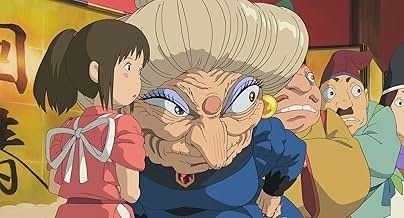
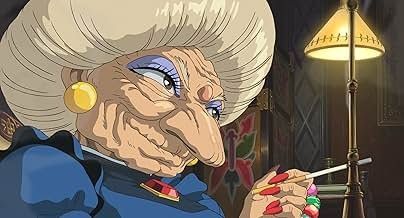
Yubaba dominates the bathhouse through contracts, surveillance, fear, and economic control. Her enormous head, elaborate clothing, jewelry, and private rooms make her visually overwhelming. Mari Natsuki’s vocal performance gives Yubaba theatrical authority. She can shift from explosive anger to false sweetness within seconds.
Yubaba is greedy and manipulative, but the film does not make her purely evil. She runs a functioning business, values competent work, and genuinely loves her enormous baby, Boh.
Her affection is possessive. She keeps Boh inside a protected room and teaches him to fear the outside world. The relationship reflects Yubaba’s broader form of control. She convinces others that safety depends on obedience.
Zeniba appears initially as another threat. She wants the stolen seal returned and punishes Haku for taking it. When Chihiro visits her cottage, Zeniba reveals a completely different environment. She offers food, conversation, and practical work.
The twin witches look almost identical, but their homes and relationships express opposing values. Yubaba accumulates wealth and controls labor. Zeniba creates objects by hand and invites others to participate.
The contrast is not entirely simple. Zeniba can also be severe, and Yubaba remains capable of honoring an agreement. The film’s moral world depends less on fixed categories than choices. Power can dominate or support, and similar people can build very different communities.
No-Face: Loneliness That Consumes Whatever Surrounds It
No-Face is one of the film’s most memorable figures because it begins as an absence. The spirit stands quietly, wears a mask, and appears to have no stable identity. Chihiro notices it outside the bathhouse and allows it inside. This basic act of recognition creates an attachment. Once inside, No-Face begins reflecting the environment around it. The bathhouse values money, appetite, hierarchy, and excess.
No-Face produces gold and is rewarded with food, service, and attention. The more it consumes, the larger and more demanding it becomes. Its voice is assembled partly from the people it swallows. This suggests that No-Face does not possess a strong self separate from its surroundings.
The workers interpret its gold as wealth rather than a warning. Their greed teaches the spirit how to control them. Chihiro’s refusal becomes the first boundary it encounters. She neither fears No-Face completely nor gives it what it wants. When she offers the herbal medicine, the spirit expels the bathhouse’s excess and gradually returns to its smaller form.
No-Face changes again at Zeniba’s cottage. In a calm environment built around cooperation, it becomes quiet and helpful. The character is often interpreted as a symbol of greed, loneliness, consumerism, or emotional dependency. All of those readings are possible because the film does not reduce it to one explanation. What matters is that No-Face absorbs the values of its environment. It becomes destructive where desire has no limit and peaceful where it is given useful work and companionship.
The Bathhouse: A Workplace, a Marketplace, and a Living Social System
The bathhouse is more than a fantasy location. It functions as a complete workplace with labor, management, customers, status, payment, waste, and competition.
Its beauty depends on workers whose effort is frequently invisible to wealthy guests. Kamaji operates the boiler room beneath the public spaces. His soot creatures carry fuel while attendants above prepare rooms and serve visitors.
The architecture expresses hierarchy. Yubaba occupies the highest and most luxurious rooms, while the hardest physical labor happens below. Chihiro enters at the lowest level. She must ask for work because employment gives her a recognized place within the system.
The bathhouse can be cruel, but it also creates community. Lin becomes protective, Kamaji helps quietly, and workers celebrate Chihiro after the river spirit rewards them. Money affects nearly every relationship. Gold changes how workers treat No-Face, while valuable guests receive attention regardless of their behavior. The film criticizes this greed without pretending that labor itself is meaningless. Work helps Chihiro develop competence and confidence.
The difference lies in whether work connects people or turns them into objects controlled by contracts. The removal of Chihiro’s name shows the danger clearly. A worker who forgets personal identity becomes easier to manage.
Humor & Supporting Characters: Strange Comedy Without Breaking the Spell
Spirited Away contains frequent humor, but it rarely feels separated from the world. The jokes emerge from character behavior, physical scale, and the strange rules of the bathhouse. Kamaji’s many arms allow him to operate the boiler while complaining that he has no need for assistance. The soot creatures appear simple and cute, yet their labor is treated as essential.
Boh provides comedy through his enormous size and fear of germs. His transformation into a small mouse forces him to experience the outside world he was taught to avoid. The bird-like servant accompanying Yubaba is transformed into a tiny creature and develops an amusing partnership with mouse-sized Boh.
The three bouncing green heads create visual absurdity without explanation. Their presence is accepted because the bathhouse contains many beings whose origins remain unknown. Lin’s irritation with Chihiro produces dry comedy, especially when her reluctant responsibility turns into genuine care.
The film’s humor never requires the fantasy to stop being mysterious. It does not pause to explain why a creature is funny or where it came from. That confidence is one reason the world feels alive. Not every detail exists to support the main plot.
Visual Design & Animation: A World Overflowing With Life
Spirited Away is one of Studio Ghibli’s richest visual achievements. The spirit world contains enough detail to suggest histories extending far beyond Chihiro’s visit. The bathhouse dominates the landscape with red walls, glowing windows, painted interiors, narrow passages, elevators, boiler rooms, kitchens, and private chambers.
Every section has a practical function while preserving the feeling of fantasy. The animation gives weight to ordinary actions. Chihiro puts on shoes, carries objects, walks down dangerous stairs, eats food, and struggles to open doors.
These physical details make the magical events more convincing. The characters live inside their bodies rather than floating through a collection of beautiful backgrounds. Food receives special attention. Steam, texture, movement, and appetite make meals visually powerful.
The parents’ transformation becomes disturbing partly because eating is animated with such physical intensity. The spirit designs range from simple silhouettes to enormous creatures covered in mud, masks, cloth, feathers, or scales.
Many remain unexplained. The film trusts visual behavior to communicate enough. Color changes with location and mood. The abandoned daytime town uses pale light and empty space. Night brings lanterns, crowds, reflections, and saturated color.
The train sequence uses muted blues and grays, creating a quiet emotional world after the bathhouse’s constant movement. The flooded landscape seen from the train is both peaceful and unsettling. Buildings and tracks continue through water without explanation. Miyazaki’s framing often allows characters to remain still within detailed environments. The film does not fear visual silence. That restraint makes sudden movement more powerful.
Music, Direction & Pacing: Joe Hisaishi Gives the Fantasy Its Memory
Joe Hisaishi’s score is essential to the film’s emotional identity. The main piano theme carries sadness, curiosity, and movement without reducing the story to one mood. The music supports Chihiro’s fear without turning the spirit world into conventional horror.
Larger orchestral passages give the bathhouse scale, while quieter sections leave room for water, footsteps, breathing, and distant machinery. The train music is especially effective. It transforms travel into reflection rather than another obstacle. Hayao Miyazaki directs the film with unusual confidence in pauses. Major plot events are separated by scenes of eating, cleaning, traveling, or simply observing.
These moments are sometimes described through the Japanese concept of ma: the meaningful space between actions. The pacing may feel unfamiliar to viewers expecting a tightly structured Western adventure. Characters do not move directly from one conflict to the next. That looseness allows the world to feel larger than the plot. Chihiro’s experience includes waiting, confusion, work, and relationships that do not exist only to deliver clues.
The film’s final section becomes deliberately calm. After No-Face’s chaos and Haku’s injury, the train journey reduces movement and dialogue. This slowdown prepares the emotional revelations at Zeniba’s cottage and during the flight with Haku. The story ends soon after Chihiro completes Yubaba’s test. There is no extended celebration or explanation of how the experience changes her future. The restraint preserves the feeling that the spirit world exists beside ordinary life, not as a chapter that can be summarized neatly.
Themes & Emotional Meaning: Growing Up Without Losing Your Name
Spirited Away is fundamentally a story about growing up. Chihiro begins as a child whose life is being changed by adults without her consent. Her parents decide to move, choose the wrong road, enter the tunnel, and eat the forbidden food. Chihiro must manage the consequences. The spirit world forces her to become responsible without demanding that she stop being a child.
She learns to work, make decisions, protect others, and continue acting while afraid. Names represent identity and memory. Yubaba controls workers by taking their names, separating them from the lives they had before entering the bathhouse. Chihiro’s shortened name, Sen, is not simply a nickname. It is an attempt to make her forget that another self exists beyond the job. Remembering her name allows her to retain moral independence. Haku’s lost name shows what happens when that connection disappears. He becomes powerful but directionless, serving someone who controls him.
The film also examines greed. Chihiro’s parents consume food because they assume money will excuse taking it. Bathhouse workers worship No-Face after it produces gold. No-Face becomes monstrous through endless consumption, while the river spirit arrives contaminated by human waste. Appetite is not presented as inherently wrong. Characters eat with joy at Zeniba’s home, and food can restore life.
The problem is consumption without attention or limit. Environmental loss appears through Haku and the polluted river spirit. Rivers are buried, filled with waste, or forgotten until their identities disappear. The film connects ecological destruction with memory. When a natural place is erased, a story and spirit are also lost.
Chosen relationships provide another theme. Chihiro receives help from Haku, Lin, Kamaji, Zeniba, and even former threats. She survives not through complete independence but through learning whom to trust and how to return care.
Critical Reception & Lasting Reputation: A Modern Animation Landmark
Spirited Away received widespread acclaim for its animation, imagination, emotional depth, music, and refusal to simplify its fantasy world for younger viewers.
It became a major commercial success in Japan and helped introduce a much larger international audience to Studio Ghibli and Hayao Miyazaki’s work. The film won the Academy Award for Best Animated Feature, becoming the first hand-drawn and non-English-language film to receive that honor.
Critics frequently praised Chihiro’s development, the bathhouse’s visual complexity, Joe Hisaishi’s score, and the story’s combination of childhood adventure with environmental and social themes. No-Face became one of the film’s most recognizable figures, inspiring extensive interpretation despite the character’s limited dialogue and uncertain origin.
The film’s reputation has continued to grow. It regularly appears in discussions of the greatest animated films and, more broadly, the strongest films of the twenty-first century. Some viewers find the plot confusing or episodic. The world does not explain its rules clearly, and several characters or events seem to disappear after serving one stage of Chihiro’s journey.
That uncertainty is intentional. The movie behaves more like memory or folklore than a mechanical fantasy system. Its influence can be seen in later animated stories that combine childhood perspective, morally ambiguous creatures, environmental themes, and detailed magical workplaces.
The film remains suitable for families, though some images may frighten younger children. The transformation of Chihiro’s parents, No-Face’s consumption, and Haku’s injuries can be intense. Its lasting power comes from refusing to underestimate its audience. Children receive adventure and strange creatures. Adults can recognize labor, identity, greed, displacement, and environmental grief.
Final Verdict: A Fantasy About Learning to See Clearly
Spirited Away remains one of the finest animated films because it understands that growing up is not a single transformation. It is a collection of small responsibilities accepted before a person feels ready.
Chihiro begins frightened, resentful, and dependent on her parents. The spirit world does not remove those qualities through magic. It gives her work to complete, people to notice, names to remember, and choices that cannot be delegated.
Haku provides protection, but Chihiro eventually becomes capable of protecting him. Their relationship is built around mutual memory rather than conventional romance. No-Face becomes dangerous because the bathhouse teaches it that consumption and wealth produce attention. In a quieter home, the same spirit becomes useful and calm. Yubaba controls people by reducing them to contracts and shortened names. Zeniba creates belonging through conversation and shared work.
The film’s environmental ideas are equally strong. Polluted and buried rivers become injured or forgotten spirits, turning ecological damage into a loss of identity. Joe Hisaishi’s music gives the story emotional continuity, while Studio Ghibli’s animation makes ordinary movement as important as magical spectacle. The film can be strange, slow, and unwilling to explain itself. Those qualities are central to its power. I recommend Spirited Away to animation fans, families with children comfortable with darker fantasy, viewers interested in Japanese folklore, and anyone who values stories that trust images and emotion more than exposition.
Personal rating: 10/10.
Spirited Away earns that score for Chihiro’s exceptional development, Miyazaki’s direction, Joe Hisaishi’s score, the unforgettable bathhouse, complex supporting characters, environmental meaning, and hand-drawn animation filled with physical detail. Its minor structural ambiguities do not weaken the experience; they allow the world to retain mystery. Chihiro enters the tunnel believing that everything important is being taken from her. She leaves understanding that identity survives change only when a person remembers their name and continues choosing who they want to be.
Pros

- Stunning visual artistry with hand-drawn details
- Engaging narrative that invites introspection
- Rich symbolism encouraging multiple interpretations
- Unique blending of traditional folklore with modern filmmaking
- Subtle humor that complements the surreal storytelling
- Emotional depth that fosters personal empowerment
Cons

- The narrative can be puzzling, requiring careful attention
- Pacing may feel uneven to some viewers
- Intense symbolism might alienate those seeking a straightforward story

Leave a comment
Your comment is awaiting moderation. We save your draft here
0 Comments