







A Tiny Watermelon Can Ruin an Entire Evening
Suika Game looks harmless. A smiling cherry drops into a transparent container, bumps into another fruit, and creates something slightly larger. The colors are soft, the faces are cheerful, and the controls require almost no explanation. Then twenty minutes disappear, the container becomes dangerously crowded, and one badly placed pear destroys a run that had seemed perfectly organized.
That contradiction defines my experience with the game. This Suika Game review is about a puzzle title that feels calm on the surface but produces the same tension as balancing too many objects on a table with one hand. The objective is simple: drop fruits into a container, combine matching pairs, and continue creating larger fruits until reaching the watermelon. The real challenge comes from gravity, collisions, limited space, and the unpredictable consequences of every placement.
Suika Game does not overwhelm players with tutorials, abilities, story scenes, or complicated progression systems. It trusts one mechanical idea to create the entire experience. That confidence is justified. Combining two identical fruits is immediately satisfying, and every successful chain creates the illusion that the next attempt will finally be under complete control.
It rarely is. Small fruits become trapped beneath larger ones, circular pieces roll into terrible positions, and one collision can disturb half the container. The game is easy to understand but difficult to manage consistently, which is exactly why it becomes so difficult to stop playing.
Core Gameplay & Mechanics: Drop, Merge, Regret, Repeat
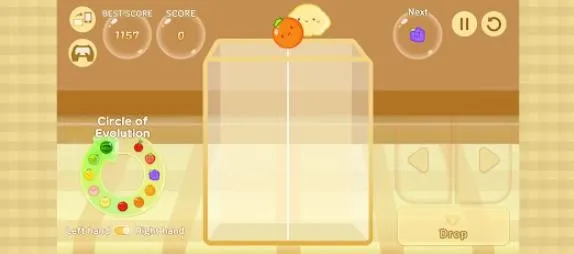
The central mechanic is based on combining matching fruits. I move the current fruit horizontally above the container and choose where to release it. Once dropped, gravity takes control. If it touches another fruit of the same type, the pair merges into the next fruit in the sequence.
Small pieces gradually become larger ones. Cherries combine into strawberries, strawberries become grapes, and the chain continues through increasingly large fruit until the watermelon appears. Every successful merge adds points and creates more room by replacing two objects with one.
That sounds generous, but larger fruits introduce their own problems. They occupy more space, roll more slowly, and can block access to smaller pieces trapped beneath them. Creating a large fruit is therefore both a reward and a new obstacle.
The game shows the current fruit and previews the next one. This small amount of information is essential. Good play requires planning not only where the current piece should land but also whether that position will remain useful when the following fruit arrives. I quickly learned that the ideal placement is rarely the most immediately satisfying one. Dropping a fruit onto its matching pair may create an instant merge, but the new larger object can roll into a central area and block future combinations. Sometimes it is better to delay a merge, preserve a clean side of the container, or build a sequence that can collapse later.
The run ends when the fruit pile crosses the upper boundary. There is no dramatic boss encounter or final mistake animation. The container simply becomes too full, and the score stops. That simplicity makes failure feel personal. The game does not hide the cause behind random enemies or complicated rules. I can usually identify the exact placement where the run began falling apart.
Physics: The Real Opponent Is Momentum
Suika Game’s difficulty comes primarily from physics. Fruit pieces have different sizes, weights, and collision behavior. They roll, bounce, settle, squeeze into gaps, and sometimes remain balanced in positions that look impossible. The circular designs make horizontal control unreliable after release. A fruit may land exactly where intended, then roll across the surface of a larger piece and settle on the wrong side. Another drop may disturb it minutes later.
This creates a useful distinction between aiming and predicting. I can choose the release point precisely, but I cannot control every collision that follows. Strong play comes from understanding likely movement and avoiding structures that depend on perfect stability. Large fruits should usually remain low because they are difficult to move once trapped near the top. Smaller fruits can fill gaps, but allowing too many different sizes to accumulate in one area creates a layered mess where matching pairs can no longer reach each other.
The container walls are both helpful and dangerous. They can stop pieces from rolling too far and support vertical stacks. They can also trap isolated fruit beneath larger objects, turning one side into unusable space. The physics occasionally feel inconsistent. A fruit may appear to touch its matching partner without merging immediately, while another pair combines after a slight collision that seemed less direct. These moments are usually minor, but they become frustrating during high-scoring runs where a few pixels can determine whether the pile survives.
Still, the uncertainty is part of the appeal. Suika Game would become a predictable sorting exercise if every piece behaved like a fixed tile. The wobbling, rolling, and accidental chain reactions give each attempt a different rhythm.
Strategy & Difficulty Curve: Order Matters More Than Speed
Suika Game does not reward fast input. There is no need to rush most placements, so I can study the container and consider the next fruit before dropping anything. The difficulty comes from creating long-term order inside a system that constantly produces new shapes.
One useful strategy is maintaining a rough size progression from one side of the container to the other. Keeping larger fruits together allows smaller pieces to remain accessible and reduces the number of isolated objects. The exact arrangement changes constantly, but some sense of hierarchy is better than allowing every size to spread randomly.
Another important habit is preserving open space in the center. The middle is valuable because fruit can roll toward either side, creating more possible combinations. Filling it with one awkward large piece can divide the container into two separate problems.
Small fruits deserve more attention than they initially appear to require. A cherry or strawberry near the bottom may seem harmless, but if it becomes covered by larger pieces, it can remain trapped for the entire run. Enough trapped pieces gradually raise the pile without contributing meaningfully to future merges.
Chain reactions provide the most satisfying moments. Two fruits merge, the new piece touches its match, and several levels combine in rapid succession. These sequences can rescue a crowded container by removing multiple objects almost instantly.
They can also destroy careful organization. A large fruit created during a chain may roll into an unexpected location, collide with another section, and push the entire pile upward. Success and instability often arrive together.
The early game feels forgiving because small pieces leave plenty of space. The middle becomes more strategic as several fruit sizes coexist. The late game is where control begins slipping away, especially when the container contains multiple large fruits and only narrow gaps remain. Reaching the watermelon is difficult but achievable. Creating additional high-level merges after that requires much stronger planning, favorable fruit order, and patience.
The Scoring System: Simple Numbers, Strong Psychological Pressure
Every merge increases the score, with larger fruits providing more value. The scoring system is easy to understand and gives immediate feedback without interrupting the game. Its simplicity creates strong replay motivation. I do not need to complete missions or unlock story chapters to feel progress. A higher score is enough.
The visible personal record becomes a constant challenge. A run may feel disappointing until one chain suddenly moves the score close to the previous best. At that point, every placement becomes more stressful because the possibility of improvement is real.
High scores also encourage risk. A safe placement may preserve the run, while an aggressive drop could trigger a valuable chain. The best decision depends on the current structure, next fruit, and how much open space remains.
The game can become mentally exhausting during long attempts because each placement carries future consequences. The presentation remains cheerful, but I often feel more pressure near a personal record than I do during louder competitive games. There is also a subtle danger in how quickly failed runs restart. The game removes almost every barrier between frustration and another attempt. One button leads directly back to an empty container and a fresh sequence.
This design is excellent for accessibility but dangerous for time management. “One more run” can become several because the next attempt always appears capable of correcting the previous mistake.
Visual Style: Friendly Fruit Hiding a Ruthless Puzzle
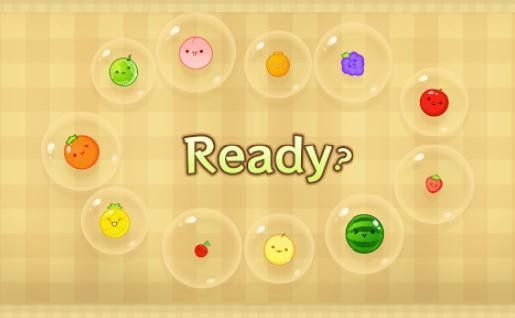
Suika Game uses a bright, simple visual style built around cheerful fruit with small faces. Each piece is immediately recognizable, and the size progression is clear without requiring labels.
The expressions create personality without turning the game into a character-driven experience. A fruit may look pleased while being crushed beneath several larger objects, which adds gentle comedy to the tension.
The transparent container keeps the entire puzzle visible. There are no unnecessary environmental details competing with the pieces, and the plain background helps collisions remain readable.
Color choices are strong enough to distinguish neighboring fruit types quickly. This matters because players often need to identify possible merges while several pieces are partially hidden. The larger fruits feel rewarding partly because their visual presence is so obvious. Creating a melon or watermelon changes the entire composition of the container. The interface is minimal and easy to read. Score, next fruit, and available information remain visible without covering the play area.
The art direction may look too simple for players expecting visual progression, animated environments, or elaborate effects. Suika Game offers nearly the same presentation throughout every run. For me, that restraint supports the design. The game does not need dramatic graphics because the changing fruit pile becomes its own visual story.
Audio & Music: Calm Sounds That Make Failure More Dangerous
The soundtrack is light, repetitive, and intentionally relaxing. It creates the atmosphere of a casual puzzle game rather than a high-pressure challenge. That calmness is slightly deceptive. The music encourages me to continue playing even as the container approaches disaster. Merge sounds are clear and satisfying. Each successful combination provides a small burst of feedback, while larger chain reactions produce a rhythm that feels rewarding even before I check the score. The fruit collisions are softer but still useful. I can hear pieces settling, rolling, and bumping into one another, which makes the physics feel more physical.
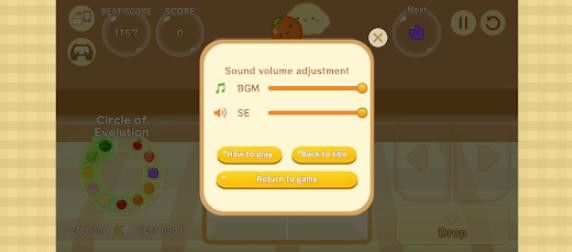
The game does not use dramatic audio to announce every mistake. A poor placement may sound almost identical to an ordinary one, leaving the player to recognize the long-term danger visually. The soundtrack can become repetitive during extended sessions. Because the game encourages many consecutive runs, the same music may eventually feel more hypnotic than pleasant. Playing with lower volume or personal background audio can help, though the original sounds contribute meaningfully to the relaxing identity.
Technical Performance & Controls: Almost Nothing Between the Player and the Puzzle
The controls are extremely simple. I move the fruit left or right and release it. This makes the game accessible to players who do not normally play action games or complex puzzle titles. Input feels responsive, and the preview line makes horizontal placement easy to understand. The difficulty comes after release rather than during control. Performance requirements are modest. The game does not rely on detailed 3D environments, heavy effects, or fast camera movement. Stable physics matter more than graphical power. Loading times are short, and restarting is almost immediate. This supports the rapid replay loop but also makes it easy to lose track of time.
The most noticeable technical annoyance comes from collision interpretation. A piece may seem close enough to merge but remain separated by a tiny gap or another hidden fruit. At other times, a falling object can create a surprisingly strong movement through the pile.
These interactions are generally consistent with the physics system, yet they do not always feel intuitive. A high-scoring run can end because one piece bounces farther than expected or causes a chain of movement that is difficult to anticipate. The game rarely feels technically broken. Its frustrations come from the fact that believable physics are not always predictable physics.
MoA Small Game Without Competitive Pressure
Suika Game is refreshingly simple compared with modern live-service titles. The core experience does not depend on buying stronger fruit, energy refills, randomized rewards, or temporary boosts. There is no pay-to-win structure because there is no competitive advantage available through spending. Progress depends entirely on placement, planning, and understanding the physics.
The game’s value comes from replayability rather than volume. It has one central mechanic, limited visual variety, and no large narrative campaign. Players expecting dozens of modes may consider the package too small. The important question is whether the main loop remains interesting. For me, it does. Every fruit sequence creates a slightly different puzzle, and the physics prevent exact repetition.
Additional modes or content may expand the experience depending on platform and version, but the original appeal remains focused on solo score chasing. The lack of aggressive monetization makes the game easy to recommend. It does not interrupt a run with advertisements or turn failure into a sales opportunity. Its greatest cost is time. The game’s design makes another attempt feel harmless even after a long session.
Who Should Play Suika Game?
Suika Game is ideal for players who enjoy score-based puzzle games, physics systems, compact sessions, and mechanics that are easy to learn but difficult to master. It works especially well as a portable game because a run can begin quickly and does not require complicated preparation.
Fans of Tetris, Threes, 2048, Drop7, and other combination puzzles may appreciate the focus on space management and future planning. Suika Game is less precise than most grid-based puzzles because its pieces roll freely, so tolerance for imperfect outcomes is important. It also suits players who want something relaxing without being completely passive. The music and visuals are calm, but the decision-making remains engaging.
Players who need story progression, character development, frequent unlocks, or visual variety may lose interest quickly. The entire experience depends on whether improving one score feels meaningful. Perfectionists may find the physics frustrating. A carefully planned structure can collapse because of one bounce, and not every failure feels completely avoidable.
Final Verdict: One of the Best Examples of Doing One Thing Extremely Well
Suika Game succeeds because it does not confuse complexity with depth. Its controls can be explained in one sentence, but every drop contains several possible consequences. A fruit may create an immediate merge, support a future chain, block an important space, or disturb a structure that appeared stable.
The physics give the game personality. A grid-based version would be easier to predict, but it would lose the rolling accidents and surprising recoveries that make each run memorable. The visual style is cheerful without distracting from the puzzle. The sound effects make combinations satisfying, while the gentle music creates a comfortable rhythm that can hide how tense the later stages become.
I appreciate the absence of aggressive monetization and unnecessary progression. The game does not demand daily missions, battle passes, or character upgrades. It asks only whether I can create a better fruit pile than last time. That focus also creates its main limitation. Players who do not care about score improvement will discover nearly everything the game offers very quickly.
For everyone else, Suika Game is dangerously effective. It turns a handful of smiling fruit into a puzzle about space, probability, patience, and the consequences of one careless decision. I recommend Suika Game to puzzle fans, portable players, casual audiences, score chasers, and anyone looking for a relaxing game that still demands attention.
Personal rating: 9/10.
Suika Game earns that score for its elegant mechanics, satisfying merges, excellent replay loop, accessible controls, charming presentation, and surprising strategic depth. It loses one point for repetitive audio, limited content variety, frustrating collision outcomes, and physics that occasionally make careful planning feel less important than luck.
The game begins with an empty container and one tiny fruit. A few minutes later, the entire space becomes a record of every decision I made. That is why restarting feels so irresistible: the next pile always looks like it could finally become perfect.

Leave a comment
Your comment is awaiting moderation. We save your draft here
0 Comments