







The Crash That Changed How I Looked at Driving Games
My first serious accident in BeamNG.drive was not spectacular by the game’s standards. I was driving an ordinary family sedan along a narrow road, entered a corner too quickly, clipped the outside barrier, and struck a tree with the front-left side of the car. There was no cinematic explosion. Instead, the wheel folded backward, the suspension collapsed, the hood bent upward, and the steering began pulling violently to one side. I could still move, but the vehicle no longer felt healthy. That small, believable chain of consequences explains why this BeamNG.drive review is about much more than watching cars crash.
BeamNG.drive is a soft-body vehicle simulator developed and published by BeamNG. It entered Steam Early Access on May 29, 2015, and remains an actively developed project. Its defining technology simulates vehicle structures as deformable interconnected components rather than treating each car as one solid object. The result is a driving game in which body panels bend, frames twist, suspension parts fail, wheels become misaligned, and mechanical damage directly affects how a vehicle behaves.
At first, the attraction appears obvious. Select a vehicle, find a steep hill or solid wall, accelerate, and observe what happens. BeamNG.drive is exceptionally good at turning destructive curiosity into entertainment. I can compare how a compact hatchback and a heavy truck survive the same collision, launch vehicles from ramps, create traffic accidents, or test how much punishment a suspension system can absorb.
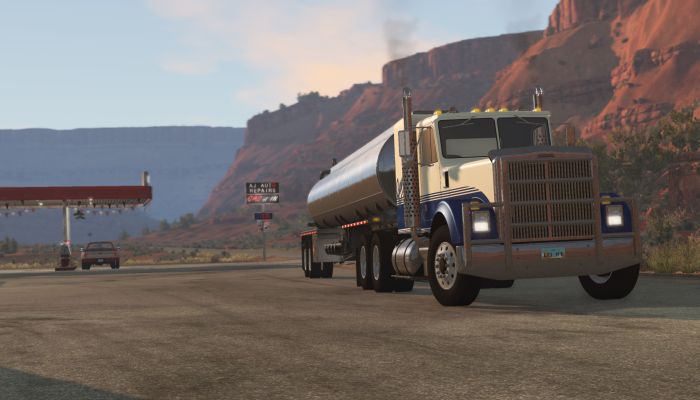
However, treating it only as a crash simulator misses most of its value. The same physics that make destruction convincing also make ordinary driving meaningful. Weight transfer matters. Tires react to different surfaces. A loaded truck behaves differently from an empty one. A damaged driveshaft changes acceleration. A bent steering component can turn a simple journey into a struggle.
My first hours were therefore divided between scientific curiosity and complete irresponsibility. One moment I was testing braking distances. The next I was attaching a trailer to a powerful truck and attempting to descend a mountain road far too quickly. BeamNG.drive encourages both approaches without insisting that one is more legitimate.
That freedom is its greatest advantage. It is also the source of one of its biggest weaknesses. New players can enter a map and immediately ask, “What am I supposed to do?” The game provides scenarios, missions, time trials, deliveries, campaigns, and an experimental career mode, but its strongest identity remains that of an open sandbox. Players who require a clearly directed progression path may initially find it empty.
Core Gameplay & Mechanics: Every Vehicle Is a Machine, Not a Costume
The central feature of BeamNG.drive is its soft-body physics system. Most driving games calculate vehicle movement around a comparatively rigid model and then display damage through prepared visual states. BeamNG.drive takes a more detailed approach. Vehicle structures are built from nodes and beams that react to forces in real time, allowing deformation to emerge from the specific angle, speed, mass, and location of an impact.
This distinction affects everything. If I hit the centre of a concrete wall head-on, the front structure compresses differently from a narrow impact against a pole. A side collision may distort the doors and roof while leaving the engine operational. Landing hard after a jump can damage suspension components without visibly destroying the body. Driving over a sharp obstacle may puncture a tire or bend a wheel.
The impressive part is not merely that vehicles become damaged. It is that the damage remains mechanically relevant. A car with a crushed radiator may continue moving until overheating becomes a problem. A damaged wheel can wobble and pull the vehicle off line. A broken axle may eliminate power delivery to part of the drivetrain. Severe frame deformation can make the car almost impossible to control even when the engine still runs.
This creates a strong relationship between cause and effect. When I lose control after an accident, I can often identify why. The steering wheel may no longer be centred because the front suspension is bent. Acceleration may weaken because the engine or drivetrain has suffered damage. The vehicle does not simply switch from a healthy state to a generic damaged state.
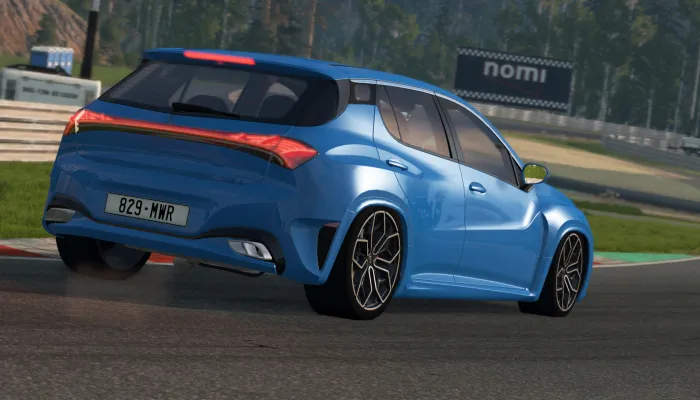
Driving physics are equally important before a crash occurs. Cars have distinct weight, suspension behaviour, power delivery, braking performance, tire grip, and drivetrain characteristics. A front-wheel-drive hatchback feels different from a rear-wheel-drive sports car. A heavy off-road truck requires more space to slow down. An older vehicle may have softer suspension and less predictable handling than a modern performance model.
BeamNG.drive supports multiple input methods, including keyboard, mouse, gamepad, and steering-wheel hardware. A controller provides a practical middle ground because analogue steering and throttle inputs make smooth driving easier. Keyboard control remains usable, but the digital nature of the keys can make subtle steering corrections or gradual acceleration more difficult.
Using a steering wheel changes the character of the simulation. Force feedback communicates grip loss, surface changes, and damage more directly. Yet hardware configuration can require patience, particularly with less common devices. BeamNG provides support documentation for steering-wheel troubleshooting, which reflects both the flexibility of the input system and the possibility of setup complications.
The vehicle selection is broad without depending on real-world manufacturer licences. Fictional brands cover compact cars, sedans, sports models, off-road vehicles, vans, buses, trucks, classic machines, and specialised configurations. Each base model may include numerous variants with different engines, transmissions, suspension setups, body styles, tires, and equipment.
This approach gives the developers freedom to design mechanically detailed vehicles without being limited by licensing agreements. The cars are fictional, but many feel inspired by recognisable automotive categories and eras. I quickly began remembering model names because each vehicle developed its own personality.
Customization is detailed. I can change individual parts, adjust tire pressure, alter suspension geometry, modify gear ratios, remove body panels, install different engines, or create unusual configurations. The system supports serious mechanical experimentation as well as absurd projects. I can build a sensible track car or attach inappropriate parts to a vehicle and discover why nobody would do that in reality.
The tuning interface can be intimidating. Numbers, component names, and technical settings appear without always explaining their practical effect. Players with automotive knowledge may enjoy this depth immediately. Others may need experimentation or external guides before understanding why a small suspension adjustment changes the car’s behaviour.
Maps are built around different driving disciplines. Urban areas support traffic, police chases, deliveries, and ordinary road driving. Mountain routes test braking and handling. Off-road environments challenge suspension travel, traction, and ground clearance. Industrial locations provide ramps, machinery, and large spaces for experimentation.
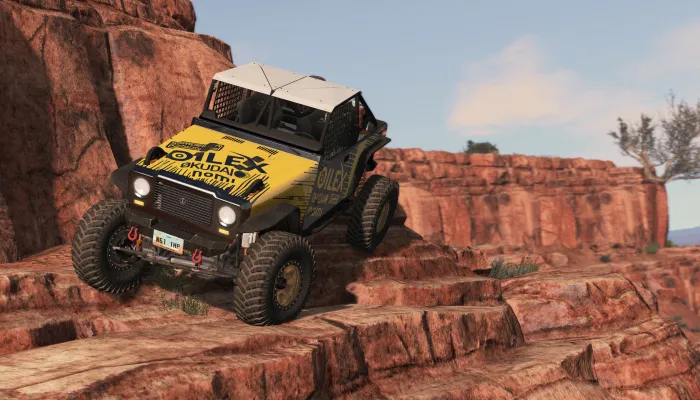
Surface simulation adds further variety. Asphalt, gravel, dirt, mud, sand, rocks, and uneven terrain demand different techniques. A powerful sports car that feels stable on a clean road may become useless on a loose slope. An off-road vehicle with appropriate tires and suspension can maintain progress where speed alone fails.
Free Roam is the purest sandbox mode. I choose a map, spawn a vehicle, adjust conditions, add traffic or artificial-intelligence vehicles, and create my own activity. The game allows environmental objects and circumstances to be manipulated, reinforcing experimentation as a central part of the experience.
Scenarios and missions add more structure. These may involve racing, delivering cargo, escaping police, completing stunt routes, towing vehicles, transporting passengers, or controlling specialised machinery. The quality varies, but the better activities demonstrate that BeamNG.drive’s physics can support more than destruction.
Racing feels unusual because mistakes carry physical consequences. In many racing games, scraping a barrier costs a little speed. Here, the same contact may damage alignment and compromise every following corner. I began driving more cautiously because preserving the vehicle mattered as much as setting a fast time.
Off-road challenges are especially convincing. Progress depends on wheel placement, momentum, differential behaviour, gearing, and throttle control. Charging at every obstacle rarely works. A slower approach can prevent underbody damage or keep the vehicle balanced on uneven ground.
Career Mode attempts to organise these systems into a broader progression structure. It combines vehicle ownership, purchases, repairs, missions, rewards, and different driving disciplines. The mode remains experimental and unfinished, which fits the game’s continuing Early Access status. BeamNG’s long-term plan has consistently described a fully developed open-world vehicle simulator with career activities across several disciplines.
I appreciated having reasons to care about a specific vehicle. Damage becomes more meaningful when repairs have a cost and the car belongs to my developing garage. However, the career systems still feel less complete than the sandbox. Progression can be uneven, menus are not always elegant, and the mode occasionally exposes features that are still being assembled.
Artificial intelligence can populate roads with traffic, race against the player, flee, chase, or follow routes. At its best, traffic makes maps feel alive and creates unpredictable situations. At its worst, AI vehicles make strange decisions, brake unexpectedly, or fail to respond naturally to complex accidents.
Official online multiplayer has not yet been fully released. BeamNG’s FAQ previously stated that online multiplayer was not among the originally promised features, although the developers announced in May 2026 that official multiplayer is now in development. That announcement also confirmed a major graphics overhaul planned for version 0.39 and a PlayStation 5 release targeted for later in 2026.
Community multiplayer modifications have filled part of this gap, but they do not provide the seamless official experience many players expect. For a simulation that would work brilliantly with cooperative convoys, shared crash testing, racing, and role-playing, the absence of integrated multiplayer remains a notable limitation.
Graphics, Audio, and Technical Performance: Beautiful Machines Under Heavy Calculation
BeamNG.drive’s presentation has improved considerably through years of updates. Vehicles are detailed, reflections and materials can look convincing, and many maps provide attractive roads, forests, towns, industrial areas, and landscapes. The game can produce excellent screenshots, particularly when lighting and weather conditions cooperate.
Vehicle deformation is the visual centrepiece. Panels bend around the actual point of impact, glass breaks, bumpers detach, suspension components collapse, and entire structures twist under severe force. Because the damage is calculated rather than selected from a small set of animations, accidents rarely look exactly the same.
This unpredictability makes replays fascinating. I often paused after an accident to inspect how the force travelled through the vehicle. A minor initial contact might push the car into a second, more destructive impact. A wheel could detach and strike another object. Cargo could shift, changing the balance of a truck before it overturned.
The simulation does occasionally produce strange results. Components may stretch unnaturally, body panels can vibrate, and extreme collisions sometimes create shapes that no real material could maintain. These moments are understandable given the complexity of the system, but they break the illusion.
Environmental visuals are less consistent than vehicle models. Some locations look modern and carefully detailed, while older areas show simpler textures, sparse scenery, or dated geometry. The announced graphics overhaul for version 0.39 may address part of this inconsistency, but as of July 2026 it remains upcoming rather than available in the current public release.
The user interface is functional but dense. Vehicle selection, parts configuration, tuning, AI settings, environmental controls, and debug tools provide enormous flexibility. They also create layers of menus that can be difficult to navigate.
Spawning or replacing vehicles may pause the experience briefly, particularly when loading complex models or large configurations. Mods can increase these delays. A heavily customized installation may take significantly longer to load and can introduce conflicts that do not exist in the standard game.
Audio contributes strongly to mechanical identity. Engines sound different according to configuration, forced induction becomes audible, transmissions react to load, tires communicate loss of grip, and impacts have convincing weight. The developers continue refining vehicle sounds; version 0.38, for example, adjusted turbocharger behaviour and sound for specific engine types.
Damage sounds are detailed without relying on one generic crash effect. Metal deformation, glass, suspension impacts, tire noise, and detached components create layered accidents. A low-speed scrape sounds different from a high-energy collision.
Technical performance is the price of this detail. BeamNG.drive is demanding because every active vehicle requires ongoing physics calculations. Adding traffic, trailers, multiple vehicles, complex maps, high graphics settings, or artificial intelligence can reduce performance substantially.
The processor often matters as much as the graphics card. A powerful GPU may render the scene comfortably while the simulation struggles to calculate many vehicles simultaneously. Players expecting to fill a city with dense traffic may need to lower their ambitions or upgrade their hardware.
This is my first major annoyance. The game invites large-scale experimentation, but performance limits how far that experimentation can go. A dramatic multi-vehicle collision is exciting until the frame rate collapses during the most important moment.
The second technical frustration is the effect of mods. BeamNG.drive has extensive modding potential and an active community, which adds vehicles, maps, configurations, scenarios, and utilities. The official game page also highlights integration with Automation, allowing players to export their custom car designs into BeamNG.drive.
Mods can dramatically expand the experience, but outdated or poorly built content may cause errors, broken textures, unstable physics, or longer loading times. Troubleshooting often requires disabling modifications, clearing the cache, or starting in Safe Mode. The freedom is valuable, but maintaining a large mod collection can become work.
The latest publicly documented release available in July 2026 is version 0.38.6, published on May 18, 2026. The update history shows frequent patches, vehicle revisions, map changes, physics adjustments, and technical fixes, confirming that development remains active.
Monetization & Ads: One Purchase, No Fuel Packs
BeamNG.drive uses a traditional premium model. I purchase the game and gain access to its vehicles, maps, scenarios, career experiments, configuration tools, and official updates. There are no premium currencies, energy limits, loot boxes, paid repair timers, or vehicle packs required to remain competitive.
There are also no intrusive advertisements during play. The interface does not interrupt a driving session to promote unrelated products, and a destroyed vehicle can be reset without watching a video or spending a consumable resource.
This model suits a simulation built around experimentation. I can restart an accident, replace a vehicle, change a configuration, or test another map without worrying about a resource economy. The game encourages curiosity rather than punishing it.
BeamNG.drive is not pay-to-win because there is no official competitive economy built around stronger purchased vehicles. Every standard vehicle and configuration is part of the base product. Community-created content may have its own distribution conditions, but the official game does not sell mechanical advantages through an in-game store.
The Early Access status deserves consideration. Players are purchasing a game that has been available for many years but is still officially unfinished. Steam’s Early Access description states that the project remains in development and that its eventual full version is intended to become a more complete open-world vehicle simulator with a developed career mode.
That label may concern buyers who expect a clearly finished campaign. In practice, the current sandbox already contains enough systems to provide hundreds of hours for the right player. The unfinished areas are most obvious in career progression, interface consistency, AI behaviour, and the absence of completed official multiplayer.
The value is excellent for simulation enthusiasts, vehicle experimenters, mod users, and content creators. It is less certain for players who want a short, directed experience with a final objective.
There are no recurring fees from BeamNG itself. Console users may eventually face platform-specific online subscription requirements once the PlayStation 5 version and official multiplayer arrive, but the exact implementation was not confirmed in the May 2026 announcement.
Who Should Play This? Drivers, Engineers, Creators, and Curious Destroyers
BeamNG.drive is ideal for players fascinated by how vehicles move, fail, and respond to physical forces. I do not need professional mechanical knowledge to enjoy it, but curiosity makes a major difference. The game rewards anyone who wants to know what happens when weight, speed, terrain, suspension, and damage interact.
Driving-simulation fans will appreciate the detailed handling and broad hardware support. The experience can be adjusted for casual controller play or a more serious steering-wheel setup. Assists and vehicle configurations make it possible to experiment without immediately understanding every mechanical system.
Car enthusiasts will find enormous value in the configuration tools. Engines, transmissions, tires, suspension, body components, and drivetrain layouts can be changed or tuned. The fictional brands are detailed enough to support the kind of comparisons usually associated with licensed automotive games.
Players who enjoy open-ended sandboxes are another clear audience. BeamNG.drive provides tools rather than a fixed sequence of entertainment. I can create police chases, delivery routes, off-road expeditions, races, mechanical tests, film scenes, or elaborate accidents.
Content creators benefit from the replay tools, camera options, custom scenarios, mods, and visually convincing destruction. BeamNG.drive has become especially recognizable through online videos involving crash tests, obstacle courses, police pursuits, and vehicle comparisons.
Modding enthusiasts should also feel comfortable. The official repository and community ecosystem extend the game far beyond its standard content. Integration with Automation adds another creative path by allowing custom-designed vehicles to enter the simulation.
The game is less suitable for players who need constant direction. Free Roam provides no automatic purpose. I must decide where to drive, what to test, or which challenge to create. Career Mode helps, but it remains incomplete.
Traditional racing fans may also be surprised. BeamNG.drive can support racing, yet it is not structured like a polished championship game. There is no central licensed motorsport ladder, cinematic career story, or large official online ranking system.
Players using low-end computers should examine the hardware requirements carefully. One vehicle on a simple map may run acceptably, while dense traffic and complex scenarios place far greater demands on the system. Performance scales with simulation complexity.
Anyone expecting flawless realism should also maintain reasonable expectations. BeamNG.drive is unusually advanced, but it is still a game and an evolving technical project. Tire modelling, AI, extreme deformation, aerodynamics, and some vehicle systems continue to develop.
Final Verdict: The Most Convincing Place to Make a Terrible Driving Decision
BeamNG.drive began my session as a crash simulator and ended it as one of the most flexible vehicle sandboxes I have played. Destruction remains an important attraction, but the real achievement is the relationship between structure, movement, damage, and control.
Driving carefully can be as satisfying as crashing. Completing an off-road route without breaking a suspension component, controlling a loaded truck down a steep hill, or finishing a race with damaged steering creates tension that scripted damage systems cannot reproduce.
The game also has an unusual educational quality. It demonstrates why speed matters, how weight affects stopping distance, why different drivetrains behave differently, and how one damaged component can influence an entire vehicle. It communicates these ideas through direct consequences rather than lectures.
BeamNG.drive is not polished in every area. Its career mode remains experimental, official multiplayer has only been announced rather than completed, and performance can limit large scenarios. The interface occasionally feels like engineering software attached to a game.
Those flaws matter, but they do not erase what the simulation achieves. Few driving games make individual vehicles feel this physical. Fewer still allow such freedom to test, modify, damage, repair, and compare them.
I recommend BeamNG.drive strongly to vehicle enthusiasts, sandbox players, mod users, content creators, and anyone fascinated by realistic physical systems. Players seeking a guided campaign or effortless online competition should understand that those areas remain less developed.
The game’s continuing Early Access status is unusual after more than a decade, but active updates and the announced graphics, multiplayer, and console plans show that development has not stopped. As of July 2026, BeamNG.drive remains an evolving project rather than a finished destination.
Personal rating: 9/10.
BeamNG.drive earns that score for its extraordinary soft-body physics, meaningful vehicle damage, detailed handling, flexible sandbox tools, extensive customization, active modding community, and fair premium model. It falls short of a perfect rating because career progression is incomplete, official multiplayer is not yet available, AI behaviour remains inconsistent, and demanding scenarios can severely affect performance.
It is one of the best games available for discovering exactly how badly a simple driving mistake can escalate—and why the car will never feel the same afterward.
Pros

- High level of realism in physics and vehicle dynamics
- Extensive modding community providing endless customization
- Immersive and detailed crash and deformation effects
- Flexible gameplay allowing for creative experimentation
- Scalable performance accommodating various hardware configurations
- Detailed environments with realistic weather and terrain effects
Cons

- Steep learning curve and challenging controls for beginners
- Performance issues on lower-end systems under heavy simulation load
- Limited availability on platforms outside of PC

Leave a comment
Your comment is awaiting moderation. We save your draft here
0 Comments