







Half Dog, Half Police Officer, Completely Chaotic
The opening idea behind Dog Man sounds like a joke invented by a child who refused to choose between two favorite characters. A police officer and his dog are injured during an explosion, and doctors save them by combining the dog’s head with the officer’s body. The result is Dog Man: a heroic law-enforcement officer with human strength, canine instincts, and absolutely no ability to resist a bouncing ball. This Dog Man review begins with that absurd origin because the film succeeds when it treats childish imagination as a creative advantage rather than something that needs to be corrected.
Released in 2025 and directed by Peter Hastings, Dog Man adapts Dav Pilkey’s popular graphic-novel series. The movie follows the title character as he protects Ohkay City from Petey the Cat, an inventive criminal whose latest schemes become more complicated after he creates a younger clone of himself named Li’l Petey.
The film uses the same visual world and comic attitude associated with Captain Underpants. Characters are deliberately simple, rules change whenever a joke requires it, and serious emotional ideas are hidden inside ridiculous situations.
At first, Dog Man appears to be a straightforward battle between an enthusiastic hero and an irritated villain. The hero catches criminals. Petey escapes from prison, builds machines, and creates increasingly ambitious plans. Then Li’l Petey enters the story and changes its emotional direction.
The younger cat does not inherit Petey’s bitterness. He is kind, curious, affectionate, and excited to meet the person he considers his father. His presence forces both Dog Man and Petey to consider forms of responsibility they were never prepared to accept.
That emotional foundation prevents the movie from becoming only a sequence of visual jokes. Dog Man remains loud, strange, and extremely fast, but underneath the chaos is a story about loneliness, chosen family, and the possibility of becoming better than the person who raised you.
Plot & Storytelling: A Super-Cop, a Criminal Cat, and One Unexpected Child
Dog Man begins with Officer Knight and his police dog Greg attempting to stop Petey. The confrontation ends in an explosion that leaves both partners severely injured.
The medical solution is presented with comic simplicity. Greg’s head is attached to Knight’s body, creating a new officer who combines their abilities and identities. The film does not spend time discussing the scientific, legal, or philosophical consequences of this decision. Dog Man exists, everyone accepts him, and the story immediately moves forward.
Dog Man becomes an effective police officer because he possesses physical strength, loyalty, courage, and a dog’s ability to track criminals. He also creates problems by chasing objects, licking people, scratching at doors, and reacting instinctively to cats. Petey remains his main enemy. The criminal cat is highly intelligent, mechanically talented, and deeply committed to proving that he is the smartest person in the city.
His schemes are rarely motivated only by money. Petey wants recognition. Every machine and escape plan is another attempt to demonstrate superiority over Dog Man, the police, and the society that repeatedly rejects him.
After becoming dissatisfied with working alone, Petey creates a clone. He expects the clone to become a smaller version of himself: brilliant, cynical, and immediately useful.
Instead, Li’l Petey emerges as an innocent kitten. He sees Petey as a father and assumes that their relationship will include affection, play, and emotional support. Petey is completely unprepared for this expectation. He created an assistant, not a child.
Li’l Petey’s kindness frustrates him because it cannot be explained as weakness or manipulation. The kitten continues to believe Petey can be good, even when Petey insists otherwise. Eventually, Dog Man becomes responsible for Li’l Petey. Their relationship develops through play, care, and shared routines rather than biological connection.
This creates a new conflict. Dog Man may be Petey’s enemy, but he provides the stable and loving home that Petey failed to create. The movie also introduces Petey’s father, known as Grampa. His presence reveals where Petey learned some of his bitterness and selfishness.
Grampa treats his son with little warmth and takes advantage of situations for personal benefit. Petey wants approval from him despite understanding that the relationship is harmful.
The story uses these three generations to explore how cruelty can be passed down. Grampa dismisses Petey. Petey begins repeating similar behavior toward Li’l Petey. Li’l Petey interrupts the pattern by continuing to offer kindness.
The final conflict involves a revived fish villain and a citywide threat that forces Dog Man and Petey to cooperate. The larger action provides spectacle, but the real resolution concerns Petey’s willingness to protect someone other than himself.
The plot is intentionally messy. Machines appear quickly, prison escapes happen with little consequence, and characters cross the city according to comic convenience.
That looseness fits the source material, though the number of subplots can make the middle section feel crowded. The film moves between Dog Man, Petey, Li’l Petey, the police station, Grampa, television reporters, and the larger villain without always giving each development enough space.
Dog Man: A Silent Hero With a Very Expressive Tail
Dog Man does not speak in conventional dialogue. He communicates through barking, whining, body language, facial expressions, and physical action.
This could have made him feel limited beside more talkative characters. Instead, the silence becomes one of his defining strengths.
The animators use his ears, eyes, posture, tail, and movement to communicate emotion. Excitement is immediate. Confusion appears through a head tilt. Sadness changes his entire body. Peter Hastings provides Dog Man’s vocal sounds, giving the character enough variation to react clearly without turning the barking into disguised speech.
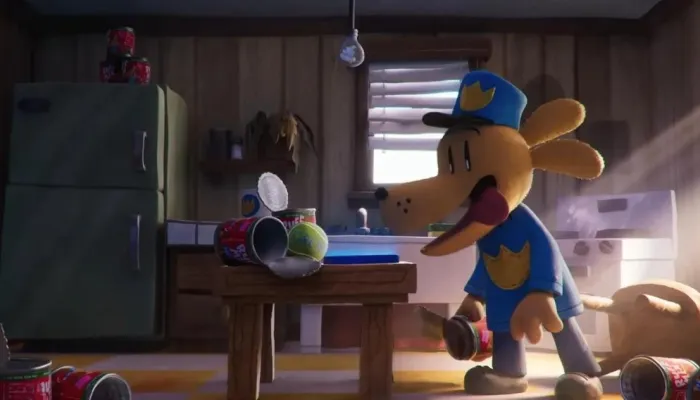
Dog Man’s heroic qualities are simple but effective. He is loyal, brave, and willing to protect others. He does not spend time discussing whether someone deserves help. His weaknesses come from instinct. He can be distracted by balls, food, squirrels, and ordinary dog behavior.
These jokes work because they do not undermine his competence completely. Dog Man may become distracted, but he usually returns to the mission when someone is in danger.
His relationship with Li’l Petey reveals his emotional warmth. Dog Man does not need an explanation before caring for the kitten. He simply recognizes that Li’l Petey needs protection and companionship. Their bond gives Dog Man more purpose than his battles with Petey. He becomes a parent-like figure despite having no experience with family life.
One limitation is that Dog Man sometimes feels secondary inside his own film. Petey speaks, changes, creates the major conflicts, and receives the deeper backstory. Dog Man remains the emotional center through kindness, but the villain receives more dramatic material. The title character is easy to love without being the most complex person in the story.
Petey and Li’l Petey: The Villain Finds Someone Who Believes in Him
Petey is the movie’s most developed character. He begins as a comic villain but gradually becomes the focus of its emotional story.
Pete Davidson voices Petey with a mixture of arrogance, irritation, insecurity, and reluctant warmth. His performance makes the character funny without hiding the resentment beneath the jokes.
Petey wants everyone to recognize his intelligence, yet he frequently sabotages the possibility of genuine connection. It is easier for him to be hated as a villain than risk being rejected after behaving sincerely.
Li’l Petey threatens that defensive identity because he assumes Petey is worthy of love before receiving any evidence. Lucas Hopkins Calderon gives Li’l Petey a bright and open voice. The character asks direct questions, responds to danger with optimism, and views family as something that should naturally involve care.
His innocence could have become overly sentimental. The movie avoids that by giving him playful energy and allowing him to participate in jokes rather than existing only as a moral lesson.
Petey initially treats Li’l Petey as a failed experiment. The younger cat does not possess the cynicism, obedience, or criminal ambition Petey expected. Over time, Petey begins responding to the kitten’s trust. He does not transform immediately, and he continues making selfish decisions.
That gradual movement makes the arc convincing within the film’s exaggerated world. Petey is not secretly good in every situation. He is someone capable of change because another person gives him a reason to care.
Their relationship becomes more powerful after Grampa appears. Petey’s father demonstrates the kind of parent Petey could become if he continues treating affection as weakness.
Petey must choose whether to repeat the behavior that hurt him or create something different for Li’l Petey. The movie’s emotional message is clearest here: understanding the source of harmful behavior does not excuse repeating it.
Li’l Petey also refuses to divide the world into perfect heroes and permanent villains. He can love Petey while recognizing that some of Petey’s choices are wrong. That is a surprisingly mature idea inside a movie filled with fart jokes, giant robots, and characters named after obvious personality traits.
Supporting Characters & Voice Performances: A Loud City Around a Quiet Hero
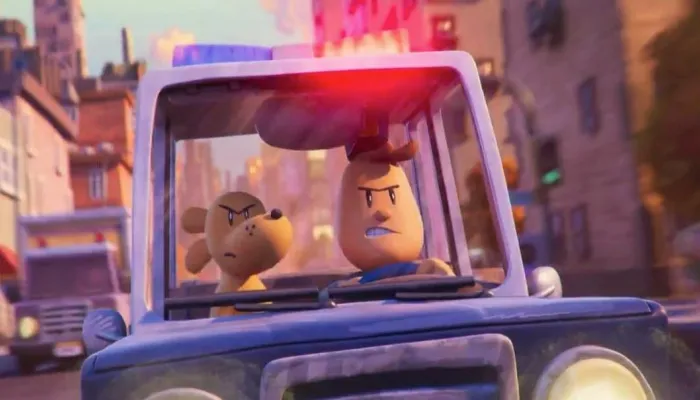
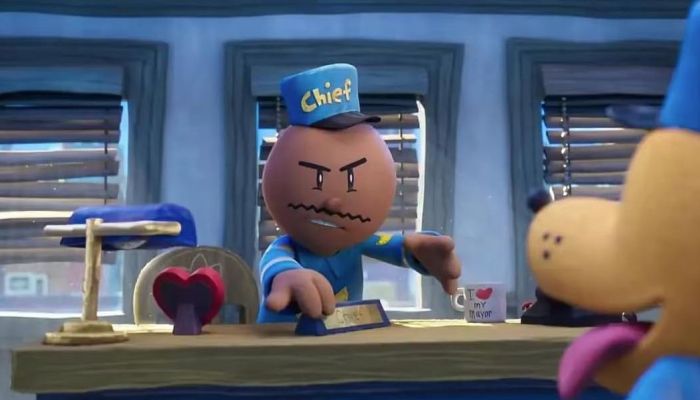
Lil Rel Howery voices Chief, the leader of the police department. He is enthusiastic, emotionally reactive, and often less organized than Dog Man.
Chief provides broad comedy through his attempts to appear authoritative while responding to increasingly impossible events. Isla Fisher voices Sarah Hatoff, a television reporter who covers Dog Man’s adventures with dramatic energy. Her character helps the film parody news media and public celebrity.
Sarah frequently treats chaos as a broadcasting opportunity. Her excitement about the story can appear more important to her than the danger surrounding it. Ricky Gervais voices Flippy, a telekinetic fish whose role expands into the movie’s larger threat. His dry delivery contrasts with the visual absurdity of the character.
Stephen Root voices Grampa with a careless and self-interested attitude. The performance makes it immediately clear why Petey carries so much resentment. Billy Boyd voices Seamus, Sarah’s camera operator, bringing nervous reactions to situations that other characters accept too easily.
The cast understands the film’s exaggerated tone. Performances are broad, fast, and designed to match characters who can move from emotional conversation to visual chaos within seconds. The strongest voice work belongs to Pete Davidson because Petey must support both comedy and genuine character development.
The supporting cast is entertaining, though several characters are used more as comic devices than complete personalities. Chief shouts, Sarah reports, and Seamus worries. Their simplicity matches the graphic-novel style, but it leaves much of the emotional work to Petey and Li’l Petey.
Humor & Comedy Style: Childish Jokes With Surprisingly Careful Timing
Dog Man uses nearly every form of comedy available to an animated family film. There is physical slapstick, toilet humor, wordplay, visual labels, exaggerated television reporting, strange inventions, and characters reacting directly to the logic of the story.
The film is not embarrassed by childish humor. Buildings explode, characters fall, machines malfunction, and bodily functions occasionally become important plot events. Some adults may find this material tiring. Younger viewers are likely to respond more positively because the jokes are direct and visually clear.
The strongest comedy comes from Dog Man’s animal instincts. A serious police operation can be interrupted because someone throws a ball or mentions a cat. These jokes work because Dog Man remains emotionally sincere. He is not trying to behave foolishly. His body simply reacts before his heroic mind catches up.
Petey’s frustration also provides reliable humor. He designs complicated plans and then watches them collapse because of Li’l Petey’s innocence, Dog Man’s unpredictability, or his own ego. The film often uses written text as part of the joke. Signs, labels, newspaper headlines, and visual sound effects preserve the handmade feeling of Dav Pilkey’s books.
My first major criticism is the speed. Jokes arrive so quickly that some disappear before the audience can fully process them. My second concern is repetition. Dog Man’s distractions, Chief’s panic, and Petey’s irritation return frequently with only small variations.
Still, the movie understands comic escalation. A simple mistake may begin with one object and end with an entire building changing shape. The humor is generally warm rather than cruel. Characters may be embarrassed or injured through cartoon logic, but the film rarely asks the audience to enjoy genuine suffering.
Visual Design & Animation: A Graphic Novel That Refuses to Sit Still
Dog Man uses a stylized computer-animated design that closely reflects the spirit of Dav Pilkey’s illustrations. Characters have simple shapes, strong outlines, and deliberately exaggerated proportions.
The movie does not attempt realistic fur, skin, architecture, or movement. It wants to look like a child’s drawing transformed into a flexible animated world.
That decision gives the film a clear identity. Ohkay City does not resemble a generic modern metropolis. Buildings bend, signs become jokes, and objects behave according to emotional rather than physical logic.
Character designs communicate personality immediately. Dog Man has large eyes, an expressive muzzle, and a police uniform that looks slightly too formal for his movements.
Petey’s sharp face and controlled posture reflect his intelligence and irritation. Li’l Petey uses rounder shapes and wider expressions to communicate innocence.
Grampa resembles an older, rougher version of Petey, making their connection visible before the relationship is explained fully.
The animation moves between polished action and intentionally rough visual ideas. Comic panels, drawn effects, and written words may appear within the three-dimensional world.
This mixture supports the film’s playful tone. It feels as though the story is being invented while I am watching.
Action scenes are colorful and readable, though the final sequences become visually crowded. Giant characters, machines, vehicles, explosions, and multiple groups compete for attention.
The strongest visual moments are usually smaller. Dog Man playing with Li’l Petey, Petey reacting to affection, or a hand-drawn label appearing beside an invention captures the film’s personality better than a large explosion.
The simple style also helps emotional expressions. Because the faces are not realistic, small changes can become exaggerated without appearing disturbing.
Music, Direction & Pacing: A Fast Film With a Soft Emotional Center
Peter Hastings directs Dog Man with constant momentum. The film moves from origin story to police comedy, Petey’s schemes, Li’l Petey’s arrival, family conflict, and citywide danger with very little delay. This pace reflects the source material’s short chapters and rapid jokes. It also helps younger viewers remain engaged.
The disadvantage is emotional compression. Petey’s relationship with his father, Li’l Petey’s attachment to both Dog Man and Petey, and Dog Man’s role as caregiver all deserve more quiet time.
The film does pause occasionally, especially when Petey begins recognizing how his behavior affects Li’l Petey. These scenes are brief but effective because they contrast with the surrounding chaos.
Tom Howe’s music supports the movie’s comic action and emotional warmth. Heroic themes accompany Dog Man’s police work, while Petey’s inventions receive more theatrical energy.
The score does not dominate the film. It supports timing and mood while allowing sound effects, barking, dialogue, and visual jokes to remain central. Songs and musical references appear as part of the comedy, though the soundtrack is not the movie’s most memorable feature.
Hastings is most successful when balancing ridiculous action with sincere character interaction. The film can move from a silly invention to a conversation about family without making either element feel completely false.
The transitions are not always smooth. A serious moment may be interrupted by a visual joke before its emotional impact has fully settled. That choice keeps the tone light, but it occasionally suggests that the film is nervous about allowing sadness to remain visible.
Themes & Emotional Meaning: You Are Not Required to Repeat the Past
Dog Man’s central theme concerns inherited behavior. Petey learned selfishness and emotional distance from Grampa. When Li’l Petey enters his life, Petey initially repeats the same pattern. He dismisses affection, avoids responsibility, and treats the younger cat as useful only when he follows instructions.
The film does not argue that Petey’s childhood excuses this behavior. It explains why change feels difficult. Li’l Petey represents the possibility of interruption. He has Petey’s intelligence without his resentment and sees no reason why power must be connected with cruelty.
Dog Man provides another model of family. He and Li’l Petey are not biologically related, yet their relationship is built from daily care, play, safety, and loyalty. The film therefore presents family as behavior rather than origin. A parent is not simply the person who created a child. A parent is someone willing to provide responsibility and affection.
Petey’s eventual change is motivated by recognizing what Li’l Petey needs and what he himself never received. The movie also explores whether people can become more than the roles assigned to them. Dog Man is created from two injured bodies but becomes a distinct person.
Petey is labeled a villain and repeatedly performs that identity. Li’l Petey refuses to believe the label defines every possible future. Even the city’s attitude toward Dog Man suggests that identity can be created through actions rather than conventional appearance.
The message is simple enough for younger viewers: being hurt does not give someone permission to hurt others, and changing direction remains possible. For adults, Petey’s story carries a more specific emotional truth. Recognizing harmful family patterns is only the beginning. Breaking them requires different choices when those choices feel unfamiliar.
Critical Reception & Audience Response: A Successful Adaptation of Childlike Chaos
Dog Man received generally positive reviews, with critics praising its visual style, fast comedy, faithful connection to Dav Pilkey’s books, and emotional story involving Petey and Li’l Petey. Reviewers frequently noted that the film was clearly designed for children but contained enough sincerity and visual invention to remain enjoyable for adults.
Pete Davidson’s performance as Petey attracted particular attention because it gave the villain humor and vulnerability. The animation was also praised for preserving the handmade personality of the source material rather than transforming it into a realistic or generic computer-animated world.
Some critics found the story overly crowded and the pace exhausting. The rapid jokes, loud action, and large number of characters can make the film feel longer than its running time. Others argued that Dog Man himself becomes less developed than Petey. The villain receives the emotional arc, while the hero remains a largely silent symbol of kindness.
Audience response was especially positive among families familiar with the books. Children could recognize characters, visual jokes, and the series’ intentionally ridiculous logic. Parents and adult viewers were more divided by the toilet humor and constant activity. Tolerance for Dav Pilkey’s style strongly influences the experience.
The film’s reputation is likely to remain stronger among its intended audience than among viewers seeking sophisticated animation drama. That does not make the movie careless. Its emotional message is clear, and its visual identity is more distinctive than many safer family adaptations.
Final Verdict: A Silly Superhero Comedy With a Genuine Family Story
Dog Man is exactly as strange as its title promises. It contains a dog-headed police officer, an evil cat inventor, a cheerful kitten clone, a telekinetic fish, giant machines, cartoon violence, and enough written sound effects to fill a comic book.
The surprise is how much emotional meaning the film creates from that chaos.
Dog Man works as a hero because he is kind without needing to explain his morality. He protects people, cares for Li’l Petey, and offers affection without demanding that anyone earn it first. Petey becomes the film’s most interesting character because he must decide whether being treated badly has permanently defined him.
Li’l Petey gives him a chance to create the relationship he never experienced. That opportunity is uncomfortable because kindness requires more vulnerability than villainy.
Pete Davidson gives Petey enough sarcasm to remain funny and enough emotional hesitation to make the eventual change believable.
The animation preserves the rough, energetic personality of Dav Pilkey’s books. It does not polish away the childish drawings, labels, visual noise, or ridiculous physical rules. The humor will divide adults. Some jokes are clever, while others depend entirely on shouting, bodily functions, or repeated accidents.
For the intended audience, that mixture is likely to work. Children receive fast comedy and action, while the emotional story introduces ideas about responsibility, forgiveness, and harmful family patterns.
I recommend Dog Man to families, fans of the books, younger superhero viewers, and anyone who appreciates animation that refuses to appear overly polished or serious. Viewers who dislike toilet humor, rapid editing, or deliberately childish storytelling may find the film exhausting.
Personal rating: 8/10.
Dog Man earns that score for its distinctive animation, expressive title character, strong Petey storyline, lovable Li’l Petey, faithful comic-book energy, and thoughtful themes about chosen family. It loses points for crowded plotting, repetitive jokes, limited development for Dog Man, a noisy climax, and emotional scenes that often end too quickly.
Dog Man may be half dog and half police officer. The film’s real heroism comes from something less unusual: choosing kindness when repeating old cruelty would be easier.
Pros

- Engaging storyline that blends humor, action, and emotional depth seamlessly
- Vibrant and detailed animation style that captivates viewers of all ages
- Dynamic character development that makes each persona relatable and memorable
- Exceptional voice acting that brings authenticity to every character
- A well-balanced mix of fast-paced adventure and reflective moments, keeping the narrative engaging
- Thoughtful themes that explore friendship, identity, and personal growth without feeling forced
Cons

- Some plot elements may seem underdeveloped for viewers expecting a more intricate narrative
- Occasional rapid pacing in certain scenes could leave little time to fully appreciate the stunning visuals
- The distinctive quirky humor might not cater to all tastes, potentially limiting its appeal

Leave a comment
Your comment is awaiting moderation. We save your draft here
0 Comments