





A Language App That Is Brilliant at Making Me Return
Duolingo understands one uncomfortable truth about learning better than many traditional courses: the perfect lesson is useless when I never begin it. The app removes almost every excuse. Lessons are short, the interface is friendly, the next activity is always obvious, and a determined green owl is prepared to remind me that my daily streak is in danger. I can complete an exercise while waiting for coffee, sitting on public transport, or pretending that five minutes of vocabulary practice makes the rest of my unproductive evening academically respectable.
This Duolingo review is based on using the app as a daily learning tool rather than expecting it to replace a complete language education. That distinction matters. Duolingo is excellent at building routine, introducing vocabulary, reinforcing sentence patterns, and making repetition feel less tedious. It is considerably weaker at developing spontaneous conversation, explaining complicated grammar consistently, and preparing me for the unpredictable speed of real people speaking naturally.
The application has expanded far beyond its original reputation as a simple collection of translation exercises. Modern courses include listening, speaking, Stories, short audio programs, personalized review, character-based conversations, pronunciation tasks, and content connected with recognized proficiency levels. Duolingo also offers mathematics, music, and chess lessons, although language learning remains the central attraction.
Its greatest achievement is not that every lesson is revolutionary. Most individual exercises are simple. The achievement is that millions of people willingly repeat those exercises day after day. Duolingo turns consistency into a visible game, and that game can create genuine progress when I understand its limits.
Getting Started: Fast, Friendly, and Almost Frictionless
Setting up a Duolingo course is easy. I select a language, choose a reason for learning, estimate my current level, and set a daily goal. Beginners can start from the first unit, while learners with previous experience may take a placement test or jump ahead.
The onboarding process avoids overwhelming me with grammatical terminology or long explanations. Within minutes, I am matching words, arranging sentences, listening to short recordings, and selecting translations. That immediate participation helps the app feel accessible even when the language uses an unfamiliar writing system.
The placement process is useful but imperfect. A short test can estimate whether I recognize common words and structures, yet it cannot fully measure speaking ability, listening under pressure, or gaps in grammar. I have occasionally been placed into material that felt too easy in one area and surprisingly difficult in another.
The app’s main path removes decision fatigue. I do not need to design a curriculum or decide which topic should come next. Duolingo places one lesson after another and gradually introduces new vocabulary and structures.
This approach is ideal when I want guidance. It is less convenient when I need to study one specific subject immediately, such as hotel vocabulary before a trip or a particular verb tense before an exam. The path prioritizes Duolingo’s sequence rather than my short-term emergency.
The Learning Path: Clear Progress With Limited Freedom
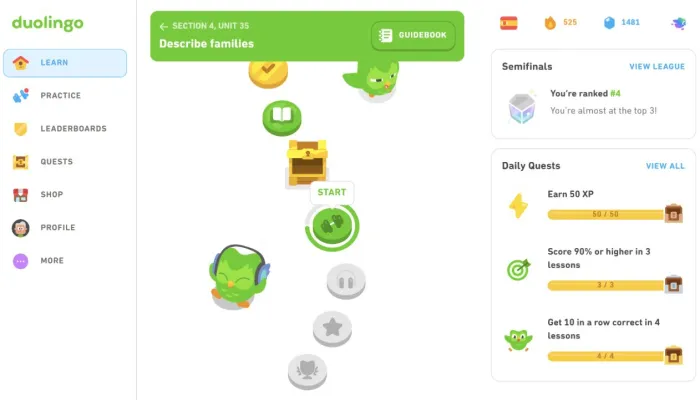
The current path organizes lessons into units with a largely fixed progression. Each section combines new material with review, listening, speaking, stories, and occasional challenge levels. Completing one group unlocks the next.
I appreciate the clarity. Older versions of Duolingo displayed many separate skill circles, which gave me more choice but also encouraged chaotic studying. I could improve the easiest topics repeatedly while ignoring difficult material. The path reduces that temptation.
The disadvantage is reduced control. When one unit feels repetitive, I cannot always replace it with a completely different subject without jumping farther ahead. The system decides when review is necessary and sometimes repeats familiar sentence patterns longer than I would choose independently.
Repetition is not automatically a flaw. Language learning requires seeing the same structures many times. The annoyance comes when repetition feels predictable rather than adaptive. I occasionally recognize the position of an answer or remember the exact sentence without demonstrating that I could produce the same idea in a real conversation.
The strongest courses use the path to build a visible progression from basic survival language toward more complex reading and listening. Smaller courses can feel significantly thinner, with fewer stories, shorter paths, less speaking practice, and limited advanced content.
Lesson Design: Small Exercises With Real Educational Value
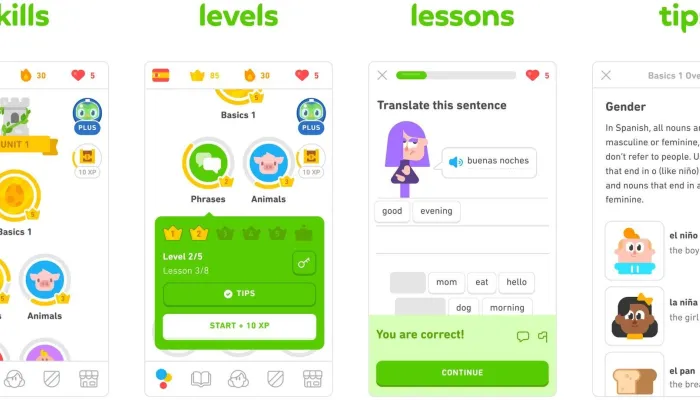
Most Duolingo lessons combine several familiar activity types. I translate short sentences, arrange words into the correct order, choose an image, listen and type what I hear, repeat a phrase aloud, match vocabulary pairs, or complete a missing word.
These exercises work well for recognition and controlled recall. They help me notice spelling, sentence order, gender, agreement, and common grammatical patterns. The app also introduces mistakes repeatedly, which can be useful when the repetition targets a genuine weakness.
The best exercises require me to produce an answer rather than recognize one. Typing a complete sentence from memory is more demanding than selecting from four options. Speaking without seeing the full sentence is more useful than repeating text already displayed on the screen.
Duolingo sometimes gives too much assistance. Word banks can allow me to construct a correct answer through elimination even when I would not know how to create the sentence independently. Images and multiple-choice options provide additional clues that make success feel more impressive than the underlying recall ability.
I learned to improve the value of lessons by answering aloud before looking at the available choices. This small habit turns passive recognition into active practice. The app does not require that extra effort, but it benefits greatly from it.
Vocabulary: Effective for Building a Base
Duolingo is particularly good at introducing common vocabulary gradually. New words appear inside sentences, return in later lessons, and become associated with audio, spelling, and simple grammatical patterns.
The short lesson format makes vocabulary review less intimidating than a large traditional word list. I rarely need to memorize twenty isolated terms at once. Instead, the app brings them back across multiple activities.
The characters and recurring scenarios also provide useful context. Words related to food, travel, work, family, shopping, and everyday routines appear in short situations rather than completely disconnected flashcards.
The weakness is that the context can remain artificial. Duolingo is famous for strange sentences, and unusual combinations can improve memorability. However, memorable does not always mean useful. Knowing how to describe an owl playing chess is less urgent than understanding what a pharmacist is asking me.
Advanced vocabulary coverage varies considerably by language. Popular courses provide more categories, longer paths, stories, audio content, and higher-level material. Less-developed courses may introduce a reasonable beginner vocabulary but offer limited support beyond that stage.
Grammar: Learning Patterns Before Understanding Rules
Duolingo often teaches grammar through exposure. Instead of presenting a long explanation of a rule, it gives me many examples and expects the pattern to become familiar. This approach can feel natural and avoids turning every lesson into a textbook chapter.
For simple structures, it works well. Repeated sentences can teach common word order, verb forms, articles, agreement, and pronouns without requiring technical vocabulary.
The limitation becomes obvious when two forms appear similar or when a mistake depends on a rule I have not understood. A red correction shows that my answer is wrong, but the explanation may be brief, unavailable, or hidden behind a premium feature.
This creates one of my main frustrations. Mistakes are essential to learning, yet the free experience sometimes treats them more as obstacles than opportunities for detailed instruction. I know which answer the app expected, but not always why my version failed.
I would not use Duolingo as my only grammar source. A concise grammar guide, teacher, or reliable reference can explain in two minutes what repeated trial and error may leave unclear for several days.
Listening Practice: Useful Training in Controlled Conditions
Listening exercises begin slowly and clearly. I hear a word or sentence, identify what was said, and can usually replay the audio at a reduced speed. This is useful for beginners learning to separate unfamiliar sounds.
As courses progress, longer audio lessons and DuoRadio-style activities provide more natural exchanges. Different character voices help prevent the language from sounding like one perfect speaker reading a textbook.
The practice still occurs under unusually favorable conditions. Recordings are short, clean, and connected with vocabulary I recently studied. Real conversations contain interruptions, background noise, unfinished sentences, regional accents, and speakers who do not wait for me to process every word.
Duolingo can build the foundation required for real listening, but it cannot reproduce the complete experience. I receive better results when I combine it with videos, podcasts, music, or conversations created for native speakers.
I also found that reading the screen too quickly can reduce the value of listening exercises. When text is visible, my eyes may solve the question before my ears have processed it. Looking away during the first playback creates a more honest test.
Speaking and Pronunciation
Duolingo includes speaking exercises that ask me to repeat phrases or respond aloud. These activities are valuable because they interrupt the habit of studying a language silently.
The speech recognition usually identifies whether my pronunciation is close enough to the expected phrase. This provides quick encouragement, particularly for beginners who feel uncomfortable hearing themselves speak.
It is not a precise pronunciation coach. The app may accept a phrase with weak rhythm or imperfect sounds, and it can occasionally reject speech that seems understandable. Microphone quality, background noise, and device settings also affect the result.
Repeating one prepared sentence is different from creating an original response. I can sound confident while reading and still freeze when someone asks an unexpected question.
AI-supported conversations in Duolingo Max attempt to reduce that gap. Roleplay presents practical situations, while Video Call with Lily allows a more flexible exchange. These tools are promising because they require active language production rather than simple repetition. Their usefulness depends on the language, level, device, subscription, and whether the supported scenarios match my goals.
Stories and Character-Based Learning
Stories are among Duolingo’s strongest features. They present short conversations involving recurring characters and ask questions about meaning, vocabulary, and context.
The writing is usually playful, and the characters have recognizable personalities. Lily is dry and unimpressed, Eddy is enthusiastic but not always perceptive, Junior creates energetic complications, and Oscar treats ordinary situations with dramatic seriousness. These personalities make repeated practice less mechanical. A sentence becomes easier to remember when it belongs to a situation involving a character rather than an anonymous textbook speaker.
Stories also teach inference. I need to understand why someone is surprised, what another person intends, or how a misunderstanding developed. This feels closer to actual reading than translating isolated statements. Not every course has the same quantity or quality of stories. Learners in the largest language courses receive a richer experience, while smaller courses may feel like simplified versions of the platform.
Gamification: The Reason Duolingo Becomes a Habit
Duolingo turns learning into a visible system of points, levels, quests, streaks, leagues, achievements, reward chests, and limited-time bonuses. Completing a lesson produces immediate feedback and a satisfying sense of movement. The streak is the most powerful feature. Seeing a growing number creates emotional resistance to missing a day. Even when I do not feel motivated, I may complete one small lesson to protect the record.
This is valuable because consistency matters. Ten focused minutes every day can produce more progress than one long session followed by two weeks of inactivity. The danger is that maintaining the streak can become more important than learning. I have completed an easy review lesson late at night simply to preserve the number, even though I was too tired to remember much. The app recorded success, but the educational value was limited.
Leagues can create the same distortion. Competing for XP encourages activity, yet the most efficient way to earn points may involve repeating easy exercises with bonuses rather than studying difficult new material. Gamification is a tool, not proof of mastery. My position on a leaderboard says more about app activity than conversational ability.
Energy, Hearts, and the Frustration of Limited Practice
Duolingo has experimented with systems that limit free learners after mistakes or lesson activity. Depending on the account, platform, and current tests, users may encounter Hearts or the newer Energy system. The older Hearts approach removes a heart when I make a mistake. Losing all hearts can interrupt progress unless I practise, wait, watch an advertisement, spend gems, or subscribe.
Energy is designed differently. Lessons consume part of a battery, correct answer streaks can restore some energy, and the supply recharges over time. In theory, this punishes individual mistakes less directly than Hearts. My underlying concern remains the same: a learning app should not make experimentation feel expensive. Language learners need permission to guess, fail, correct themselves, and try again.
Limited resources may encourage concentration, but they also create pressure to choose safe answers. A difficult lesson becomes emotionally connected with the possibility of being locked out or redirected toward payment. This is one of the clearest ways the free version reminds me that Duolingo is both an educational platform and a subscription business.
Streaks, Notifications, and the Green Owl’s Personality
Duo the owl has become more than a mascot. Notifications, animations, widgets, social media posts, and exaggerated threats about lost streaks have created a recognizable brand personality. The humor makes reminders less corporate. Instead of receiving a neutral message about unfinished work, I may see a dramatic owl behaving as though one missed lesson has destroyed a lifelong friendship.
This personality is effective because it turns the app into a recurring character in my routine. It also becomes tiring when reminders feel manipulative or when several features compete for attention. Notifications can be adjusted, and I recommend doing so. A learning habit should remain intentional rather than developing into anxiety about disappointing an animated bird. The mascot works best as encouragement. When the app uses loss aversion too aggressively, motivation starts feeling closer to obligation.
Super Duolingo: Paying for a Smoother Version
Super Duolingo removes advertisements and provides a less restricted learning experience. Depending on the current platform and system, subscribers receive unlimited Hearts or Energy, expanded review tools, mistakes practice, and unrestricted access to certain challenges.
The biggest benefit is convenience. Lessons flow without commercial interruptions, and difficult exercises no longer carry the same fear of exhausting a limited resource.
The Practice Hub is useful for targeted review, especially when I want to revisit mistakes, listening exercises, speaking tasks, or weak vocabulary. It makes the app feel more like a learning tool and less like one narrow path.
Super does not transform the teaching method completely. The core exercises remain similar to the free version. I am paying primarily for fewer restrictions, fewer interruptions, and easier access to practice.
Whether it is worth the cost depends on frequency. A daily user may save enough time and frustration to justify the subscription. Someone completing a few lessons per month can learn plenty without paying.
Duolingo Max and AI Conversation
Duolingo Max includes Super benefits and adds AI-powered activities such as Roleplay and Video Call with Lily. These features are designed to create conversations that respond to my answers rather than follow one completely fixed script.
Roleplay places me in situations like ordering food, discussing plans, shopping, or asking for information. Afterward, the app may provide feedback on accuracy and complexity.
Video Call with Lily feels closer to spontaneous speaking. Lily asks questions, reacts to responses, and continues the exchange without requiring another human learner to be available.
This can be valuable for people who experience anxiety during live conversation. The artificial partner is patient, always accessible, and unlikely to become irritated when I pause or make an obvious mistake. The limitations are important. Availability differs by language and course. AI feedback can miss nuance, and a simulated conversation cannot fully reproduce the social pressure, accent variation, interruptions, and unpredictable phrasing of a real speaker.
Max is the most interesting version of Duolingo for active speaking, but it is also the most expensive tier. I would not pay for it solely because it contains AI. Its value depends on whether I will use those speaking features regularly rather than returning to easier standard lessons.
Advertisements and Monetization
The free version of Duolingo is usable, but monetization is visible. Advertisements can appear after lessons, subscription promotions are frequent, and limited-resource systems encourage upgrades.
Most ads do not interrupt an exercise halfway through, which is better than many free mobile apps. They usually appear after a completed lesson, allowing the educational task itself to remain focused. The frequency can still become annoying during a longer study session. Completing several short lessons means encountering the possibility of several interruptions. Duolingo also promotes free trials aggressively. Trial offers are useful, but users should pay attention to renewal conditions and subscription management.
I would not describe Duolingo as pay-to-win because language learning is not a competitive game with a purchasable victory. I would describe it as free-to-start and genuinely useful without payment, while carefully designed to make the premium experience feel significantly more comfortable.
Course Quality: Popular Languages Receive the Best Experience
Duolingo offers an impressive number of courses, including widely studied languages and smaller or fictional options. The variety makes the platform accessible to learners with unusual interests.
Course quantity should not be confused with equal course quality. Spanish, French, English, German, Italian, Portuguese, Japanese, Korean, and Chinese receive substantial development and increasingly advanced content.
Less popular courses may have shorter paths, fewer voices, limited stories, reduced speaking content, and little material beyond beginner or lower-intermediate levels.
This difference is one of the most important factors when evaluating Duolingo. Two users can install the same app and receive very different educational products depending on their selected language pair. The direction matters too. A course for English speakers learning Spanish may be more developed than a course for speakers of another language learning the same target language.
Can Duolingo Make Me Fluent?
Duolingo can help me become more capable. It can build vocabulary, introduce grammar, improve reading speed, train listening with controlled audio, encourage basic pronunciation, and establish a daily routine. Fluency requires more. I need extended reading, unscripted listening, original writing, cultural context, correction from knowledgeable speakers, and real conversations where I cannot predict the answer format.
The strongest Duolingo courses now contain material connected with higher proficiency levels, but completing a course path is not the same as demonstrating that level in every skill. Recognition inside an app may develop faster than spontaneous production.
I think of Duolingo as a strong foundation and maintenance tool. It is particularly effective during the beginner stage, when structure and frequent repetition are essential. At intermediate levels, it becomes one component of a larger system. I get better results when combining it with graded readers, native media, grammar references, tutors, language exchanges, and writing practice.
Math, Music, and Chess
Duolingo’s expansion into mathematics, music, and chess follows the same philosophy as its language courses: short exercises, immediate feedback, clear progression, and frequent rewards.
The math lessons are approachable and visually friendly, making them useful for refreshing basic concepts or helping younger learners practise without a traditional worksheet. Music lessons introduce rhythm, notation, and keyboard interaction through small challenges. The experience is playful, though a touchscreen cannot replace the physical technique of learning an instrument. Chess lessons teach piece movement, tactics, and common patterns in a structured format. They are useful for beginners who find full matches overwhelming.
These courses demonstrate how effectively Duolingo can package practice. They also reveal the limits of the format. Short, controlled exercises help me begin, but deeper ability requires longer and less predictable application.
Interface, Visual Design, and Technical Performance
Duolingo has one of the most recognizable interfaces in educational software. Bright icons, large buttons, expressive characters, and clear progress markers make the app easy to navigate.
Animations give correct answers a satisfying response without delaying lessons excessively. Mistakes are obvious, and instructions are usually understandable without lengthy tutorials.
The mobile app is the most complete version, particularly for newer premium and AI features. The web version can still be useful for typing practice and longer sessions but may not receive every function at the same time.
Performance is generally stable, although speech recognition, audio playback, and lesson synchronization can occasionally fail. Losing progress because of a connection issue is particularly irritating when a streak or limited Energy is involved.
The app changes frequently. Interface experiments, feature tests, and different systems may appear for one user before another. This makes the experience feel actively developed but can also create confusion when guides or screenshots no longer match the current layout.
Privacy and the Cost of Personalization
Duolingo personalizes lessons through account activity, mistakes, progress, and usage patterns. This helps the app decide what to repeat and how to maintain engagement.
Users should still review privacy settings and understand that a free digital service can collect information about learning behavior, device use, and interaction with features. AI conversation tools may involve additional processing because the app needs to interpret spoken or written responses.
I avoid sharing sensitive personal details during simulated conversations. Practising a language does not require telling an AI character private information that I would not place in another online service.
Personalization is helpful when it improves review. It becomes less comfortable when every interaction appears optimized primarily to increase time spent inside the app.
Who Should Use Duolingo?
Duolingo is ideal for complete beginners, casual learners, travellers preparing basic vocabulary, people returning to a language after a long break, and anyone who struggles to maintain a study routine. It is also useful for experienced learners who want a light daily review tool. A quick lesson can keep vocabulary active during periods when more serious study is difficult. Children and teenagers may respond well to the visual design and game systems, though younger users may need help understanding subscriptions, ads, privacy, and the difference between app progress and actual proficiency.
Duolingo is less suitable as the only resource for learners preparing for high-level professional communication, academic writing, interpretation, or advanced examinations. Those goals require detailed correction and extended language production. People who dislike gamification may find the streaks, leagues, animations, and repeated promotions distracting. A traditional textbook or tutor may provide a calmer experience.
How I Would Use Duolingo Effectively
I would begin with one manageable daily goal rather than chasing large XP totals. Fifteen focused minutes are more useful than an hour spent repeating easy lessons for league points. I would say every answer aloud, even when the app only asks me to tap words. This adds speaking practice without requiring a separate activity. I would keep a small external list of recurring mistakes. Writing down difficult structures forces me to process them beyond one correction screen. I would also combine Duolingo with real content as early as possible. Beginner videos, simple stories, songs, podcasts, and conversations reveal how the language behaves outside the app’s carefully controlled environment.
Most importantly, I would treat the streak as a reminder rather than an achievement. The purpose of the number is to support learning. Learning should never become a task performed only to protect the number.
My Rating
I give Duolingo a personal rating of 8.5/10. It is one of the most effective applications I have used for creating a daily learning habit. Its lessons are accessible, polished, and easy to fit into ordinary life. The characters, rewards, streaks, and short exercises turn repetition into something I am far more likely to continue.
The app becomes less convincing when its engagement systems compete with education. Energy restrictions, advertisements, league pressure, and constant subscription promotion can make learning feel like resource management. Grammar support is inconsistent, and successful app exercises do not guarantee that I can understand or answer a real person.
Duolingo works best when I stop asking whether it can make me fluent by itself. It is a strong starting point, a useful practice companion, and an unusually effective habit builder. It gives me a reason to interact with a language every day, but I still need to carry that language beyond the green owl’s carefully designed path.
The most honest recommendation is simple: use Duolingo, but do not live entirely inside it. Protect the habit, not merely the streak. Speak aloud, study your mistakes, listen to real people, and eventually enter conversations where no word bank is waiting at the bottom of the screen.
Pros

- Adaptive learning path tailored to individual pace
- Gamification features that boost motivation
- Visually appealing and user-friendly design
- Effective audio integration for pronunciation practice
- Regular updates and fresh content that keep the experience dynamic
- Engaging and interactive learning environment
Cons

- Limited in-depth explanation of complex grammar concepts
- The constant gamification may distract from deeper learning at times
- Some lessons can become overly repetitive

Leave a comment
Your comment is awaiting moderation. We save your draft here
0 Comments