
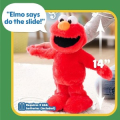






When Elmo Started Sliding Across the Floor
The first thing that caught my attention about the Sesame Street Elmo Slide Plush was not its familiar red fur or enormous orange nose. It was the movement. Most interactive plush toys remain in one place while they sing, speak, or wave their arms. This Elmo does something more ambitious: he sways his hips, flaps his arms, moves his mouth, and slides from side to side while performing “The Elmo Slide.” The result sits somewhere between a traditional stuffed character and a small dancing robot disguised as a cuddly preschool toy.
That combination creates an immediate sense of personality. Elmo does not simply play a recorded song after a button press. His whole body becomes part of the performance. Squeezing his left hand activates the main music-and-dance routine, while squeezing his right hand starts an “Elmo Says” activity based on the familiar Simon Says format. The toy can speak and sing in both English and Spanish, with a switch under the foot used to select the language.
At approximately 14 inches tall, Elmo is large enough to become the visual centre of a play session without being too large for a toddler to carry around the house. The official recommended age is two years and older, which makes sense considering the simple hand-activated controls and emphasis on following movement instructions.
My immediate concern was whether the sliding feature would be more than a short-lived novelty. Dancing electronic toys often produce an impressive first reaction but struggle to support imaginative play after the song has been repeated several times. Elmo Slide has a better foundation than many similar toys because children already know the character, can imitate his movements, and can use the plush in ordinary pretend play after the electronic routine ends.
Even so, this is not a quiet bedtime companion. It is an energetic toy built around music, repetition, physical movement, and a recognizable television personality. Parents searching for a calm plush may find its mechanical body and repeated song less appealing than a conventional stuffed Elmo. Families wanting an active, instantly understandable gift are more likely to appreciate what it offers.
Interactive Features & Play: Two Hands, Two Ways to Join Elmo
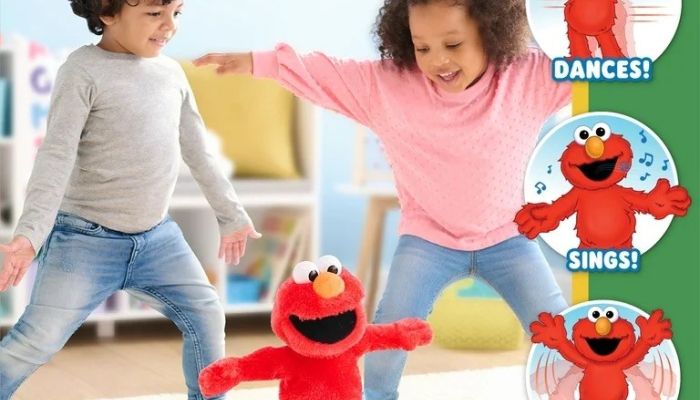
The main play mode begins by squeezing Elmo’s left hand. He performs “The Elmo Slide” while his arms flap, his hips sway, his mouth opens and closes, and hidden wheels move him laterally across a suitable surface. The routine encourages children to copy the dance rather than remain seated and watch.
This imitation is where the toy works best. A young child does not need to understand menus, read instructions, or remember a complicated button sequence. The action is visible and easy to copy. Elmo moves his arms, and the child can move their arms. Elmo slides to the side, and the child can attempt the same motion. The toy turns a recorded song into a basic physical activity.
The sliding mechanism depends heavily on the floor. Hidden wheels allow Elmo to move on smooth surfaces, but thick rugs, uneven flooring, deep carpet, and clutter can restrict or stop the motion. This is one of the most important practical limitations because the word “slide” creates an expectation of visible travel.
On a clean hard floor, the sideways motion should look more impressive and match the product demonstrations. On carpet, Elmo may continue singing and moving his upper body while making little progress across the surface. The toy therefore benefits from having a dedicated open area where furniture, small objects, and rug edges will not interfere with its wheels.
The second mode is activated through Elmo’s right hand. “Elmo Says” uses movement prompts such as lifting the arms, giving children simple instructions to follow. It works like an Elmo-themed version of Simon Says, with the character leading the activity.
I consider this mode more valuable for repeated play than the signature song. A musical performance is entertaining, but it remains largely the same each time. An instruction-following game gives the child a clearer role. Instead of watching the toy demonstrate its technology, the child listens, responds, and participates.
The two modes complement each other well. The dance routine provides the strongest first impression, while “Elmo Says” offers a more structured activity. Neither mode is mechanically complex, but complexity would not necessarily improve a toy designed for preschoolers.
The bilingual function adds meaningful flexibility. Moving the switch beneath Elmo’s foot changes between English and Spanish phrases and songs. This does not turn the toy into a complete language-learning system, but it can expose children to familiar instructions and sounds in another language.
Families should keep their expectations realistic. Elmo Slide does not offer open-ended conversations, voice recognition, personalized responses, or a large library of educational lessons. It uses pre-recorded phrases and routines. Its strength is consistency and simplicity, not advanced artificial interaction.
The controls are appropriately direct, though hand activation may require a deliberate squeeze. Very young children sometimes press interactive plush toys in the wrong location or lack enough hand strength to trigger a deeply placed button immediately. A parent may need to demonstrate where and how to squeeze each hand.
This is the first specific annoyance. The toy presents two activities through visually similar hands, but the distinction is not obvious until the child learns that the left and right sides trigger different routines. A clearer tactile marker could have made independent play easier.
The second annoyance is repetition. “The Elmo Slide” is intentionally catchy, which is excellent for children and potentially exhausting for adults after the tenth performance. The toy appears designed to encourage frequent activation, so its appeal to the child may become a test of patience for everyone else in the room.
Materials, Movement, and Build Quality: A Plush Toy With Machinery Inside
The exterior uses soft plush fabric intended to preserve Elmo’s familiar appearance and make the toy pleasant to touch. Product listings describe the fill as 100% recycled polyester, combining a traditional stuffed-toy surface with an internal electronic and mechanical structure.
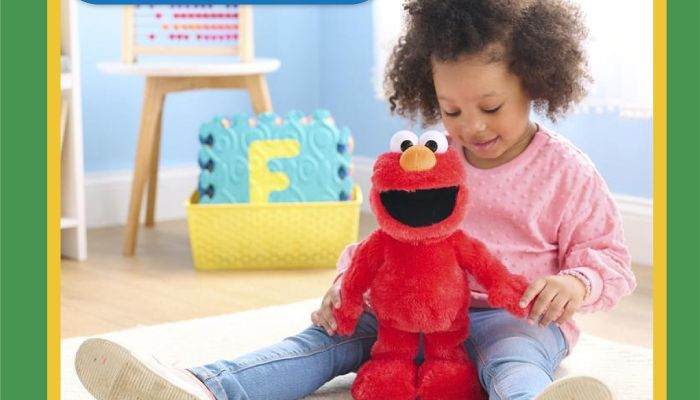
Visually, the toy captures the essential Elmo features well: bright red fur, round white eyes, a large orange nose, a wide black mouth, and long arms that become part of the dance routine. The exaggerated design is immediately recognizable to young Sesame Street fans.
The 14-inch size gives Elmo enough physical presence for the dance mechanics. A much smaller body would make the sliding motion less noticeable, while a larger model could be difficult for toddlers to handle. The dimensions place it between a small travel plush and a large display toy.
However, Elmo Slide is not as flexible or squeezable as an ordinary plush. Motors, wheels, speakers, battery housing, switches, and internal support components add firmness and weight. A child can hug or carry the toy, but it will not feel like a completely soft sleeping companion.
That difference matters when buying the toy as a gift. The product photographs may suggest a standard stuffed Elmo, while the real appeal is its electronic performance. Parents primarily seeking a cuddly plush should consider a simpler model without internal mechanics.
The hidden wheels are a clever design decision because they preserve the character’s appearance. Elmo does not look like a vehicle with visible rollers attached to his feet. When the toy is inactive, most of the movement hardware remains visually unobtrusive.
The wheels also introduce a practical cleaning concern. Hair, thread, dust, and small debris can collect around moving parts, particularly when the toy is used frequently on the floor. Keeping the play surface clean should help maintain consistent movement.
The listed care guidance recommends spot cleaning with a damp cloth and allowing the toy to dry flat. The electronic components mean it cannot be treated like a machine-washable stuffed animal. This could become inconvenient if a toddler spills food or a drink directly onto the plush.
Durability is difficult to judge solely from the soft exterior. The most vulnerable elements are likely to be the motorized mechanism and moving arms rather than the fabric itself. Children may naturally try to push Elmo manually, twist his limbs, stop him while he is sliding, or carry him by one arm.
Adult supervision is useful during the first sessions, not because the normal dance is unusually dangerous, but because children need to understand that the moving parts should not be forced. A toy with motors will generally require more careful handling than a passive plush.
The mouth movement adds personality to the performance. Seeing Elmo’s mouth open and close while he sings helps connect the voice to the character instead of making the audio sound as though it is coming from a hidden speaker. The synchronization does not need to be perfect to support the illusion.
The overall visual effect is strongest from a small distance. Up close, the mechanical stiffness becomes easier to notice. From across the floor, the swaying body, moving arms, opening mouth, and sideways travel create a lively performance that should hold a young child’s attention.
Audio, Languages, and Battery Performance: Catchy by Design
Elmo Slide is built around recognizable character audio. The voice, song, movement prompts, and cheerful delivery are intended to resemble the version of Elmo children know from Sesame Street. Familiarity is important because the emotional response depends partly on the belief that Elmo is performing specifically for the child.
The speaker must compete with the noise created by the internal motor and wheels. Electronic movement toys often produce mechanical sounds underneath their music, and Elmo’s sliding action cannot be completely silent. The song and voice should remain the main audio layer, but parents should expect to hear some motor noise during movement.
The English and Spanish options increase the toy’s usefulness in bilingual homes. Switching languages does not require an app, internet connection, account, or downloadable update. The physical selector is located under the foot, making the choice controlled by the parent rather than easily changed during every performance.
The simplicity is welcome. There is no Bluetooth setup, Wi-Fi pairing, mobile application, or software registration. Elmo works as a self-contained toy, which reduces privacy concerns and avoids the risk that a discontinued app will remove core features.
Four AA batteries are required, and batteries are included with the toy. Including them allows the toy to work immediately after unboxing, which is especially useful when it is given as a birthday or holiday gift.
Four batteries are also a significant ongoing requirement. Singing alone consumes power, but Elmo must additionally operate his mouth, arms, hips, and sliding wheels. Families whose children activate the toy repeatedly should expect to replace the batteries more often than they would in a simple talking plush.
The included batteries may be intended primarily for demonstration or initial use rather than maximum lifespan. Keeping a spare set available would prevent the toy from becoming unusable immediately after a child has become attached to it. One retailer-hosted customer review specifically praised the toy while noting the practical need to keep extra batteries ready.
Rechargeable AA batteries may reduce long-term expense, provided they are used according to the manufacturer’s battery instructions. Adults should handle installation and ensure that the compartment is closed correctly.
Battery-powered products also require careful storage. The product warning states that batteries must remain out of children’s reach and that suspected ingestion requires immediate medical attention. The battery compartment should be checked periodically, especially if the toy experiences drops or rough handling.
An automatic shutoff or limited routine duration is useful in this category because it prevents the toy from continuing indefinitely. A published hands-on review reported that Elmo turns off after a short period rather than producing continuous noise. Even with that safeguard, adults may still wish for a volume selector.
The lack of a clearly promoted volume control is a practical weakness. Children often enjoy louder repetition than parents do, and a low-volume setting would make the toy easier to tolerate in apartments, during early mornings, or near a sleeping sibling.
Price & Overall Value: More Performance Than a Standard Plush
The value of Sesame Street Elmo Slide Plush depends less on the quantity of features than on how strongly the child responds to Elmo. For a preschooler who already loves the character, seeing him sing and move may be much more exciting than receiving an unfamiliar interactive toy with more advanced technology.
The toy includes its central functions without additional purchases. There is no subscription, app, downloadable content, or accessory pack required to access the English song, Spanish mode, dance routine, or “Elmo Says” activity. Once batteries are installed, the complete experience is available.
That makes the ownership model straightforward. The only recurring cost is battery replacement. There are no advertisements, paid digital unlocks, or online accounts.
Retail price is less stable. Listings can vary considerably according to stock levels, region, seller, and whether the toy is still widely distributed. One historical UK review listed a launch-era price of approximately £60, while current marketplace listings may be higher or lower depending on availability.
I would hesitate to recommend paying an inflated reseller price. Elmo Slide is charming, but its routines remain limited. At a normal mainstream toy price, the moving mechanism and bilingual functions provide reasonable value. At a collector-level markup, the repetition and floor limitations become much harder to overlook.
The best value comes from active use. A child who dances, follows instructions, invents new movements, and includes Elmo in pretend stories receives more than a short electronic performance. A child who watches the song twice and loses interest leaves the buyer with an expensive motorized plush.
The toy may also work well in a preschool classroom, playgroup, or family setting where several children can copy the dance together. Its movement prompts naturally support group participation, although adults would need to manage turns when children want to hold or activate Elmo.
Compared with screen-based entertainment, Elmo Slide offers an appealing physical alternative. It encourages children to stand, listen, imitate, and move around the room. The manufacturer specifically promotes the toy as a way to inspire exercise and original dance movements.
It should not be presented as a serious fitness or educational device. The activity is brief and playful. The developmental benefit comes from movement, listening, imitation, and pretend play rather than a structured curriculum.
Who Should Buy This? The Right Audience for Elmo’s Dance Party
Sesame Street Elmo Slide Plush is best suited to children aged two and older who already recognize and enjoy Elmo. The official age recommendation begins at two years, while some regional retail coverage has described it for children aged three and above. Buyers should follow the age guidance printed on the packaging of the exact version sold in their market.
Toddlers who enjoy music and movement are the clearest audience. The toy offers an immediate invitation to stand, copy gestures, and move sideways. Children who are naturally energetic may engage more deeply than those who prefer quiet construction, drawing, or storybooks.
Bilingual English-Spanish families may find additional value in the language switch. Familiar phrases delivered by a trusted character can make another language feel playful rather than instructional.
The toy also suits children who enjoy interactive characters but are not ready for complicated electronic products. There are no screens, menus, passwords, or voice commands. Two hand controls activate the main activities.
Parents who want a quiet plush should skip it. Elmo Slide contains motors, recorded speech, music, and repeated phrases. Its body is firmer than a normal stuffed toy, and its greatest feature requires floor space.
Families with mostly carpeted rooms should also think carefully. Elmo can still sing and move his upper body, but the advertised sliding effect depends on a smooth surface. The product will not look as dynamic when the wheels cannot travel properly.
Children who are sensitive to loud sounds or sudden mechanical movement may need a gentle introduction. Adults can activate Elmo from a small distance before placing the moving toy directly beside the child.
It is less suitable for rough play. Throwing, sitting on the toy, pulling the arms forcefully, or pushing the body while the motor is running may shorten its life. A passive plush is a better choice for children who regularly treat toys as climbing equipment.
Gift buyers should confirm that the recipient actually likes Elmo. Character recognition supplies much of the emotional value. Without that connection, the toy becomes a limited singing figure competing against many other interactive products.
Final Verdict: A Charming Dance Partner With a Limited Playlist
Sesame Street Elmo Slide Plush is a successful interactive character toy because it does more than speak. Its coordinated mouth, arm, hip, and wheel movements create a genuine performance, while the two hand controls keep operation simple enough for preschoolers.
I particularly like that the toy encourages participation. The child is not only listening to Elmo sing. They are invited to copy his movements, follow instructions, and invent dances of their own. That gives the product more value than a plush that plays phrases without requesting a response.
The English and Spanish modes broaden its usefulness, and the absence of an app or internet requirement keeps setup straightforward. Four included AA batteries allow Elmo to perform immediately after opening the package.
The physical design also makes a positive impression. Elmo remains visually recognizable and soft on the outside, while recycled polyester fill adds a small sustainability benefit. The internal mechanism inevitably makes the body firmer than a traditional plush, but that is the compromise required for dancing and sliding.
The weaknesses are practical rather than surprising. Elmo needs a smooth, open floor to perform the advertised slide properly. The routines are limited, the sound may become repetitive, and regular use can consume batteries. Cleaning is also restricted to surface care because the toy contains electronics and motors.
I recommend Sesame Street Elmo Slide Plush for children aged two or older who love Elmo, enjoy music, and respond positively to imitation games. It is particularly suitable as a birthday or holiday gift when the child’s interest in Sesame Street is already known.
I would not recommend it as a premium-priced collectible, a quiet bedtime plush, or a durable companion for rough play. Buyers should also avoid inflated marketplace pricing when the toy’s limited set of routines does not justify a major markup.
Personal rating: 8/10.
Sesame Street Elmo Slide Plush earns that score for its expressive movement, recognizable character design, bilingual audio, simple controls, active-play focus, and entertaining “Elmo Says” mode. It loses points for repetitive sound, heavy battery use, limited cleaning options, mechanical stiffness, and a sliding feature that depends heavily on the floor.
For the right child, Elmo’s sideways dance may become the main event in the room. For the adults nearby, keeping spare batteries—and perhaps a little patience—will be equally important.
Pros

- Engaging nostalgic experience that appeals to various age groups.
- Accessible on multiple platforms including PC, Mac, and Android.
- Straightforward installation process with clear instructions.
- Customizable gameplay with mods and cheats to enhance the experience.
- Vibrant audio-visual design that evokes fond childhood memories.
- Optimized performance ensuring smooth operation on diverse devices.
Cons

- Gameplay simplicity may not satisfy hardcore gamers seeking advanced challenges.
- Some mod and cheat features can be confusing for new users.
- Performance issues may occur on older devices or in heavily restricted environments.

Leave a comment
Your comment is awaiting moderation. We save your draft here
0 Comments