





One Door, Thirty Beans, and Immediate Regret
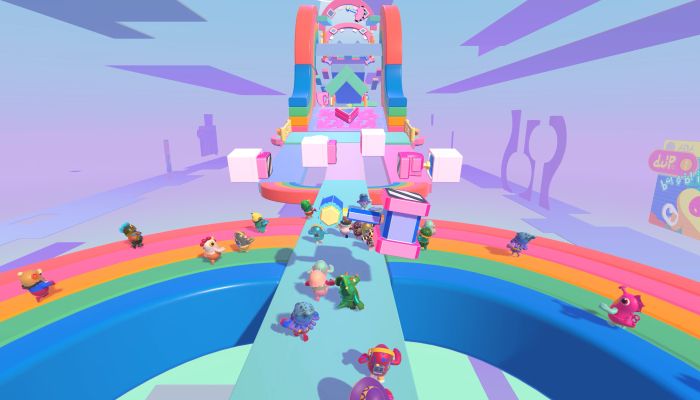
My first round of Fall Guys looked too cheerful to be dangerous. Dozens of brightly colored contestants stood in front of a simple obstacle course filled with spinning platforms, padded barriers, and oversized fruit. The rules were obvious: reach the finish line before enough players qualify. I ran confidently toward a row of doors, chose the wrong one, collided with a crowd, fell onto my back, and watched half the lobby disappear into the distance. This Fall Guys review begins with that failure because the game’s appeal depends on making embarrassment feel almost as rewarding as victory.
Fall Guys is a free, cross-platform multiplayer party royale in which groups of bean-shaped contestants compete through escalating rounds until one winner or surviving squad remains. Current official descriptions emphasize obstacle-course chaos, cross-play, community-created levels, cosmetic customization, and several ways to compete with friends.
The concept is easy to understand because it resembles a television game show. Each episode begins with a large group and removes contestants after every round. Some stages ask me to race toward a finish line. Others demand survival, object control, memory, teamwork, or direct competition. The final round usually places a smaller group inside a more demanding challenge where one mistake can end the entire run.
What surprised me was how quickly I became emotionally invested. A single episode may last only a few minutes, yet surviving three rounds creates enough momentum that elimination suddenly feels personal. I might laugh after being thrown from the first obstacle, but losing in the final ten seconds of a final round produces a very different reaction.
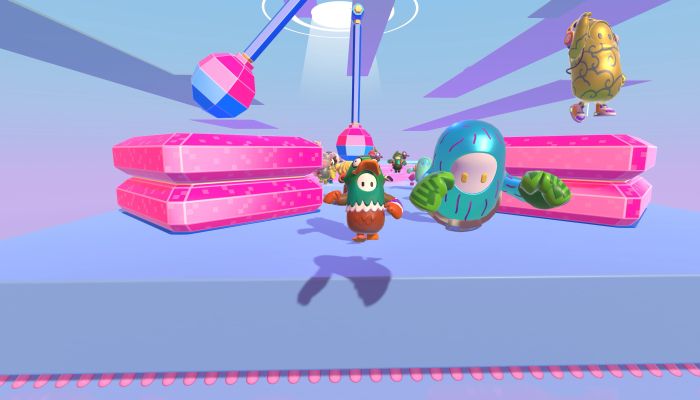
The game’s presentation helps prevent frustration from becoming too serious. Contestants do not look like athletes. They resemble soft jelly beans wearing costumes, moving with limited balance and exaggerated momentum. When several players collide, the result looks less like competitive sabotage and more like a bag of toys being shaken down a staircase.
That visual comedy is not merely decoration. It gives Fall Guys permission to be chaotic, occasionally unfair, and mechanically imprecise. The game wants me to care about winning, but not so much that I forget how ridiculous the competition looks.
This balance works most of the time. It fails when network delay, awkward collision physics, or an overcrowded community map causes an elimination that feels disconnected from my decisions. Fall Guys is at its best when chaos creates a story. It is at its worst when chaos becomes an excuse for unreliable feedback.
Core Gameplay & Mechanics: Running, Diving, Grabbing, and Getting Flattened
The basic control scheme is intentionally compact. I can move, jump, dive, and grab. Some modes add object interactions or specialized mechanics, but most rounds are built from those four actions.
Movement feels responsive enough for a party game, though every contestant carries deliberate weight. A Fall Guy does not stop instantly after sprinting, and landing from a jump can create a short stumble. Running into another player changes momentum. Hitting a rotating obstacle can send the character farther than expected.
Jumping handles small gaps and low barriers, while diving extends horizontal distance and can rescue an otherwise failed leap. A well-timed dive may carry me across the finish line, through a closing gate, or onto the edge of a platform. A poorly timed one leaves the character sliding on the floor while everyone else runs past.
The recovery animation matters more than I initially expected. After a hard landing or collision, the bean may need a moment to stand. That brief delay creates chain reactions. One fall becomes a second collision, the second collision pushes me into another obstacle, and a small mistake grows into a complete disaster.
Grabbing is the most controversial action. I can hold ledges, carry certain objects, interact with stage elements, or briefly grab another player. In cooperative situations, it can help with movement. In competitive rounds, it becomes a tool for blocking, delaying, or pulling someone away from safety.
A successful defensive grab feels clever. Being grabbed near the finish line feels infuriating. The mechanic introduces direct player conflict without turning the game into combat, but network differences make the exact range and timing difficult to read. I have been caught by players who appeared too far away, while my own grabs sometimes failed despite looking perfectly aligned.
This is my first major annoyance. Grabbing creates memorable rivalries, yet its visual feedback is not always precise enough for high-stakes finals. Losing because another player predicted my movement is fair. Losing because the server and my screen disagree about where their arms are is much harder to accept.
Race rounds are the most immediately accessible. I move through spinning bars, collapsing floors, gates, fans, moving platforms, launch pads, conveyor belts, swinging objects, and crowds of other players. The obstacles are usually simple in isolation. Difficulty comes from timing them while dozens of contestants occupy the same space.
Crowds can help or hurt. Other players may reveal the correct route, trigger platforms, or create momentum through a doorway. They can also block jumps, push me from narrow surfaces, and turn a safe opening into a pile of fallen bodies.
Survival rounds remove finish-line pressure and ask me to remain active until enough players are eliminated. Platforms may rotate, disappear, tilt, or become covered by moving hazards. These rounds reward awareness because the safest space changes constantly.
Logic and memory rounds use pattern recognition or environmental clues. They provide a welcome change from pure movement, though their quality varies. A good logic round makes observation feel important. A weaker one becomes trivial when most players simply follow the largest crowd.
Team games divide the lobby into groups and assign a shared objective. Teams may collect objects, defend territory, move large items, or score against opponents. These rounds can be entertaining with friends because communication creates structure inside the chaos.
With random teammates, team modes are less reliable. I can perform well and still be eliminated because another player ignores the objective or accidentally helps the opposition. That lack of individual control is consistent with the party-game identity, but it remains one of the easiest ways to turn a strong run into a frustrating exit.
Squads and Duos reduce some of that frustration by allowing players to compete with people they know. Cross-platform parties and shared progression through an Epic Games account make it easier to form groups across supported systems.
Squad scoring also changes how I think about a race. Finishing first is valuable, but helping the entire group qualify matters more. One teammate reaching the end quickly may compensate for another player struggling near the start.
Final rounds are designed to produce pressure. Some are races, others involve disappearing tiles, rotating hazards, or survival on shrinking platforms. The best finals remove the protection of a large crowd and make every movement visible.
Winning a final feels excellent because the earlier rounds create a natural tournament arc. I am not simply completing one stage. I am surviving a complete episode and watching the field become smaller after each challenge.
The difficulty curve is unusual. Basic controls are easy enough for almost anyone to use, but mastery depends on route knowledge, momentum control, obstacle cycles, camera positioning, and understanding how other players behave. Experienced players identify faster paths and know when a risky shortcut is worth attempting.
Newcomers may struggle because many current players already understand older rounds. A stage that appears confusing for the first time may be routine for the front of the lobby. Fall Guys teaches through failure, which is effective but occasionally harsh.
Creative Mode and Modern Variety: A Larger Game With Uneven Quality
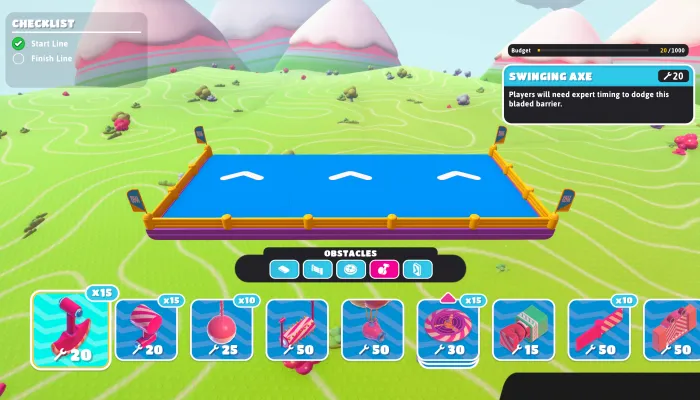
Fall Guys Creative allows players to build custom rounds and share them with the wider community. Official descriptions present it as a level editor supporting community courses, while featured selections are influenced by factors such as play activity and originality.
The editor significantly expands the game’s potential. Instead of waiting only for developer-made rounds, players can design platforming courses, survival challenges, puzzles, races, and unusual experiments. A strong creator can combine familiar objects in ways that feel different from standard playlists.
Creative levels also provide more targeted practice. I can replay a difficult course, learn advanced movement, or experience a challenge built around one specific mechanic. Custom lobbies make these stages useful for friend groups that want a less formal session.
The problem is consistency. Official stages are usually built around tested sightlines, recognizable routes, readable hazards, and performance limits. Community creations range from excellent to confusing, repetitive, excessively long, or poorly optimized.
Some levels communicate their rules immediately. Others place too many objects in one space, use unclear checkpoints, or depend on narrow jumps that expose the limits of the game’s physics. Creativity does not automatically produce good level design.
This is my second major annoyance. Fall Guys increasingly benefits from community content, but a playlist filled with uneven Creative maps can feel less polished than the original game-show structure. A clever user-made round adds variety. A badly signposted course makes the session feel like unpaid quality testing.
The mobile version supports playing user-generated content, though the Creative level editor itself is not available there. Epic’s support documentation states that mobile players can access the game modes and community stages but cannot build levels directly on mobile.
Ranked Knockout, introduced in 2026, gives competitive players a more formal way to test consistency and climb through structured competition. The current official site highlights Ranked Knockout alongside the standard party-royale and Creative features.
A ranked option makes sense because Fall Guys has always contained more skill than its visual comedy suggests. Precise movement, route optimization, and obstacle knowledge separate experienced players from beginners.
However, competitive structure makes technical weaknesses more visible. In a casual playlist, an unlucky collision becomes a joke. In ranked play, the same collision may affect progression. The game’s loose physics and occasional network differences were designed for entertainment before strict competition.
Fall Guys therefore works best when ranked modes supplement rather than replace the social experience. The core identity remains a colorful game show where a perfect run can end after one badly timed jump.
Graphics, Audio, and Technical Performance: Bright Beans With Occasional Wobbles
Fall Guys uses a simple, colorful visual style designed for instant readability. Courses rely on bold shapes, bright surfaces, moving hazards, and clear contrast between safe platforms and dangerous areas. Even crowded stages rarely become visually realistic or dark.
The bean characters are equally effective. Their basic silhouette remains recognizable under elaborate costumes, making customization possible without changing the core hitbox too dramatically. Clothing ranges from simple colors and patterns to licensed collaborations and multi-part character outfits.
Animation gives the contestants personality. They wave, stumble, bounce, fall, recover, celebrate, and panic with exaggerated body movement. A successful jump looks satisfying, but a failed landing often looks even better.
The visual style also keeps failure friendly. Falling into slime or being thrown from a platform never appears severe. The contestant disappears, respawns, or is eliminated without realistic injury.
Course themes provide variety through medieval arenas, futuristic stages, jungle obstacles, space-inspired environments, sports areas, and custom construction sets. The strongest themes connect visual identity with mechanics rather than simply changing background colors.
Creative stages can look more repetitive because they frequently reuse the same construction pieces. Skilled builders overcome that limitation through layout and pacing, but many user-made maps reveal the modular nature of the editor immediately.
Audio design is playful and functional. Music uses energetic electronic melodies, cheerful rhythms, and game-show intensity. Qualification produces a satisfying celebration, while elimination delivers a blunt visual and audio response.
Obstacles have clear sound cues. Rotating machinery, fans, doors, launchers, and moving platforms communicate their cycles through audio as well as animation. These sounds help when the camera is focused on another part of the course.
Character noises are intentionally limited. Beans produce small squeaks and reactions instead of speaking. This prevents language barriers and lets the physical comedy remain central.
Technical performance is generally strong on powerful PCs and current consoles. Fall Guys also supports cross-play and cross-progression across its available platforms through Epic Games accounts.
Performance can be less consistent on weaker hardware, crowded Creative stages, or unstable connections. The Nintendo Switch and mobile versions require greater visual compromises, while user-generated maps may contain more objects than official stages would normally use.
Network behaviour has the greatest effect on fairness. Player positions, grabs, moving obstacles, and qualification order must remain synchronized across many contestants. Even a small delay can make another bean appear to move suddenly or survive a collision that looked fatal.
Loading and matchmaking times depend on region, playlist, platform population, and time of day. Cross-platform matchmaking helps maintain larger pools, but limited or specialized modes may take longer to fill.
I encountered occasional clipping, strange rebounds, delayed grabs, and moments when the character’s recovery did not match the apparent force of a collision. These issues are not constant, but they matter when one mistake ends an episode.
Monetization & Ads: Free Competition Built Around Costumes
Fall Guys is free to play. The full competitive foundation is available without an entry fee, including multiplayer shows, cross-platform play, Creative courses, and rotating activities.
Monetization focuses primarily on cosmetics, premium currency, and passes. Show-Bucks can be earned in limited quantities through progression or purchased, then spent on costumes, colors, patterns, faceplates, emotes, celebrations, and pass access.
This means Fall Guys is not conventionally pay-to-win. Purchased costumes do not increase running speed, jump height, balance, or grab strength. A default bean has the same essential mechanical abilities as someone wearing an expensive licensed outfit.
That fairness is important. Victory comes from movement, timing, route knowledge, teamwork, and luck rather than purchased statistics.
The cosmetic shop still creates pressure. Rotating availability and collaborations encourage quick decisions because a favorite costume may disappear before the player earns enough currency. Licensed characters can be especially tempting because their emotional value comes from another franchise.
The game includes free progression rewards, but the most elaborate cosmetics are often connected to Show-Bucks or premium pass tracks. Players who care little about appearance can ignore most of the store. Players who treat customization as a central goal will encounter much stronger spending pressure.
Show-Bucks prices increased in April 2026, according to an official announcement, making careful spending more important for current players. Epic also states that qualifying purchases made through its payment systems can return a percentage through Epic Rewards, though that rebate should not be confused with a discount that removes the initial cost.
There are no traditional forced advertisements between rounds. The game does not require me to watch a commercial after elimination or before joining another show. Promotional pressure remains inside the shop, pass, collaboration banners, and reward interface.
Parents should still review spending controls. Fall Guys looks suitable for a broad family audience, and cosmetic purchases may feel harmless individually. Repeated small purchases can accumulate quickly.
The best free-to-play approach is to choose a small number of favorite cosmetics, save earned currency, and avoid treating every collaboration as essential. The bean is mechanically complete without a premium costume.
Who Should Play This? Party Players, Families, and Competitive Beans
Fall Guys is ideal for players who want multiplayer competition without the complexity or tone of a traditional shooter. The rules are visible, the controls are simple, and a new player can contribute within minutes.
Families may appreciate the lack of realistic violence. Contestants push, collide, and fall, but the presentation remains playful. Children can understand most race and survival objectives without reading long instructions.
Friend groups benefit from cross-platform parties. Players on different supported systems can join compatible playlists together, while shared progression helps preserve cosmetics and rewards through an Epic Games account.
Competitive players may enjoy route optimization, advanced dives, obstacle timing, Ranked Knockout, and difficult Creative courses. Fall Guys is easy to begin but contains enough mechanical nuance to reward practice.
Creative players can spend time designing and sharing custom rounds on platforms that support the editor. The system is especially appealing to anyone who enjoys experimenting with level flow rather than only competing.
The game is less suitable for players who dislike elimination-based structure. A mistake near the end of a round can remove several minutes of progress. There is no guarantee that a strong performance in earlier stages will protect the final result.
Players who demand precise physics may also become frustrated. Fall Guys deliberately uses soft collisions and unstable bodies. Skill reduces mistakes but cannot remove every unpredictable interaction.
Solo players can enjoy matchmaking, though the experience becomes more social with friends. Random squads are inconsistent, and silent teammates may ignore shared objectives.
Anyone looking for a deep narrative, character development, or meaningful long-term progression will find little beyond cosmetics, ranks, and personal improvement. Fall Guys is a competition platform rather than a story-driven adventure.
Final Verdict: Still One of Multiplayer’s Funniest Ways to Lose
Fall Guys remains one of the easiest multiplayer games to recommend for mixed groups. Its controls are understandable, its presentation is welcoming, and its rounds create tension without requiring realistic combat or complicated equipment systems.
I enjoyed the immediate rhythm of entering a show, surviving a chaotic opening race, adapting to a strange second round, and realizing that a final was suddenly within reach. The tournament structure gives short sessions a clear beginning and end.
The movement system deserves more credit than its simplicity suggests. Jumping, diving, recovering, controlling momentum, and reading obstacle cycles create meaningful skill. Experienced players are not simply luckier; they understand how the bean behaves under pressure.
Luck still matters. Another player can fall into me, a rotating bar can produce an unusual rebound, or a team round can place my result in the hands of strangers. That uncertainty is part of the game’s humor, though it occasionally damages competitive credibility.
Creative Mode has extended Fall Guys beyond its original collection of developer-made rounds. The best community courses demonstrate impressive imagination and give friend groups new challenges. The weakest feel visually repetitive, poorly communicated, or unnecessarily punishing.
The free-to-play model is mechanically fair. Premium purchases focus on appearance rather than power, allowing non-paying players to compete normally. The shop and limited cosmetics still encourage spending, and the 2026 Show-Bucks price increase makes restraint more valuable.
I recommend Fall Guys to families, casual competitors, cross-platform friend groups, party-game fans, and players who enjoy obstacle courses. It also has enough depth for more serious competition, provided players accept that physics and network behavior will occasionally interfere.
Those seeking precise competitive rules, a strong solo campaign, or meaningful character progression should look elsewhere. Fall Guys offers costumes, ranks, community maps, and repeated shows rather than a traditional long-term adventure.
Personal rating: 8/10.
Fall Guys earns that score for its accessible controls, colorful presentation, entertaining obstacle courses, cross-platform support, strong social play, Creative Mode, and fair cosmetic-only competitive structure. It loses points for unreliable grabs, uneven user-created content, connection-related frustration, repetitive playlists, and growing cosmetic costs.
Winning a crown feels excellent. Watching three opponents grab one another and fall from the final platform feels almost as good.
Pros

- Unique and unpredictable gameplay that keeps each match fresh
- Vibrantly designed visuals that enhance the overall fun experience
- Simple, accessible controls that allow beginners to quickly join the action
- Engaging multiplayer dynamics that foster a strong community spirit
- Regular updates that introduce new content and challenges
- High replayability with dynamically changing obstacle courses
- A blend of casual play and competitive strategy that appeals to a wide audience
Cons

- Occasional connectivity and server performance issues can disrupt gameplay
- High levels of randomness sometimes undermine strategic gameplay for experienced players
- Limited customization options in competitive modes may restrict tailored experiences
Leave a comment
Your comment is awaiting moderation. We save your draft here
0 Comments