


A Tactical Shooter That Refuses to Follow Its Own Rules
Most competitive shooters spend years refining a stable ruleset. FragPunk builds its identity around disrupting one. A round may begin as a recognizable 5v5 attack-and-defend match, only for the selected Shard Cards to change player health, alter weapon behavior, introduce unusual traps, modify objectives, or add an advantage so strange that both teams must reconsider their plans before the barriers even disappear.
That unpredictability is the foundation of this FragPunk review. The game resembles a meeting between Valorant, Counter-Strike, an arcade shooter, and a deck of rule-changing cards that somebody dropped across the tactical planning table. Its weapons are direct and responsive, its Lancers provide specialized abilities, and its short rounds avoid the exhausting commitment associated with longer competitive matches. Then a card makes heads smaller, changes the battlefield, protects a player during an objective interaction, or turns an ordinary tactical situation into organized nonsense.
FragPunk is at its best when the chaos creates new decisions. I may have chosen a weapon and Lancer for one kind of round, but the cards demand another approach. A defensive position that worked thirty seconds ago may become useless. A normally risky objective play may suddenly become the safest option. Familiar maps remain less predictable because their practical rules keep changing.
The same system can also become the game’s greatest annoyance. Tactical shooters usually reward learning stable interactions and improving through repetition. FragPunk occasionally allows one card combination to distort a round so aggressively that preparation feels secondary to what was drawn. This is entertaining in casual play but potentially frustrating when rank and competitive pride are attached to the outcome. The result is a shooter with a strong personality, satisfying movement, stylish presentation, and one genuinely distinctive mechanic. It is also surrounded by heavy live-service menus, multiple progression systems, character unlocking, cosmetic promotion, and enough currencies to make the interface feel more complicated than the gunplay.
Core Gameplay & Mechanics: Fast Rounds With Little Time for Hesitation
FragPunk’s main mode, Shard Clash, uses a familiar attack-and-defend structure. Two teams of five compete across several short rounds. Attackers attempt to plant a device called the Converter at one of the available sites, while defenders prevent the plant, disable it, or eliminate the attacking team. Players do not respawn during an ordinary round, so one poor decision can remove a person from the action until the next begins.
The format is easy to understand, but FragPunk makes it faster and less economically punishing than many traditional tactical shooters. Weapon selection does not revolve around a long financial system in which one lost round can damage several future purchases. Instead, guns have availability restrictions that prevent constant use of the strongest options while allowing players to spend more time fighting with equipment they actually enjoy.
This structure reduces some of the frustration I associate with extended tactical matches. A terrible round ends quickly, and the shorter overall match length makes experimentation less intimidating. Trying an unfamiliar Lancer or weapon does not feel like committing the next forty minutes to regret. The movement is more flexible than in Counter-Strike but less ability-driven than the most chaotic hero shooters. Sprinting, sliding, jumping, and rapid repositioning give fights an arcade-like energy. Players can still be punished severely for entering a sightline carelessly, but the game rarely feels completely static.
Gunplay remains the most important skill. Abilities provide information, area control, healing, obstruction, traps, or explosive pressure, yet most engagements still end through positioning and accurate shooting. FragPunk generally avoids letting every character carry a devastating ultimate that replaces ordinary combat. Lancer skills create openings; weapons finish the job. Time-to-defeat can feel unforgiving. A clean burst or well-placed shot may end an encounter before I can respond, especially against players who already understand recoil patterns and common angles. This keeps every corner dangerous, although it can make learning a new map unpleasant when experienced opponents know exactly where a head will appear.
Shard Cards: FragPunk’s Best Idea and Its Biggest Competitive Risk
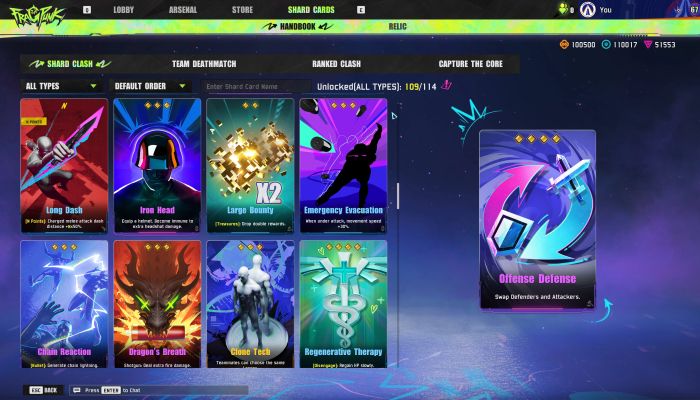
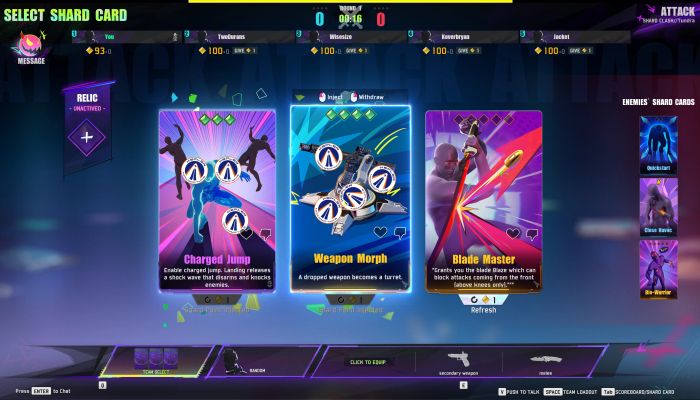
Before a round begins, teams select Shard Cards that modify the upcoming rules. This process gives FragPunk an identity far stronger than another collection of colorful heroes and futuristic weapons. Cards can make small tactical adjustments or transform the round into something that barely resembles the one before it. Some effects improve specific actions. Others change health, movement, ammunition, objectives, map interaction, weapon properties, or the physical characteristics of players. Certain cards are humorous, while others create clear strategic advantages that demand an immediate response.
The strongest Shard Cards produce adaptation rather than free power. A card may encourage the team to use a different route, protect one type of objective play, or make an overlooked weapon suddenly valuable. These rounds feel fresh because both sides must solve a new problem using familiar mechanical tools. Team voting adds a social layer. Players may disagree about whether to select a reliable advantage or a bizarre modifier with greater potential. In coordinated groups, this becomes part of the strategy. In solo matchmaking, teammates may choose the funniest card without considering the map, Lancer composition, or opposing options.
That difference summarizes the entire system. Shard Cards are brilliant when they create informed improvisation. They are irritating when they replace planning with random imbalance. Competitive consistency is therefore FragPunk’s central design challenge. A tactical shooter asks players to study maps, control recoil, understand timing, and predict enemy decisions. Cards deliberately interfere with that knowledge. The game must keep them influential enough to remain exciting without allowing one draw to decide the round before anyone fires.
The developers have continued rotating and removing cards rather than allowing the pool to expand without control. That is necessary because hundreds of interacting modifiers can produce balance problems faster than conventional weapon updates. For casual sessions, I love the system. It prevents repeated matches from blending together and creates stories worth discussing afterward. For serious ranked play, I occasionally want fewer surprises and clearer limits on how much one card can change.
Lancers & Abilities: Heroes Supporting the Weapons
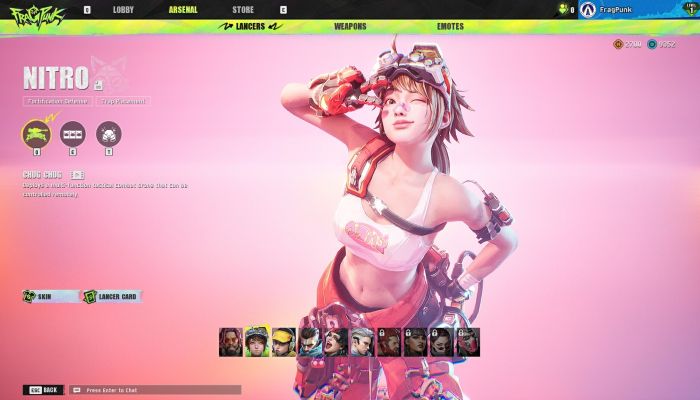
FragPunk calls its playable characters Lancers. Each has a visual identity, background, voice, and set of abilities designed around a battlefield role. Some gather information, some block sightlines, some heal or protect allies, and others create direct offensive pressure.
The abilities are readable enough that a new player can understand the basic purpose of a character quickly. A reconnaissance-focused Lancer helps locate enemies. A defensive specialist can slow or obstruct an approach. A duelist may create opportunities to enter a site aggressively. The game benefits from keeping these abilities relatively compact. I do not need to memorize a long sequence of upgrades during the match, and most skills communicate their danger clearly. The focus returns to aiming soon after an ability is deployed.
Character combinations still matter. Vision becomes more valuable when paired with explosives or aggressive entry tools. Healing can preserve limited resources during a round, while traps punish teams that repeat the same route. Balance is not perfect. Certain Lancers feel immediately useful across most maps, while more specialized choices require favorable cards, sites, or teammates. Newer players may also encounter characters they cannot access yet, making the roster feel less open than the weapon selection.
Unlocking additional Lancers is one of the progression system’s more controversial elements. The game is free, and characters can be earned without payment, but slow progression creates pressure to purchase access. In a hero shooter, locking playable options matters more than locking a weapon skin because team composition affects strategy. FragPunk is not automatically pay-to-win merely because heroes can be purchased. A paid character does not guarantee accurate shooting or intelligent positioning. However, faster access gives paying players greater flexibility, especially when the meta favors a character a free player has not unlocked.
Weapons & Gunplay: Familiar Categories, Strong Feedback
The arsenal includes recognizable tactical-shooter categories: assault rifles, submachine guns, shotguns, sniper rifles, marksman weapons, light machine guns, pistols, and melee options. Each category has a clear purpose, allowing players with previous FPS experience to begin learning quickly. Assault rifles remain the most flexible choice. They work across medium distances and reward controlled bursts or confident recoil management. Submachine guns are easier to handle during aggressive close-range pushes but lose authority across open spaces. Shotguns can dominate narrow routes, while sniper rifles punish predictable movement.
The weapon feedback is satisfying. Shots feel sharp, hit indicators are readable, and the audiovisual response makes successful bursts rewarding. The game’s colorful presentation does not make the guns feel harmless. Recoil and accuracy still require practice. Running into a fight while firing wildly rarely produces consistent results against competent opponents. Stopping, controlling the first bullets, and placing the crosshair before exposing myself remain more valuable than relying on character abilities to rescue a poor entry.
Weapon restrictions add variety by discouraging endless use of one preferred gun. I appreciate the intention because it pushes players toward a broader arsenal without creating a traditional economy. The limitation can also feel artificial when the exact weapon I want is unavailable during an important round. Some Shard Cards alter weapon behavior enough to disrupt learned expectations. This can be enjoyable when both teams clearly understand the change. It becomes frustrating when the combination of card effects, Lancer skills, and unfamiliar weapons makes a death difficult to interpret.
Maps & Match Flow: Bold Spaces With Clear Combat Lanes
FragPunk’s maps use bright colors, strong landmarks, vertical structures, narrow interiors, and broader exterior routes. They are visually busier than Counter-Strike environments but generally retain readable lanes and objective areas. The strongest maps support multiple styles without becoming confusing. Aggressive players can enter through direct routes, while coordinated teams use utility and alternate paths to create pressure. Defenders have strong positions, but many can be challenged through abilities or synchronized pushes. Visual identity helps navigation. Instead of learning one realistic industrial location after another, I can remember areas through color, architecture, lighting, and unusual environmental details. This also matches the game’s comic-inspired presentation.
Some maps contain too many decorative elements near combat information. Bright surfaces, character effects, card modifiers, weapon flashes, and ability indicators may compete during a crowded site attack. The game usually preserves enemy readability, but occasional fights become visually noisy. Shard Cards change the practical value of locations between rounds. A defensive corner may become dangerous after a movement modifier, while a card affecting objectives can make one site easier to attack. This gives maps longer-term variety, although it also makes traditional memorization less reliable.
Game Modes: Shard Clash Carries Most of the Experience
Shard Clash is the clear centerpiece because it combines tactical shooting with the card system most effectively. FragPunk also offers arcade-style alternatives, training options, custom rooms, and modes that emphasize fighting without the full competitive structure. These alternatives are useful for warming up, testing Lancers, practicing weapons, or taking a break from single-life rounds. They also give new players a lower-pressure environment in which to learn movement and aiming.
The arcade modes are less distinctive because several resemble familiar deathmatch or elimination formats available in many shooters. Without the tension of the Converter objective and meaningful card selection, FragPunk can feel like a stylish but conventional arena FPS.
Training tools are valuable because the main game introduces several systems simultaneously. Players must learn maps, guns, Lancers, cards, and tactical timing. Practicing against artificial opponents or inside a controlled map environment reduces the initial learning burden.
The mode selection may also be affected by the active player population in a region. FragPunk’s Steam audience declined significantly after its large launch, although Steam numbers do not include every platform or launcher. A smaller population can increase matchmaking times or concentrate experienced players in the remaining queues. That does not make the game unplayable, but it matters for a competitive live service. A shooter depends on finding opponents near the player’s skill level, location, and preferred mode. Too many separate queues can become difficult to sustain when the audience contracts.
Graphics, Art Direction & Audio: A Shooter With a Comic-Book Pulse
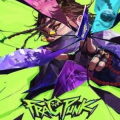
FragPunk’s visual style is one of its strongest advantages. Character portraits, menus, cards, maps, weapon skins, transitions, and effects use bold graphic design influenced by comics, street art, animation, and digital collage.
The game does not pretend to be military simulation. Colors are saturated, character silhouettes are distinctive, and interface elements frequently move with exaggerated energy. This gives the entire product a coherent personality that extends beyond individual heroes.
Shard Cards receive especially strong presentation. Selecting one feels like modifying a physical deck rather than clicking a plain menu option. Their illustrations and names help even unusual rules remain memorable.
The maps use varied lighting and strong thematic details, though visual effects occasionally become excessive during coordinated ability use. When multiple Lancers deploy skills while a card changes the round, the screen can fill with barriers, explosions, markers, and colored zones.
Sound design supports the gunplay well. Weapons have enough weight to distinguish them, footsteps provide useful positional information, and ability cues help identify threats. Announcer lines and character voices contribute energy without always remaining subtle.
The soundtrack and menu audio maintain momentum, but the interface can become exhausting because nearly every reward, event, currency, and promotion arrives with visual and sonic celebration. The game rarely allows the player to enter a quiet menu.
Technical Performance: Responsive When the Live-Service Machinery Behaves
FragPunk’s relatively compact matches benefit from quick loading and responsive controls when servers are stable. Movement feels immediate, shooting feedback arrives quickly, and the frame rate is important because the game rewards fast reactions.
Performance varies by platform and hardware. Competitive players will naturally prioritize lower settings and higher frame rates, while the bold art direction allows the game to remain attractive without maximum detail.
Network conditions have a large effect on close fights. A small delay can make an encounter feel as though I was defeated after reaching cover, particularly when time-to-defeat is short. This is common in online shooters but remains especially visible when one accurate burst determines a round.
Updates may introduce balance issues, visual bugs, crashes, matchmaking problems, or unexpected card interactions. The complexity of the Shard system makes quality control harder because every new modifier can interact with numerous weapons, abilities, and map elements.
The game is technically ambitious not because its maps are enormous, but because its rules are unstable by design. Maintaining that instability without allowing it to become unreliability is an ongoing challenge.
Monetization & Progression: The Interface Wants My Attention Before the Match Does
FragPunk is free to play, and its core competitive matches do not require an upfront purchase. The business model includes cosmetic skins, battle passes, character progression, events, rotating rewards, premium options, and several currencies. The cosmetics suit the art direction well. Lancer outfits and weapon skins can be imaginative without damaging the visual identity of the game. Because FragPunk already embraces stylization, unusual cosmetics feel less disruptive than they might in a grounded military shooter.
The problem is presentation. Menus can bombard new players with event notices, passes, login rewards, currency icons, limited-time offers, challenges, and progression tracks before they understand the basic game. The interface behaves as though every screen must persuade me to claim, inspect, unlock, or purchase something. This creates information overload. Instead of making the free experience feel generous, the number of systems can make it feel calculated. Even harmless rewards become tiring when they require navigating several pages and acknowledging repeated notifications.
Character unlocking is more concerning than cosmetic sales. A skin changes appearance; a Lancer changes tactical options. The grind may encourage players to choose between substantial time investment and direct spending.
FragPunk does not sell victory directly. Mechanical skill remains too important for that. Its monetization is still aggressive enough to weaken the welcoming quality of an otherwise accessible shooter.
Who Should Play FragPunk?
FragPunk is best suited to players who enjoy tactical shooters but find traditional matches too long, serious, or repetitive. The short rounds and Shard Cards create quick sessions in which losing one match does not feel like sacrificing an entire evening.
Valorant players may appreciate the Lancer abilities and objective structure, while Counter-Strike fans will recognize the emphasis on angles, accurate shooting, and single-life rounds. Players who enjoy roguelike modifiers or unpredictable party-game rules may find the card system especially appealing. Dedicated competitive players should approach with more caution. The randomness that keeps casual matches fresh can interfere with the stable learning environment ranked players often expect. Balance changes and card rotations may also force the meta to move quickly.
People who dislike crowded free-to-play interfaces, character grinds, battle-pass pressure, or numerous currencies may become frustrated before the core gameplay has enough time to make its case. FragPunk deserves to be tried because there is no purchase barrier. A few Shard Clash matches reveal its identity more clearly than any menu or trailer.
Final Verdict: FragPunk Breaks Tactical-Shooter Rules for Better and Worse
FragPunk is one of the more inventive attempts to enter the crowded hero-shooter market because it changes the structure of each round rather than relying only on another roster of colorful characters. The Shard Cards create tactical situations I cannot prepare for through map memorization alone, forcing both teams to adapt before the first engagement.
The gunplay is strong enough to support that experimentation. Weapons feel responsive, accurate shooting remains valuable, and Lancer abilities usually enhance combat rather than replace it. Short matches make the game easier to enjoy casually than several established tactical shooters.
The cards are both its identity and its risk. When they encourage creative planning, FragPunk feels fresh. When one combination produces an overwhelming advantage, the shooter’s competitive foundation becomes less convincing.
The Lancers are visually memorable and mechanically readable, although locking parts of the roster behind slow progression weakens the fairness of the free-to-play structure. The same problem appears in the menus, where numerous currencies, passes, events, and reward notifications compete with the simple desire to begin another match.
The visual presentation is excellent. Bold colors, comic-inspired graphics, animated cards, stylish characters, and energetic maps give FragPunk a personality that many mechanically competent shooters lack. I recommend FragPunk to casual tactical-shooter players, groups looking for short competitive sessions, and anyone attracted to unpredictable rule modifiers. Ranked purists may enjoy the shooting while disliking the amount of controlled randomness.
Personal rating: 8/10.
FragPunk earns that score for its excellent Shard Card concept, responsive weapons, short match format, distinctive art direction, and ability to make familiar maps feel different from round to round. It loses points for aggressive monetization, slow character unlocking, crowded menus, inconsistent competitive balance, and the uncertainty surrounding whether its remaining audience can support every mode equally well.
FragPunk does not defeat its competitors by creating the most disciplined tactical shooter. It succeeds by asking a more entertaining question: what happens when everybody understands the rules, votes to change them, and then has fifteen seconds to invent a new plan?
Pros

- Immersive narrative that deeply engages players
- Refined gameplay mechanics offering versatility and challenge
- Stunning visuals and dynamic audio that enhance the gaming experience
- Strong community support with numerous mods and custom content
- Cross-platform availability with easy download and installation
- Optimized performance with attention to stability and minimal lag
Cons

- Some cheat features may compromise fair competitive play
- Complex modifications and cheats might overwhelm new players
- Occasional bugs during multiplayer matchmaking can affect gameplay
Leave a comment
Your comment is awaiting moderation. We save your draft here
0 Comments