







My Dignity Lasted About Twenty Seconds
My first serious match began with a simple plan: stay away from the edge, let the other players exhaust themselves, and move in only when the arena became safer. Twenty seconds later, my gelatinous fighter was hanging from a railing with one hand while another player repeatedly pulled at my costume. A third competitor charged into both of us, lost balance, and sent the entire group tumbling into the hazard below. It was a terrible strategy, a ridiculous defeat, and the exact moment this Gang Beasts review started writing itself.
Gang Beasts is a multiplayer party fighting game developed by Boneloaf. It places soft, unstable characters inside hazardous arenas scattered around the fictional Beef City. The official description emphasizes gelatinous fighters, slapstick melee encounters, customizable characters, and dangerous environments. Players can compete locally or online, while the Steam version includes PvP, shared or split-screen play, Remote Play Together, and multiple game modes.
The basic objective appears simple. I enter an arena, grab opponents, strike them, lift them, and try to remove them from the stage. Depending on the map, that might mean throwing someone from a rooftop, dropping them into industrial machinery, pushing them onto railway tracks, or leaving them in a position where the environment finishes the argument.
Understanding the objective takes seconds. Controlling my character is another matter.
Gang Beasts does not provide the clean, predictable movement of a traditional fighting game. Its characters wobble, stumble, cling to objects, and collapse into heaps of rubbery limbs. A punch may connect perfectly, glance away harmlessly, or turn the attacker around at the worst possible moment. Grabbing an opponent can lead to a decisive throw, but it can just as easily leave both players tangled together near a dangerous edge.
That uncertainty immediately creates comedy. It also establishes the game’s central tension. Gang Beasts is funniest when nobody has complete control. It is most frustrating when I need the character to perform one precise action and the physics decide to interpret my input more creatively.
My early matches were full of accidental victories and deserved defeats. I survived one round because two stronger opponents dragged each other from the arena. I lost another after grabbing a rail instead of the player beside it. In one particularly embarrassing moment, I spent several seconds trying to lift an unconscious opponent, only to fall over and carry both of us into danger.
Few games make losing this entertaining. Even fewer make success feel so suspicious.
Core Gameplay & Mechanics: Wrestling With Opponents and the Controls
Gang Beasts uses a compact set of actions built around movement, jumping, grabbing, striking, lifting, climbing, and changing body position. Each arm can grab independently, allowing me to hold an opponent with one hand while striking with the other, cling to two separate surfaces, or secure both hands before attempting a throw.
The system is easy to describe but difficult to master. Grabbing is contextual because the character attaches to whatever the hand reaches first. I might grab an opponent’s head, arm, costume, nearby railing, floor, or piece of scenery. That creates improvisation, but it also means a planned move can fail because one hand catches the wrong object.
Striking is intentionally untidy. Punches and head-first attacks depend on distance, body angle, momentum, and the current position of both fighters. Repeatedly pressing the attack buttons can produce results against inexperienced opponents, but stronger players use movement, grabs, and positioning to create cleaner opportunities.
Characters can be temporarily knocked unconscious. During that short window, another player may grab, drag, or lift them toward a hazard. Recovery times are not always identical, which creates tense situations where I am carrying a motionless opponent and hoping they do not wake before reaching the edge.
Lifting requires more than holding the grab buttons. I also need to raise the character’s arms and position the body correctly. With practice, I learned to pull opponents upward, drag them over barriers, and use momentum during throws. None of these actions feels perfectly controlled, but improving at them makes a noticeable difference.
Climbing adds another layer. By grabbing a ledge, pulling upward, and coordinating jumps or body movement, I can recover from situations that initially appear hopeless. Hanging from the side of an arena is not necessarily the end of a round. I may be able to climb back, grab an opponent who approaches, or pull someone down with me.
These recovery moments create some of the game’s best drama. I once watched an opponent celebrate too early after pushing me over a railing. My character caught the edge with one hand. The opponent leaned down to finish the job, I grabbed their costume, and both fighters began swinging against the wall. I eventually climbed back while the other player fell. It was not graceful, but it felt magnificent.
The physics system makes every interaction unstable. Characters have weight, but their limbs and balance respond loosely to movement. Carrying another player changes my centre of mass. Running into an object can knock me over. Pulling too aggressively near an edge may move my own character farther than the opponent.
This means positioning is more important than it first appears. The safest player is not always the most aggressive one. Standing between an opponent and a hazard gives me an advantage, while attacking with my back toward an open edge is an invitation to disaster. The environment is often more dangerous than the other fighters.
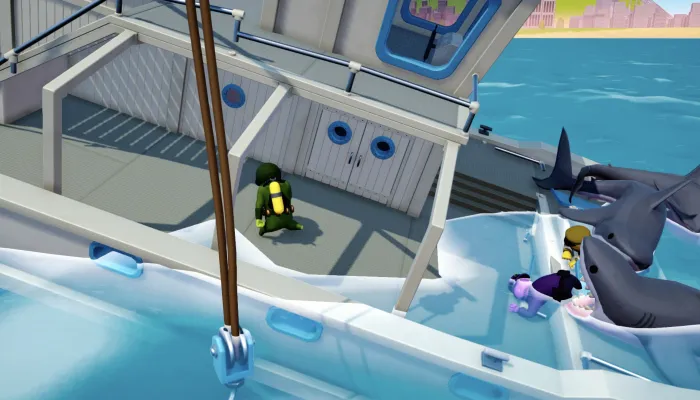
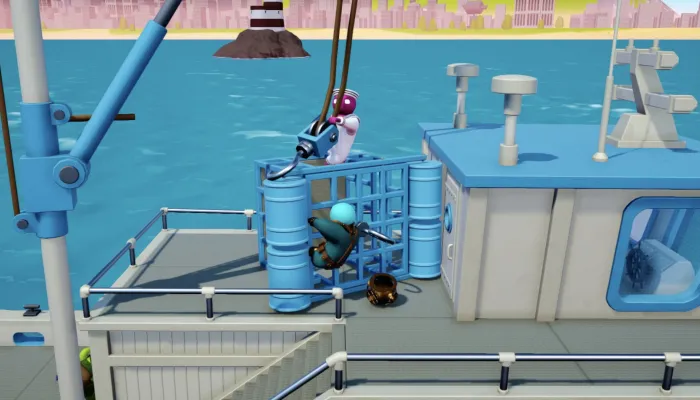
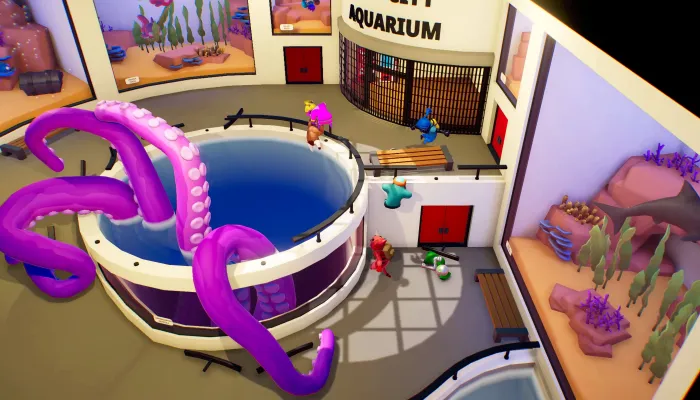
Maps provide much of the mechanical variety. Gang Beasts includes arenas built around moving vehicles, elevated platforms, industrial equipment, breakable structures, unstable surfaces, and other hazards. Beef City is presented as a collection of exaggerated urban and industrial locations rather than a set of neutral fighting rings.
Some stages begin relatively safely and become more dangerous over time. Floor sections may weaken, objects may move, or available space may shrink. Other arenas are hazardous immediately. The best maps force players to adapt without making the environmental threat feel completely random.
Arenas with visible edges are usually easy to understand. I can see the danger, plan around it, and use it against opponents. Maps involving machinery or moving structures are more chaotic because timing becomes harder to judge. These stages often create the funniest moments, though they can also produce sudden eliminations that feel disconnected from player skill.
The standard melee mode is the clearest expression of the game. Every player competes to be the last fighter remaining. Alliances may form briefly, but they rarely survive for long. Even when two players cooperate against a stronger opponent, one of them usually attempts a betrayal as soon as the danger passes.
Gang mode introduces team-based competition. The official Steam page describes it as a mode where friends can fight against rival groups in Beef City. Team play changes the rhythm because rescuing an ally can be more useful than chasing an opponent. It also creates opportunities for coordinated attacks, although the physics make coordination unreliable in the best possible way.
The game has also featured a cooperative mode in which up to four players face waves of enemies, as well as an unconventional football mode built around the same unstable movement. Official PlayStation promotional material highlighted both wave-based cooperative play and clumsy two-versus-two football.
The football mode is amusing because Gang Beasts characters are poorly suited to football. Movement is imprecise, players collapse after contact, and controlling the ball often feels secondary to interfering with the opposing team. It is less refined than a dedicated sports game, but that lack of refinement is the point.
The difficulty curve depends heavily on the people in the match. Against beginners, rounds become random collections of grabs and falls. Against skilled players, the mechanics reveal more depth. Experienced competitors understand recovery timing, climbing, body positioning, reliable attack patterns, and how to use each arena.
However, the game never becomes fully predictable. Mechanical knowledge improves my odds, but physics remain part of every outcome. That protects the party atmosphere, though it can frustrate players who want competitive results to reflect skill alone.
Graphics, Audio, and Technical Performance: Soft Fighters in a Hard City
Gang Beasts uses a deliberately simple visual style. Characters have rounded bodies, minimal facial detail, flexible limbs, and brightly colored costumes. Their appearance makes the physical conflict feel playful rather than severe, even when fighters are being thrown into dangerous environments.
Character customization gives each player a recognizable identity. Costumes include hats, glasses, animal-themed pieces, uniforms, and other comic combinations. These outfits make crowded matches easier to follow, but they also contribute to the humour. A serious confrontation becomes much less serious when one participant is dressed as a chicken and another is wearing an oversized hat.
The animation system is closely connected to the physics. Characters do not move through carefully staged combat sequences. They react to forces, collisions, grabs, and changes in balance. This creates awkward but expressive motion. A fighter can look confident for half a second and then fold over a railing like a bag of warm jelly.
Arenas use clear shapes and strong visual separation. Hazards are usually easy to identify, and the simple art direction keeps the action readable even when several players are tangled together. The environments are not packed with decorative detail, but they do not need to be. Their main role is to provide recognizable surfaces, obstacles, and dangerous boundaries.
The visual simplicity has limitations. Some stages look plain when separated from the chaos of a full match. Textures and background elements can feel basic, and the presentation lacks the detail expected from larger modern releases. Gang Beasts relies on animation and player interaction more than visual spectacle.
Costume pieces can also interfere with readability. Large accessories may obscure grabs or make it difficult to understand which body part is attached to an opponent. In crowded scenes, several characters can merge into one confusing pile of limbs and clothing.
The audio design is restrained but effective. Impacts, footsteps, environmental machinery, movement, and character reactions provide feedback without dominating the action. The strongest audio element is often the human response outside the game: laughter, shouting, accusations, and desperate negotiations between players.
Environmental sounds help communicate danger. Moving machinery, approaching vehicles, or unstable structures often provide warnings before a situation becomes critical. These cues are useful because watching every opponent and every hazard at once is impossible.
Music is less important during actual rounds. Gang Beasts does not need a constant dramatic soundtrack because the physical comedy creates its own rhythm. The quieter presentation gives room for players to react to the action.
Technical performance is generally sufficient for the game’s simple art style, but physics-heavy scenes can produce rough moments. When several characters grab one another near moving objects, collisions may become unstable. Fighters can vibrate, stretch into awkward positions, or become temporarily trapped against scenery.
Online play adds another source of inconsistency. Gang Beasts depends on timing, body position, and rapid reactions. Connection delay can make grabs feel uncertain or cause an opponent’s movement to appear slightly disconnected from the result. A player may seem safely positioned before suddenly being pulled toward an edge.
This is one of the game’s biggest annoyances. The physics are already intentionally loose, so network delay makes it even harder to distinguish an input mistake from a technical problem. Local multiplayer usually provides the clearest and funniest version of the experience because every player shares the same immediate game state.
Matchmaking quality can also vary depending on platform, region, and active player population. The Steam version supports online PvP as well as local shared-screen play, while the DRM-free version sold through Boneloaf’s itch.io page is specifically described as local-only and does not include online gameplay.
I also encountered occasional moments where a character became stuck, a costume behaved strangely, or an object reacted with far more force than expected. Some of these situations were funny. Others interrupted the round or created an unfair advantage.
The technical roughness does not destroy Gang Beasts because chaos is part of its identity. Still, there is a limit. A surprising collision can improve a party game. A repeated connection issue or broken interaction cannot be excused simply because the characters look funny.
Monetization & Ads: A Straightforward Premium Party Game
Gang Beasts follows a traditional premium model. Players purchase the game and receive access to its arenas, modes, character customization, and multiplayer features. It is not structured around collectible cards, energy timers, randomized premium rewards, or purchasable combat advantages.
There are no pay-to-win mechanics. Every player enters a match with the same basic movement and fighting abilities. Costumes affect appearance rather than combat power, so winning depends on positioning, mechanical knowledge, opportunism, and the unpredictable behaviour of the physics system.
This is an excellent fit for a party game. A player who buys the game later does not begin with weaker statistics. There are no premium punches, stronger grabs, or paid recovery boosts. The playing field may be physically unstable, but it is economically fair.
Advertising is also absent from the normal premium experience. Matches are not interrupted by promotional videos, and the game does not ask players to watch an advertisement for another attempt. Once the game is installed, the path from menu to match is relatively direct.
Platform subscriptions are a separate consideration. Online multiplayer on consoles may require the relevant platform’s online service, but this is not a Gang Beasts-specific purchase. Local play remains the most economical option for groups sharing one system.
The value depends on how the game will be used. For a player who regularly hosts friends or family, Gang Beasts can provide many memorable sessions. Its simple objective makes it easy to introduce to new players, and the unpredictable physics prevent matches from becoming identical.
For a solo player, the value is less convincing. Gang Beasts is designed around social interaction. Playing without friends removes much of the laughter, rivalry, and spontaneous storytelling that make the game special. Online matchmaking can replace local opponents, but it cannot fully reproduce the atmosphere of several people reacting in the same room.
The amount of structured content is also limited compared with larger fighting or party games. There is no extensive campaign, detailed progression system, or deep collection loop. The value comes from repeating the same broad actions with different people and on different stages.
That is not necessarily a flaw. Gang Beasts knows what kind of game it is. Buyers simply need to understand that they are paying for a social playground rather than a long single-player adventure.
Who Should Play This? Best With Friends and Flexible Expectations
Gang Beasts is ideal for groups that enjoy competitive party games without taking the results too seriously. Its controls are simple enough for newcomers to understand, while its climbing, grabbing, recovery, and positioning systems give experienced players room to improve.
Local multiplayer groups are the clearest target audience. The game supports shared and split-screen PvP on Steam, along with Remote Play Together. Sitting beside the people responsible for each betrayal makes every round funnier.
Families may also enjoy it because the visual style presents conflict as exaggerated slapstick. The characters look more like soft toys than dangerous fighters, and the absurd costumes reduce the intensity further. Parents should still judge whether the repeated physical conflict is suitable for their household, but the tone is comic rather than realistic.
Players who like physics-based games should feel comfortable immediately. Success requires accepting that characters will not always move exactly as expected. Anyone who enjoys improvising around unstable systems may appreciate how often mistakes become opportunities.
Competitive players can find mechanical depth, particularly in movement, climbing, carrying, and stage knowledge. However, Gang Beasts is not designed as a perfectly controlled tournament fighter. Physics and environmental hazards influence outcomes too strongly for every result to feel completely fair.
People who become frustrated by imprecise controls should skip it. The wobbling movement is not a temporary beginner problem. Practice helps, but the characters are intentionally awkward. Learning the game means controlling instability rather than eliminating it.
Solo-focused players should also be cautious. The available modes are most entertaining with other humans. Without conversation, rivalry, and shared reactions, the repetition becomes more visible.
Players looking for a large progression system may be disappointed. There are no extensive skill trees, equipment statistics, narrative chapters, or long-term character builds. Customization is primarily cosmetic, and improvement comes from personal skill rather than persistent upgrades.
Gang Beasts is also less suitable for groups that need strict competitive fairness. A weaker player can win because two experts target one another, a platform collapses unexpectedly, or a collision produces an unusual result. For a party, that unpredictability is valuable. For a serious competition, it may feel irritating.
Final Verdict: Glorious Nonsense With a Few Loose Limbs
Gang Beasts is one of those games that looks mechanically broken to an observer and carefully designed to anyone who has spent time with it. The characters wobble, strikes miss, bodies collapse, and fights frequently end through accidents. Yet beneath that disorder is a readable set of systems built around positioning, grabbing, recovery, stage awareness, and social deception.
I enjoyed it most when I stopped trying to play perfectly. Gang Beasts rewards adaptability more than rigid planning. A failed throw can become a new grab. Falling from a platform can lead to a dramatic climb. An opponent’s attack may create the opening I need, even when neither of us intended the result.
The game is genuinely funny, but its humour is not based only on costumes or visual jokes. It comes from cause and effect. Players understand what they wanted to do, see what actually happened, and immediately recognize the gap between those two outcomes.
That comedy is strongest in local multiplayer. Sharing a screen turns every disputed grab and suspicious alliance into part of the experience. Online play remains useful and expands access to matches, but connection issues can weaken the precision and immediacy of the physics.
The game’s technical roughness also deserves criticism. Inconsistent grabs, unstable collisions, occasional glitches, and limited solo value prevent Gang Beasts from becoming a complete recommendation for every player. Its content is broad enough for repeated party sessions, but not deep enough to support everyone over the long term.
My recommendation is therefore straightforward. Buy Gang Beasts for a group, not for isolation. Play it with people who can laugh at unfair outcomes, temporary alliances, failed rescues, and accidental self-eliminations. Do not approach it expecting the control accuracy or competitive structure of a traditional fighting game.
When the right players are present, Gang Beasts can produce some of the funniest multiplayer moments available. A basic match becomes a sequence of panicked grabs, dramatic recoveries, reckless betrayals, and victories nobody fully earned.
Personal rating: 8/10.
Gang Beasts earns that score for its creative physics, memorable arenas, approachable controls, strong local multiplayer, and exceptional ability to turn failure into entertainment. It loses points for inconsistent grabbing, online delay, technical glitches, limited solo appeal, and a lack of deeper long-term progression.
It is awkward, unstable, occasionally unfair, and often hilarious. In this case, all four qualities are part of the attraction.
Pros

- Engaging and humorous gameplay that provides endless fun.
- Intuitive controls that are easy to pick up while allowing for skillful play.
- Low system requirements which ensure smooth performance on various devices.
- Physics-based combat mechanics that generate unpredictable and entertaining outcomes.
- Robust local and online multiplayer modes that foster a vibrant community.
- Support for cheats and mods that allow for extensive customization and experimentation.
Cons

- Lack of a deep narrative may not appeal to players seeking story-driven games.
- Repetitive gameplay scenarios can eventually limit the variety of experiences.
- Occasional performance issues during intense multiplayer sessions can be frustrating.
Leave a comment
Your comment is awaiting moderation. We save your draft here
0 Comments