






The Moment I Realized My Arms Were the Controller
My first minutes in Gorilla Tag were less graceful than the name suggested. I pushed one hand against the virtual ground, launched myself sideways, struck a tree instead of climbing it, and watched another gorilla move past me with the effortless speed of someone who had spent months learning every surface. There was no joystick carrying that player forward. No teleport marker. Every leap, turn, and desperate escape came from physical arm movement. That immediate difference defines this Gorilla Tag review: the game takes one unusual locomotion idea and builds an entire social competition around it.
Gorilla Tag is a multiplayer virtual-reality game created by Another Axiom. Players inhabit legless gorilla avatars and move by pushing, striking, and pulling against the environment with their hands and arms. The Steam version supports SteamVR and Oculus PC hardware, while the broader game became especially recognizable through Meta Quest.
The premise sounds almost comically basic. I enter a map, move like a gorilla, and either chase other players or avoid being tagged. Yet the absence of conventional movement changes everything. I cannot simply hold a stick forward while calmly observing the environment. To gain speed, I must develop rhythm. To climb, I need to understand how my hand contacts surfaces. To escape, I have to move physically and think about the next wall, branch, ledge, or platform.
That physical demand creates an unusually immediate VR experience. Many virtual-reality games use motion controllers for aiming or interaction while leaving locomotion to a thumbstick. Gorilla Tag makes the arms responsible for almost every meaningful action. Movement is not the path between activities. Movement is the activity.
The result is initially awkward, often exhausting, and surprisingly expressive. New players shuffle and slap at the ground. Skilled players rebound between surfaces, climb vertically, change direction in the air, and maintain speed through routes that look impossible from below.
My first impression therefore contained equal parts embarrassment and curiosity. I was clearly bad at the game, but I understood why improvement mattered. Every successful climb felt like something I had physically learned rather than a statistic the game had increased for me.
The social atmosphere arrived just as quickly. Other gorillas talked, laughed, demonstrated routes, chased one another, and occasionally produced enough noise to turn a simple lobby into a school playground during lunch. Gorilla Tag can be welcoming, chaotic, irritating, and hilarious within the same minute.
Core Gameplay & Mechanics: Locomotion Without Buttons or Legs
Gorilla Tag’s central movement system uses the position and velocity of the VR controllers. I push my virtual hands against the ground or another solid surface, and the avatar moves in the opposite direction. A forceful downward-and-backward strike sends me forward. A push against a wall moves me away from it. Grabbing is not the primary concept; momentum comes mainly from physical contact and release.
This system is easy to understand in theory and difficult to control consistently. During my early attempts, I used large, inefficient arm swings. The movements produced some speed, but they also made direction changes unreliable and exhausted me quickly.
More experienced movement relies on shorter, controlled contacts. The hand reaches the surface, applies force at the correct angle, and leaves before unnecessary friction disrupts the motion. Learning how the game interprets controller speed is more important than simply swinging harder.
Ground movement resembles a series of alternating pushes. I can use both arms symmetrically for a strong launch or alternate hands to maintain rhythm while turning. The exact technique varies according to surface, route, and personal comfort.
Jumping is not activated through a dedicated button. I strike downward and use the resulting force to leave the surface. This makes every jump adjustable. The angle of the push affects direction, while the strength and timing affect distance.
The lack of a fixed jump arc gives Gorilla Tag unusual freedom. I can launch toward a branch, correct my route through another surface contact, or use a wall to redirect momentum. It also creates inconsistency. A slight change in hand angle can send me away from the intended platform.
Climbing is based on repeated surface contacts. To move upward along a vertical structure, I press one hand against the wall and push my body in the desired direction before switching hands. The game does not lock the hand to the surface like a conventional climbing simulator.
This makes wall climbing faster and more athletic once mastered. It also means there is little room for passive rest. I cannot hang comfortably from a wall while planning the next movement. I must maintain the rhythm or fall.
Branches, platforms, ropes, walls, tunnels, and sloped surfaces turn each map into a movement puzzle. The environment is not only scenery. It determines possible routes, escape options, and the techniques needed to maintain speed.
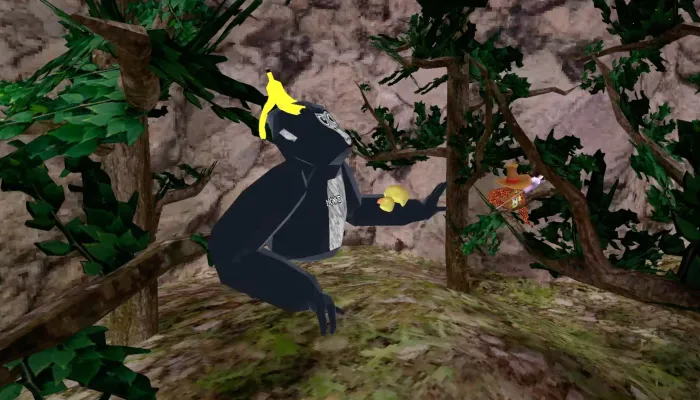
The Forest environment is especially effective for teaching the game. Trees offer vertical routes, branches create alternative paths, and the central terrain gives beginners enough open space to practice basic movement. Meta’s official launch material also highlighted additional environments such as Canyons, Caves, Mountain, City, and Clouds.
Different areas encourage different skills. Forest rewards branch movement and rapid changes in elevation. Canyons place more emphasis on wall routes and narrow platforms. Mountain uses slippery surfaces that alter momentum. Caves and other spaces introduce tighter paths where route knowledge becomes essential.
Gorilla Tag includes multiple play styles. The classic Tag structure turns one player into the pursuer while everyone else attempts to escape. Infection spreads the tagged condition through the lobby until only one uninfected player remains. Hunt gives players specific targets, while Team Paintball divides competitors into opposing groups. Casual rooms allow players to socialize and practice without the pressure of a formal chase. These modes have been part of the game’s official store presentation.
Infection is the mode that best matches the movement system. As more gorillas become infected, safe space disappears and the final survivors face several pursuers. The opening can feel relaxed, but the final moments produce real pressure.
A good chase is based on prediction rather than raw speed alone. I watch where another player is moving, identify the next available surface, and decide whether to follow or cut across a shorter route. The environment creates constant opportunities for misdirection.
Turning around repeatedly to watch the pursuer is risky because physical movement continues while my attention shifts. A successful escape often depends on knowing the map well enough to move forward without checking every obstacle.
Hunt creates a more focused objective. Instead of chasing everyone, I receive information about a particular target. This reduces the chaotic crowd behavior of Infection and rewards searching, navigation, and identifying another player’s movement style.
Team Paintball adds projectile-based interaction while preserving locomotion as the foundation. Movement remains more important than stationary accuracy because a slow target is easy to pressure.
Casual play may be the most useful mode for beginners. Without a chase forcing every mistake, I can study other players, test climbing techniques, and repeat routes. It also reveals that Gorilla Tag is partly a social platform rather than only a competitive game.
Private rooms strengthen that social side. Friends can create their own lobbies, invent rules, practice together, or ignore official objectives entirely. Meta’s launch description specifically promoted private friend rooms and open social interaction between players.
The depth comes from locomotion techniques the game does not teach fully. Players develop methods for wall climbing, rapid wall movement, branching, corner changes, slippery surfaces, and efficient ground travel. Community knowledge becomes part of the learning process.
This is my first major annoyance. Gorilla Tag’s strongest mechanic is also poorly explained to newcomers. Basic movement makes sense immediately, but the gap between shuffling around the ground and moving competently through the trees is enormous.
Watching skilled players can help, yet public lobbies are not always patient classrooms. A beginner may receive useful advice, be ignored, or become the easiest target in the match.
Physicality and VR Comfort: Fun That Requires Real Space
Gorilla Tag is more physically demanding than its simple visuals suggest. Repeated arm swings engage the shoulders, upper back, and torso. Quick direction changes may cause me to rotate my body, crouch, reach upward, or lean toward a surface.
A short session can feel energetic. A long session can feel like exercise.
That physical involvement is one of the game’s greatest strengths. Movement has weight because I am responsible for producing it. Escaping another player feels more personal when my own timing and effort created the distance.
The same physicality introduces practical risks. Gorilla Tag encourages wide, rapid arm movements while the player’s view is completely inside the headset. Furniture, walls, televisions, desks, lamps, and nearby people can become real-world hazards.
A generous play boundary is essential. I need enough room to extend both arms in every direction without hitting anything. Ceiling height also matters when reaching upward.
Using wrist straps is equally important. The game rewards rapid controller motion, and losing grip during a powerful swing could damage equipment or injure someone nearby.
Fatigue affects performance. As my arms become tired, pushes lose precision and movement becomes less efficient. This makes the game naturally self-limiting, though competitive excitement can encourage players to continue longer than is comfortable.
Warm-up matters more here than in most games. Shoulder and wrist discomfort can develop when a player begins with aggressive movement before finding a relaxed technique. Efficient players often appear fast because their motions are controlled, not because every swing uses maximum force.
Gorilla Tag may produce less conventional artificial-motion discomfort for some users because movement is tied closely to physical hand action. The body performs an input that visually results in motion, creating a stronger connection than passive thumbstick movement.
That does not make the game universally comfortable. The avatar can move quickly, change direction suddenly, fall from heights, and slide across surfaces. New VR users may still experience dizziness or nausea.
The lack of visible legs also takes adjustment. My body is represented primarily through arms and torso position. Reaching for a surface sometimes feels natural; at other times, the virtual body does not align perfectly with what I expect.
My second major annoyance is that competitive pressure encourages unsafe movement. When another player is close, it is easy to forget the real room and swing wider than intended. Gorilla Tag works best when safety boundaries are treated as a hard limit, not an obstacle to push through.
Graphics, Audio, and Technical Performance: Minimal Visuals, Maximum Social Noise
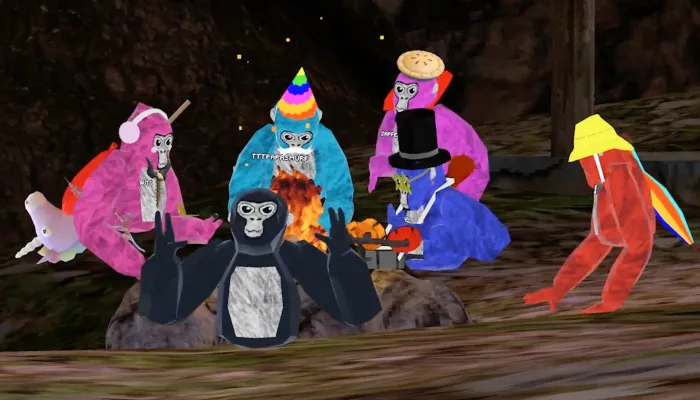
Gorilla Tag uses simple low-poly environments and uncomplicated gorilla models. Characters have broad bodies, long arms, flat colors, and limited facial detail. Maps rely on clear shapes rather than dense textures or realistic lighting.
This simplicity is not merely an artistic shortcut. It supports performance on standalone VR hardware and keeps fast movement readable. When several players occupy the same tree or narrow platform, elaborate character models would make the scene harder to understand.
The gorilla silhouette is especially effective. Arm positions are easy to see, which helps me interpret another player’s movement and predict the next push. Cosmetic items can change appearance without obscuring the fundamental body structure too much.
Environments are visually basic compared with premium VR adventures. Trees, rocks, platforms, caves, and buildings use stylized geometry with relatively limited detail. Players seeking photorealistic landscapes will not find them here.
The minimal design gives Gorilla Tag a playground quality. Maps feel like spaces built for movement rather than places attempting to simulate reality. That matches the social and competitive tone.
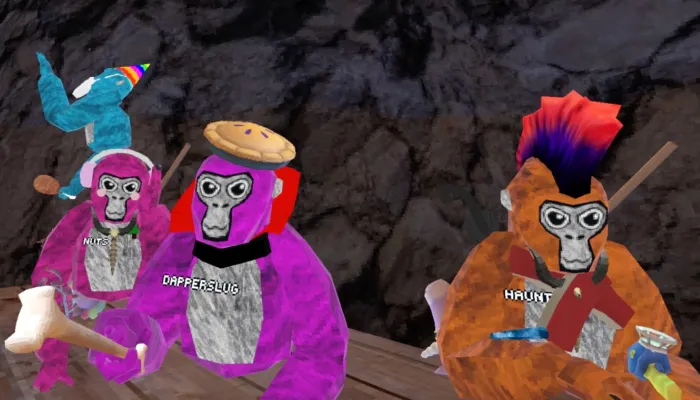
Color is functional. Player body colors help distinguish people quickly, while infected or team states can use clear visual changes. Cosmetic hats, badges, handheld items, and accessories add personality to otherwise similar avatars.
The City area serves as a commercial and social space. The Steam description references a rotating store inventory containing items that players can purchase, wear, and use for self-expression.
Cosmetics have become an important part of the game’s identity. Players remember specific hats, seasonal items, bundles, and limited releases. An avatar with a recognizable outfit becomes easier to identify across a busy lobby.
Audio is dominated by player voices. Built-in voice chat turns every room into a live social environment. Conversations, jokes, warnings, arguments, instructions, and shouting become part of the experience.
This can produce exceptional moments. A skilled player may coach a beginner through wall climbing. A group may invent a challenge. Friends can coordinate a chase or spend an entire session joking in the City.
Voice chat can also be overwhelming. Several people speaking at once create noise, and the youthful audience can make public rooms unpredictable. Muting, reporting, and parental controls are therefore not secondary features; they are important parts of safe use.
The game’s own sound effects are relatively restrained. Surface contacts, movement, mode changes, and environmental interactions provide feedback without competing heavily with conversation.
Technical performance benefits from the simple presentation. Standalone VR hardware can maintain responsive movement more easily than it could with highly detailed graphics.
Responsiveness is critical because even a short delay between arm movement and avatar motion would damage the central mechanic. When performance is stable, the locomotion feels immediate.
Connection quality affects player positions and tagging. An opponent may appear slightly behind the place recognized by the server, making a tag feel longer-ranged than expected. In casual play, this becomes a minor complaint. In a close chase, it can decide the outcome.
The Steam version requires SteamVR or Oculus PC support and remains labeled as an Early Access title on its store page. Players using PC VR must also account for headset connection quality, runtime configuration, and computer performance.
Bugs may appear through clipping, unusual collisions, lobby connection failures, or cosmetic problems. The basic locomotion is robust, but a social live-service environment introduces many opportunities for smaller technical issues.
The limited visuals also reduce the sense of progression between areas. Different maps use distinct layouts and mechanics, yet the visual detail does not always make exploration rewarding on its own. I visit locations primarily for how they play.
Monetization & Cosmetics: Free Movement With a Rotating Shop
Gorilla Tag uses a free-to-play model on its primary standalone VR platform, with monetization centered on cosmetic items and in-game currency. The shop in City offers a rotating inventory of wearable or usable items designed for avatar expression.
Cosmetics do not increase movement speed, jumping distance, grip, or tagging range. A player wearing no premium items has the same core physical abilities as someone using a complete paid outfit.
This means the competitive foundation is not pay-to-win. Success comes from movement technique, map knowledge, reaction, prediction, and physical control.
The strongest pressure comes from appearance and availability. A rotating shop encourages players to purchase items before they disappear. Seasonal cosmetics and limited bundles can create urgency even though they provide no mechanical advantage.
For a young audience, that distinction may not reduce the desire to spend. Social recognition matters. A rare hat or handheld cosmetic can signal status inside a lobby.
Parents should review purchase controls before allowing unrestricted access to the store. The game may be free, but a collection of small cosmetic purchases can exceed the price of a traditional premium title.
The Steam version follows a different entry model from the standalone Quest release and is sold as a paid product on Steam. The exact price can change by region or promotion, so buyers should check the current storefront rather than assume every version is free.
There are no traditional third-party advertisement videos interrupting matches. I do not need to watch a commercial after being tagged or before entering another room.
The absence of pay-to-win systems keeps the movement community relatively fair. A veteran player may appear impossibly fast, but that advantage comes from practice rather than a purchased ability.
The cosmetic economy still shapes the social experience more than I expected. City is not simply another map. It is where players browse, compare outfits, and discuss items. Commercial identity becomes part of community identity.
The model is reasonable for players who ignore or carefully limit cosmetic spending. It becomes less comfortable for collectors who feel compelled to obtain every temporary item.
Who Should Play This? Social VR Players Ready to Move
Gorilla Tag is best suited to players who want active VR rather than a seated or controller-driven experience. Its main mechanic requires physical arm movement, and the game becomes more rewarding as that movement improves.
Competitive players may enjoy the gap between basic understanding and mechanical mastery. The controls are minimal, but advanced movement requires practice comparable to learning routes in a platformer or movement shooter.
Social players are another obvious audience. Public and private rooms allow conversation, games, practice, and improvised activities. Gorilla Tag often works as a place to spend time rather than a structured competition.
Friends with compatible VR hardware may get the most reliable experience. Private rooms reduce unwanted noise, allow custom rules, and create a safer environment for younger players.
Children and teenagers are a major part of the game’s community, but age suitability depends on more than visual content. Public voice chat, strangers, in-app purchases, and physical safety all require parental attention.
Players with limited space should be cautious. Gorilla Tag can technically operate within a guardian boundary, but the best and safest experience requires enough room for energetic arm movement.
Anyone with shoulder, wrist, back, or mobility limitations may find the controls uncomfortable or inaccessible. There is no conventional locomotion option that fully replaces the physical system without changing the game’s identity.
Players seeking a story-driven campaign should skip it. Gorilla Tag has environments, events, cosmetics, and modes, but its long-term appeal comes from movement and social interaction rather than narrative progression.
Those who dislike public voice chat may still enjoy private rooms, though part of the broader community atmosphere will be lost.
Final Verdict: One of VR’s Simplest and Most Important Ideas
Gorilla Tag proves that a game does not need realistic graphics, a large campaign, or dozens of buttons to change how virtual reality feels. Its central idea is simple: movement comes from the hands. Everything else grows from that decision.
I found the early experience physically awkward but mechanically convincing. Every failed climb taught me something about surface angle, timing, or momentum. Every successful escape demonstrated that the movement system was more controllable than it first appeared.
The game’s best moments occur when technique and social interaction meet. A player demonstrates a route, I attempt to copy it, another gorilla begins a chase, and the lesson becomes a competition without any menu or formal tutorial.
The minimal presentation keeps attention on movement, though it also makes the game less appealing as a visual showcase. Gorilla Tag is not the VR title I would use to demonstrate realistic lighting or cinematic storytelling. It is the title I would use to explain why VR controls can create forms of play impossible on a standard screen.
Its community is both a strength and a risk. Public rooms feel alive, but they can become noisy and unpleasant. Younger players require supervision, purchase restrictions, and a clear understanding of voice-chat safety.
The cosmetic model is competitively fair because money does not buy faster movement. Rotating items can still create pressure, particularly for younger users who want to match friends or display limited accessories.
I recommend Gorilla Tag to active VR players, competitive movement fans, social groups, and anyone curious about unconventional locomotion. I recommend it more cautiously to new VR users, players with limited space, and families uncomfortable with open voice chat.
Personal rating: 8.5/10.
Gorilla Tag earns that score for its inventive locomotion, high skill ceiling, physical immediacy, social flexibility, varied maps, and fair competitive foundation. It loses points for weak onboarding, public-lobby noise, cosmetic pressure, fatigue, latency-sensitive tagging, and real-world safety concerns.
Few games make looking foolish during the first hour feel this promising. In Gorilla Tag, every clumsy slap against the ground is one step closer to moving like the player who just disappeared into the trees.
Pros

- Innovative movement mechanics that provide a unique physical gaming experience
- Immersive VR environment that blurs the line between digital and physical play
- Active community support that leads to frequent updates and fresh mods
- Minimalistic design that focuses on intuitive gameplay and clear visuals
- Free download availability making it accessible to a wide range of players
- Engaging multiplayer modes that foster both cooperation and competitive play
- Encourages creativity and strategic thinking during exploration and navigation
Cons

- Steep learning curve, especially for new players adjusting to motion-based controls
- Control scheme may be challenging in confined physical spaces
- Limited narrative depth and story elements compared to other immersive VR titles

Leave a comment
Your comment is awaiting moderation. We save your draft here
0 Comments