





The Christmas Movie Built Around One Terrible Family Mistake
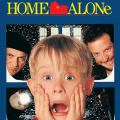
The moment that defines Home Alone for me is not Kevin McCallister screaming in front of the bathroom mirror or sending two burglars into another carefully prepared trap. It is the quiet morning after his family leaves for Paris, when Kevin walks through an empty house and slowly realizes that nobody is coming downstairs to tell him what to do. At first, the silence feels like freedom. Then it begins to feel much larger. This Home Alone review starts there because the film works best not as a collection of violent holiday jokes, but as a story about a child discovering that independence and loneliness can look almost identical.
Released in 1990 and directed by Chris Columbus from a screenplay by John Hughes, Home Alone follows eight-year-old Kevin after a chaotic family departure leaves him accidentally stranded in suburban Chicago. His parents and relatives travel to France, while Kevin remains behind in a house he previously wished he could have entirely to himself.
The premise is simple enough to explain in one sentence, but the movie builds surprising emotional range around it. Kevin eats whatever he wants, watches films he is normally forbidden to see, jumps on beds, explores private rooms, and creates the kind of temporary kingdom a frustrated child might imagine.
That fantasy eventually collides with fear. Kevin hears unfamiliar noises, remembers stories about a supposedly dangerous neighbor, and discovers that two burglars are targeting the neighborhood. The house that initially represented freedom becomes something he must defend.
The film is often remembered for slapstick, traps, and Christmas nostalgia. Those elements are central, but they work because the story first establishes Kevin as a lonely child trying to prove that he can handle a world built for adults.
Plot & Storytelling: One Forgotten Child and Two Very Persistent Burglars
The story begins inside the McCallister home on the night before an international family trip. The house is crowded with parents, siblings, cousins, luggage, food, arguments, and last-minute preparation.
Kevin is treated as the youngest inconvenience in a family already operating at maximum stress. His older brother Buzz humiliates him, his relatives dismiss him, and his mother Kate struggles to manage the chaos without giving Kevin the attention he wants.
After an argument at dinner, Kevin wishes that his family would disappear. A storm later causes a power outage, alarms fail, and the morning departure becomes a frantic rush.
During the headcount, a neighboring child is accidentally counted in Kevin’s place. The family reaches the airport and boards the plane without noticing that Kevin is still sleeping in the attic.
The setup requires several coincidences, but the film presents them clearly enough that the mistake feels possible within the confusion. The house is overcrowded, the adults are exhausted, and every stage of the departure happens under pressure.
Kevin wakes to find the house empty. Because he remembers his wish, he initially believes he has caused his family to vanish.
This misunderstanding allows the first act to operate like a childhood fantasy. Kevin celebrates by eating junk food, using his brother’s possessions, watching violent movies, and ignoring every household rule.
The comedy comes from the mismatch between his confidence and his age. Kevin behaves like a sophisticated adult while misunderstanding basic responsibilities.
He can prepare a dramatic meal but becomes nervous while shopping alone. He can create an elaborate story for a cashier but panics when confronted by an ordinary question.
The external threat comes from Harry and Marv, two burglars who have been targeting empty homes during the holiday season. Harry disguises himself as a police officer to gather information about travel plans, while Marv leaves flooded sinks behind as a signature.
Their scheme is broad enough for family comedy but serious enough to create danger. They are not imaginary monsters. They are adults willing to break into a house they believe contains no protection.
Kevin first avoids the threat through deception. He uses mannequins, music, lights, recordings, and movement to make the home appear occupied.
These early defenses are among the film’s cleverest scenes because they rely on Kevin’s imagination rather than physical force. He cannot defeat adults directly, so he manipulates what they believe they see.
The plot becomes more exaggerated once Harry and Marv realize that Kevin is alone. Kevin contacts the police indirectly, prepares the house, and creates a series of traps intended to delay the burglars until help arrives.
The final invasion is the film’s most famous sequence. The tone shifts toward live-action cartoon violence, with burns, falls, blunt impacts, sharp objects, slippery floors, swinging paint cans, and other hazards.
The injuries would be severe in reality, but the film establishes its own physical logic. Harry and Marv react with exaggerated pain and continue moving long after ordinary people would require emergency care.
The rescue arrives through Old Man Marley, Kevin’s neighbor, whose storyline runs parallel to the burglary plot. Kevin initially believes frightening rumors about him, but later learns that Marley is a lonely man separated from his family.
This subplot gives the story emotional depth. Kevin’s fear of Marley comes from gossip, while their eventual conversation teaches him that adults can also experience regret, isolation, and fear of rejection.
The film resolves both family separations on Christmas morning. Kevin is reunited with his mother, and Marley reconnects with his son and granddaughter. The symmetry is effective without becoming too complicated. Kevin defends his home physically, but his more important achievement is learning why he wants his family back.
Kevin McCallister: Clever, Frustrating, and Completely Believable
Kevin works as a protagonist because the film does not make him perfectly innocent. He is funny, inventive, observant, and brave, but he is also selfish, rude, impulsive, and capable of making his own family miserable.
His argument with Buzz is understandable, yet Kevin escalates the situation. He insults relatives, resents rules, and imagines that life would improve if everyone disappeared.
These flaws make his growth meaningful. If Kevin began as a patient and grateful child, the story would lose its emotional movement.
His intelligence is presented through practical creativity rather than unrealistic academic genius. Kevin notices patterns, uses household objects, imitates adult behavior, and understands how fear can influence decisions.
He is particularly good at performance. When he needs to appear older or more dangerous, he uses recorded dialogue, controlled lighting, and confident speech.
The famous gangster-film recording becomes a tool because Kevin understands that people react to tone without seeing the source. He turns a fictional threat into social power.
His traps reveal the same kind of intelligence. They are built from familiar household materials rather than advanced technology. The creativity feels connected to a child’s environment, even when the execution becomes unrealistically effective.
Kevin is also emotionally vulnerable. His confidence weakens at night, when the house becomes quiet and ordinary sounds feel threatening. The furnace in the basement becomes a monster in his imagination. Later, Kevin confronts it and demands that it stop frightening him.
That moment is small but important. Kevin’s growth is not only about fighting burglars. It is about learning that fear can be confronted even when it does not disappear immediately.
His church conversation with Marley demonstrates another kind of maturity. Kevin listens to an adult problem and offers simple advice without fully understanding its complexity. The advice still matters because it comes from someone who knows what it feels like to miss family while being too proud or frightened to say so.
Macaulay Culkin’s performance makes Kevin convincing. He can shift from arrogance to panic, from calculation to sadness, without making the character feel inconsistent.
His comic timing is precise, but the quieter scenes are equally important. Kevin staring at families, watching holiday activity from a distance, or waiting on Christmas morning gives the story emotional weight.
Harry and Marv: Burglars Designed for Live-Action Cartoons
Harry and Marv succeed because they are threatening enough to justify Kevin’s fear but foolish enough to survive within a family comedy.
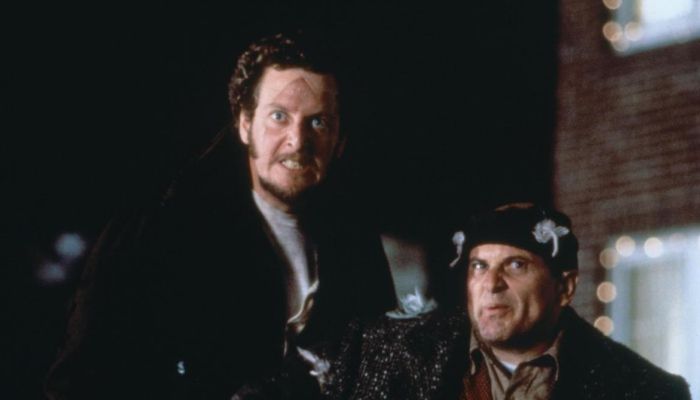
Joe Pesci gives Harry an impatient, aggressive energy. He sees himself as the professional leader and becomes increasingly furious when a child repeatedly humiliates him.
Pesci’s performance is especially funny because he appears to be suppressing language too harsh for the film. His frustrated muttering sounds like a man attempting to censor himself while in extreme pain.
Daniel Stern gives Marv a slower, more confused personality. Marv is physically larger but less strategic, making him the easiest target for Kevin’s tricks. His reactions are some of the film’s strongest comic moments. Stern commits fully to every scream, delayed realization, and exaggerated injury.
The partnership works through contrast. Harry plans. Marv misunderstands. Harry becomes angry at Kevin. Marv occasionally appears impressed by him. The burglars also become more ridiculous as the film progresses. Their original crime carries real consequences, but the final act transforms them into durable cartoon antagonists.
This tonal shift is deliberate. The audience is not expected to worry that Kevin has permanently injured them. Pain becomes rhythm, with each trap building toward the next reaction.
The main weakness is repetition. After several traps, the structure becomes predictable: the burglars approach, Kevin activates the hazard, and the film pauses for a reaction.
The performers keep the sequence entertaining, but a few traps could have been removed without weakening the climax.
Supporting Cast & Family Dynamics: Chaos Before the Silence
Catherine O’Hara gives the film much of its emotional credibility as Kate McCallister. Her horror upon realizing that Kevin is missing becomes the central adult perspective.
Kate is not presented as careless in a simple way. She makes a terrible mistake, but the circumstances were chaotic, and her response is immediate.
Her journey back to Chicago shows determination and guilt. She argues with airport staff, searches for transportation, waits in terminals, and accepts help from strangers. O’Hara avoids making the performance overly sentimental. Kate is exhausted, frightened, angry, and focused on reaching her son.
John Heard gives Peter McCallister a quieter role. He remains with the family in Paris and attempts to coordinate a solution, but the film gives Kate the more active emotional journey.
The extended McCallister family is intentionally overwhelming. Buzz is arrogant, Uncle Frank is rude, and the cousins contribute to the sense that Kevin is constantly being pushed aside.
The family’s behavior explains Kevin’s wish without completely excusing it. He is loved, but the household is too crowded and distracted to make him feel heard.
Buzz is especially important because his treatment of Kevin establishes the younger brother’s resentment. His shelves, private possessions, frightening stories, and pet tarantula represent an older sibling’s power.
The film does not provide a deep resolution between them. Buzz remains mostly unchanged, which is believable within a family comedy.
Old Man Marley provides the strongest supporting storyline. Roberts Blossom plays him with a quiet sadness that contrasts with the exaggerated rumors surrounding him.
The film first presents Marley through Kevin’s imagination. He appears frightening because Buzz has constructed a story around his appearance and solitary behavior.
When Kevin meets him in the church, the supposedly dangerous man becomes gentle and vulnerable. This reversal reinforces the film’s message about fear being shaped by incomplete information. John Candy appears as Gus Polinski, a friendly musician who offers Kate transportation. The role is brief, but Candy brings warmth and comic ease.
His stories about family mistakes provide temporary relief during Kate’s stressful journey and remind the audience that imperfect parenting does not automatically mean a lack of love.
Humor & Slapstick: Pain, Timing, and Childhood Logic
Home Alone uses several kinds of comedy. The early scenes rely on family chaos, Kevin’s attitude, adult impatience, and misunderstandings. The middle portion uses independence comedy. Kevin attempts adult tasks with partial knowledge, often succeeding just enough to remain confident.
The final act becomes physical slapstick. The burglars slip, fall, burn themselves, collide with objects, and repeatedly underestimate the house. The best traps are simple and visually immediate. An icy staircase requires no explanation. The audience sees the danger before Harry reaches it and waits for the inevitable fall.
This anticipation is essential to slapstick. The joke is not only the injury. It is the delay between understanding the trap and watching the character fail to avoid it.
The heated doorknob works in the same way. The camera shows Harry approaching, while Kevin’s earlier preparation remains in the audience’s memory. Some traps are more elaborate, including swinging paint cans and the zip-line escape. These provide larger action beats but are less grounded in ordinary household accidents.
The comedy occasionally becomes uncomfortable because the injuries are severe. Stepping on a nail, receiving burns, and being struck by heavy objects would be far beyond harmless mischief in reality.
The film survives this problem by abandoning realism during the invasion. Harry and Marv behave like animated characters inside live-action bodies. My first major criticism is that the trap sequence continues slightly too long. The escalation is funny, but the rhythm begins to repeat before the police arrive.
My second complaint is that Kevin’s planning becomes almost impossibly precise. He predicts movement through the house with a level of accuracy that belongs more to a master strategist than an eight-year-old.
That exaggeration is part of the fantasy, yet it occasionally weakens the sense that Kevin is improvising under pressure.
Visual Style & Production Design: A House That Becomes a Character
The McCallister house is one of the film’s most important creative achievements. It must function as a family home, childhood playground, frightening empty space, and defensive maze.
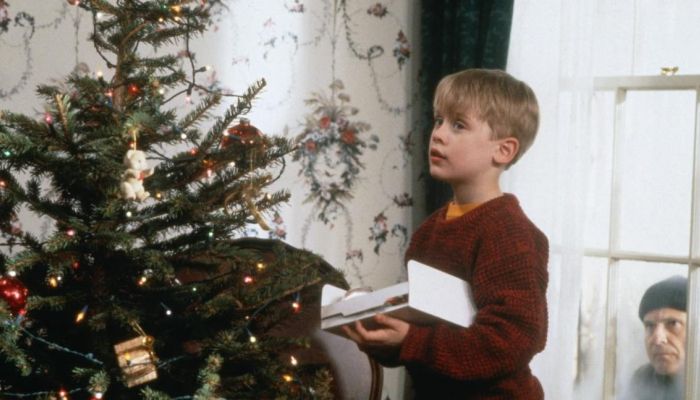
Production design gives the house warmth through rich reds, greens, wood, patterned wallpaper, Christmas decorations, and large rooms. The color palette supports the holiday setting without making every frame look artificial. The house feels decorated but still lived in. During the opening chaos, the rooms appear crowded and noisy. After the family leaves, the same spaces feel much larger.
This transformation is achieved through composition, lighting, and sound. Empty hallways and staircases become slightly threatening because Kevin’s small body is isolated within them.
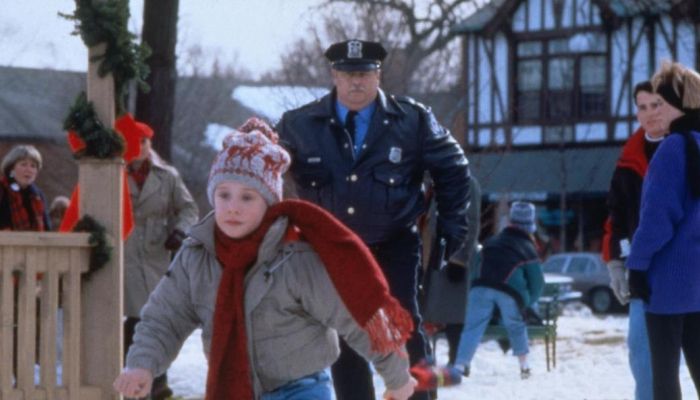
The basement is darker and more industrial, allowing the furnace to become a believable childhood monster. The exterior also matters. Snow, neighboring homes, Christmas lights, and quiet suburban streets create an idealized holiday environment. This calm setting makes the burglars’ presence more unsettling. They do not enter a visibly dangerous neighborhood. They invade a place that appears safe.
The church scenes use softer lighting and open space, creating a visual pause before the final confrontation. The airport and travel sequences contrast with the house through crowds, movement, public announcements, and limited personal control.
Chris Columbus directs the environments clearly. I always understand where Kevin, Harry, and Marv are located during the final sequence.
That spatial clarity makes the traps more effective because the house has already become familiar. The audience knows which staircase, doorway, window, or hallway is being used.
Music, Direction & Pacing: John Williams Makes Mischief Feel Magical
John Williams’ score gives Home Alone much of its Christmas identity. The music combines childlike wonder, mystery, warmth, and comic tension.
The main themes evoke traditional holiday music without simply copying familiar songs. Bells, choir-like textures, strings, and playful rhythms make the film feel seasonal from the opening.
The score also supports Kevin’s imagination. When the house feels frightening, the music suggests mystery rather than horror. During the trap sequence, the score becomes rhythmic and mischievous. It helps organize the physical comedy almost like choreography.
Chris Columbus directs with a clear understanding of tone. The film can move from family argument to childhood fantasy, from quiet loneliness to broad violence, without becoming completely disconnected.
The opening is intentionally loud and crowded. The middle slows down to allow Kevin’s independence to become both entertaining and uneasy. The final act increases speed through cross-cutting, music, physical comedy, and Kevin’s movement through the house.
The pacing is generally strong, though the family departure requires a relatively long setup. That time is necessary because the film must establish enough confusion to make the central mistake believable.
The quiet middle section is one of the film’s greatest strengths. A less patient movie might have introduced the burglars immediately. Instead, Home Alone allows Kevin to enjoy freedom before realizing its emotional cost. The change gives the later danger more meaning.
Themes & Emotional Meaning: Independence Is Not the Same as Being Alone
Home Alone is often described as a story about a child defending his house, but its deeper theme concerns the difference between independence and isolation.
Kevin wants control because he feels powerless inside his family. Everyone is older, louder, and more capable of deciding what happens.
When the house becomes his, he initially experiences complete freedom. He chooses food, entertainment, bedtime, and daily activity.
The fantasy weakens because independence without connection becomes lonely. Kevin can operate the house, but he cannot replace the people who gave it emotional meaning.
The movie does not suggest that Kevin’s family is perfect. They are impatient, distracted, and occasionally cruel. His growth involves recognizing their value without pretending that every conflict was imaginary.
Kate experiences the opposite lesson. She already loves Kevin, but losing him forces her to confront how easily he became invisible inside the family’s chaos. The reunion works because both characters have changed. Kevin no longer wants everyone to disappear, while Kate understands the seriousness of leaving him unheard.
Marley’s story reinforces the theme. He is physically close to his family but emotionally separated from them. Kevin encourages him to risk rejection because remaining alone guarantees that nothing will improve. Christmas functions as more than decoration. It represents a period when family expectations become especially visible.
The film allows celebration and disappointment to exist together. The decorations are beautiful, but several characters are lonely beneath them. Home is also presented as both a place and a relationship. Kevin protects the physical house because it represents his family, even while they are absent.
Critical Reception & Lasting Reputation: From Mixed Reviews to Holiday Classic
Home Alone received a mixed critical response when it was released. Some reviewers praised Macaulay Culkin’s performance, John Williams’ score, the family premise, and the physical comedy.
Others criticized the sentimentality, exaggerated violence, predictable plotting, and the transformation of burglars into targets for increasingly severe punishment.
The film became an enormous commercial success and connected strongly with audiences. Its popularity exceeded the expectations created by its relatively simple premise.
Over time, Home Alone developed into a major Christmas tradition. Television broadcasts, home-video releases, quotations, music, and repeated family viewing turned it into something larger than its original theatrical reception.
Macaulay Culkin’s performance became one of the most recognizable child roles in popular cinema. Kevin’s scream, facial expressions, and improvised defenses became part of the film’s cultural identity.
The house itself became iconic. Viewers remember the staircase, basement, attic, kitchen, front entrance, and exterior almost as clearly as the characters. John Williams’ music also contributed significantly to the film’s lasting reputation. The score allows audiences to identify the movie before any dialogue begins.
Modern criticism often examines the severity of the traps and the wealth represented by the McCallister family’s lifestyle. These observations are fair, though the film operates primarily within comic fantasy rather than realistic social drama.
The movie’s legacy has also been shaped by numerous sequels and imitations. Most repeated the child-versus-criminal structure without matching the emotional balance of the original.
What separates Home Alone is not the traps alone. It is the combination of Kevin’s fantasy, Kate’s journey, Marley’s loneliness, Christmas atmosphere, and carefully structured comedy.
Final Verdict: A Christmas Comedy With More Heart Than Its Traps Suggest
Home Alone remains effective because it understands the emotional fantasy beneath its famous premise. A child who feels ignored imagines how wonderful life would be without his family.
The film grants that wish and then carefully reveals its limits.
Kevin enjoys the freedom. He eats what he wants, controls the house, and proves that he can solve problems independently. What he cannot replace is the feeling of belonging. The silence that first feels exciting eventually becomes painful.
Macaulay Culkin carries the movie with unusual confidence. His performance is funny enough for broad comedy but restrained enough during Kevin’s lonely moments. Catherine O’Hara gives the reunion emotional credibility because Kate’s journey is defined by determination rather than passive regret.
Joe Pesci and Daniel Stern transform ordinary burglars into one of cinema’s most memorable comic partnerships. Their reactions give the final act its energy even when the traps become excessive.
Chris Columbus directs the house with exceptional clarity, while John Williams gives the film a musical identity that remains inseparable from Christmas.
The Old Man Marley subplot prevents the movie from becoming only a revenge fantasy. Kevin learns that fear can come from stories, while loneliness can continue because people are afraid to reconnect.
I recommend Home Alone to families, Christmas-film fans, viewers who enjoy physical comedy, and anyone interested in a simple premise executed with strong craft. It is not realistic, and it is not always gentle. Its burglars survive enough damage to end several ordinary careers.
The emotional core remains honest. Children want independence, families make mistakes, pride creates distance, and home matters most when the people connected to it are missing.
Personal rating: 9/10.
Home Alone earns that score for Macaulay Culkin’s performance, Catherine O’Hara’s emotional urgency, the memorable burglars, John Williams’ score, excellent production design, clear direction, inventive comedy, and lasting Christmas atmosphere. It loses one point for excessive slapstick, convenient plotting, thin supporting relatives, and physical injuries that occasionally overwhelm the family tone.
The traps made Home Alone famous. The empty house, the church conversation, and Kevin waiting for his mother are what made it last.
Pros

- Timeless holiday charm and nostalgia
- Creative humor that balances slapstick and heartfelt moments
- Accessible on multiple platforms for streaming and downloading
- Impressive cinematography that captures a festive, wintry atmosphere
- Inventive character development paired with witty dialogues
- Encourages creativity, resilience, and self-reliance in challenging situations
Cons

- Some slapstick humor may not resonate with all audiences
- The film's effects and settings can feel dated compared to modern movies
- The implausible premise might not appeal to viewers favoring realistic storytelling

Leave a comment
Your comment is awaiting moderation. We save your draft here
0 Comments