







Five Minutes as a Cat, One Destroyed Kitchen
My first objective in I Am Cat was not officially described as “ruin an elderly woman’s afternoon,” but that is what happened. I climbed onto a table, pushed a cup toward the edge, watched it fall, and immediately began searching for something larger to break. A few minutes later, food was scattered across the kitchen, drawers were open, and Granny was responding to my behavior with the understandable irritation of someone whose home had been invaded by a highly mobile disaster. This I Am Cat review begins with that small domestic catastrophe because the game understands one central truth: playing as a cat is most entertaining when curiosity and misbehavior become the same activity.
I Am Cat is a virtual-reality sandbox developed by New Folder Games. It places me inside interactive domestic and neighborhood environments where I can move like a cat, complete quests, experiment with objects, irritate human characters, and create my own physical comedy. The full release expanded the experience beyond Granny’s house with additional locations including a town, garage, and butcher’s shop, alongside new characters, quests, recipes, tools, skins, and environmental activities.
The concept is deliberately uncomplicated. I am not saving the world or building a heroic reputation. I am a cat. I climb furniture, steal food, knock objects down, explore spaces that humans would prefer I leave alone, and decide whether to cooperate with Granny’s requests or turn the entire house into a playground.
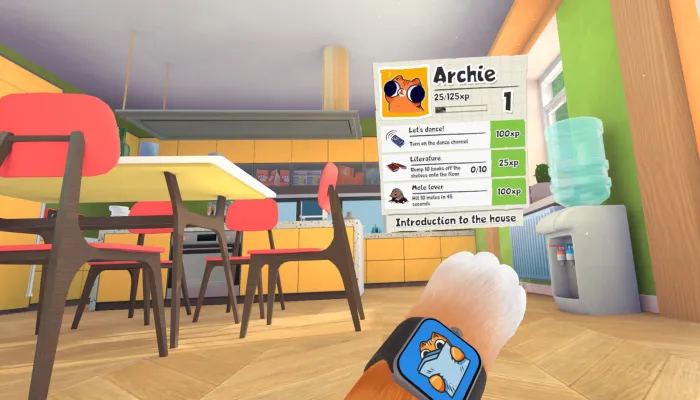
That freedom gives the opening an immediate charm. Most VR games spend their first hour explaining fictional history, combat systems, or equipment menus. I Am Cat hands me paws and an environment full of movable objects. The tutorial is largely physical: touch something, pull it, throw it, taste it, break it, or climb over it.
The fantasy works because VR is well suited to small acts of mischief. Pushing a cup from a table would be trivial with a controller. In virtual reality, I reach toward it, make contact with my paw, and watch it slide toward the edge because of my own movement. The action feels personal even when the result is completely pointless.
My early excitement was balanced by a concern that the joke might run out quickly. Being a destructive cat is funny, but a full game needs more than breakable dishes. I Am Cat addresses that problem through quests, expanded locations, tools, recipes, collectibles, customization, and multiplayer, though the underlying experience remains a sandbox rather than a tightly structured adventure.
Core Gameplay & Mechanics: Paws, Physics, and Feline Problem-Solving
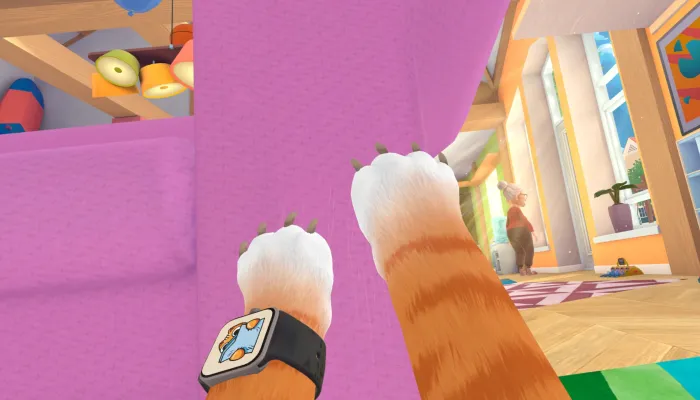
Movement in I Am Cat is designed around embodying a small animal rather than controlling a human-shaped character. I use my virtual paws to interact with surfaces, objects, furniture, and characters. The exact locomotion can vary with comfort settings and platform, but physical hand movement remains central to the experience.
The most convincing interactions happen at close range. Opening a drawer, pulling an item from a shelf, moving food around a kitchen, or reaching into an awkward space feels more appropriate for VR than selecting an object through a traditional button prompt.
Climbing gives the game much of its vertical freedom. A human sees a kitchen counter as a work surface. A cat sees it as a platform connected to cupboards, shelves, hanging objects, and food that has been placed far too confidently near the edge.
The game encourages me to examine rooms according to feline logic. The floor is only one possible route. Chairs become steps. Drawers become footholds. Tables become observation platforms. Small openings become invitations.
This transformation of ordinary space is one of the strongest design choices. The house does not need fantasy architecture because my scale and movement make familiar rooms feel different. Reaching a high shelf can become a small traversal challenge, while escaping after stealing something creates an improvised chase.
Physics drive most of the comedy. Objects react to pushes, throws, collisions, gravity, and other objects. A controlled attempt to move one item can knock over several others. A carefully prepared recipe can become floor decoration after one careless paw movement.
The system works best when consequences appear natural. A cup falls because I pushed it. A chair shifts because I landed awkwardly. Food rolls away because the surface is not level. These simple physical relationships make the environment feel responsive.
Physics are also a source of inconsistency. Small objects may be difficult to grab cleanly, items can collide in strange ways, and a paw may connect with something other than the object I intended to touch. VR interaction always involves some approximation between real and virtual hand position, and I Am Cat regularly exposes that gap.
This is my first major annoyance. The game invites precise mischief but does not always provide precise control. Knocking a vase from a shelf is easy. Placing a small ingredient in exactly the right location can be much more frustrating.
Quests provide structure for players who need more than free experimentation. Granny and other characters can give tasks involving objects, food, movement, exploration, or environmental interaction. Completing them offers direction and helps reveal mechanics that I might otherwise miss.
The quests are most enjoyable when they support the cat fantasy. Stealing an item, finding a hidden route, preparing something inappropriate, or solving a household problem through physical interaction feels natural within the game’s tone.
Less interesting objectives can feel like ordinary fetch tasks performed with paws. Moving between locations to retrieve one item is not automatically entertaining simply because the player is a cat.
Cooking and recipes add another layer of experimentation. The full release promoted new cooking combinations among its expanded mechanics, giving players reasons to use kitchen items beyond throwing them.
Cooking in VR has natural comic potential. Ingredients can be grabbed, moved, mixed, dropped, or intentionally misused. A successful recipe feels satisfying because I physically performed the process rather than selecting ingredients from a menu.
Tools expand the possible chaos. Official launch material highlighted activities such as using a slingshot, painting walls, cutting trees, and operating a lawn mower. These additions push I Am Cat beyond the original indoor toy-box concept and give the larger locations more practical purpose.
The lawn mower is a good example of the game’s humor. It is not a system I expected from a cat simulator, but that mismatch is the joke. I Am Cat is willing to give its feline protagonist access to tools no responsible human would place near an animal.
Exploration improves as the world expands. Granny’s house remains the emotional center because its compact rooms are filled with recognizable objects and clear opportunities for trouble. The town and other locations provide more variety, new characters, and larger spaces.
The larger world does not always match the density of the house. Domestic rooms work well because almost every object has an obvious relationship to a cat. Wider outdoor spaces occasionally contain more travel than meaningful interaction.
Multiplayer was added through a free update, allowing players to share the game’s sandbox with friends. Official Meta material promoted the mode as a way to enter I Am Cat together rather than creating mischief alone.
The addition makes sense because physical comedy improves when someone else witnesses or causes it. Two cats can cooperate on tasks, compete over objects, explore together, or create far more disorder than Granny can reasonably manage.
Multiplayer also increases technical unpredictability. Physics objects, moving players, voice communication, and network synchronization all need to agree. When they do, the shared sandbox is much funnier. When they do not, objects or player positions can behave strangely.
Graphics, Audio, and Technical Performance: A Cartoon House Built for Trouble
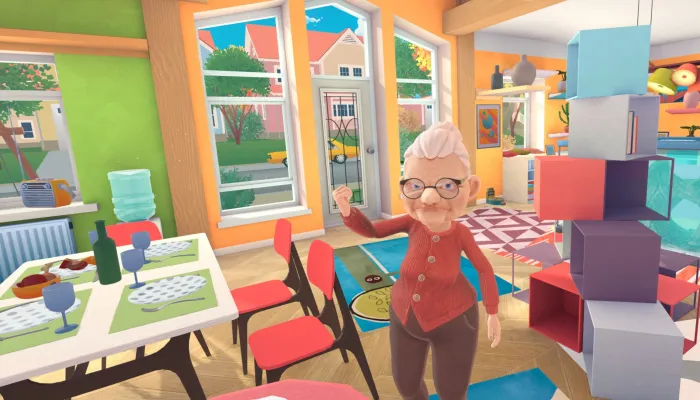
I Am Cat uses a colorful, stylized visual design rather than realistic domestic detail. Characters, food, furniture, tools, and outdoor spaces use simple shapes and bright materials that remain readable through a VR headset.
The cat paws are the most important visual element because they connect my physical movement to the avatar. Seeing paws instead of human hands reinforces the role immediately. Reaching for a drawer or swiping an object feels different when the virtual limb belongs to an animal.
Granny is designed as both caretaker and comic antagonist. Her reactions provide context for the player’s behavior. Without her, breaking a room would be simple object simulation. With her nearby, the same action becomes deliberate disobedience.
The exaggerated presentation keeps the conflict harmless. I may ruin a kitchen or provoke another character, but the game does not treat the destruction with realistic severity. It resembles slapstick animation performed through VR physics.
Indoor spaces contain enough visual detail to support investigation without becoming difficult to read. Cupboards, appliances, containers, tables, shelves, and decorations communicate their purpose quickly.
Outdoor areas are broader but visually simpler. They provide new opportunities and characters, although some surfaces and environmental props lack the polish of larger-budget VR releases.
Animation quality varies. Cat movement feels convincing when my paws align well with the environment. Human and animal characters can appear more mechanical, particularly when reacting to unexpected player behavior.
The sound design supports the household comedy. Objects collide, glass and dishes react to impacts, appliances make recognizable noises, and characters respond vocally to what I am doing.
Cat sounds reinforce the role without requiring spoken dialogue from the player character. Meows and physical reactions provide enough identity for the fantasy to work.
Repeated character lines can become noticeable during longer sessions. Granny may respond to similar behavior in similar ways, reducing the surprise after I have tested the same interaction several times.
Performance depends heavily on platform, headset, PC configuration, and the complexity of the scene. The Steam version uses OpenXR through SteamVR and lists support for Valve Index and Meta Quest 2 and 3 configurations.
The developers have issued performance and compatibility updates, including fixes for headsets running at refresh rates above 72 Hz and other VR-related improvements.
That ongoing work is important because physics-heavy VR games are sensitive to frame-rate instability. A normal game may tolerate a short stutter. In VR, the same interruption can affect comfort, interaction accuracy, and spatial awareness.
I encountered the most concern around busy scenes. Several movable objects, active characters, tools, and multiplayer synchronization can place more strain on the game than walking through an empty room.
Clipping is another common rough edge. Paws may pass partly through surfaces, objects may become trapped, and items can occasionally settle in positions that make them difficult to retrieve.
These problems do not destroy the sandbox, but they weaken the illusion. I Am Cat works because the environment feels touchable. When a paw or object behaves incorrectly, the game reminds me that I am manipulating a physics system rather than inhabiting a house.
Monetization & Extra Content: Premium VR With Additional Purchases
I Am Cat is sold as a premium game on Steam rather than as a free download supported by mandatory advertisements. The store also offers a broader “Whole Kitten Caboodle” package, indicating that additional content can be bundled with the base release.
The main game is not pay-to-win. There is no competitive progression system where purchased equipment makes one cat faster, stronger, or better at completing the central sandbox activities.
Cosmetics and shop items allow players to change the appearance of the cat. The full launch introduced new skins and additional purchasable or unlockable items intended to personalize the avatar.
Customization fits the game, especially after the addition of multiplayer. A distinct skin makes each cat easier to recognize and gives players another form of expression.
The danger comes from fragmented content. A sandbox feels most satisfying when every visible location and toy appears available for experimentation. Separate unlocks or purchases can make the environment feel artificially divided.
Some platform versions have offered location-unlock purchases, and user reports indicate that purchasing or restoring those unlocks has not always worked smoothly. Such reports are anecdotal rather than proof of a universal problem, but they show why buyers should confirm exactly what a package includes before paying.
There are no traditional third-party advertisement videos interrupting the Steam VR experience. I do not need to watch a commercial after upsetting Granny or before attempting another quest.
The value depends on how much the player enjoys unscripted interaction. Someone who completes the main tasks and leaves may find the experience relatively short. A player who enjoys experimenting, replaying interactions, testing tools, searching for secrets, and using multiplayer can receive much more from the same content.
The game also has mobile versions, but these should not be treated as identical to the VR release. Touchscreen controls, physical presence, platform pricing, and available content may differ. The core appeal of the original experience comes from embodying the cat through VR interaction.
Who Should Play This? Curious VR Owners and Dedicated Trouble-Makers
I Am Cat is best suited to players who enjoy physical VR sandboxes. Its strongest moments come from interacting freely rather than following a strict mission sequence.
Cat lovers are an obvious audience. The game captures familiar feline behavior through climbing, stealing food, exploring restricted spaces, ignoring human expectations, and pushing objects from elevated surfaces.
Younger players may appreciate the simple humor and recognizable environment. However, headset age guidance, play-space safety, online interaction, and optional purchases should still be managed by an adult.
Content creators can find plenty of material because the physics regularly produce short comic situations. A simple household objective can become a chain of accidents with a clear beginning and punchline.
Players who enjoy games such as Job Simulator or other object-focused VR comedies may understand the appeal immediately. I Am Cat is less concerned with narrative consequence than with giving me a room full of physical possibilities.
Multiplayer groups may receive more long-term value than solo players. Shared chaos, improvised games, and cooperative exploration provide reasons to return after the main surprises are known.
Players seeking deep combat should skip it. The game’s action is based on interaction, movement, tools, and comedy rather than an advanced fighting system.
Anyone expecting a long narrative campaign may also be disappointed. Quests provide direction, but the broader structure remains episodic and sandbox-driven.
Players sensitive to VR discomfort should approach carefully. Climbing, rapid head movement, close interaction, and artificial locomotion can be tiring or uncomfortable depending on personal tolerance.
Those with very small play areas should clear extra space. Reaching, throwing, and turning quickly can bring controllers dangerously close to furniture or walls.
Final Verdict: A Delightful Cat Simulator That Needs Smoother Paws
I Am Cat understands why people want to play as a cat. It is not primarily the appearance, the meowing, or the novelty of having paws. It is permission to approach a human environment without respecting its intended use.
A kitchen becomes a collection of objects waiting to fall. A cupboard becomes a climbing challenge. A meal becomes something to steal. A request from Granny becomes either a quest or an opportunity to create a larger problem.
The VR format makes those choices feel direct. Reaching, pushing, throwing, climbing, and opening objects provide a physical relationship that a standard controller would struggle to reproduce.
I enjoyed the game most when I ignored efficiency. Completing a quest correctly was satisfying, but creating an accidental chain reaction often produced the better memory. I Am Cat is a comedy sandbox first and an objective-driven adventure second.
The expanded full release improves variety through new locations, characters, recipes, tools, activities, and quests. Multiplayer further increases the potential for unpredictable situations by adding another player-controlled cat to the environment.
Technical roughness remains the main reservation. Object handling is not always precise, performance can vary, and busy physical scenes may expose clipping or collision problems. These weaknesses matter because interaction is the entire foundation of the game.
The structure is also unlikely to satisfy players who need a strong narrative or constant progression. Once I have discovered the main jokes and completed the available tasks, continued enjoyment depends on experimentation, customization, multiplayer, and personal attachment to the cat fantasy.
I recommend I Am Cat to VR players who enjoy physical comedy, interactive environments, cat behavior, and self-directed play. It is especially easy to recommend to younger audiences and families when purchases, headset safety, and multiplayer access are properly supervised.
Personal rating: 8/10.
I Am Cat earns that score for its convincing feline perspective, playful physics, dense household interactions, climbing, humorous characters, expanded locations, tools, quests, and multiplayer potential. It loses points for imprecise grabbing, uneven content density, technical instability, repetitive reactions, and limited long-term structure.
It may not be the most polished VR sandbox available, but few games make pushing one carefully placed object from a shelf feel this completely justified.
Pros

- Innovative narrative perspective that immerses players in a unique adventure.
- Engaging gameplay mechanics that blend exploration with puzzles.
- Charming, hand-drawn visual style that enhances the overall experience.
- Dynamic soundtrack that adapts well to different in-game scenarios.
- User-friendly interface that simplifies navigation and installation.
- Robust mod and cheat support that allows for extensive player customization.
Cons

- Some puzzles may feel repetitive despite their creative intent.
- Difficulty progression can be inconsistent for different skill levels.
- Mod integration can occasionally lead to stability issues if not managed properly.

Leave a comment
Your comment is awaiting moderation. We save your draft here
0 Comments