




Moana Returns to an Ocean That Feels Less Mysterious
The first Moana ended with a satisfying sense of completion. Moana restored the heart of Te Fiti, understood her connection to the ocean, returned voyaging to Motunui, and accepted her role as a leader. Moana 2 begins after that transformation, when she is no longer the uncertain daughter asking whether she belongs beyond the reef. She is now an experienced wayfinder searching for other island communities. This Moana 2 review starts with that change because the sequel’s central challenge is not teaching Moana who she is. It is finding a new reason for her to risk everything after she has already discovered the answer.
Directed by David Derrick Jr., Jason Hand, and Dana Ledoux Miller, Moana 2 reunites Moana with Maui for another ocean adventure. This time, the goal is to find the lost island of Motufetu, a place that once connected different peoples across the Pacific before a curse separated them.
The premise expands the first film’s interest in navigation, heritage, and community. Moana is no longer fighting only for Motunui. She is trying to reconnect cultures that have been isolated from one another for generations. That larger mission gives the sequel scale, but it does not automatically give it the emotional precision of the original. Moana already understands her calling, Maui has already learned humility, and their friendship has already survived its most important test.
Moana 2 compensates by surrounding them with new companions, a darker supernatural threat, and a stronger emphasis on leadership. The film is colorful, energetic, and easy to enjoy. It also frequently feels like the first chapter of a larger franchise plan rather than a completely self-contained story.
Plot & Storytelling: A Lost Island and a New Generation of Voyagers
The story begins with Moana exploring distant waters in search of evidence that other people still exist beyond Motunui. Her voyages have made her more confident, respected, and comfortable with responsibility.
She eventually discovers a clue connected to Motufetu, an island once used as a meeting point for communities spread across the ocean. The storm god Nalo cursed the island and caused it to sink, preventing different peoples from finding one another. Moana receives a message from her ancestors warning that Motunui’s future depends on restoring this connection. Without contact with other communities, her people may eventually become vulnerable and isolated.
The mission immediately carries greater social responsibility than her first journey. Moana is not sailing only to correct one broken relationship between a goddess and a demigod. She is trying to reverse generations of separation.
Unlike the first film, Moana does not leave alone. She assembles a crew from Motunui.
Loto is an inventive engineer whose practical ideas help improve the canoe and solve mechanical problems. Moni is a storyteller and enthusiastic admirer of Maui. Kele is an older farmer whose complaints and reluctance provide contrast with the younger members.
Pua finally joins the ocean journey more directly, while Heihei continues to function as a chaotic passenger who survives situations through a combination of luck and complete lack of understanding.
The crew gives Moana new leadership responsibilities. She must explain decisions, manage conflicting personalities, and protect people who do not possess her experience.
This is one of the sequel’s strongest ideas. Leadership is different from individual courage. Moana can no longer make every risky choice based only on what she is willing to sacrifice personally.
Unfortunately, the supporting crew members are introduced quickly and rarely developed beyond their main traits. Loto invents, Moni admires, and Kele complains.
Their interactions are pleasant, but the screenplay does not give them the depth needed to become as memorable as Moana, Maui, or even several supporting characters from the original.
Maui initially follows a separate path. He is attempting to confront the forces connected to Motufetu and becomes trapped by Matangi, a mysterious character associated with bats and the supernatural realm surrounding the cursed island.
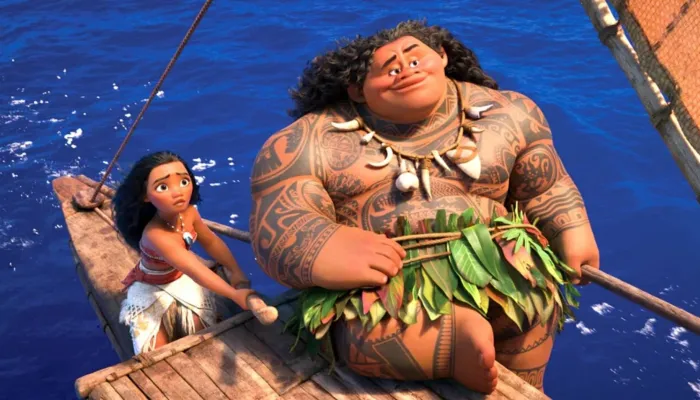
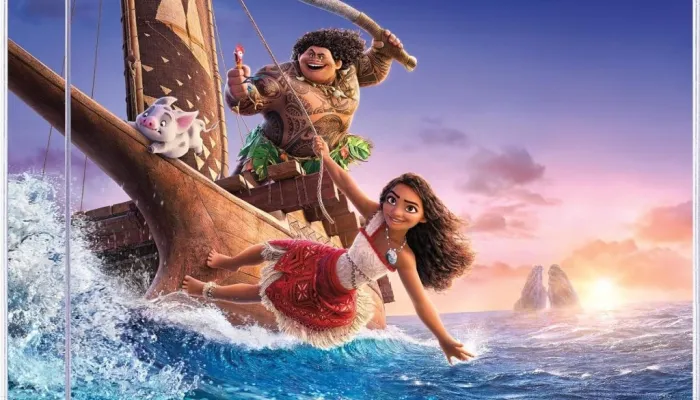
Moana and Maui eventually reunite, restoring the partnership at the center of the series. Their relationship is warmer and less confrontational than before. They no longer need to prove themselves to each other. Moana understands Maui’s insecurity, while Maui respects her ability as a wayfinder.
That maturity is believable, but it removes some comic tension. Their disagreements in the original exposed their flaws and gradually created trust. In the sequel, the friendship is already stable, so the screenplay must create energy through external danger.
The journey leads the crew through hostile waters, strange creatures, storms, supernatural obstacles, and the territory of the Kakamora.
The Kakamora return with a somewhat expanded role. Instead of functioning only as coconut-armored pirates, they become connected to the wider story of separated communities.
This development fits the sequel’s themes, though it also adds another narrative element to an already crowded journey. The climax requires Moana to reach Motufetu and break Nalo’s curse. The task is not solved through conventional combat alone. Moana must complete a dangerous act of connection while Maui and the crew protect her.
The ending transforms Moana’s status in a way that suggests future stories. It provides a dramatic conclusion to the immediate mission but leaves important questions open. That franchise-oriented ending is exciting in theory. It also makes the movie feel less final than the first film.
Moana’s Development: From Wayfinder to Leader
Moana begins the sequel as a far more capable protagonist. She understands the ocean, reads natural signs, navigates with confidence, and accepts that voyaging is central to her identity.
Auliʻi Cravalho continues to give Moana energy, warmth, and emotional sincerity. Her performance reflects a character who has matured without becoming distant. The main challenge is finding a meaningful flaw for someone who already completed such a strong personal journey. Moana’s new struggle is responsibility. She is no longer trying to convince people that she should voyage. She is the person others follow into danger.
This changes the emotional weight of her choices. When she sailed alone in the first film, the greatest risk was personal failure. Here, a mistake could harm her crew and the future of Motunui.
The sequel also introduces Moana’s younger sister, Simea. Their relationship gives Moana a direct connection to what she may lose by leaving. Simea sees Moana as both sister and heroic figure. Moana loves voyaging, but departure now carries greater emotional cost because someone is waiting for her at home.
This relationship provides several of the film’s warmest scenes. Moana is not only an explorer looking toward the horizon. She is part of a family that experiences every journey from the shore.
The film could have developed this tension more deeply. Simea is emotionally important at the beginning and end, but much of the central adventure separates her from the story. Moana’s leadership is tested when the journey becomes more dangerous than expected. She must maintain the crew’s confidence while privately carrying fear and uncertainty.
Her determination remains inspiring, though the screenplay rarely allows her to make a serious leadership mistake. Most problems come from supernatural obstacles rather than flawed decisions. This reduces the complexity of her growth. Moana learns and sacrifices, but she does not undergo the same level of self-reassessment as in the first film.
Her final choice still carries emotional force because it demonstrates complete commitment to connection. Moana is willing to risk her life to restore a link between people she has never met.
The transformation that follows changes how future stories may understand her. It elevates her beyond the role of ordinary wayfinder while preserving her emotional bond with Motunui.
The moment is visually impressive, but it also creates uncertainty. Moana’s humanity was central to her original appeal. Making her increasingly mythic could either deepen the series or create emotional distance.
Maui: A More Loyal Demigod With Less Room to Grow
Maui returns as a powerful, confident, and highly theatrical demigod. Dwayne Johnson again gives the character comic energy and emotional warmth.
Maui is still proud of his reputation, but he no longer treats Moana as an inexperienced obstacle. He respects her and accepts that they function as partners. This development is satisfying because it preserves the lessons of the first film. Maui does not forget his growth simply to recreate old conflict.
His affection for Moana is clearer. He worries about her safety, recognizes her courage, and understands that her determination may push her toward extreme risk. The problem is that Maui has less personal development available. His first story addressed abandonment, insecurity, ego, and the need for human admiration.
Moana 2 gives him danger and loyalty but not an equally strong internal conflict. His capture by Matangi creates vulnerability, yet the film does not explore the emotional effect of his powerlessness for long.
Maui’s magical hook remains central to the action. His transformations produce visual comedy and allow the final sequences to reach a larger scale. The tattoos again function as animated commentary, with Mini Maui expressing thoughts that the full character may not admit aloud.
Maui also provides one of the film’s clearest connections to the growing mythology around Nalo. He understands more about the gods and recognizes that Moana’s mission may attract greater supernatural attention.
That knowledge positions him as a mentor, although Moana often acts with enough confidence that the traditional mentor role is no longer necessary. The film’s emotional climax gives Maui an opportunity to express genuine fear for Moana. Johnson’s performance becomes more effective when the character’s confidence disappears.
I wanted more scenes in that quieter register. Maui’s comedy remains entertaining, but his relationship with Moana is strongest when his protective affection becomes visible.
The New Crew: Useful Companions Without Enough Individual Life
Loto is the most practically useful new crew member. Her inventions help the canoe function, and her enthusiasm for rebuilding objects gives the group technical flexibility.
She is intelligent, fast-thinking, and occasionally so focused on improvement that she creates additional problems. The character has the foundation for a strong supporting role, but the film rarely moves beyond her identity as the engineer.
Moni is fascinated by Maui and knows stories about his adventures. His admiration produces comedy once he meets the demigod and discovers that the real person does not always match the legend.
This idea could have explored the difference between storytelling and reality. Instead, Moni’s enthusiasm remains mostly a repeated joke.
Kele is reluctant to join the adventure and dislikes the disruption caused by travel. His farming knowledge eventually becomes useful, demonstrating that a crew needs more than traditional heroic skills.
His complaints create contrast, but the character sometimes feels included mainly to generate friction without threatening the group emotionally. The crew members are likable and contribute to the mission. None receives enough personal material to become essential.
This is my first major criticism. Moana 2 adds companions to explore leadership but does not fully develop the people being led. The original film focused on a small central relationship between Moana and Maui. The sequel expands the cast without expanding its running time enough to support everyone.
Pua’s increased presence is welcome. The pig was left behind during most of the first journey, so including him satisfies a simple audience expectation. Heihei remains an effective source of unpredictable comedy. His complete lack of awareness allows him to interrupt tension without needing dialogue.
The animal companions are familiar and entertaining, but their roles also contribute to the crowded feeling. The canoe contains several comic personalities competing for moments.
Matangi, Nalo, and the Villain Problem
Matangi is introduced as a mysterious figure connected to the forces surrounding Motufetu. Her visual design, bat companions, and theatrical behavior make her immediately intriguing.
Awhimai Fraser gives Matangi a playful, dangerous voice. She appears capable of shifting between threat, ally, and independent observer. Her musical number adds personality and briefly changes the emotional rhythm of the journey.
The problem is that the film does not give Matangi enough screen time. She appears to be an important new figure, offers Moana guidance, and then leaves much of the central conflict behind.
Her unclear loyalty may be intentional because the sequel is building toward future stories. Within this film, however, she feels underused. Nalo represents the larger threat. His curse separated the ocean’s communities and transformed Motufetu into a dangerous objective.
The film describes his power more often than it explores his personality. He functions as an absent force behind storms, monsters, and supernatural resistance. This makes the climax visually dangerous but emotionally less focused. Moana is fighting a curse rather than confronting a fully developed antagonist.
The first film benefited from the revelation that Te Kā and Te Fiti were two forms of the same being. The final conflict was therefore connected to restoration rather than victory. Moana 2 lacks an equally elegant antagonist concept. Nalo’s motive is based on keeping people divided, but the film offers little personal context for that desire.
A clear villain is not always necessary. Nature, history, and isolation can create powerful conflict. Still, the sequel’s mythology repeatedly points toward Nalo as an individual enemy. Delaying his full presence makes the story feel like preparation for another film.
Voice Cast & Character Performances: Moana Remains the Emotional Center
Auliʻi Cravalho continues to define Moana through confidence, empathy, and determination. Her voice has matured naturally with the character. She handles the emotional scenes with Simea particularly well. Moana sounds protective without becoming parental, preserving the sense of a close sisterly relationship.
Cravalho also carries the musical material effectively, even though the sequel’s songs are not as immediately memorable as those in the original. Dwayne Johnson remains entertaining as Maui. His comic confidence is familiar, and the performance becomes stronger whenever Maui’s concern for Moana interrupts the usual pride.
Hualālai Chung gives Moni energetic admiration, while Rose Matafeo makes Loto sound intelligent and constantly excited by technical possibilities. David Fane brings dry frustration to Kele. His performance provides contrast with the younger, more enthusiastic members of the crew.
Khaleesi Lambert-Tsuda gives Simea an affectionate and lively presence. The character’s admiration for Moana is clear without feeling completely idealized. Temuera Morrison and Nicole Scherzinger return as Moana’s parents, Tui and Sina. Their roles are smaller, but they continue to represent the balance between community responsibility and support for Moana’s calling.
Rachel House returns as Tala through the spiritual connection Moana maintains with her ancestors. Tala’s presence gives the sequel continuity and reminds Moana that leadership exists across generations. Awhimai Fraser makes Matangi one of the most immediately interesting new characters. The performance suggests more complexity than the screenplay has time to reveal.
The cast is strong throughout. The limitation is not performance quality but the amount of material available to each supporting character.
Humor & Family Entertainment: Familiar Energy With Fewer Surprises
Moana 2 maintains a playful tone through Maui’s confidence, Heihei’s confusion, Pua’s reactions, the new crew’s arguments, and several strange ocean creatures.
The humor is broad and suitable for younger audiences. Physical accidents, exaggerated expressions, and sudden transformations appear frequently. Maui’s tattoos continue to produce effective visual jokes. Mini Maui can challenge the larger character without speaking.
Heihei remains funny because he has no understanding of the danger around him. The joke is familiar, but Alan Tudyk’s vocal sounds and the animators’ timing keep it effective. Moni’s admiration for Maui creates several amusing exchanges. He expects a flawless legendary hero and receives someone who enjoys being admired far too much.
Loto’s inventions produce comedy through unintended consequences. Kele’s reluctance adds grumbling commentary to the group. The problem is that the humor rarely surprises me. The characters perform their expected comic roles, but few sequences achieve the originality of the original film’s encounter with Tamatoa or Maui’s earliest arguments with Moana.
This is my second major criticism. Moana 2 is consistently pleasant, but it is less distinctive. The comedy supports the adventure without giving it many unforgettable scenes. The Kakamora provide some of the strongest visual humor. Their tiny armor, improvised technology, and intense commitment remain effective.
The sequel attempts to give them more emotional significance, though the transition from comic enemies to sympathetic allies happens quickly. The film avoids excessive cynicism. Its jokes rarely undermine sincere moments completely, which helps preserve the family tone.
Visual Design & Animation: The Ocean Is Still the Film’s Greatest Star
Moana 2 is visually polished and often beautiful. The ocean remains a living presence, responding to Moana through movement, shape, and playful physical behavior.
Water animation is especially impressive. Waves, spray, reflections, storms, underwater light, and the ocean’s hand-like forms create a world that feels both physical and magical. Moana’s home has expanded since the first film. Motunui appears more active as a voyaging community, with new boats, construction, rituals, and signs that the people have embraced exploration.
The visual development supports the story. Moana’s first adventure changed more than her personal identity. It changed the direction of her society. The canoe is larger and built for a crew, reflecting Moana’s transition from individual voyager to leader.
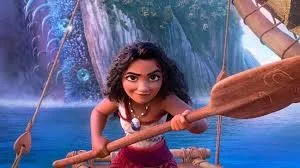
Character animation remains expressive. Moana’s confidence appears through posture and movement, while her fear becomes visible during the journey’s most dangerous moments. Maui’s transformations are fluid and imaginative. His scale allows the action to move between personal interaction and mythic spectacle.
Matangi’s environment provides the film with some of its most unusual imagery. Bats, shadows, purple lighting, and vertical spaces distinguish her world from the brighter ocean settings.
The storm sequences are powerful but visually crowded. Dark clouds, lightning, waves, creatures, damaged boats, and multiple characters compete for attention. Most of the action remains understandable, yet the climax lacks the clean symbolic power of Moana returning the heart to Te Fiti.
The sequel’s strongest images are often connected with navigation: stars above open water, boats moving together, islands emerging, and communities seeing evidence that they are not alone. These moments support the story’s theme more effectively than the large supernatural battles.
Music & Songs: Strong Performances Without Another “How Far I’ll Go”
Music was one of the original Moana’s defining strengths. Songs such as “How Far I’ll Go,” “You’re Welcome,” and “We Know the Way” combined character, culture, narrative movement, and immediate memorability.
Moana 2 faces an almost impossible comparison. Abigail Barlow and Emily Bear lead the songwriting for the sequel, while Opetaia Foaʻi and Mark Mancina return to contribute to its musical identity.
The songs continue to support Polynesian influences, ocean voyaging, community, and Moana’s emotional development. “Beyond” functions as Moana’s main statement of purpose. It reflects her responsibility to travel farther and connect her people with a larger world.
Auliʻi Cravalho performs it with confidence, but the song does not establish the same simple emotional hook as “How Far I’ll Go.”
“Can I Get a Chee Hoo?” gives Maui another energetic number. Dwayne Johnson performs with enthusiasm, and the sequence reinforces his role as Moana’s supporter. Matangi’s song provides a different sound and allows the film to pause for a more theatrical character moment.
The group songs involving Motunui and the crew help establish community. They are narratively useful even when they do not remain in my memory afterward. The score is effective during navigation, storms, and emotional reunions. Drums, voices, and orchestral movement maintain continuity with the first film.
The main weakness is memorability. I understood what each song contributed while watching, but fewer melodies stayed with me after the film ended. This matters because Moana is not simply an animated adventure with occasional music. Its songs are expected to carry character development and cultural scale. The sequel’s music is professionally composed and strongly performed. It suffers mainly from comparison with an exceptional original soundtrack.
Direction & Pacing: An Expanded Series Packed Into One Voyage
Moana 2 was originally developed from material intended for a streaming series before becoming a theatrical feature. That history helps explain the film’s structure.
The story contains several locations, new characters, smaller adventures, mythology developments, and transitional encounters that can feel episodic.
Directors David Derrick Jr., Jason Hand, and Dana Ledoux Miller keep the film moving. The adventure rarely becomes slow, and younger viewers should have little difficulty following the immediate objective.
The pace becomes a weakness because the story has more ideas than emotional space.
The new crew needs development. Simea needs time with Moana. Matangi needs a clearer role. Maui needs a personal arc. Nalo needs greater presence. Motufetu needs mythology.
The film touches all of these elements but explores few of them deeply. The first Moana was structurally clean. A girl, a demigod, a boat, a stolen heart, and a dying island formed one focused emotional journey.
The sequel expands the world but loses some of that elegance. Several transitions feel like the end of one episode and the beginning of another. A new obstacle appears, the group solves it, and the story moves to the next stage.
This does not make the film confusing. It makes it feel assembled from a broader collection of adventures. The emotional scenes are generally placed well, especially Moana’s departure and the climax involving her sacrifice. However, the ending moves rapidly from apparent tragedy to transformation, reunion, celebration, and setup for future conflict. A slower conclusion would have allowed the characters to process what happened.
Themes & Emotional Meaning: No Island Should Stand Alone
Moana 2 expands the original film’s focus on identity into a broader theme of connection.
Motufetu once allowed different island communities to find one another. Nalo’s curse turned separation into a form of control. The film argues that isolated people become more vulnerable. Shared knowledge, navigation, stories, and cooperation allow communities to survive.
Moana’s mission is therefore cultural as well as physical. She is restoring the possibility of exchange. This theme has real emotional value. The final discovery that other communities exist changes how Motunui understands its place in the world.
The island is no longer the complete boundary of Moana’s responsibility. Her leadership must extend across distance without erasing her connection to home. The sequel also explores legacy. Moana follows the knowledge of her ancestors but must travel beyond the places they reached.
Respecting tradition does not mean repeating every old route. It means carrying inherited knowledge into situations previous generations could not resolve. Simea represents the next generation watching Moana. Her presence reminds the protagonist that leadership creates examples other people may follow.
Maui’s story adds the idea that strength should support connection rather than personal glory. His most meaningful actions are performed to protect Moana and her mission. The film’s message about community is clear, but its conflict simplifies division into one god’s curse. Real cultural isolation is more complicated than a magical island disappearing.
As a mythic family story, the metaphor works. Connection requires risk, travel, curiosity, and the willingness to trust people beyond one’s familiar world.
Critical Reception & Audience Response: A Successful Sequel With Familiar Weaknesses
Moana 2 received a mixed-to-positive critical response. Reviewers consistently praised its animation, family-friendly spirit, Auliʻi Cravalho’s performance, cultural imagery, and the continuing appeal of Moana and Maui.
The ocean visuals and large theatrical scale were frequently identified as major strengths. Criticism focused on the crowded story, less memorable songs, thin new characters, and a structure that appeared influenced by the project’s origins as a planned series.
Many critics considered the sequel entertaining but less emotionally precise than the original. The first film’s personal journey and clear central relationship were difficult to match.
The soundtrack also received comparison with Lin-Manuel Miranda’s songs from the original. The sequel’s music was generally viewed as competent but less distinctive. Audience response was warmer, particularly among families and younger viewers. Moana remains a popular character, and returning to her world provided strong appeal even without the original film’s novelty.
The movie became a major commercial success. Its performance demonstrated the continuing strength of the characters and Disney’s animated franchises. Commercial popularity does not remove the structural problems, but it helps explain why the film emphasizes world expansion and future possibilities.
Viewers who mainly wanted another colorful voyage with Moana, Maui, Pua, and Heihei are likely to enjoy the film. Those expecting a sequel with the emotional originality and musical impact of the first may find it disappointing. The general reputation can be summarized clearly: Moana 2 is an enjoyable continuation, not a transformative one.
Final Verdict: A Worthy Return That Cannot Match the First Voyage
Moana 2 is a colorful, sincere, and visually impressive continuation of Moana’s story. It understands that the heroine cannot simply repeat her original journey.
Moana is now a leader, wayfinder, sister, and symbol for her community. Her challenge is not discovering whether she should cross the ocean. It is deciding how far her responsibility extends.
The lost island of Motufetu gives the sequel a meaningful objective. Restoring it reconnects people who were separated by fear and supernatural control. Auliʻi Cravalho remains the emotional center. Her performance gives Moana confidence without removing vulnerability.
Dwayne Johnson continues to make Maui entertaining, though the demigod receives less development than before. His strongest scenes reveal concern for Moana beneath the usual performance of invincibility.
The new crew expands the world but receives insufficient attention. Loto, Moni, and Kele are useful and pleasant without becoming essential characters.
Matangi is intriguing, but her limited role makes her feel like a preview of future mythology. Nalo is even more distant, operating primarily through the effects of his curse.
The animation is excellent. The ocean remains playful, dangerous, and expressive, while storms and navigation sequences provide genuine theatrical scale. The songs support the story but rarely achieve the emotional clarity or immediate memorability of the original soundtrack.
The film’s origins as a longer-form project are visible in its crowded, episodic construction. It contains enough characters and ideas for several chapters but compresses them into one fast adventure.
I recommend Moana 2 to families, younger viewers, fans of Moana and Maui, and anyone looking for an attractive ocean adventure with positive themes. It does not equal the first film’s focused storytelling, musical strength, or emotional surprise. It does, however, preserve the qualities that made Moana worth following.
Personal rating: 7.5/10.
Moana 2 earns that score for Auliʻi Cravalho’s performance, Moana’s leadership arc, beautiful animation, strong ocean imagery, sincere themes of connection, and the continuing friendship between Moana and Maui. It loses points for crowded plotting, underdeveloped companions, an absent villain, less memorable songs, episodic pacing, and an ending designed partly around future installments.
The first Moana was about finding the courage to cross the reef. Moana 2 is about understanding that reaching the other side means accepting responsibility for the people who follow.
Pros

- Immersive storytelling that continues Moana's journey and deepens her character development
- Expanded exploration of Polynesian culture and mythology, enhancing representation
- Opportunity to introduce new characters that can enrich the narrative
- Possibility of heartwarming and empowering musical numbers that resonate with audiences
- Themes of environmental conservation and leadership can reflect contemporary issues
- Inspiration for young audiences by showcasing strong female characters and diverse role models
Cons

- Risk of not capturing the magic of the original film, leading to disappointment
- Potentially overcomplicating the story with too many new elements or characters
- Challenge of meeting high expectations set by the original movie's success

Leave a comment
Your comment is awaiting moderation. We save your draft here
0 Comments