






Bikini Bottom Gets Scooped Up
The image that defines Saving Bikini Bottom: The Sandy Cheeks Movie arrives almost immediately: Bikini Bottom is ripped from the ocean floor, sealed inside a giant container, and carried toward the surface as though an entire underwater civilization were a laboratory sample. SpongeBob and Sandy Cheeks narrowly escape, stare at the empty space where their home used to be, and begin a rescue mission that sends them far beyond the familiar streets of the series. This Saving Bikini Bottom review starts with that absurd disaster because the movie’s greatest strength is its willingness to treat a ridiculous premise with complete confidence.
Released in 2024, the film shifts the spotlight from SpongeBob to Sandy. She is no longer simply the brilliant squirrel who lives under the sea and appears whenever an invention or karate match is needed. The story takes her back to Texas, introduces her unusual family, and forces her to confront the scientific organization connected to her life before Bikini Bottom.
That change gives the movie a potentially strong emotional foundation. Sandy is caught between two homes: the Texas family that shaped her and the underwater community she chose. Saving Bikini Bottom is therefore not only about rescuing a town. It is about deciding what makes a place feel like home.
The film moves quickly, piles jokes on top of action, and rarely allows a scene to remain calm. Younger viewers may enjoy that constant momentum. Older fans may find themselves wishing the movie trusted its characters enough to slow down.
I laughed at several visual ideas and appreciated the decision to build the story around Sandy. At the same time, the film often feels less like a carefully structured adventure and more like a collection of energetic set pieces connected by a very simple rescue plot.
Plot & Storytelling: A Rescue Mission From the Ocean to Texas
The story begins in Bikini Bottom, where Sandy continues her scientific research while SpongeBob performs his usual routine at the Krusty Krab. Their ordinary day ends when B.O.O.T.S. Marine Biology Lab removes the entire town from the sea.
Bikini Bottom’s buildings, residents, roads, and recognizable landmarks are lifted together. The operation is so large and sudden that most characters barely understand what is happening before they are trapped.
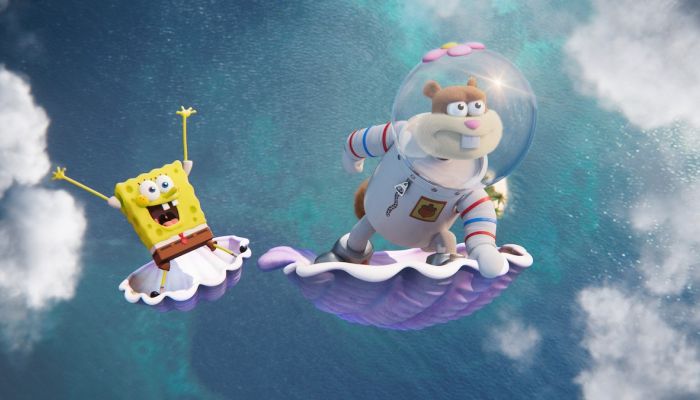
Sandy and SpongeBob avoid capture and decide to follow the stolen town to the surface. Their journey takes them through the ocean, across the beach, and eventually toward Texas. The rescue mission has a simple goal: reach the laboratory, free Bikini Bottom, and return it to the ocean before the experiment causes permanent damage.
That simplicity is useful because the film contains many characters, locations, action scenes, and visual jokes. The audience always understands what Sandy and SpongeBob are trying to accomplish.
The weakness is that the plot rarely surprises me. The responsible organization is introduced early, the main villain’s intentions are easy to predict, and most obstacles exist primarily to delay the heroes.
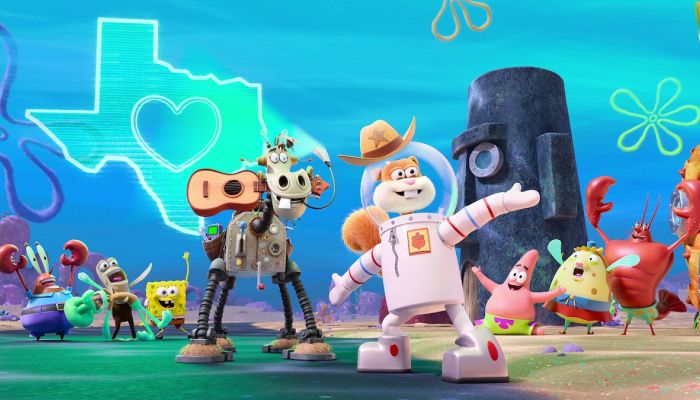
The story becomes more interesting once Sandy reaches Texas and reunites with her family. The Cheeks are performers, adventurers, and enthusiastic participants in a traveling circus-style act.
Sandy’s relatives are affectionate but chaotic. They immediately recognize her as part of the family, yet they also represent a life she chose to leave behind.
This creates a conflict the movie could have explored more deeply. Sandy is proud of her Texas background, but Bikini Bottom has become central to her identity. Returning home should force her to consider how much she has changed.
Instead, the screenplay moves quickly from reunion to action. The family helps with the rescue, but emotional conversations are brief. SpongeBob remains Sandy’s closest companion throughout the mission. His optimism keeps the story light, while Sandy provides planning, scientific knowledge, and physical ability.
Their friendship works because the characters approach danger differently. SpongeBob assumes that enthusiasm can solve almost anything. Sandy believes in preparation, invention, and direct action.
The villain, Sue Nahmee, runs the operation behind Bikini Bottom’s removal. Her plan involves studying and commercializing the town’s residents rather than simply observing them. The concept fits the series’ history of mocking greed and exploitation. Bikini Bottom is treated as a product, and its residents are valuable only if they can generate money.
However, Sue Nahmee is written as a broad cartoon antagonist. She has energy and visual presence, but limited psychological depth. The final act takes place inside the laboratory, where Sandy, SpongeBob, the Cheeks family, and the captured residents become part of a large escape sequence. The climax is energetic and visually busy. It includes transformations, improvised plans, character teamwork, and the kind of impossible physical comedy expected from SpongeBob.
The resolution arrives quickly. Bikini Bottom is saved, Sandy’s two families are connected, and the movie returns to a celebratory tone without spending much time on the consequences of the disaster.
Sandy Cheeks: Finally the Main Hero
Making Sandy the lead is the movie’s best decision. She has always been one of the most capable characters in the SpongeBob universe, yet she is often placed outside the emotional center of major stories.
Here, Sandy drives the rescue. She understands the surface world, recognizes the scientific threat, and has the skills needed to travel across unfamiliar environments. Her intelligence is treated as practical rather than decorative. Sandy builds, analyzes, improvises, and explains what is happening around her. She is also physically capable. Her karate training and athletic confidence make her believable as an action hero within the exaggerated logic of the series.
The film gives her a personal connection to the villain’s organization. This makes the rescue more complicated than a random attack because Sandy must confront a system connected to her own scientific history.
Her relationship with Texas is equally important. Sandy has never hidden her pride in her origins. Her accent, clothing, music, and stories constantly remind viewers that she is a Texan living underwater.
The movie expands that background by introducing relatives who share her confidence but express it differently. Sandy is a scientist and explorer. Her family members are performers and risk-takers.
That contrast suggests that Sandy’s independence was inherited rather than developed entirely in Bikini Bottom. Unfortunately, the film does not explore her internal conflict as fully as it could. Sandy rarely appears genuinely uncertain about whether she belongs in Texas or underwater.
Her answer is clear from the beginning: Bikini Bottom is her home. The family reunion supports that conclusion rather than challenging it.
A more emotionally ambitious story might have allowed Sandy to feel tempted by the possibility of remaining with her relatives. Instead, the movie prioritizes movement and comedy. Even so, Sandy emerges as a convincing protagonist. She is responsible for most of the meaningful decisions and never feels like a supporting character inside her own film.
SpongeBob & the Supporting Cast: Familiar Faces With Limited Time
SpongeBob plays the role of loyal companion. He follows Sandy into danger without hesitation and treats the rescue of Bikini Bottom as a personal responsibility.
His optimism is useful because Sandy occasionally becomes frustrated or focused on technical problems. SpongeBob reminds her why the mission matters emotionally.
The friendship between them is warm, but the movie does not develop it in a new direction. They already trust each other, so the story contains little interpersonal conflict between them. SpongeBob provides many of the film’s jokes through exaggerated reactions, strange physical changes, and complete confidence in obviously dangerous situations.
Patrick, Squidward, Mr. Krabs, Plankton, and other Bikini Bottom residents spend much of the movie inside the laboratory. Their scenes offer familiar comedy, but most of them receive only brief moments. The film uses the ensemble as a source of recognizable faces rather than giving each character a meaningful subplot.
Patrick remains cheerful and confused. Squidward reacts with irritation. Mr. Krabs worries about business and money. Plankton looks for opportunities inside the crisis.
These behaviors are consistent with the series, yet they are also predictable. Longtime viewers will know almost exactly how each character responds before the scene begins.
The Cheeks family receives more attention. They bring a different energy from the Bikini Bottom cast and expand Sandy’s background. Their circus-based lifestyle creates several visual jokes and action possibilities. They travel together, perform tricks, and approach danger with enthusiasm.
The family members are likable, but there are many of them. Individual personalities receive limited development because the movie must introduce the entire group quickly. This creates an odd imbalance. Sandy’s relatives are central to the plot, yet most remain memorable primarily through appearance or one repeated trait.
Voice Cast & Character Performances: Sandy Carries the Film
Carolyn Lawrence continues to give Sandy the confidence and warmth that made the character distinctive. Her performance balances scientific precision, Texas pride, irritation, and genuine affection for SpongeBob.
Because Sandy leads the film, Lawrence has more opportunities to show emotional range. She handles action scenes effectively but is strongest during quieter moments connected to home and family.
Tom Kenny remains instantly recognizable as SpongeBob. His performance preserves the character’s high energy, innocence, and ability to turn one emotional reaction into a full comic sequence.
SpongeBob’s voice can become overwhelming when the movie is already moving quickly. Kenny’s performance is not the problem; the pacing simply gives the character fewer quiet moments.
Wanda Sykes voices Sue Nahmee with exaggerated confidence. Her delivery gives the villain a strong comic presence and makes even simple lines sound theatrical.
The performance is entertaining, though the character is written too broadly to become a memorable threat. Sue Nahmee functions as an obstacle rather than a psychologically interesting opponent. Clancy Brown, Bill Fagerbakke, Rodger Bumpass, and Mr. Lawrence return to the familiar roles of Mr. Krabs, Patrick, Squidward, and Plankton.
Their performances remain dependable. Each actor can establish a character’s identity within seconds, which is useful in a movie that gives the supporting cast limited screen time.
The Cheeks family adds several new voices and regional personalities. The actors lean into the exaggerated Texas atmosphere without completely losing the sense that these characters care about Sandy.
The voice cast is generally strong. The main limitation comes from the screenplay’s speed, which leaves little room for performers to build longer emotional exchanges.
Humor & Comedy Style: Fast, Strange, and Extremely Loud
Saving Bikini Bottom uses several kinds of humor at once. There are visual transformations, physical accidents, character reactions, regional jokes, scientific absurdity, and references to familiar SpongeBob behavior.
The strongest comedy comes from the collision between underwater logic and the surface world. SpongeBob is physically vulnerable outside the ocean, but the movie finds absurd solutions that allow him to continue moving.
Sandy’s practical approach also creates humor. She may explain a problem scientifically while SpongeBob responds with emotional confidence or complete misunderstanding.
The Cheeks family adds circus comedy, including dangerous stunts performed as though they are normal family activities.
Several jokes depend on sudden changes in animation or character design. SpongeBob characters can stretch, flatten, expand, or become temporarily realistic without warning. This freedom is part of the franchise’s identity. The world does not require consistent physical rules as long as the visual joke is clear.
My first major criticism is that the film rarely allows a joke to breathe. A funny image appears, another character reacts, music rises, and the movie immediately moves to the next gag.
Comedy often needs a pause. SpongeBob’s best television episodes know when to hold on an uncomfortable expression or allow silence to make a situation stranger. This movie prefers speed. The result is a large number of jokes with fewer moments that remain memorable afterward.
My second complaint is the reliance on noise. Characters shout frequently, action sequences are filled with sound, and emotional reactions are often pushed to maximum intensity. Younger viewers may enjoy that energy. Older audiences may find the constant stimulation tiring.
The movie is funniest when it becomes simple. Sandy and SpongeBob talking, Patrick misunderstanding a situation, or Squidward reacting to inconvenience can be more effective than a large digital action sequence.
Visual Design & Animation: Bikini Bottom Meets Live-Action Texas
The film combines computer-animated characters with live-action environments and performers. This hybrid approach gives the surface world a different texture from Bikini Bottom.
Sandy and SpongeBob appear colorful and exaggerated against roads, buildings, landscapes, and laboratory sets. The contrast supports the idea that they have entered a world where they do not naturally belong.
The characters are expressive, with flexible faces and bodies capable of extreme movement. SpongeBob can change shape instantly, while Sandy’s suit and physical animation maintain her more controlled personality. Bikini Bottom remains visually familiar. Its buildings, streets, colors, and landmarks appear close to the established world of the series.
The scene in which the town is removed from the ocean is one of the film’s strongest visual concepts. Seeing the familiar environment treated as a portable object creates immediate scale and danger.
The laboratory is bright, clean, and intentionally artificial. It resembles a commercial research facility designed to convert strange discoveries into products.
The villain’s experiments give the animators opportunities to modify familiar characters. Some transformations are funny, while others feel designed mainly to fill the screen with movement. The Texas sequences use warm colors, open landscapes, vehicles, and performance spaces to establish Sandy’s original home.
The live-action integration is uneven. Some scenes blend the animated characters naturally into the environment. Others make the separation between digital figures and physical sets obvious. This artificial quality is not always damaging because SpongeBob has never depended on realism. The series regularly changes visual styles for comedy.
The bigger issue is visual clutter. Action scenes contain many characters, objects, effects, and rapid camera movements. The central idea remains understandable, but individual jokes can disappear inside the activity.
Music, Direction & Pacing: A Movie in Permanent Fast-Forward
Director Liza Johnson maintains a quick pace from the opening disaster through the final rescue. The movie has little interest in extended setup.
This helps the story reach its central adventure quickly. Children do not need to wait long before Bikini Bottom is threatened and the heroes begin moving.
The pacing becomes a weakness when Sandy’s emotional story requires attention. Her reunion with the Cheeks family should be a major event, yet the film moves toward the next objective almost immediately.
The direction prioritizes clear action and broad comedy. Characters are constantly traveling, escaping, falling, planning, or reacting.
That rhythm makes the film easy to watch but difficult to absorb. A scene may introduce an emotional idea, deliver two jokes, and end before either has developed fully. The music combines energetic adventure scoring with country and Western influences connected to Sandy’s Texas identity.
These musical choices fit the setting and help distinguish the surface scenes from Bikini Bottom. The score performs its function but rarely becomes emotionally memorable. It often supports movement rather than defining character moments.
The film would benefit from greater contrast. A slower conversation, a quiet look at Sandy’s family home, or a calm moment between Sandy and SpongeBob could make the action feel faster by comparison.
Instead, nearly every sequence operates at a similar level of excitement. The lack of rhythm makes the movie feel longer than its actual running time.
Themes & Emotional Meaning: Choosing More Than One Home
The central theme is belonging. Sandy comes from Texas but has built her adult life in Bikini Bottom.
Her family represents history, tradition, and biological connection. SpongeBob and the other residents represent the relationships she chose.
The movie argues that these forms of family do not need to compete. Sandy can remain a Cheeks while also protecting the underwater community that became her home.
This is a warm message, especially for children who have moved between places or feel connected to more than one culture.
The story also addresses exploitation. Sue Nahmee sees Bikini Bottom’s residents as scientific material and commercial property. She does not recognize their community, relationships, or independence. Their unusual qualities matter only because they can be sold.
Sandy’s scientific identity creates a meaningful contrast. She also studies marine life, but she lives among the people she observes and treats them as friends. The film suggests that science without empathy can become another form of greed.
This idea is valuable but underdeveloped. Sue Nahmee is so exaggerated that the ethical conflict remains simple. Sandy never seriously questions whether her earlier work contributed to the threat. A stronger story might have explored her responsibility more directly.
The film also presents cooperation as the solution to crisis. Sandy’s scientific skills, SpongeBob’s optimism, the Cheeks family’s performance abilities, and the Bikini Bottom residents’ strange talents all become useful.
Nobody saves the town alone. That message fits both the franchise and the family-adventure format.
Critical Reception & Audience Response: A Sandy Showcase With Mixed Results
Critical response to Saving Bikini Bottom: The Sandy Cheeks Movie was mixed to negative. Reviewers often praised Sandy as a strong central character and appreciated Carolyn Lawrence’s performance.
The expanded focus on Sandy’s Texas background also received positive attention. Many viewers welcomed the opportunity to see a supporting character lead her own story.
However, critics frequently objected to the rushed pacing, overloaded plot, uneven live-action integration, and lack of memorable humor.
Some reviews argued that the movie felt less carefully written than the strongest SpongeBob television episodes or earlier theatrical films.
The villain and laboratory storyline were often described as broad and predictable. The emotional material involving Sandy’s family was seen as promising but insufficiently developed.
Audience response was somewhat more forgiving, particularly among younger viewers and families seeking energetic entertainment.
Fans of Sandy may enjoy seeing her intelligence and physical ability placed at the center of the action.
Longtime SpongeBob viewers may be more divided. The characters remain recognizable, but the movie’s rapid style can feel different from the slower, stranger comedy of the classic series.
The movie is unlikely to replace the earliest SpongeBob stories in the franchise’s reputation. It works better as a light streaming adventure than as a defining theatrical event.
Final Verdict: Sandy Deserved the Spotlight—and a Better Script
Saving Bikini Bottom: The Sandy Cheeks Movie has a good central idea. Sandy is one of the strongest supporting characters in the SpongeBob universe, and her combination of science, courage, Texas pride, and loyalty makes her a natural lead.
The film gives her an adventure connected to both parts of her identity. Bikini Bottom is threatened, Texas becomes essential to the rescue, and her biological and chosen families eventually work together.
I enjoyed seeing Sandy make the major decisions. She is not reduced to explaining technology while SpongeBob receives every heroic moment.
SpongeBob remains an effective companion because his optimism balances Sandy’s practical thinking. Their friendship is dependable, though the movie does not reveal anything especially new about it.
The Cheeks family is energetic and visually amusing. Their presence expands Sandy’s history, but most relatives are introduced too quickly to become memorable individuals.
The villain’s plan creates a clear conflict but lacks depth. Sue Nahmee wants to exploit Bikini Bottom, and the movie never gives her motivation beyond exaggerated ambition and greed.
The visual presentation is colorful and flexible. The combination of animation and live action fits the franchise’s willingness to experiment, though the integration is inconsistent.
The comedy produces several amusing images, but the film is too impatient. It rarely trusts silence, character interaction, or a simple expression.
The emotional material has the same problem. Sandy’s return to Texas and reunion with her family should carry greater weight, yet the story keeps racing toward the laboratory.
I recommend Saving Bikini Bottom to younger SpongeBob fans, families seeking a fast animated adventure, and viewers who especially like Sandy Cheeks. Longtime fans should expect a noisy spin-off rather than the sharp timing of the franchise’s best episodes.
Personal rating: 6.5/10.
Saving Bikini Bottom earns that score for its capable lead, strong central friendship, colorful animation, expanded Sandy backstory, familiar voice cast, and positive themes about belonging. It loses points for rushed storytelling, a weak villain, thin supporting characters, uneven hybrid visuals, noisy humor, and emotional ideas that never receive enough room.
Sandy Cheeks proves that she can carry a movie. The disappointing part is that the movie rarely slows down long enough to let her fully do it.
Pros

- Visually stunning underwater world that captivates the audience.
- Engaging storyline with innovative twists and layered narrative.
- Strong character development with relatable protagonists and supporting cast.
- Accessible content suitable for viewers of all ages.
- Excellent integration of modern digital distribution and streaming options.
- Meaningful exploration of themes like friendship, perseverance, and environmental stewardship.
Cons

- Occasional pacing issues during mid-story segments.
- Some humor heavily relies on nostalgia, which might alienate newer viewers.
- Limited offline download options on certain streaming platforms.


Leave a comment
Your comment is awaiting moderation. We save your draft here
0 Comments