





Garfield Leaves the Couch, Whether He Likes It or Not
My first reaction to The Garfield Movie was that Garfield had been assigned the one mission he would normally reject immediately: leave the house and participate in the plot. The orange cat is famous for sleeping, eating lasagna, insulting Odie, and avoiding physical effort. This time, however, he is pulled away from his comfortable indoor routine and pushed into a large-scale adventure involving his estranged father, a dangerous criminal cat, and an elaborate robbery. This The Garfield Movie review begins with that contradiction because it defines both the film’s energy and its main problem.
The movie understands Garfield’s recognizable habits. He loves food, dislikes Mondays, treats Jon’s home as a private restaurant, and views physical activity as a personal attack. Yet the story rarely allows him to remain the lazy observer audiences know. It transforms him into the lead of a fast family adventure filled with chases, action scenes, emotional revelations, and complicated plans.
That approach makes the film accessible to younger viewers who may not know the original comic strip, but it also reduces some of Garfield’s distinctive appeal. Garfield is funniest when ordinary life gives him opportunities for sarcasm. He does not need a major criminal conspiracy to be entertaining. A missing meal or an inconvenient door can be enough.
The film is bright, energetic, and easy to follow. Its emotional story about Garfield reconnecting with his father gives the adventure a personal foundation, while Odie provides dependable physical comedy. The result is a pleasant family movie with several amusing moments, though it often feels more like a general animated action comedy with Garfield placed at its center than a story naturally built around Garfield’s personality.
Plot & Storytelling: From Unlimited Lasagna to a Dangerous Heist
The story begins by showing how Garfield entered Jon Arbuckle’s life. As a small kitten, he was left alone near a restaurant before meeting Jon, following the smell of food, and quickly becoming part of the household. The sequence establishes Garfield’s lifelong relationship with eating while giving his origin a more emotional tone.
In the present, Garfield lives an extremely comfortable life with Jon and Odie. Food can be ordered through a phone, entertainment is always available, and almost every practical responsibility belongs to someone else. Garfield has created the perfect indoor existence.
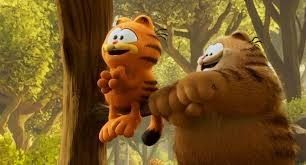
That routine ends when Garfield and Odie are captured. The incident leads Garfield to Vic, his biological father, who has been absent for most of his life. Vic is street-smart, adventurous, and comfortable living outside the rules of domestic life.
Their reunion is not affectionate. Garfield remembers being abandoned and has no interest in accepting excuses. Vic, meanwhile, behaves as though charm and confidence can repair years of absence.
The central conflict involves Jinx, a white Persian cat with a personal grievance against Vic. She forces him to participate in a risky milk robbery and uses Garfield and Odie as leverage.
This setup pushes the characters into a heist narrative involving planning, infiltration, security systems, vehicles, and dangerous obstacles. The film borrows familiar ideas from crime movies but presents them through colorful slapstick and animal characters.
The plot is more complicated than Garfield’s traditional stories require. Several characters have past connections, hidden motivations, and emotional misunderstandings. Younger audiences should still be able to follow the main objective, but some of the villain’s history receives more explanation than it deserves.
The strongest part of the narrative is Garfield’s relationship with Vic. Garfield believes his father deliberately chose freedom over responsibility. That belief has shaped his identity even if he rarely speaks about it directly.
Vic attempts to prove that the past was more complicated, but the screenplay delays the full explanation to preserve emotional tension. This creates an effective misunderstanding, though the eventual revelation is predictable.
Garfield’s resentment gives the character more emotional depth than simple hunger jokes would provide. He has built a comfortable life with Jon partly because stability matters to him. His selfish behavior may be comic, but the story suggests that his attachment to home is also connected to fear of being abandoned again.
Odie accompanies Garfield throughout the adventure and often demonstrates greater practical competence. He solves problems, operates equipment, and remains loyal even when Garfield takes him for granted.
Jon spends much of the film searching for his pets. His role provides emotional context, but he remains separated from the main group for too long. The relationship between Jon and Garfield is central to the character’s history, yet the movie gives more attention to Garfield and Vic.
The final act increases the scale through action, rescue attempts, and several changes in loyalty. It is lively, though it follows a familiar pattern in which the family conflict must be resolved at the same time as the villain is defeated.
The story works as uncomplicated entertainment. Its weakness is that it often chooses movement over observation. Garfield’s sarcastic relationship with ordinary life is replaced by constant external pressure.
Garfield & Vic: A Father-Son Story Hidden Inside the Comedy
Garfield’s relationship with Vic is the film’s emotional center. Garfield sees himself as independent, but his anger reveals how deeply the absence affected him.
His comfortable life with Jon is not only about food. It provides certainty. Meals arrive, the house is safe, and Jon returns every day. Garfield’s laziness becomes part of a carefully protected routine.
Vic represents everything outside that routine. He improvises, steals, travels, and survives through confidence. He has none of Jon’s predictability.
The contrast gives Garfield a meaningful choice between two versions of family. Jon represents care expressed through consistency. Vic represents biological connection complicated by failure and regret.
The film does not ask Garfield to reject Jon in order to accept Vic. That is an important decision. Family is presented as something that can expand rather than a prize awarded to one father figure.
Vic’s personality is appealing but not always convincing. He is designed as a charming rogue, so the movie occasionally moves too quickly past the consequences of his actions.
His failure to explain the past creates much of the conflict. Some of that silence makes emotional sense, but part of it exists because the plot needs Garfield to remain angry until the final act.
Garfield’s emotional development is straightforward. He begins convinced that Vic abandoned him without concern. Through the adventure, he sees evidence that challenges this belief.
The reconciliation is warm, but the film avoids exploring the harder question of how trust should be rebuilt over time. One heroic action cannot erase years of absence, even if it can begin a new relationship.
For a family movie, the simplified resolution is understandable. Still, a more patient approach would have made the emotional ending stronger.
Voice Cast & Character Performances: Familiar Characters With New Voices
Chris Pratt voices Garfield with a relaxed, conversational delivery. He captures the character’s confidence, appetite, and casual selfishness without making the performance overly theatrical.
The voice is pleasant, but it does not always possess the dry laziness strongly associated with Garfield. Pratt’s version sounds younger and more ready for adventure, which fits the film’s action-focused interpretation.
That choice will divide audiences. Viewers encountering Garfield for the first time may accept the performance immediately. Longtime fans may miss a slower, more exhausted style of sarcasm.
Samuel L. Jackson gives Vic the film’s strongest vocal personality. His natural authority and comic timing make the character sound confident even when his plans are falling apart.
Jackson also gives Vic enough emotional weight to prevent him from becoming only a reckless criminal. The quieter lines suggest regret beneath the performance of independence.
Harvey Guillén voices Odie, though Odie communicates mainly through sounds, expressions, and physical behavior. The limited dialogue fits the character, allowing animation to carry most of the comedy. Nicholas Hoult voices Jon Arbuckle with a nervous, affectionate quality. Jon is caring but easily overwhelmed, especially once Garfield and Odie disappear.
Hoult’s performance is effective, though the screenplay does not give Jon enough time with Garfield. Their relationship is established quickly and then placed in the background.
Hannah Waddingham gives Jinx a dramatic villainous presence. She treats every threat as a performance, which matches the character’s desire for revenge and attention.
Jinx is energetic and visually memorable, but the character’s motivation is stretched across too much exposition. Waddingham keeps the scenes entertaining even when the writing becomes repetitive.
Ving Rhames voices Otto, a large bull with a personal reason to oppose the dairy operation. His deep delivery provides comic contrast with the character’s emotional devotion. The supporting cast is filled with recognizable voices, but some characters feel designed around celebrity casting rather than necessary narrative roles.
The performances are professional and energetic. The main limitation is that Garfield’s voice does not dominate the film as strongly as the character’s reputation might suggest.
Humor & Character Comedy: Lasagna, Laziness, and Too Much Action
The movie includes the expected Garfield material. He loves lasagna, avoids exercise, complains about inconvenience, and treats Odie as both companion and assistant.
Food jokes appear throughout the film. Garfield’s appetite influences decisions, distracts him from danger, and provides visual comedy.
The opening domestic scenes are among the funniest because they allow Garfield’s personality to interact with modern convenience. His ability to order food without leaving the couch is exactly the kind of technological development he would consider meaningful progress.
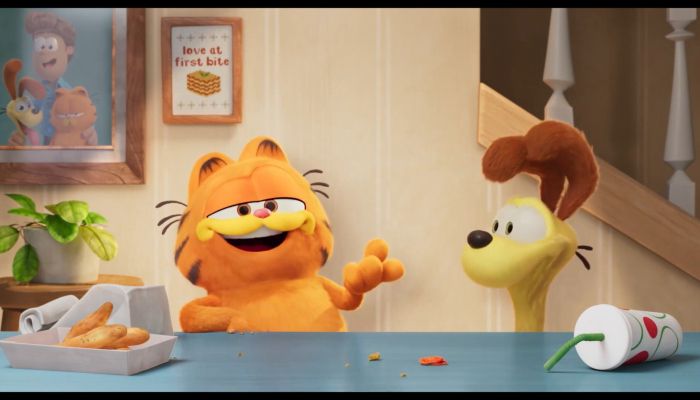
Odie provides physical humor through expressions and actions. He is less sarcastic than Garfield but often more capable. The contrast works well. Garfield believes he is the intelligent leader, while Odie quietly solves several practical problems.
The film also uses fast visual jokes, exaggerated reactions, and references to familiar movie genres. Some sequences parody heist planning or action-film seriousness.
The humor is suitable for a broad family audience, but it rarely becomes especially sharp. Garfield’s original appeal often depends on cynical observations about work, routine, relationships, and human behavior.
Here, jokes are more likely to come from collisions, chases, facial expressions, or sudden danger. The comedy is active rather than verbal.
This is my first major criticism. The movie gives Garfield many lines, but not enough memorable sarcasm. He comments on events, yet the script rarely gives him observations strong enough to define the scene.
My second complaint is that the film sometimes treats noise as a substitute for humor. Characters shout, vehicles move quickly, objects crash, and music emphasizes every reaction.
Children may enjoy the energy, but the constant activity leaves fewer opportunities for comic timing. A pause before a dry Garfield response could have been funnier than another chase.
The best jokes come when the film slows down and allows the characters’ personalities to conflict. Garfield resenting physical effort, Vic improvising badly, Odie succeeding without recognition, and Jon panicking over his missing pets all produce natural comedy.
Visual Design & Animation: A Bright World With Soft Edges
The Garfield Movie uses colorful computer animation with rounded characters, expressive faces, and exaggerated movement. The design aims for warmth rather than realism.
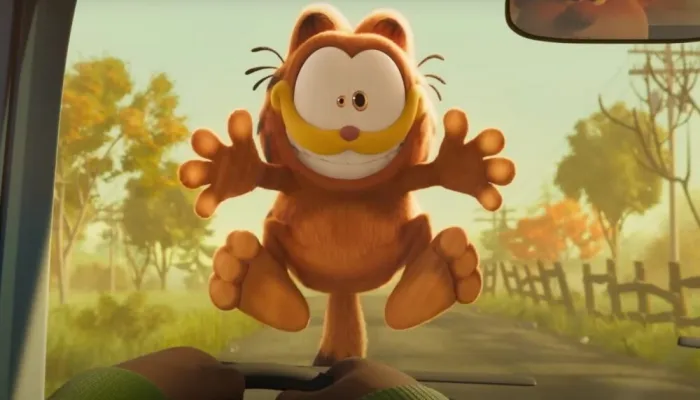
Garfield’s model preserves the important features: orange fur, dark stripes, large eyes, rounded body, and a facial expression capable of moving from boredom to panic quickly.
The animation makes him more physically active than his traditional image suggests. He runs, climbs, falls, and participates in action scenes with surprising flexibility. Odie is animated with strong body language. His ears, eyes, tongue, and posture communicate reactions without requiring full dialogue.
Vic has a rougher silhouette than Garfield, helping distinguish his outdoor life and less comfortable history. His body appears leaner and more prepared for movement.
The environments include Jon’s home, restaurants, city streets, industrial locations, trains, farms, and the dairy facility central to the heist.
These settings are clear and polished, but few are visually unforgettable. The film’s world often resembles the general style of contemporary family animation rather than a setting unique to Garfield.
The dairy facility provides the largest visual playground. Conveyor belts, machines, containers, vehicles, and security systems create opportunities for action. Lighting and color remain bright even during dangerous scenes. The film avoids darkness or visual intensity that might frighten younger viewers. Character animation is consistently expressive. Reactions are pushed far enough to remain readable, especially during rapid sequences.
The technical quality is strong, but the art direction lacks a defining visual idea. The movie looks attractive without creating many images that remain in my memory afterward.
The most successful visual moments are the simplest ones: Garfield surrounded by food, resting comfortably at home, or reacting with complete disbelief to the expectation that he should move.
Music, Direction & Pacing: Always Moving, Rarely Resting
Director Mark Dindal keeps the film moving at a rapid pace. Scenes rarely remain quiet for long, and the plot introduces new locations or obstacles frequently.
That energy helps younger audiences remain engaged. The story is never difficult to follow because every sequence has a clear immediate objective.
The pacing becomes less effective when emotional scenes need time. Garfield’s anger toward Vic is important, but conversations about abandonment are often followed quickly by another joke or action beat.
The film sometimes appears nervous about allowing sadness to remain visible. A serious moment begins, reaches an emotional point, and then moves toward comedy before the feeling can fully settle.
The music supports the playful adventure through energetic cues, pop selections, and emotional themes during the father-son material. It performs its function well but rarely becomes a defining part of the film. I remembered the visual action more clearly than the score.
The direction is strongest during the opening and quieter character moments. Garfield’s home life has a relaxed rhythm that fits him naturally. Once the heist begins, the film adopts the speed of many animated adventures. Characters move from one challenge to another with limited opportunity for observation.
This creates a strange mismatch. Garfield is a character built around resisting effort, yet the movie almost never stops demanding effort from him. A slower film could have used his laziness as the organizing principle. Instead, the direction frequently treats it as an obstacle the story must overcome.
Themes & Emotional Meaning: Home Is More Than a Place With Food
The movie’s central theme concerns family and abandonment. Garfield believes he was left behind because Vic valued freedom more than responsibility.
This belief affects how he sees his present life. He acts selfishly, but he also depends deeply on Jon and Odie.
Jon provides a stable home without demanding that Garfield become a different kind of cat. Odie offers loyalty even when Garfield is dismissive.
Vic’s return forces Garfield to reconsider whether family relationships can survive failure. The film argues that people—or cats—can make serious mistakes without becoming incapable of change.
That message is compassionate, though the screenplay occasionally makes forgiveness appear too easy. Reconnection requires honesty, responsibility, and time.
The film also explores comfort versus experience. Garfield’s indoor life protects him but limits his understanding of the world and his own history.
The adventure teaches him that comfort is valuable because it is connected to people, not only food and furniture.
This is a useful correction to Garfield’s apparent priorities. He may speak constantly about meals, but the emotional resolution shows that he values belonging more.
The story does not suggest that Garfield must abandon his comfortable nature. He returns home still loving food and avoiding unnecessary work.
Growth therefore does not mean becoming a completely different character. It means allowing another relationship into the life he already values.
The movie’s emotional ideas are clear and appropriate for younger audiences. They are not explored with great complexity, but they give the action a reason to exist.
Critical Reception & Audience Response: Popular With Families, Divisive With Reviewers
Critical response to The Garfield Movie was mixed. Many reviewers found the animation polished and the voice cast energetic but criticized the familiar plot, rapid pacing, excessive action, and limited use of Garfield’s dry humor.
A common concern was that the film did not feel specific enough to its central character. The heist story could have supported several animated heroes with relatively minor changes.
Critics also questioned the casting of Chris Pratt. Some found his relaxed delivery appropriate, while others felt it lacked the distinctive weariness and sarcasm expected from Garfield.
Samuel L. Jackson’s performance as Vic received more consistent praise. His voice gave the emotional story confidence and helped the father-son relationship feel stronger.
The film performed better with many general viewers and families than with professional critics. Younger audiences responded to the action, visual comedy, colorful characters, and simple emotional message.
Garfield fans were more divided. Some appreciated seeing the character in a large modern production. Others wanted a story closer to the comic-strip tradition of domestic laziness and everyday sarcasm.
The difference in response is understandable. As a family adventure, the movie is fast, harmless, and easy to enjoy. As an adaptation of Garfield’s specific comic personality, it is less successful.
The film does not damage the character, but it rarely demonstrates why Garfield remained popular for decades. His attitude is present; his observational humor is reduced.
Final Verdict: A Pleasant Adventure That Needed More Garfield
The Garfield Movie is an enjoyable family animation with a warm emotional message, polished visuals, and a dependable collection of jokes. It is unlikely to frustrate younger viewers, and its rapid pacing makes it easy to watch.
I liked the opening most because it captured Garfield’s ideal world: unlimited food, minimal movement, and complete control over Jon’s household. Those scenes felt connected to the character’s history.
The adventure with Vic provides a meaningful emotional direction. Garfield’s resentment gives him vulnerability beneath the sarcasm, while Vic’s regret adds weight to his confident personality.
Samuel L. Jackson gives the strongest performance, balancing humor with enough emotional seriousness to support the family conflict.
Chris Pratt’s Garfield is likable and easy to understand, but the performance and screenplay make the character more conventional than expected. I wanted more laziness, sharper complaints, and longer pauses before the punchlines.
The film’s action is technically competent. The heist includes clear objectives, imaginative obstacles, and several visually busy sequences.
The problem is not that the adventure is poorly made. It is that the adventure regularly pushes Garfield away from what makes him distinctive.
The emotional conclusion is sincere, though predictable. Garfield learns the truth about his father, Vic receives an opportunity to reconnect, and the definition of family expands.
I recommend The Garfield Movie to families with younger children, casual animation fans, and viewers seeking a simple comedy adventure. Longtime Garfield fans should expect a modern action-oriented interpretation rather than a close recreation of the comic strip’s quiet sarcasm.
Personal rating: 7/10.
The Garfield Movie earns that score for its appealing animation, energetic cast, accessible humor, emotional father-son story, lovable Odie, and clear family themes. It loses points for generic plotting, limited sarcasm, underused Jon, excessive action, predictable emotional turns, and a version of Garfield who spends far too much time running.
The film understands that Garfield loves lasagna. It only partly understands that he is often funniest when absolutely nothing can convince him to leave the couch.
Pros

- Nostalgic appeal for longtime fans
- Layered narrative that blends classic and modern storytelling
- Excellent visual animation that combines traditional and digital techniques
- Engaging soundtrack with a vibrant sound design
- Broad intergenerational appeal and accessible humor
- Seamless integration with modern streaming platforms
Cons

- Some episodes may feel slow for younger audiences
- Humor might not resonate with all modern viewers
- Occasional reliance on niche nostalgic moments that could alienate newcomers

Leave a comment
Your comment is awaiting moderation. We save your draft here
0 Comments