







Marvel’s Rejects Walk Into a Death Trap
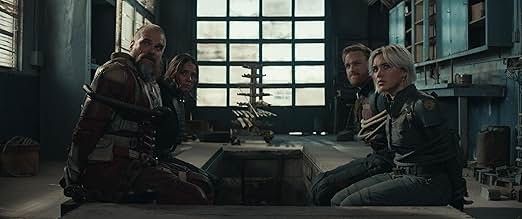
The moment that defines Thunderbolts* for me comes before the team has earned a name, a headquarters, or even a convincing reason to trust one another. Yelena Belova enters an underground facility expecting another assignment and discovers several other disposable operatives waiting in the same room. Nobody knows why they have been sent there. Everybody recognizes that someone wants the witnesses removed. Within seconds, professional caution becomes a desperate fight between people who are slowly realizing that they were all marked for elimination. This Thunderbolts review begins there because the film’s best idea is brutally simple: what happens when a group of damaged supporting characters discovers that the people controlling them consider them replaceable?
Released in 2025 and directed by Jake Schreier, Thunderbolts* brings together Yelena Belova, Bucky Barnes, John Walker, Ava Starr, Alexei Shostakov, and Antonia Dreykov. Their histories stretch across several earlier Marvel projects, but the movie does not treat continuity as its main attraction.
Its real focus is emotional exhaustion. These characters have been trained, manipulated, praised, condemned, and used by governments or powerful individuals. None feels completely heroic. Most no longer know what they are supposed to do when a mission ends.
The team’s immediate enemy is Valentina Allegra de Fontaine, a politically ambitious intelligence leader attempting to eliminate evidence connected with her secret programs. Her most dangerous creation is Bob, a confused man whose extraordinary abilities are connected with a destructive psychological presence known as the Void.
Thunderbolts* could easily have become a louder version of a familiar antihero-team formula. Instead, it spends surprising amounts of time on loneliness, shame, depression, and the uncomfortable fact that saving someone may require entering the emotional place they are trying hardest to hide.
The film still contains Marvel jokes, collapsing buildings, superhuman battles, and franchise preparation. Not every attempt at psychological depth works. Some characters receive far more attention than others, and the final branding twist risks reducing a sincere story to another piece of corporate universe management.
Yet Thunderbolts* is one of the more human Marvel films because its heroes do not win by becoming stronger than the problem. They win by refusing to leave one another alone inside it.
Plot & Storytelling: Disposable Operatives Decide They Are People
Yelena begins the film working for Valentina while struggling with a growing sense of emptiness. She completes dangerous missions efficiently, but the work provides no direction beyond the next assignment.
Her sister Natasha is gone, her relationship with Alexei remains complicated, and the assassin identity created by the Red Room no longer gives her a clear enemy to fight. Valentina sends Yelena to destroy evidence inside a secret facility. The assignment appears routine until she encounters John Walker, Ava Starr, and Antonia Dreykov. Each operative believes the others are targets. A fight begins, revealing their different abilities and the complete absence of trust between them.
Yelena fights with speed and precision. Walker relies on enhanced strength, military aggression, and the shield associated with his damaged Captain America legacy. Ava uses her phasing ability to move through physical attacks. Antonia mirrors combat techniques through Taskmaster conditioning.
The facility begins sealing itself around them. They gradually understand that Valentina arranged the confrontation to eliminate everyone connected with her illegal operations.
Another person is trapped inside the building: Bob, an apparently ordinary and deeply confused man who cannot remember exactly how he arrived there.
Bob seems physically harmless, but his presence inside a high-security laboratory immediately raises questions. Unlike the trained operatives, he responds to danger with uncertainty rather than instinct.
The group escapes, though not everyone survives the attempt. The early loss establishes that the film is willing to discard a recognizable character quickly, but it also exposes one of the screenplay’s weaknesses: Antonia receives too little material before her role ends.
Yelena, Walker, Ava, and Bob continue together while Valentina attempts to erase the facility and control the political consequences.
Alexei enters the story after recognizing that Yelena is in danger. He is still obsessed with the public image of the Red Guardian and treats the possibility of joining a heroic team as a long-delayed return to importance.
His enthusiasm clashes with the others’ emotional condition. Alexei sees a glorious adventure. Yelena sees another situation in which powerful people expect damaged individuals to clean up their failures.
Bucky Barnes follows the crisis from a different position. He has entered public life and attempts to use official authority, yet he remains frustrated by systems that protect people like Valentina.
Sebastian Stan plays Bucky as a man who has completed much of his personal recovery but still carries visible weariness. He is more stable than the others, though stability has not made institutions easier to trust.
The group eventually learns that Bob was part of an experimental program designed to create an extraordinarily powerful superhuman. The procedure succeeded physically while intensifying the psychological darkness already inside him.
Bob becomes the Sentry, a figure capable of flight, immense strength, speed, and near-invulnerability. His power appears to offer Valentina the ideal replacement for the Avengers.
The problem is that Bob’s abilities cannot be separated safely from the Void. The darker presence transforms his depression, fear, and self-hatred into a force capable of consuming other people.
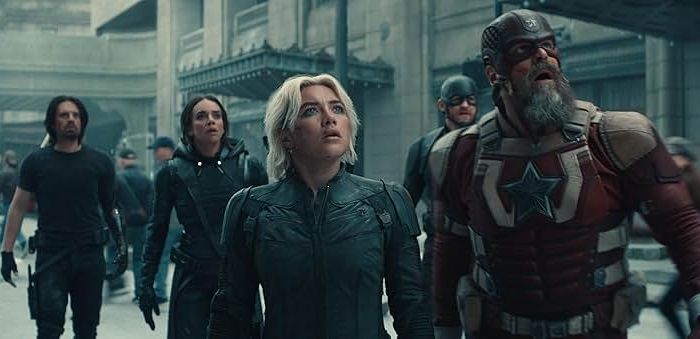
The plot changes from exposing Valentina to rescuing Bob before the Void spreads across New York.
That shift is important. The team cannot solve the final threat through conventional combat because attacking Bob reinforces the idea that he is a dangerous problem rather than a person in crisis. Yelena chooses to enter the Void directly. The others follow, moving through spaces created from Bob’s painful memories and emotional isolation.
The climax therefore becomes an internal rescue rather than another battle over a beam in the sky. The characters reach Bob by remaining beside him when his mind insists that everyone leaves.
The immediate crisis ends with the group publicly presented as a new heroic team. Valentina attempts to absorb their success into her own political strategy, branding them in a way that creates the meaning behind the title’s asterisk.
The ending is funny and strategically important for future Marvel stories. It is also slightly uncomfortable because these characters have just escaped one form of control only to enter another public identity.
Yelena Belova: Florence Pugh Carries the Team Through the Darkness
Yelena is the emotional center of Thunderbolts*. The film opens with her isolation and repeatedly returns to the question of what remains after a person becomes excellent at surviving. Florence Pugh gives Yelena humor without using jokes to erase pain. Her sarcasm often sounds automatic, as though she developed it to prevent honest conversation from becoming too dangerous.
Yelena is highly capable. She can enter guarded locations, improvise during combat, and recognize manipulation quickly. Competence does not protect her from depression. She describes an emptiness that cannot be solved by completing another mission.
The film’s strongest choice is refusing to give that feeling one simple cause. Natasha’s death matters, as do the Red Room, her work for Valentina, and her unstable relationship with Alexei.
Yet Yelena’s condition is not presented as a puzzle that can be solved by identifying one traumatic event. It has become part of how she experiences everyday life. Her first connection with Bob is based on recognition. He appears frightened and disoriented, but Yelena understands the emotional vacancy beneath his confusion.
She does not approach him as a therapist or inspirational speaker. She responds as someone who knows what it is like to feel disconnected from the person performing daily tasks. This makes her decision to enter the Void convincing. Yelena does not believe she possesses a magical cure. She believes leaving Bob alone would confirm the worst thing he believes about himself.
Pugh is especially effective during quiet scenes. Yelena’s expressions change before her words do, allowing humor, suspicion, and sadness to exist together.
Her relationship with Alexei also gains greater emotional detail. She cares about him but is exhausted by his need to transform every interaction into a story about his heroic importance. Yelena wants a father figure capable of listening. Alexei initially wants an audience.
Their gradual improvement gives the film warmth, though the relationship does not receive a complete resolution. Alexei becomes more present, but the history between them cannot be repaired through one mission. Yelena’s leadership emerges without formal appointment. The others follow because she is the first person willing to understand what the problem actually requires.
Bob, Sentry, and the Void: Power Without Emotional Stability
Lewis Pullman gives one of the film’s most difficult performances. Bob must appear vulnerable, funny, suspicious, powerful, and terrifying without making those states feel like unrelated characters.
When he first appears, Bob is wearing medical clothing and seems genuinely unsure of his own history. His ordinary behavior contrasts with the trained operatives around him.
He is not impressed by their reputations because he barely understands the situation. This makes his early interactions with Yelena unexpectedly gentle. Once his abilities emerge, the film shifts his physical presence completely. Bob can withstand attacks that would destroy ordinary people, move through the air, and overpower the entire team.
The Sentry identity initially appears confident and almost serene. It gives Bob access to the strength and admiration he lacks in ordinary life. That confidence is fragile because it depends on denying the Void.
The Void is not presented simply as an evil personality waiting to take control. It is connected with Bob’s depression, shame, addiction history, isolation, and belief that he causes harm wherever he goes. The visual metaphor is direct. Darkness spreads across the city and removes people into private rooms shaped from painful memory.
This psychological approach is one of the film’s greatest strengths, though it also creates risk. Depression is not literally a destructive supervillain, and comparing mental illness with an entity capable of consuming a city can produce uncomfortable implications. The film partly avoids that problem by refusing to destroy the Void. Bob cannot separate himself permanently from every dark thought.
The team helps him return, but the darkness remains something he must continue managing. Pullman’s performance makes this message work. Bob’s fear after the crisis is as important as his power during it. He understands that becoming the Sentry does not mean he has gained safe control.
The character’s future remains uncertain. He may be the most powerful person in the room, but the film wisely treats trust and support as more important than another display of strength.
Alexei Shostakov: A Loud Father Learning to Stay Present
David Harbour returns as Alexei with the same combination of comic arrogance, physical confidence, and emotional need established in Black Widow.
Alexei still wants to be recognized as the legendary Red Guardian. He tells stories about past glory, exaggerates his importance, and assumes that every mission may become the moment history finally appreciates him. His behavior is funny because the gap between self-image and reality remains enormous.
Thunderbolts* gives that comedy a sadder foundation. Alexei’s obsession with heroic identity protects him from recognizing how absent and disappointing he has been as a father. He loves Yelena, but love has not automatically made him attentive.
When she speaks about feeling empty, Alexei initially responds with motivational performance rather than listening. He wants to fix the discomfort quickly because remaining in it would require acknowledging his own failures.
Harbour becomes especially effective when Alexei’s confidence drops. The character does not suddenly become emotionally sophisticated, but he begins understanding that presence matters more than speeches. His decision to remain beside Yelena during the Void sequence completes this small transformation. Alexei cannot defeat her pain physically. For once, he must stay without making himself the center of the event.
The film occasionally overuses his comedy. Several scenes allow Alexei to continue shouting or celebrating after the central joke has landed. Still, he provides necessary warmth inside a story that could have become relentlessly bleak.
John Walker: A Failed Symbol Looking for a Useful Role
John Walker remains one of the MCU’s most uncomfortable characters. He is physically capable, deeply insecure, and unable to separate public respect from personal worth. Wyatt Russell gives Walker aggression without reducing him to a simple bully. The character has genuine courage and military skill, but those qualities are constantly distorted by his need for recognition.
His time as Captain America ended publicly and painfully. He now carries the shield and enhanced abilities without the identity that once justified them. Thunderbolts* reveals that his personal life has also deteriorated. The heroic role he pursued did not create stability, admiration, or a clear future.
Walker reacts to the underground trap by treating everyone as a potential enemy. He is accustomed to environments where hesitation appears weak. His arguments with Yelena are especially effective because they possess different forms of cynicism. Yelena distrusts the mission. Walker distrusts the people beside him.
The character gradually becomes useful within the group because his aggression is redirected toward protection rather than status. His development remains limited, however. The film gives Walker enough personal detail to suggest a larger crisis but not enough time to examine it fully.
This is one of my major criticisms. Walker’s family situation and damaged public identity are introduced, then mostly left behind once Bob’s story takes control. Russell’s performance keeps him interesting. Small moments of embarrassment and defensive anger reveal how much of Walker’s behavior comes from fear of being seen as a failure.
Ava Starr: A Survivor Who Deserved More Space
Ava Starr, also known as Ghost, returns with far greater physical control than she possessed during Ant-Man and the Wasp. Hannah John-Kamen plays her as observant, practical, and less interested in heroic performance than almost everyone around her. Ava understands what it means to be used as a weapon by institutions. Her phasing ability caused immense physical pain and made ordinary life nearly impossible.
That history should make her central to the film’s themes of exploitation and recovery. The screenplay gives her several useful action moments and dry exchanges, but limited emotional development. Ava joins the group because survival requires cooperation. Her growing loyalty is visible, though rarely explained.
Her phasing remains visually effective. She can pass through walls, avoid attacks, and approach situations from angles unavailable to the rest of the team. The action choreography uses the ability clearly without repeating every effect from her earlier appearance.
John-Kamen gives Ava enough personality to remain memorable inside crowded scenes. The problem is that the film prioritizes Yelena, Bob, and Alexei so heavily that Ava becomes another valuable supporting member waiting for a deeper story.
Bucky Barnes: The Veteran Hero at the Edge of the Team
Bucky enters the film with more traditional heroic experience than the other members. He has fought beside the Avengers, survived Hydra’s control, and spent years confronting the crimes committed through the Winter Soldier identity.
Sebastian Stan gives him a tired stability. Bucky no longer appears defined entirely by guilt, but he has not become optimistic about politics or institutions. His public role gives him access to official channels. Those channels prove inadequate when Valentina controls the narrative and protects herself through authority.
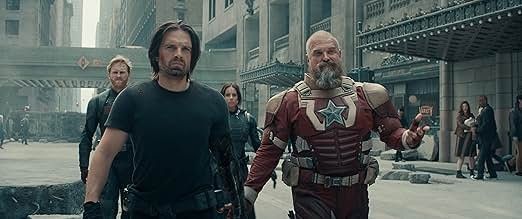
Bucky’s response is practical. He abandons procedural limits and intercepts the group directly. His arrival is staged like an intimidating action set piece, briefly making him appear to be another threat before his actual goal becomes clear. Bucky could have functioned as the team’s emotional mentor. He understands guilt, manipulation, and the difficulty of living after being used as a weapon.
The film only uses this connection partially. His conversations with Yelena and Walker are shorter than the character relationships suggest they should be. This is another frustration. Bucky has the history most closely connected with the film’s themes, but he often behaves like an experienced supervisor placed around the younger emotional center. Stan remains effective, especially when Bucky’s patience gives way to dry irritation. He provides a sense that this dysfunctional team exists inside a larger heroic history.
Valentina Allegra de Fontaine: Power Protected by Public Language
Julia Louis-Dreyfus plays Valentina as a person who rarely needs to raise her voice because institutions already amplify it. She is intelligent, controlled, politically adaptable, and willing to remove anyone who could expose her decisions.
Valentina’s greatest ability is not combat. It is reframing. A failed experiment becomes a security program. Disposable operatives become unstable threats. A public crisis becomes an opportunity to present herself as the person who created the solution.
Her treatment of Bob is especially revealing. She sees his emotional vulnerability as a technical obstacle attached to an otherwise perfect asset. The film uses her as a criticism of organizations that adopt the language of protection while treating individuals as equipment.
Louis-Dreyfus delivers this material with polished confidence and small flashes of panic. Valentina is most entertaining when her control begins slipping and she must invent a new explanation immediately. The character is effective but not especially deep. Her ambition and self-preservation are clear, while her personal beliefs remain harder to identify.
A more complex version might genuinely believe that controllable superhumans are necessary in a world without a stable Avengers team. The film hints at this justification without spending enough time on it. Valentina remains primarily the manipulator who creates the crisis and then claims ownership of the rescue.
Team Chemistry: People Who Become Useful by Admitting They Are Not Fine
The central group works because its members do not become friends immediately. Their first instinct is suspicion, and their second is irritation.
Yelena finds Walker exhausting. Walker interprets disagreement as challenge. Ava observes more than she speaks. Alexei wants the team to admire him. Bucky expects basic competence and rarely receives it.
Bob changes the dynamic because he cannot participate in their performance of toughness. His vulnerability forces the others to decide whether they are a collection of operatives or people capable of protecting someone.
The humor grows naturally from personality. Alexei’s heroic fantasies clash with Yelena’s sarcasm. Walker’s seriousness becomes funny when nobody respects the authority he tries to project. The film avoids making every member equally charming. Walker remains difficult. Ava remains distant. Bucky remains impatient.
This preserves the sense that teamwork is an action rather than a sudden emotional transformation. Their connection becomes clearest during the Void sequence. Each character enters despite understanding that physical ability may be useless.
They cannot guarantee Bob will recover. They simply refuse to make Yelena face him alone. That choice gives the team legitimacy. They become heroic before receiving any official title.
Action & Visual Style: Grounded Fights Before Psychological Spectacle
Thunderbolts* uses more practical and physically grounded action than many recent MCU films.
The underground confrontation establishes each character through movement. Yelena fights efficiently, Walker attacks with direct force, Ava phases through danger, and Antonia copies familiar combat techniques.
The choreography allows the performers to occupy the space clearly. I can usually understand who is attacking, where exits are located, and how the facility itself becomes part of the trap. Yelena’s early jump from a high structure is staged with unusual attention to emotional state. The physical action reflects recklessness rather than ordinary mission confidence.
Bucky’s interception sequence uses vehicles, weapons, and controlled aggression to remind the audience how dangerous he remains without turning the scene into weightless digital movement. Bob’s transformation changes the action language. Once the Sentry appears, ordinary combat becomes irrelevant.
The imbalance is intentional. The team’s weapons and training cannot compete with someone who possesses overwhelming power. The Void introduces the film’s strongest visual concept. Darkness spreads through streets and turns people into flat shadows before pulling them into internal spaces.
These rooms are built from Bob’s memories and emotional associations. The production design becomes less about physical realism and more about psychological repetition. The final act is visually restrained compared with many Marvel climaxes. There is destruction, but the central objective is reaching one person rather than defeating an army. Some digital effects remain inconsistent. Sentry’s movements can appear overly smooth, and parts of the citywide darkness lack the physical texture of the earlier action. Still, Jake Schreier gives the film a more coherent visual identity than several franchise entries built around interchangeable digital environments.
Music, Direction & Pacing: A Superhero Film Comfortable With Awkward Silence
Son Lux provides a score that supports the movie’s uneasy emotional tone. The music uses electronic textures, unstable rhythms, choral elements, and heavier orchestral movement without relying entirely on familiar heroic themes. Yelena’s scenes often feel suspended between action and emotional distance. The score allows emptiness to remain present rather than pushing every moment toward triumph.
Bob and the Void receive darker musical material that avoids turning the character into a conventional monster. Jake Schreier directs with a clear interest in faces and uncomfortable pauses. Characters are sometimes allowed to stand in silence after someone says the wrong thing.
This approach gives the performances room, especially during Yelena and Bob’s conversations. The first half moves efficiently. Yelena’s condition, Valentina’s cleanup operation, the underground trap, Bob’s introduction, and the escape develop with clear momentum.
The middle becomes less focused as Bucky, Alexei, political pressure, and the Sentry program enter the story. Several characters need more development than the running time can provide. Ava and Walker are affected most clearly. The final act slows emotionally while increasing visual danger. Entering the Void requires the film to become more abstract and less dependent on external action.
Schreier handles this transition well, though the dialogue occasionally explains the metaphor too clearly. The image of people sitting beside Bob already communicates the point. The ending then shifts back into franchise comedy and future setup. This is entertaining, but the tonal change arrives quickly after an emotionally vulnerable climax.
Themes & Emotional Meaning: Nobody Escapes the Void Alone
Thunderbolts* is primarily about loneliness. Every central character believes some part of their history separates them from ordinary connection. Yelena has been shaped by assassination and loss. Bob believes his darkness makes him dangerous. Walker sees failure as a permanent public identity. Ava has spent much of her life experiencing her body as a source of pain.
Alexei performs confidence because attention protects him from irrelevance. Bucky has recovered enough to function, yet he still lives with memories of actions committed through his body.
The film does not claim that forming a team cures these problems. Its more responsible message is that isolation makes them harder to survive. The Void works as both literal threat and emotional metaphor. Bob becomes trapped inside the belief that everyone leaves and that his existence only harms others. Yelena reaches him not by arguing that his feelings are irrational but by remaining present.
The others then join her. Their presence does not erase the dark room immediately. It creates evidence against the certainty that Bob is alone. Shame is another major theme. Valentina controls the operatives partly because each believes their past makes them undeserving of better treatment. Being disposable feels believable when someone already sees themselves as damaged.
The team changes when its members begin rejecting that assumption. They may have committed harmful acts, but accountability does not require permanent dehumanization.
Heroism is redefined through this idea. The Thunderbolts do not become heroes because the government gives them a title. They become heroic when they protect someone who cannot reward them and when they refuse to abandon one another inside emotional danger. The film also criticizes public branding. Valentina converts the team’s actions into a political identity that benefits her. This suggests that institutions can absorb genuine courage and package it as official success without changing the system that caused the crisis.
Critical Reception & Audience Response: A Welcome Return to Character-Driven Marvel
Thunderbolts* received generally positive critical reviews. Florence Pugh and Lewis Pullman were widely praised, while the film’s focus on emotional isolation, found family, and damaged antiheroes was often viewed as a welcome change from larger multiverse stories.
Many reviewers described it as one of Marvel’s stronger recent films. The grounded team dynamic and relatively focused plot helped it feel more accessible than projects dependent on extensive cosmic mythology. The treatment of mental health generated both praise and debate. Some viewers appreciated the direct depiction of depression and the refusal to solve Bob’s struggle through violence.
Others argued that transforming psychological darkness into a city-threatening superhuman force risked simplifying or sensationalizing mental illness.
The ensemble also received positive attention. David Harbour’s comedy, Wyatt Russell’s insecurity, Sebastian Stan’s weary authority, and Hannah John-Kamen’s restrained performance gave the team distinct personalities. Criticism focused on uneven character development, limited use of Taskmaster, familiar antihero-team elements, and an ending that returned quickly to franchise setup.
The movie’s theatrical performance was more modest than its critical approval might have suggested. It attracted a positive audience response but did not become one of Marvel’s largest financial successes.
That difference reflects a broader challenge for the franchise. Good reviews no longer guarantee that casual audiences will follow every connected character into theaters.
Thunderbolts* requires some familiarity with previous stories, particularly Yelena, Walker, Bucky, Ava, Alexei, and Valentina. The film provides enough context to understand the immediate conflict, though emotional details carry more weight for returning viewers.
Its reputation is likely to remain stronger as a character piece than as a major event film. The action is entertaining, but the scenes people remember most involve damaged characters recognizing one another.
Final Verdict: Marvel’s Damaged Outsiders Become Heroes by Staying
Thunderbolts* is one of the stronger modern MCU films because it understands that lesser-known characters do not need a larger cosmic threat to justify their existence. They need a reason to matter to one another.
Yelena begins the story emotionally disconnected from every mission she completes. Bob enters with even less control over his identity, carrying a darkness that becomes physically dangerous when powerful people attempt to exploit it. Florence Pugh and Lewis Pullman give the film its emotional foundation. Their scenes are funny, awkward, sad, and refreshingly free from forced romance.
David Harbour’s Alexei adds warmth, though his need for attention occasionally consumes too much space. Wyatt Russell continues making John Walker one of Marvel’s most uncomfortable and interesting failed heroes.
Sebastian Stan gives Bucky a stable, weary presence. Hannah John-Kamen makes Ava quietly compelling despite receiving insufficient material. Julia Louis-Dreyfus turns Valentina into a believable institutional threat: someone capable of surviving any failure by changing the language used to describe it.
The action is clear and often physical. The underground battle, Bucky’s interception, and Sentry’s arrival give each stage a different scale. The final confrontation is the film’s boldest choice. Bob is not defeated. He is reached.
The mental-health metaphor is not perfect. Depression is more complicated than a dark alter ego, and turning pain into a supernatural threat can create uncomfortable simplification.
The film’s emotional principle remains valuable. People experiencing darkness do not always need another person to produce the perfect sentence. Sometimes the first necessary act is refusing to leave.
I recommend Thunderbolts* to Marvel viewers, fans of character-driven superhero stories, audiences who enjoy dysfunctional team dynamics, and anyone who prefers emotional stakes over multiverse exposition.
Personal rating: 8.5/10.
Thunderbolts* earns that score for Florence Pugh’s outstanding lead performance, Lewis Pullman’s vulnerable work, strong ensemble chemistry, grounded action, Son Lux’s score, and a psychologically focused final act. It loses points for uneven character development, limited use of Ava and Bucky, the abrupt treatment of Taskmaster, an overly direct metaphor, and franchise setup that arrives too quickly after the emotional resolution.
The Avengers once assembled because the world needed extraordinary champions. The Thunderbolts come together because several discarded people finally understand that none of them should have to face the darkness alone.
Pros

- Intricate narrative that challenges conventional storytelling
- Well-developed characters with moral ambiguity
- Stunning cinematography highlighting emotional depth
- High production value with meticulous set design and practical effects
- Smart integration of humor alongside intense, dramatic moments
- Thought-provoking themes of redemption, sacrifice, and duality
Cons

- Complex narrative might confuse viewers looking for straightforward heroism
- Moral ambiguity may not satisfy fans preferring clear-cut good vs evil dynamics
- Deliberate pacing could be perceived as slow for audiences expecting constant action

Leave a comment
Your comment is awaiting moderation. We save your draft here
0 Comments