





A Halloween Classic Powered by Personality
Hocus Pocus is the kind of film that becomes more enjoyable when the lights are low, the weather is cold, and the room contains at least one unnecessary Halloween decoration. I first approached it expecting a lightweight Disney comedy about three theatrical witches chasing children through Salem. That description is accurate, but it does not explain why the film has remained so popular. The plot is simple, the rules are inconsistent, and some of the humor belongs unmistakably to the early 1990s. Yet the Sanderson sisters enter every scene with such confidence that the entire production feels larger, stranger, and more memorable than its story should allow.
This Hocus Pocus review looks at the 1993 film as both a family fantasy and a seasonal cult favorite. Directed by Kenny Ortega, it follows teenager Max Dennison after his family moves from California to Salem, Massachusetts. Max is skeptical about the town’s obsession with its witch-trial history, but one reckless decision on Halloween night brings Winifred, Mary, and Sarah Sanderson back after three centuries. With sunrise approaching, Max, his younger sister Dani, classmate Allison, and an enchanted cat named Binx must prevent the sisters from restoring their youth permanently.
The film does not build suspense with subtlety. It uses colored smoke, exaggerated performances, magical books, graveyards, broomsticks, musical numbers, and broad physical comedy. That enthusiasm is its greatest strength. Hocus Pocus never appears embarrassed by its own silliness, and the result is a Halloween movie that feels sincere even when almost everything on screen is deliberately ridiculous.
The Sanderson Sisters: Three Performances That Carry the Film
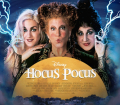
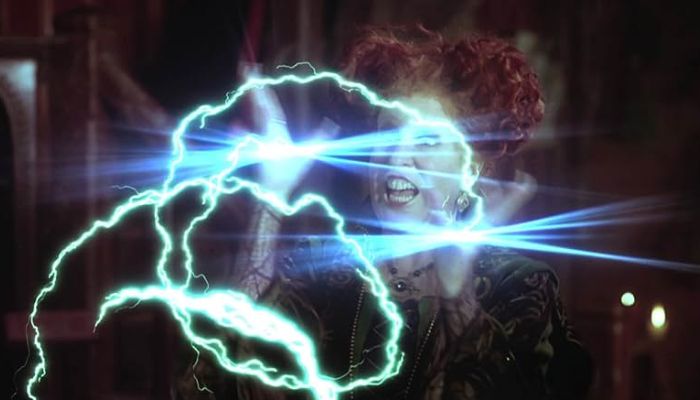
Bette Midler’s Winifred Sanderson is the central force of Hocus Pocus. She is proud, impatient, controlling, and completely convinced of her own brilliance. Winifred treats every setback as a personal insult and every room as a stage awaiting her entrance. Midler plays the role with large gestures, sharp comic timing, and enough musical confidence to make the character feel dangerous without losing the family-friendly tone.
Winifred is the planner, but her plans frequently collapse because she underestimates modern life and overestimates her sisters’ ability to follow instructions. Her irritation provides much of the comedy. She can move from grand supernatural authority to exhausted sibling frustration within seconds, often because Mary or Sarah has misunderstood something obvious. Kathy Najimy gives Mary Sanderson an unusual combination of loyalty, physical comedy, and practical instinct. Mary is not presented as intellectually sophisticated, but her ability to identify children through smell makes her genuinely useful. Najimy’s facial expressions and sideways mouth create a visual performance that remains funny even when Mary has little dialogue.
Sarah Jessica Parker’s Sarah Sanderson is dreamy, distracted, flirtatious, and far more dangerous than her soft behavior initially suggests. Her singing voice becomes a supernatural lure, drawing children toward the sisters. Parker plays Sarah with a floating physicality, as though the character is never completely connected to the ground or the conversation taking place around her. The chemistry among the three actresses is the reason the film works. They do not behave like three unrelated villains sharing a plan. They feel like sisters who have spent centuries irritating, protecting, and competing with one another. Winifred dominates, Mary follows with nervous enthusiasm, and Sarah becomes distracted by whatever attracts her attention. Their arguments are often more entertaining than the main chase.
Max Dennison: A Skeptic Who Creates the Entire Problem
Max begins the film as an outsider who dislikes Salem’s fascination with Halloween. He misses California, resents the move, and treats local history as an embarrassing performance designed for tourists. His skepticism is understandable, but it also makes him careless. He lights the Black Flame Candle partly to impress Allison and partly to prove that the legend is meaningless.
Omri Katz gives Max the restless attitude of a teenager who wants to appear more confident than he feels. He is dismissive toward Dani, awkward around Allison, and defensive whenever someone challenges his judgment. These qualities make him believable, though not always likable. Max’s strongest trait is his willingness to take responsibility once the danger becomes real. He does not spend the entire film denying what happened. After bringing the Sanderson sisters back, he helps search for a solution, protects Dani, and begins trusting people whose knowledge he initially mocked.
His character arc is straightforward: he learns that maturity is not the same as cynicism. Rejecting everything associated with childhood or local tradition does not make him intelligent. The film places him beside Dani, whose belief in magic initially appears childish but proves more useful than his skepticism. The romance between Max and Allison is one of the weaker parts of the story. Allison is capable and knowledgeable, but their connection develops mainly because the plot needs them together. The film gives them chemistry through shared danger rather than meaningful conversation, which is sufficient for a Halloween adventure but not especially memorable.
Dani Dennison: The Emotional Heart of the Story
Thora Birch’s Dani is one of the film’s most important strengths. She is talkative, brave, emotionally direct, and far less interested than Max in pretending she does not care. Her excitement about Halloween gives the opening section warmth, while her fear and determination later provide genuine emotional stakes. Dani’s relationship with Max feels believable because affection and irritation exist together. She complains when he embarrasses or dismisses her, but she also trusts him. Max initially treats taking Dani trick-or-treating as an obligation, yet the events of the night force him to recognize how deeply responsible he feels for her safety.
Dani is not passive. She confronts the Sanderson sisters, speaks directly to Binx, and remains active during escape attempts. Her courage occasionally exceeds what would be sensible, but that confidence suits a child who believes moral clarity is more important than appearing calm. Birch gives Dani enough vulnerability that the character never becomes a miniature adult. She can be frightened, stubborn, excited, and hurt within the same scene. Her bond with Binx is especially effective because both characters understand what it means to fear losing a sibling.
Thackery Binx and the Weight of an Old Failure
Binx provides the film with its tragic foundation. In 1693, Thackery Binx fails to save his sister Emily from the Sanderson sisters. Winifred transforms him into an immortal black cat, forcing him to live for centuries with the memory of that night.
The idea is much darker than the film’s comic surface suggests. Binx is trapped inside one form, separated from his family, and unable to move beyond his guilt. His mission to prevent the sisters from returning gives him purpose, but it also keeps him emotionally tied to the moment that destroyed his ordinary life. As a talking animal companion, Binx serves several practical functions. He explains the witches’ history, warns the group about magical rules, and guides them through situations they do not understand. His knowledge prevents the story from stopping repeatedly for research scenes.
The character’s emotional connection with Dani gives the final moments more weight. Dani treats him as a person rather than a magical tool, while Binx sees another younger sibling in danger. Their friendship allows his centuries of regret to become part of the present story. The effects used for Binx show their age, particularly when the cat’s mouth must match human speech. The character still works because the voice performance, physical animal footage, and emotional writing create a clear personality beyond the technical limitations.
Allison: Useful Knowledge Without Enough Personal Story
Allison begins as Max’s classmate and the person who introduces him more directly to Salem’s local history. She comes from a family connected with the Sanderson cottage and knows enough about the legend to understand that the Black Flame Candle should not be treated casually. Vinessa Shaw gives Allison intelligence and composure, especially compared with Max’s impulsiveness. She often asks the practical question or notices the detail that moves the group forward. Her knowledge helps prevent her from becoming only a romantic reward.
The film still gives her limited personal development. I learn very little about her beyond her family background, confidence, and interest in Max. She joins the adventure quickly and remains dependable, but the story does not explore what Halloween, Salem, or the witches mean to her personally. A stronger version of the character might have connected her family more directly with the town’s history or given her a specific reason to feel responsible for what happens at the cottage. As written, Allison is useful and likable but less distinctive than Dani, Binx, or the Sanderson sisters.
Salem and the Halloween Atmosphere
Hocus Pocus creates an idealized Halloween version of Salem filled with decorated houses, costume parties, school legends, graveyards, autumn streets, and adults too distracted to notice supernatural chaos. The town feels both contemporary to 1993 and connected with a much older mythology.
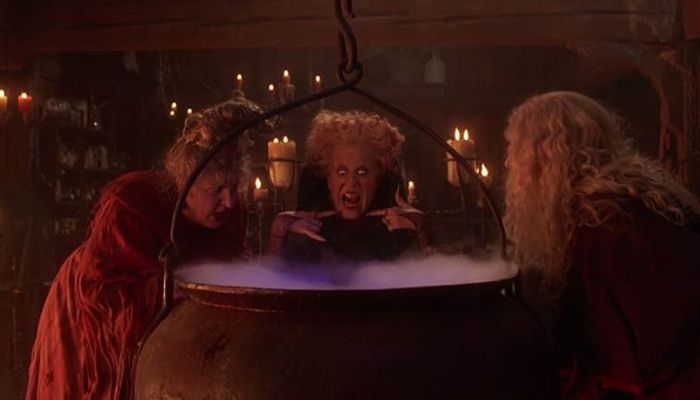
The Sanderson cottage is one of the film’s best locations. It contains cauldrons, hanging objects, candles, old wood, magical ingredients, and Winifred’s living spellbook. The production design makes the space theatrical without losing its slightly unpleasant physical texture. The graveyard scenes use fog, moonlight, stone monuments, and twisted trees to create a classic seasonal atmosphere. These locations are spooky enough for children without becoming visually severe.
The contrast between old Salem and modern Halloween creates several good jokes. The sisters mistake paved roads, buses, fire engines, televisions, and costumed adults for unfamiliar magic. Their confusion works because they adapt just quickly enough to remain dangerous. The town’s adults are largely useless, but that is part of the family-adventure structure. A Halloween party gives the witches access to a room full of people who assume they are performers, while children become the only characters capable of understanding the real threat.
“I Put a Spell on You” and the Importance of Musical Performance
The Town Hall musical sequence is the film’s defining scene. Winifred takes control of the stage and transforms “I Put a Spell on You” into both a public performance and an actual enchantment. The adults dance, laugh, and remain trapped in the sisters’ influence while the younger characters recognize the danger. Bette Midler performs with such authority that the scene temporarily stops feeling like a plot requirement and becomes a complete musical event. Mary and Sarah provide comic support, backing vocals, and choreography that reflects their individual personalities.
The number also demonstrates the Sanderson sisters’ greatest advantage: they are entertaining. The people of Salem do not run from them because the sisters understand spectacle. Their appearance is strange, but on Halloween, strangeness looks like commitment to a costume. Sarah’s “Come Little Children” has a different effect. It is softer, more unsettling, and directly connected with the sisters’ plan. The melody sounds almost comforting, which makes its purpose more disturbing. Parker’s performance gives the sequence a dreamlike quality that remains one of the film’s strongest atmospheric elements.
Comedy, Camp, and Early-1990s Humor
Hocus Pocus uses broad comedy rather than subtle wit. Characters shout, fall, misunderstand modern objects, exchange insults, and react with exaggerated expressions. Much of the humor depends on timing and performance rather than clever plotting.
The Sanderson sisters create most of the successful comedy because each reacts differently to the modern world. Winifred tries to maintain authority, Mary approaches confusion with practical curiosity, and Sarah is delighted by almost everything. Some jokes have aged less gracefully. The film repeatedly treats Max’s virginity as a source of embarrassment and plot explanation, which feels more awkward now than playful. A few interactions also rely on gender stereotypes and romantic assumptions typical of family comedies from the period.
Billy Butcherson provides another source of physical humor. Presented initially as a frightening resurrected figure, he becomes increasingly irritated with Winifred and less threatening once he can finally speak. Doug Jones uses movement to make Billy expressive before dialogue becomes available. The camp tone allows the film to move between danger and comedy without creating a severe emotional break. Winifred can threaten the heroes in one scene and become furious at a sprinkler system in the next. The film’s reality is flexible enough to support both.
Visual Effects and Production Design
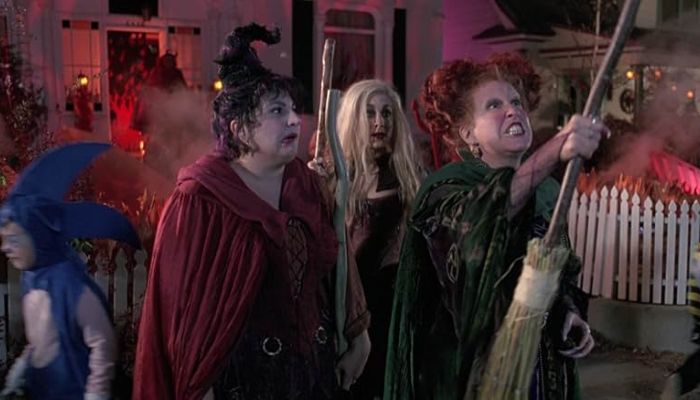
The practical sets, costumes, makeup, and props remain more convincing than several digital effects. The sisters’ clothing immediately communicates personality: Winifred’s elaborate green costume suggests authority, Mary’s heavier silhouette reflects her earthy physical comedy, and Sarah’s softer purple appearance supports her dreamy behavior.
Winifred’s spellbook is a particularly memorable prop. Its stitched cover, moving eye, metal details, and physical weight make it feel dangerous and alive. The book has more personality than many supporting characters. Flying sequences vary in quality. Brooms, mops, and vacuum cleaners provide a funny visual idea, though compositing and wire work are often visible by modern standards. The effects remain charming because the scene is built around personality rather than realism.
The magical energy, smoke, and transformation effects look dated in places, but the film rarely depends on spectacle alone. Practical environments give the actors something tangible to inhabit, helping the fantasy retain texture. Kenny Ortega’s background in choreography is visible in the staging. Characters move through frames with theatrical purpose, especially during musical scenes and group comedy. The camera often allows the performers to complete physical jokes rather than cutting too quickly.
Pacing and Story Structure
The opening in 1693 establishes the witches, Binx, and the emotional stakes efficiently. The transition to modern Salem then slows the film enough to introduce Max, Dani, Allison, and the town’s Halloween culture before the central mistake occurs.
Once the sisters return, the story becomes a chase through several locations. The heroes escape, search for a solution, believe they have succeeded, and discover that the danger continues. This structure is repetitive but appropriate for a family adventure. The middle section occasionally loses momentum when the characters move between the cottage, school, party, cemetery, and Dennison house. The Sanderson sisters’ performances prevent the film from feeling completely mechanical, but the plot itself is thin.
The magical rules are also inconsistent. The spellbook, candle, potion, sunrise deadline, salt protection, and immortality curse create enough information for the story, yet some abilities appear or disappear according to what the current scene requires. I never found the inconsistencies damaging because Hocus Pocus operates through fairy-tale logic. Emotion, timing, and theatrical payoff matter more than a perfectly structured magical system.
Themes of Sibling Loyalty and Letting Go
Beneath the comedy, the film repeatedly returns to siblings. Max must learn to protect and value Dani, while Binx remains trapped by his failure to save Emily. The Sanderson sisters also display loyalty, though their relationship is shaped by Winifred’s dominance and constant insults. Max’s development becomes meaningful when viewed beside Binx. Both older brothers face a younger sister in danger, but Max receives the opportunity Binx lost centuries earlier. Their cooperation gives Max’s responsibility emotional context.
Binx’s story is also about releasing guilt. He has spent centuries believing that his existence must remain attached to one failure. Helping Dani allows him to complete the protective act he could not complete for Emily. The film does not explore these themes with great subtlety, but it gives the final scenes genuine emotion. The ending works because the adventure has always been about more than stopping three witches. It is about whether love can survive failure without becoming permanent punishment.
Who Should Watch Hocus Pocus?
Hocus Pocus is ideal for viewers who enjoy Halloween comedies, theatrical villains, family fantasy, nostalgic 1990s films, musical performances, and seasonal stories that are spooky without becoming deeply frightening. The Sanderson sisters remain entertaining enough that adults can enjoy the performances even when the plot is aimed at younger audiences.
Families should know that the story includes child endangerment, supernatural threats, an enchanted corpse, and discussions of virginity, though the overall tone remains comic and highly stylized. Very young viewers may find Winifred or the graveyard imagery unsettling.
The film is less suitable for audiences seeking detailed mythology, subtle character writing, or modern visual effects. Its appeal depends heavily on accepting camp, theatrical acting, and a plot that functions mainly as a path between memorable scenes.
My Rating
I give Hocus Pocus a personal rating of 8/10. It is not a perfectly written fantasy film, and much of its reputation depends on atmosphere, repetition, and seasonal nostalgia. The plot exists mainly to bring the Sanderson sisters into modern Salem and place them in situations where their performances can dominate.
That performance-driven structure is enough. Bette Midler, Kathy Najimy, and Sarah Jessica Parker create three villains who are threatening, ridiculous, musically gifted, and strangely lovable at the same time. Thora Birch and the story of Binx provide the emotional sincerity needed to keep the film from becoming only a collection of comic scenes.
Hocus Pocus works best as a Halloween tradition rather than a carefully constructed supernatural drama. Its graveyards, decorated streets, magical book, theatrical costumes, strange songs, and sibling relationships create a specific seasonal feeling that newer productions often imitate without reproducing. I may notice more flaws each time I return, but the moment the Sanderson sisters begin arguing, the film’s weaknesses become much easier to forgive.
Pros

- Timeless appeal that resonates with audiences of all ages.
- Humorous blend of comedy and spooky elements that keep viewers entertained.
- Memorable characters with quirky, larger-than-life personalities.
- Rich nostalgic value that evokes warm childhood memories.
- Versatile viewing options across streaming platforms and downloadable formats.
- Creative practical effects and set design that enhance the film's magical experience.
Cons

- Certain sequences may feel slow-paced for some viewers.
- The reliance on older special effects can seem dated compared to modern films.
- The PG rating may raise concerns for parents seeking strictly child-safe content.

Leave a comment
Your comment is awaiting moderation. We save your draft here
0 Comments