





Gru Has a Baby, a New Identity, and No Quiet Moments
The scene that defines Despicable Me 4 for me is not one of its large action sequences or Minion experiments. It is Gru attempting to handle his new baby son, Gru Jr., while the child responds to almost every effort with suspicion, rejection, or deliberate irritation. Gru has faced supervillains, secret agents, giant machines, and his own criminal past. None of those challenges prepared him for a baby who appears personally offended by his existence. This Despicable Me 4 review begins with that relationship because the film’s strongest material is found inside Gru’s increasingly chaotic family, even when the larger story keeps pulling attention elsewhere.
Released in 2024 and directed by Chris Renaud, Despicable Me 4 continues the animated franchise built around former supervillain Gru, his wife Lucy, their daughters Margo, Edith, and Agnes, and an expanding population of Minions. The family’s routine changes when Gru’s old school rival Maxime Le Mal escapes from custody and threatens revenge.
To protect everyone, the Anti-Villain League moves the family into a safe-house community and gives them new identities. Gru becomes a solar-panel salesman named Chet, Lucy attempts to work in a hair salon, and the girls must adapt to new schools and unfamiliar neighbors.
The disguise premise creates opportunities for domestic comedy. Gru has spent years becoming comfortable as a father and agent, only to be placed inside a suburban identity he cannot perform convincingly. The family must appear ordinary at the exact moment their lives have become even stranger.
At the same time, the film introduces Maxime’s insect transformation, his partner Valentina, an aspiring young villain named Poppy Prescott, and a group of Minions given unstable superpowers. Each idea can support several jokes. Together, they make the movie crowded.
Despicable Me 4 remains colorful, fast, and easy to watch. It offers enough familiar personalities to entertain established fans. Its problem is not a lack of ideas. It is the inability to choose which idea deserves to become the emotional center.
Plot & Storytelling: Witness Protection With Too Many Side Missions
The story begins when Gru attends a reunion at Lycée Pas Bon, the school where he trained as a young villain. There he encounters Maxime Le Mal, a former classmate who has transformed himself using cockroach-related technology.
Maxime has never forgiven Gru for overshadowing him during their school years. His resentment combines personal humiliation with a desire to prove himself as a superior villain.
Gru helps the Anti-Villain League arrest Maxime, but the victory does not last. Maxime escapes and announces that he intends to target Gru’s family, particularly Gru Jr.
The threat forces Gru, Lucy, the girls, the baby, and several Minions to leave their home. They are moved to the suburban community of Mayflower and assigned new names.
The safe-house concept is promising because the family must hide every trait that makes them recognizable. Gru cannot behave like a former villain. Lucy must avoid revealing her agent skills. The girls must build new social identities.
Gru’s cover job immediately creates problems. He knows very little about selling solar panels and even less about pretending to enjoy ordinary neighborhood conversation.
Lucy’s attempt to work at a salon produces a separate comic disaster. She has confidence but lacks professional hairdressing experience, turning a routine appointment into a reason to abandon the workplace.
Margo struggles at her new school after being humiliated by another student. Her subplot reflects the emotional cost of relocation, though it receives limited development.
Edith adapts more easily and approaches the new environment with her usual physical confidence. Agnes experiences a crisis because she is told she cannot bring her beloved goat, Lucky, to the safe house. These family stories provide useful reminders that hiding affects each person differently. Unfortunately, the film moves away from them repeatedly.
The most important new character is Poppy Prescott, the teenage daughter of Gru’s wealthy neighbors. She discovers Gru’s true identity and reveals that she dreams of becoming a villain.
Rather than reporting him, Poppy blackmails Gru into helping her steal the school mascot from Lycée Pas Bon. She believes completing the robbery will prove she deserves admission. This side mission gives the film a second central plot. Gru must stop Maxime while secretly assisting a young criminal whose ambition resembles his own past.
The relationship has potential because Poppy gives Gru a chance to examine the example he presents to younger people. He once celebrated villainy, but now understands the damage caused by selfish ambition. The screenplay barely explores that contradiction. Poppy remains enthusiastic about crime, and Gru agrees to help mainly because she controls his secret.
The robbery returns the film to Lycée Pas Bon and introduces more gadgets, traps, school mythology, and action. It is entertaining but temporarily disconnects the story from Maxime.
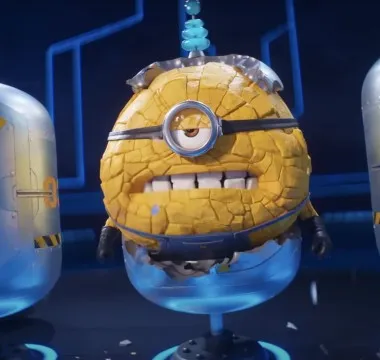
Meanwhile, the Anti-Villain League experiments on five Minions, turning them into the Mega Minions. Each receives a different superpower, including stretching, flight, strength, energy abilities, and a rock-like body.
Their training and public heroics form another largely independent storyline. The Mega Minions generate several visual jokes but have limited influence on the main family conflict until late in the movie.
The climax brings Maxime’s revenge plan, Gru Jr.’s kidnapping, the Mega Minions, Gru, Poppy, and the rest of the family into the same larger confrontation. The pieces technically connect, but the film never fully overcomes its fragmented structure. It feels like several animated episodes edited into one feature.
Gru and Gru Jr.: The Funniest Relationship Deserved More Attention
Gru Jr. is the most important addition to the family. The baby resembles Gru physically but appears to prefer almost everyone else. Gru wants affection from his son and repeatedly attempts to earn it. Gru Jr. responds with blank stares, physical resistance, and perfectly timed rejection. Steve Carell gives Gru’s frustration a wounded quality. Gru can handle being insulted by an enemy, but being ignored by his baby affects him immediately.
The comedy works because Gru has changed dramatically across the series. The former villain who once avoided emotional attachment now desperately wants validation from his child.
Gru Jr. also behaves like a tiny version of Gru’s older criminal identity. He is stubborn, physically destructive, and strangely confident. This raises an interesting possibility: Gru must learn to parent someone who reflects the least manageable parts of himself.
The film uses that idea mainly for jokes. Gru Jr. causes accidents, creates messes, and reacts with amusement when Gru suffers. Maxime’s decision to target the baby gives the relationship narrative importance. Gru’s rescue becomes more than another professional mission.
During the climax, Gru must protect a son who has spent much of the movie refusing to connect with him. The emotional reward comes when Gru Jr. finally responds with affection.
The moment is warm and effective, but the development leading to it is thin. The baby’s change occurs because the story reaches its ending rather than because the relationship has evolved through several meaningful experiences.
I wanted more quiet scenes between them. Gru feeding the baby, struggling through bedtime, or confronting his own fear of failing as a father could have given the comedy greater emotional weight.
Instead, the film treats Gru Jr. as both emotional objective and comic device. He is central to Maxime’s plan but less central to the middle of the movie. This is my first major criticism. Despicable Me 4 discovers an excellent family dynamic and then surrounds it with so many subplots that it cannot develop fully.
Maxime Le Mal: A Cockroach Villain With an Old Grudge
Maxime Le Mal is designed as a theatrical rival from Gru’s past. He speaks with exaggerated confidence, values presentation, and sees villainy as a competition for status.
Will Ferrell gives Maxime a large vocal personality. He sounds proud, offended, romantic, and ridiculous, often within the same conversation. The French-accented performance makes Maxime immediately recognizable, though the character relies heavily on one exaggerated comic mode.
His connection with Gru is based on school rivalry. Maxime believes Gru stole attention that should have belonged to him. That history offers an opportunity to explore Gru’s younger years and the competitive culture of villain education. The film provides only brief details.
Maxime’s cockroach transformation is visually strange and appropriately unpleasant. His body gains insect features while his technology uses swarms and biological modification.
The design fits the franchise’s love of villains built around one visual concept. Vector had direction and technology. El Macho had exaggerated strength and performance. Balthazar Bratt used 1980s nostalgia.
Maxime has cockroaches. The concept produces effective action and a few strong visual jokes, but it does not reveal much about his personality. The insect obsession is a weapon rather than a meaningful extension of his character.
Valentina accompanies him throughout the revenge plan. Sofía Vergara gives the character confidence and dramatic energy, though the screenplay gives her limited independent motivation.
She supports Maxime, reacts to his behavior, and participates in the villainous spectacle. Their relationship could have offered a comic contrast with Gru and Lucy’s marriage. Instead, Valentina remains mostly an accessory to Maxime’s plans.
Maxime’s revenge is personal but simple. He wants to hurt Gru, demonstrate superiority, and transform Gru Jr. into something that belongs to his own insect world. The plan creates urgency but not complexity. Maxime is entertaining enough to carry individual scenes without becoming one of the franchise’s strongest villains.
Poppy Prescott: A Young Villain Looking for a Mentor
Poppy is introduced as a quiet suburban teenager before revealing that she knows exactly who Gru is. Her calm blackmail creates a strong contrast with Gru’s panic. Joey King gives Poppy a dry, controlled delivery. The performance makes her feel more strategic than the adults around her.
Poppy admires Gru’s criminal history and wants to study at Lycée Pas Bon. To prove herself, she intends to steal Lenny, the school’s honey badger mascot. Her ambition positions Gru as an accidental mentor. He has spent years moving away from villainy, yet his past continues inspiring younger people.
This could have become the film’s most interesting theme. Gru wants to protect his children from danger while helping another child enter the dangerous world he left. The movie rarely confronts this contradiction. Gru objects to the plan but participates because Poppy threatens his cover.
Their mission develops a degree of trust, though it is based more on shared action than emotional conversation. Poppy’s parents appear unaware of her ambitions. Their wealthy suburban lifestyle provides comfort without understanding who she wants to become.
The character therefore has a mild connection with the franchise’s recurring interest in children seeking attention from unavailable adults. Poppy could also have formed a stronger relationship with Margo, Edith, or Agnes. A teenage aspiring villain entering Gru’s family circle should affect the daughters directly.
Instead, she spends most of her important scenes with Gru. The girls remain largely separate from the subplot.
By the end, Poppy has completed the robbery and gained confidence, but her future moral direction remains unclear. The film treats her villainous ambition as playful rather than potentially harmful.
She is memorable and well performed. She also feels like a character introduced for future possibilities rather than fully resolved within this story.
Lucy and the Girls: Familiar Characters Fighting for Space
Lucy remains an energetic agent, caring mother, and enthusiastic partner for Gru. Kristen Wiig gives her the same combination of confidence and comic awkwardness established in the previous films.
Her salon subplot provides physical comedy but little development. Lucy attempts to perform ordinary work, creates a disaster, and spends the rest of the film avoiding the consequences.
The sequence is amusing, though it could belong to almost any animated character placed inside an unfamiliar profession.
Lucy’s strongest role should be helping Gru manage the threat to their family and the challenges of parenting Gru Jr. Those moments exist, but they are brief. The film separates Gru into the Poppy storyline while Lucy handles smaller domestic crises.
Margo receives the most emotionally grounded problem among the daughters. Moving to a new school places her in an unfamiliar social hierarchy, and she struggles after public embarrassment.
Miranda Cosgrove gives Margo a sincere uncertainty that fits the character’s age. Unfortunately, the subplot nearly disappears before reaching a meaningful resolution. Edith remains adventurous and physically fearless. Dana Gaier gives her limited dialogue but preserves the character’s confident energy.
Agnes continues to represent emotional innocence. Madison Polan voices her with warmth, particularly during scenes involving Lucky. Her distress about leaving the goat behind is understandable, yet the storyline becomes another comic branch rather than a central family conflict.
The daughters were once essential to Gru’s transformation. In Despicable Me 4, they frequently feel like members of a familiar brand waiting for individual jokes. This is my second major complaint. The family has expanded, but the screenplay gives less attention to the characters who originally gave the series its emotional identity.
Gru’s role as a father should include separate relationships with Margo, Edith, Agnes, and Gru Jr. Instead, most emotional attention moves toward the baby because the plot requires it.
The Mega Minions: Superhero Parody as a Separate Short Film
The Mega Minions are created when the Anti-Villain League tests a powerful serum on five volunteers.
The sequence parodies superhero origin stories. The Minions receive impressive abilities without the discipline, intelligence, or coordination needed to use them responsibly.
One becomes extremely strong. Another can stretch. A flying Minion struggles with direction. An energy-powered member creates uncontrolled destruction. A rock-like Minion becomes heavy and difficult to manage.
The designs are clear and immediately communicate each power. Younger viewers may find the transformation especially entertaining because it combines Minion behavior with superhero spectacle.
Their public rescue attempts produce large amounts of collateral damage. The joke is that giving greater power to the Minions does not create greater competence. This idea is funny, but the subplot exists at a distance from Gru’s family for most of the film. It often feels like a Mega Minions short inserted into the feature.
The characters receive promotional importance larger than their narrative importance. Their images dominated much of the film’s marketing, but their role in the central story remains limited.
They eventually contribute to the climax, providing enough connection to justify their presence technically. A more focused film might have linked the Mega Minion experiment directly to Maxime’s technology or Gru Jr.’s transformation.
Instead, the subplot develops separately until the screenplay needs additional heroes during the finale. The visual comedy is dependable. Stretching, flying, super strength, and failed rescues create obvious opportunities.
The problem is accumulation. Despicable Me 4 already contains witness protection, a revenge plot, a baby relationship, Poppy’s robbery, school difficulties, Lucy’s job, Agnes’ goat, and the larger villain confrontation. The Mega Minions are entertaining, but they occupy time the family story needs more urgently.
Humor & Comedy Style: Familiar Chaos at Maximum Speed
Despicable Me 4 uses physical comedy, character reactions, Minion language, baby behavior, villain theatrics, suburban awkwardness, and superhero parody.
The strongest jokes are connected to personality. Gru attempting to earn Gru Jr.’s affection works because the franchise has spent several films developing him as a father.
Lucy’s confidence inside the salon becomes funny because she approaches an unfamiliar profession like a dangerous mission. Poppy’s calm control over Gru reverses the expected adult-child relationship.
The Minions continue to generate visual comedy through language misunderstandings, workplace accidents, costumes, and complete commitment to bad ideas. Their material remains accessible because the jokes rarely depend on detailed dialogue. Movement, expression, and sound explain the setup.
However, the Minions are now divided across several functions. Some accompany the family, others remain with the Anti-Villain League, and the Mega Minions receive their own storyline.
This reduces the sense that they belong to one comic group connected with Gru’s household. The film also relies heavily on rapid escalation. A small mistake becomes a large public disaster within seconds. That speed keeps the experience active but weakens comic timing. Several scenes end before their strongest idea can develop.
The supermarket and neighborhood sequences benefit from recognizable situations. Gru and Lucy trying to appear normal while behaving suspiciously offers more natural comedy than some of the larger action.
The final act becomes extremely loud. Powers, insects, transformations, vehicles, Minions, and multiple rescues compete for attention. The humor remains family-friendly, though a few images involving cockroaches may be unpleasant for sensitive younger viewers.
The film rarely becomes emotionally heavy. Even the kidnapping of Gru Jr. is surrounded by jokes and exaggerated villain behavior. That consistency protects the light tone but limits tension. I never doubt that the family will be restored safely.
Visual Design & Animation: Polished, Colorful, and Increasingly Crowded
Despicable Me 4 maintains the polished visual style associated with Illumination. Characters use simple but expressive shapes, environments are bright, and movement is exaggerated for comedy.
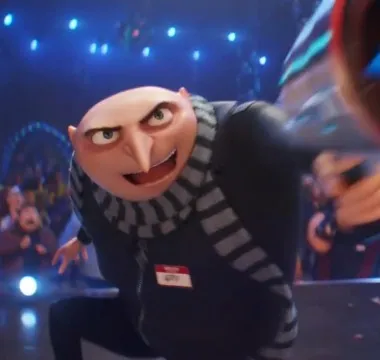
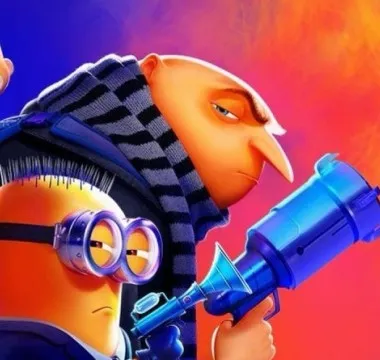
Gru’s silhouette remains instantly recognizable through his long body, narrow legs, striped scarf, and pointed nose. Gru Jr. cleverly resembles his father while remaining visually readable as a baby. His facial expressions communicate stubbornness before he can speak.
Maxime’s transformation introduces insect textures and additional limbs without making him too frightening for the family audience. Valentina’s fashion and posture reinforce her role as a glamorous villainous partner.
Mayflower contrasts with Gru’s darker home and underground technology. The neighborhood uses clean lawns, large houses, expensive facilities, and a controlled suburban appearance. This setting gives the family’s disguise a visual joke. Gru’s appearance and behavior never fit the environment completely.
Lycée Pas Bon returns the film to Gothic villain architecture, secret mechanisms, dramatic halls, and dangerous school traditions. The Mega Minions use superhero shapes while preserving basic Minion proportions. Their designs are simple enough for toys and clear enough for rapid action.
Animation quality remains strong during physical comedy. Facial reactions, body distortion, baby movement, and Minion accidents are carefully timed. The film’s weakness is not visual execution but visual prioritization. So many characters and effects appear during the climax that the screen becomes crowded.
Maxime’s insects, the transformed baby, Mega Minion abilities, vehicles, buildings, and family members create constant motion. The movie looks expensive and technically confident. It has fewer images with the emotional clarity of Gru reading to the girls or sitting quietly with his new family in the original film.
Music, Direction & Pacing: A Film Afraid of Slowing Down
Chris Renaud returns to direct the franchise with Patrick Delage serving as co-director. The movie moves with the efficiency expected from Illumination.
Scenes begin quickly, communicate one central joke or plot point, and transition before attention can weaken. This approach is effective for younger audiences and short-term entertainment. It is less effective for emotional development.
The film contains several potential centers: Gru and Gru Jr., Poppy’s villain ambition, the family’s new identities, Maxime’s revenge, and the Mega Minions. Renaud keeps every storyline moving but cannot give all of them satisfying depth.
The witness-protection section should provide a slower middle where the family experiences the pressure of hiding. Instead, it becomes a launching point for several additional adventures. Heitor Pereira and Pharrell Williams continue contributing to the musical identity of the series. The score supports villain action, family comedy, Minion chaos, and suburban awkwardness.
Pop music and recognizable songs provide additional energy. The franchise has always used music to turn transitions and Minion sequences into playful performances. The music works well but does not create a defining emotional theme for the fourth film.
The direction is strongest during compact comedy. Gru attempting a normal conversation, Lucy panicking after the salon incident, or Gru Jr. rejecting his father requires less spectacle and produces more character. The action remains readable despite the crowded plot. The problem is not confusion about what is happening. It is limited time to care about why each event matters.
Themes & Emotional Meaning: Family Identity Cannot Be Hidden Easily
Despicable Me 4 explores family identity through the safe-house premise. Gru and his relatives receive new names, jobs, routines, and social roles. The disguise is necessary for protection, but it asks every family member to suppress part of who they are.
Gru cannot use his villain reputation or agent authority. Lucy cannot behave like an elite operative. The girls must leave friendships, routines, and personal attachments behind. The film suggests that identity is created through relationships rather than names. They remain a family even while pretending to be other people.
Gru Jr. strengthens this theme. The baby has no understanding of Gru’s professional history. He responds only to daily interaction. Gru cannot impress his son by being a successful villain or respected agent. He must earn connection through patience and care.
This is a meaningful challenge for a character who once tried to control every situation through intelligence and authority. Poppy’s admiration introduces another theme: people cannot fully escape the influence of their past.
Gru has changed, but his criminal achievements remain attractive to someone who sees villainy as exciting. The film stops before examining whether Gru has a responsibility to challenge the culture that once trained him.
Maxime represents the opposite response to the past. He preserves an old school humiliation and turns it into lifelong revenge. Gru has built a family and changed direction. Maxime remains trapped inside competition with the person he remembers from childhood.
The contrast is clear but underdeveloped. The movie could have connected both men through their different relationships with Lycée Pas Bon. The Mega Minions introduce a simple responsibility theme. Power without judgment creates more danger than protection.
This idea is familiar in superhero stories and receives mostly comic treatment. The movie’s overall message remains positive: family requires adaptation, old mistakes do not have to define the future, and responsibility matters more than reputation.
Critical Reception & Audience Response: Dependable Entertainment With Franchise Fatigue
Despicable Me 4 received a mixed critical response. Reviewers generally praised the animation, voice cast, fast comedy, and dependable appeal of Gru and the Minions.
Steve Carell’s performance remained a major strength. Critics recognized that Gru’s combination of villainous confidence and parental vulnerability still provides the franchise with its clearest personality.
The relationship between Gru and Gru Jr. was frequently identified as a promising addition. The baby creates new comedy and gives Gru another family role to navigate.
The main criticism concerned the crowded plot. Many reviewers felt the film contained too many characters and independent storylines without giving any one of them sufficient depth. The Mega Minions divided opinion. Some viewers enjoyed the superhero parody and visual comedy, while others saw the subplot as a marketing-driven distraction.
Maxime received mixed reactions. Will Ferrell’s performance was energetic, but the villain’s motivation and cockroach concept were considered less memorable than those of earlier antagonists. Audience response was warmer, particularly among families and established fans. Younger viewers responded to the Minions, Gru Jr., bright action, and rapid humor.
The film’s commercial success demonstrated that the franchise remains powerful even after several sequels and spin-offs. That popularity does not eliminate signs of repetition. The series continues adding family members, villains, Minion variations, and new locations without changing its basic emotional formula.
For many viewers, familiarity is part of the appeal. Despicable Me 4 provides recognizable characters behaving in predictable but comforting ways. Others may experience franchise fatigue. The movie rarely offers the surprise or emotional focus of the original.
Final Verdict: An Enjoyable Sequel That Needed to Choose One Story
Despicable Me 4 is polished, energetic, and reliably amusing. It understands the basic appeal of its world: Gru tries to maintain control, family life exposes his emotional weakness, villains create theatrical problems, and Minions turn simple tasks into disasters.
Gru Jr. is the film’s best new idea. His refusal to accept Gru immediately creates a challenge that cannot be solved through gadgets or authority. Steve Carell makes Gru’s frustration funny because it comes from genuine affection. The former supervillain is desperate for a baby’s approval.
Poppy is another strong addition. Her calm blackmail and enthusiasm for villainy give Gru a young mirror of his former identity. The safe-house setting could have connected these ideas through a focused story about identity, parenting, and the influence of past behavior.
Instead, the film adds Maxime’s revenge, Lucy’s salon disaster, Margo’s school embarrassment, Agnes’ missing goat, the mascot robbery, Valentina, and the Mega Minions. Most of these elements are entertaining in isolation. Together, they prevent the movie from building emotional momentum.
Will Ferrell gives Maxime energy, but the character never becomes more than a theatrical rival with insect technology. The Mega Minions will likely appeal to children and work well as visual comedy. They also feel like characters developed for promotional visibility before narrative necessity.
The daughters deserve more. Gru’s transformation began because Margo, Edith, and Agnes changed his understanding of family. Their reduced roles make the fourth film feel emotionally removed from the foundation of the series.
The animation remains excellent, the action is clear, and the voice cast performs with confidence. Despicable Me 4 is never difficult to watch. I recommend it to families, younger audiences, Minion fans, and viewers who remain attached to Gru’s household. Those expecting the emotional focus of the first film or a tightly constructed sequel may find it overly busy.
Personal rating: 7/10.
Despicable Me 4 earns that score for Steve Carell’s performance, Gru Jr.’s comic potential, Poppy’s confident introduction, polished animation, accessible humor, and the continuing warmth of Gru’s family. It loses points for crowded plotting, a weak central villain, underused daughters, disconnected Mega Minion material, rushed emotional development, and a climax overloaded with characters and effects.
The film still knows how to make Gru funny. It is less certain which of its many new ideas should matter most.
Pros

- Captivating storyline that successfully balances humor and heartfelt moments
- Stunning animation that brings vibrant and engaging visuals to life
- Innovative storytelling techniques that keep the narrative fresh and lively
- Thoughtful character development that honors legacy while introducing new ideas
- A well-crafted soundtrack that enriches the emotional impact of each scene
- Subtle social themes and cultural nods that add layers of meaning to the plot
Cons

- Some humor moments may feel repetitive to viewers familiar with the franchise
- Pacing occasionally lags during certain transitional scenes
- A few plot elements might come across as predictable compared to earlier installments

Leave a comment
Your comment is awaiting moderation. We save your draft here
0 Comments