



A Movie Powered by Yellow Chaos
The opening of Minions explains almost everything the film wants to be. The tiny yellow creatures have existed throughout history, attaching themselves to the most powerful villain they can find and accidentally helping to destroy nearly every master they serve. Dinosaurs, ancient rulers, and legendary tyrants disappear through a mixture of bad luck and Minion enthusiasm. It is silly, fast, visually clear, and almost completely independent of ordinary dialogue. This Minions review begins there because the movie’s greatest strength and biggest weakness are the same: it trusts comic energy more than character depth.
Released in 2015 and directed by Pierre Coffin and Kyle Balda, Minions is a prequel to Despicable Me. It follows Kevin, Stuart, and Bob decades before they meet Gru. After their species loses its sense of purpose, the trio leaves an isolated cave in search of a new villain worthy of their loyalty.
Their journey takes them to 1960s New York and then London, where they encounter Scarlet Overkill, an ambitious supervillain who dreams of becoming Queen of England. Scarlet appears to be the perfect leader for the Minions. She is theatrical, successful, stylish, and dangerous.
The relationship quickly becomes less comfortable. The Minions’ natural ability to create disasters turns Scarlet’s carefully planned rise to power into a personal conflict. She wants obedient assistants. Kevin, Stuart, and Bob are physically incapable of completing any task without introducing confusion.
The movie is bright, energetic, and filled with visual jokes. Younger viewers may enjoy the constant movement and recognizable characters. Older audiences may appreciate the soundtrack, historical references, and surprisingly detailed production design.
Yet a feature-length story asks more from the Minions than they were originally designed to provide. In Despicable Me, they worked as comic interruptions around Gru’s stronger emotional journey. Here, they must carry almost every scene themselves. Sometimes they do. Sometimes the film feels like a short joke stretched across an entire adventure.
Plot & Storytelling: The Search for a Perfect Villain
The story begins by presenting the Minions as a species driven by one central need: they want to serve someone evil and powerful. Their loyalty does not come from ideology. They simply feel happiest when helping a villain.
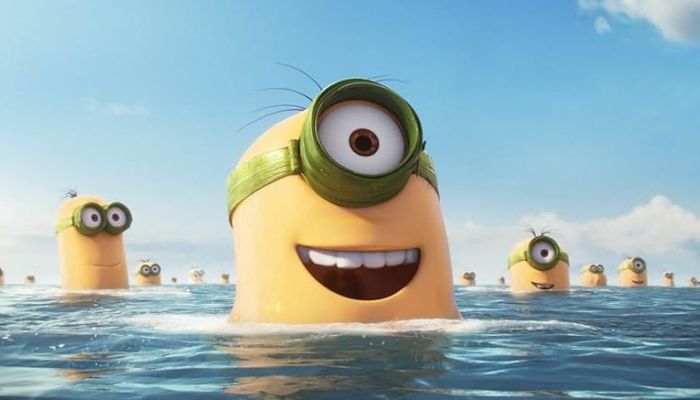
Unfortunately, their enthusiasm frequently causes the villain’s destruction. After losing several masters, the Minions retreat to an icy cave and build a community away from the world.
At first, life inside the cave appears comfortable. The Minions play, work, celebrate, and create their own routines. Over time, however, they become depressed because they have no leader to serve.
Kevin decides to leave the cave and search for a new master. Stuart joins because he misunderstands the invitation, while Bob is selected after the other Minions avoid volunteering.
This gives the film a simple three-character structure. Kevin is responsible and determined. Stuart is distracted by music and personal pleasure. Bob is innocent, affectionate, and easily impressed.
The trio reaches New York, where they learn about Villain-Con, a convention in Orlando that brings together criminals, inventors, and aspiring supervillains. The idea is one of the film’s funniest concepts. Villainy is treated like a professional industry with merchandise, public appearances, recruitment, and celebrity culture.
During the journey, the Minions meet the Nelson family, whose cheerful domestic appearance hides a shared enthusiasm for robbery. The family gives the film an amusing reversal of the traditional road-trip encounter. At Villain-Con, Kevin, Stuart, and Bob compete for the opportunity to work for Scarlet Overkill. She challenges the assembled villains to steal a ruby from her hand, expecting the task to demonstrate their worth.
The Minions succeed largely through chaos rather than skill. Scarlet hires them and brings them to her castle in England. Her husband, Herb Overkill, supplies elaborate inventions and weapons. He gives the Minions equipment for their first major assignment: stealing Queen Elizabeth II’s crown.
This central robbery produces several action sequences, including an attempt to enter the Tower of London and an encounter with the Queen herself.
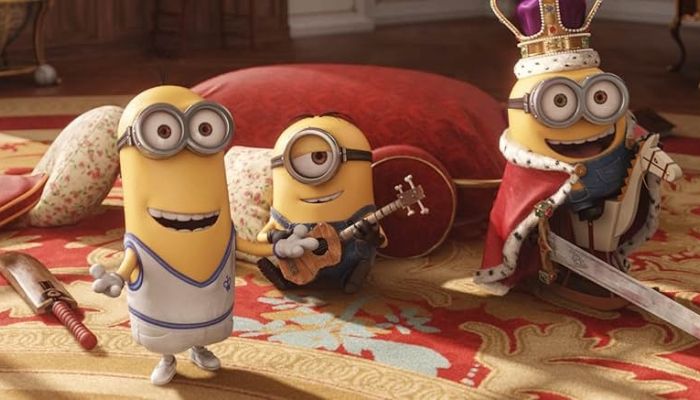
Bob accidentally becomes King of England after pulling the legendary sword from the stone. The development is absurd but fits the movie’s approach to British history, where royal traditions become physical jokes. Bob eventually gives the crown to Scarlet, believing this will satisfy her. Instead, Scarlet sees his brief rule as betrayal and decides that the Minions must be punished.
The plot then becomes a conflict between the trio and the villain they wanted to serve. Scarlet’s dream of becoming queen turns into a public coronation and a large revenge plan. The narrative is easy to follow, but it is also thin. The Minions search for a villain, find one, disappoint her, and then survive her anger.
There are no major emotional surprises. Kevin wants to rescue his friends and eventually reunite the entire Minion community. Stuart remains mostly motivated by music, while Bob continues to approach danger with childlike optimism.
The film compensates through constant activity. New locations, costumes, gadgets, songs, historical jokes, and chase scenes arrive before the basic plot has time to feel completely repetitive. That strategy works during individual sequences. Across the full movie, the lack of deeper conflict becomes more noticeable.
Kevin, Stuart, and Bob: Three Personalities Inside One Species
Kevin functions as the group’s leader. He is taller, more focused, and more willing to accept responsibility than most Minions. His decision to leave the cave gives the story its direction. Kevin recognizes that the community cannot continue without a renewed purpose.
He is not a complex hero, but he demonstrates courage, persistence, and loyalty. When Stuart and Bob are captured or threatened, Kevin becomes more serious. His leadership also creates comedy because he is still a Minion. He may form a reasonable plan, but execution remains vulnerable to misunderstanding, distraction, and physical accidents.
Stuart is the least interested in the official mission. He joins Kevin without fully understanding what he has volunteered to do and quickly becomes focused on guitars, music, and entertainment. This makes him funny in short scenes, though his character development is minimal. Stuart begins distracted and remains distracted.
His musical interest gives the film several opportunities to use 1960s culture. He treats performance as more important than danger, responsibility, or royal politics. Bob is the emotional center of the trio. He is smaller, kinder, and more visibly innocent than Kevin or Stuart.
He carries a teddy bear, becomes excited by simple experiences, and approaches strangers with little suspicion. His vulnerability makes him easy to support even when he accidentally creates problems. Bob’s brief time as king is especially effective because he has no interest in political power. He enjoys the attention but willingly gives the crown away when he believes Scarlet wants it.
His innocence also exposes Scarlet’s cruelty. Punishing Bob feels particularly unreasonable because he has no understanding of betrayal or ambition. Pierre Coffin voices the Minions and gives each one a recognizable rhythm despite their shared vocal language. Their speech combines fragments from several languages, invented sounds, names, and expressive tone.
The dialogue is rarely meant to be translated exactly. Meaning comes from gesture, context, facial expression, and repetition. This is an impressive performance and animation achievement. I almost always understand what the characters want, even when their sentences contain no conventional English.
The limitation is emotional range. Kevin, Stuart, and Bob are distinct enough for comedy but not developed enough to support a highly dramatic story. They work best as physical performers rather than psychologically complicated protagonists.
Scarlet Overkill: A Stylish Villain With a Simple Motivation
Scarlet Overkill is introduced as the world’s first major female supervillain celebrity. She enters Villain-Con with theatrical confidence and immediately controls the room.
Sandra Bullock gives Scarlet a polished voice that can shift from charming to furious without warning. The performance makes the character entertaining even when the writing provides limited motivation. Scarlet grew up without the comfort and status she wanted, and she dreams of becoming Queen of England. Her ambition is presented through fairy-tale imagery, luxury, costumes, and public recognition.
The movie suggests that she does not want only political authority. She wants the symbolic confirmation that she has become important. Her relationship with the Minions begins with exaggerated affection. She praises them, welcomes them into her home, and presents herself as the glamorous leader they have been seeking.
That warmth disappears as soon as she believes they have taken something meant for her. Scarlet’s reaction reveals the insecurity beneath her confidence. She cannot tolerate the idea that her assistants might receive attention or power before she does.
Her anger becomes increasingly large and theatrical. She threatens the Minions, interrupts the coronation, and uses Herb’s inventions to pursue revenge. The character is visually memorable, but emotionally simple. She wants the crown, feels betrayed, and responds with destruction.
A stronger screenplay might have explored why she needs public status so intensely or how her relationship with Herb supports her ambition. Instead, Scarlet functions mainly as a stylish source of danger.
Herb Overkill is more relaxed. Jon Hamm voices him with smooth enthusiasm, making his dangerous inventions sound like gifts from an affectionate host. Herb appears genuinely devoted to Scarlet. He supports her plans without competing for attention and treats villainy as both profession and lifestyle.
Their marriage is one of the film’s more interesting ideas, but it remains underdeveloped. A supervillain couple with a healthy personal relationship could have supported sharper comedy. The movie uses them primarily to provide gadgets, threats, and a larger final confrontation.
Humor & Comedy Style: A Feature-Length Collection of Minion Jokes
Minions relies heavily on visual comedy. Characters fall, misunderstand instructions, wear inappropriate costumes, operate dangerous machinery, and survive accidents that would end an ordinary animated character’s story.
The strongest jokes require little dialogue. Bob attempting to behave like a king, Kevin struggling to maintain control, or Stuart becoming distracted by a guitar can be understood immediately.
The film also uses contrast. Serious institutions such as the British monarchy, royal guards, prisons, and criminal conventions are disrupted by characters with no respect for formality.
Queen Elizabeth II is presented as unexpectedly strong and active. The joke works because the Minions assume they are confronting a passive ceremonial figure and discover a far more capable opponent.
British stereotypes appear throughout the film, including tea, royal traditions, formal guards, pubs, and national pride. The approach is affectionate but broad. The 1960s setting provides another layer of humor through clothing, music, technology, and cultural references.
Some jokes are aimed primarily at adults. Historical figures, popular songs, film references, and visual details may pass unnoticed by younger viewers. The movie rarely depends on these references for basic understanding. Children can enjoy the physical joke while adults recognize the additional context.
My first major criticism is repetition. The Minions misunderstand something, cause an accident, react dramatically, and move to the next misunderstanding. The details change, but the pattern remains familiar.
My second concern is the limited emotional consequence. Because the Minions survive nearly everything and rarely understand the seriousness of the situation, tension remains low.
This is not necessarily a problem for a light comedy. It becomes more noticeable during the final act, when the movie expects me to care about danger after spending most of its running time proving that danger has little effect.
The humor is strongest in short bursts. Individual scenes can be very funny, especially when animation and sound combine around one clear idea. A full film creates fatigue. The Minions’ language, shouting, repeated falls, and constant motion may become exhausting for viewers who do not already enjoy the characters.
Visual Design & Animation: A Colorful Trip Through the 1960s
Minions has a bright and carefully designed visual world. The yellow characters stand clearly against blue denim, urban streets, dark villain costumes, and colorful 1960s environments.
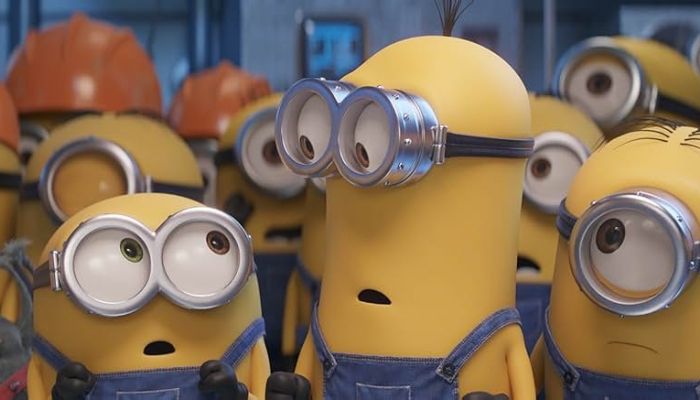
The Minion designs remain extremely simple. Their cylindrical bodies, goggles, gloves, boots, and overalls create instantly recognizable silhouettes. Small changes distinguish individuals. Height, number of eyes, hairstyle, and posture make Kevin, Stuart, Bob, and other Minions readable within a large crowd.
The animation gives them a wide physical range. Their bodies stretch, bounce, flatten, and react to impacts while maintaining a consistent basic shape. Facial animation is especially important. A change in eye direction or mouth shape can communicate confusion, fear, pride, or excitement without conventional speech.
The 1960s setting gives the production designers opportunities beyond the suburban environments of Despicable Me. New York, Orlando, Villain-Con, London, and Scarlet’s home each have a distinct identity.
Villain-Con is visually dense, filled with criminal inventions, unusual costumes, promotional displays, and crowds of exaggerated characters.
London receives a playful animated interpretation. Familiar landmarks, royal buildings, narrow streets, transportation, and period details create a recognizable but deliberately artificial city.
Scarlet’s castle combines luxury with villain technology. Her costumes and surroundings use red, black, and metallic elements to contrast with the Minions’ yellow and blue design.
The film’s action remains visually clear despite frequent movement. Characters are easy to locate, and the main objective of each sequence is usually obvious. The animation is polished, but the film sometimes fills the frame with unnecessary activity. Background characters, signs, machines, and reactions compete for attention.
This visual density matches the energy of the comedy, though it can reduce the impact of individual jokes. The most effective moments often involve simple composition: one Minion, one object, and one terrible decision.
Music & Sound: The 1960s Do Much of the Heavy Lifting
Music is one of the film’s strongest elements. The 1960s setting allows the soundtrack to use recognizable rock, pop, and soul songs. These tracks create energy and help establish time and place without requiring long explanations.
The Minions’ relationship with music also supports Stuart’s personality. Instruments, performances, and rhythmic movement appear naturally within the story. Several sequences function almost like animated music videos. The characters travel, dance, or create chaos while the soundtrack controls the pace.
This approach gives the movie immediate appeal, but it can also make scenes feel assembled around song selection rather than narrative need. Heitor Pereira’s score supports the action and comedy with playful themes. It moves between spy-movie energy, royal ceremony, emotional warmth, and exaggerated danger.
The score is effective but less memorable than the popular songs. Sound design is essential to the Minions’ comedy. Their voices, impacts, machine noises, sudden silences, and musical reactions create much of the rhythm.
Pierre Coffin’s vocal performance turns invented language into a flexible comic tool. The Minions can sing, argue, celebrate, panic, and tell stories without using consistent vocabulary.
The sound mix is frequently loud. Music, shouting, crashes, and rapid dialogue compete during action scenes.
Younger viewers may enjoy the intensity. Others may find the constant audio stimulation tiring. The film would benefit from more quiet comedy. A longer pause or a single confused sound can sometimes be funnier than a crowded sequence filled with effects.
Direction & Pacing: Fast Enough to Hide the Thin Story
Pierre Coffin and Kyle Balda direct the movie with a clear understanding of the Minions’ physical appeal. The camera frequently holds a wide enough view for the audience to understand the setup before the accident occurs.
The opening historical sequence is especially efficient. It establishes the species, motivation, comic pattern, and eventual crisis within a short period. The road to Villain-Con also moves well. Each new encounter adds a location or character without losing the central objective.
The middle section slows slightly after Scarlet hires the trio. The crown theft provides direction, but the story begins repeating its central idea: the Minions attempt to help and accidentally create a larger problem.
The final act becomes increasingly busy. Scarlet’s coronation, the Minions’ imprisonment, Kevin’s transformation, the public chase, and the arrival of the larger Minion group are packed together.
The speed prevents boredom but reduces emotional impact. Kevin’s determination to save Bob and Stuart should be the film’s dramatic center, yet the sequence moves quickly into another oversized visual joke. The movie’s running time is reasonable, but the structure still feels stretched because the characters have limited emotional development.
A shorter feature or extended television special might have matched the material more naturally. The direction succeeds at creating momentum. It is less successful at creating contrast. Nearly every scene aims for comedy, movement, or musical energy.
Without calmer sections, the film cannot make its largest moments feel significantly different from its smaller ones.
Themes & Emotional Meaning: Purpose, Belonging, and the Need to Serve
Minions presents a strange idea as its emotional foundation: the Minions require a villain to give their lives meaning.
This is played as comedy, but the cave sequence briefly treats the loss of purpose seriously. The community becomes inactive and depressed despite having food, safety, and companionship. Kevin’s journey is motivated by responsibility. He recognizes that survival is not enough if the Minions no longer feel connected to a shared goal.
The movie does not examine why serving villains is necessary. The Minions simply possess this instinct, and their moral understanding appears extremely limited. They do not admire cruelty in a conscious way. They respond to confidence, power, and theatrical evil as though these qualities create natural leadership.
This allows the film to present them as innocent despite their willingness to assist dangerous characters. Kevin’s leadership offers a healthier form of purpose. He leaves the cave to help his community rather than gain status for himself.
Bob represents unconditional affection, while Stuart represents individual pleasure and creativity. Together, the trio suggests that community requires responsibility, warmth, and personal freedom.
The movie also explores recognition. Scarlet wants a crown because she believes status will prove her value. The Minions want a master because service gives them identity.
Both needs are external. Neither Scarlet nor the Minions initially understands how to define worth without attaching themselves to a larger symbol. The difference is that Kevin cares about others. Scarlet cares primarily about how others see her.
The film does not develop these themes deeply, but they give the comedy a small emotional foundation. The ending introduces young Gru, suggesting that the Minions have finally found the leader who will define their future.
Their immediate attraction to him is based on cleverness, confidence, and theatrical theft. The moment connects the prequel to Despicable Me while providing the Minions with renewed purpose.
Critical Reception & Audience Response: Popular Characters, Divided Reviewers
Minions received a mixed critical response. Reviewers generally praised the animation, visual comedy, soundtrack, and energy. Many critics also recognized that Kevin, Stuart, and Bob were more distinct and appealing than a completely interchangeable Minion crowd.
The main criticism was the thin story. The Minions had worked effectively as supporting characters, but some reviewers felt they lacked the emotional depth and dialogue needed to sustain an entire film.
The repetitive comedy also divided opinion. Viewers who already enjoyed Minion behavior found the movie energetic and funny. Those who considered the characters irritating received almost no relief from them. Scarlet Overkill attracted praise for her design and Sandra Bullock’s performance, though critics often described the character as underwritten.
The 1960s soundtrack was frequently identified as one of the film’s most enjoyable elements. Its song choices gave the adventure more personality and helped adult audiences remain engaged.
General audiences responded more positively than many professional critics. The film became a major commercial success and confirmed the Minions as characters capable of supporting an independent franchise.
Merchandising, memes, social media, toys, clothing, and promotional appearances expanded their popularity far beyond the original Despicable Me audience. That cultural visibility also created backlash. The Minions became so widely used that some viewers began to associate them with advertising rather than storytelling.
The movie’s reputation therefore depends heavily on tolerance for the central characters. There is little middle ground. For fans, Minions provides nearly continuous access to the comedy they enjoy. For everyone else, it can feel like ninety minutes inside an extremely loud advertisement.
Final Verdict: A Funny Prequel That Works Better in Small Doses
Minions is a colorful, energetic, and technically polished animated comedy. It knows exactly why audiences respond to its central characters and gives them almost uninterrupted control of the screen.
Kevin provides enough leadership to move the story forward. Stuart adds musical distraction, while Bob supplies innocence and emotional warmth.
The trio’s search for a villain creates a simple reason to move through history, America, Villain-Con, and London. The journey is easy to understand and filled with visual variety.
Sandra Bullock makes Scarlet Overkill entertaining, even though the character’s ambition remains basic. Jon Hamm gives Herb a relaxed charm that deserved more screen time.
The animation is consistently expressive. The Minions’ invented language rarely prevents understanding because their gestures and reactions carry the meaning. The soundtrack is one of the movie’s clearest successes. Its use of 1960s music gives the adventure an identity beyond yellow characters and physical accidents.
The main limitation is structural. Minions were created to interrupt larger stories with short bursts of chaos. Making them the center of a feature reveals how little emotional variation they possess.
The jokes can be funny, but they accumulate without developing. One misunderstanding leads to another, danger produces another exaggerated reaction, and the plot continues before the previous gag has fully settled.
I recommend Minions to younger viewers, families seeking simple animated comedy, Despicable Me fans, and anyone who already enjoys the characters’ language and physical humor. Viewers who prefer layered storytelling, quieter comedy, or emotionally complex protagonists may find the film repetitive.
Personal rating: 7/10.
Minions earns that score for its polished animation, clear visual comedy, memorable soundtrack, appealing central trio, energetic voice work, and playful 1960s setting. It loses points for a thin plot, repetitive humor, underdeveloped villains, limited emotional depth, and a final act that becomes louder rather than more meaningful.
The Minions can carry a movie. The real question is whether the audience wants to be carried at their speed for the entire journey.
Pros

- The Minions' humor appeals to all ages, making it a family-friendly movie
- The vibrant animation and colorful visuals enhance the viewing experience
- The characters are distinct and memorable, each bringing unique traits to the story
- The film promotes themes of friendship and loyalty, highlighting the importance of support
- The clever mix of nostalgia, especially with the 1960s setting and music, adds depth
- The continuous slapstick comedy keeps viewers engaged and entertained throughout
Cons

- The plot can feel simplistic and may not satisfy those looking for a more complex storyline
- Some might find the humor repetitive after a while, leading to viewer fatigue
- The character development aside from the main Minions is limited, making it hard to connect with others

Leave a comment
Your comment is awaiting moderation. We save your draft here
0 Comments