




A Bright City Built on an Uncomfortable Lie
The moment that defines Zootopia for me arrives long before its mystery becomes complicated. Judy Hopps steps off a train and sees the city for the first time: towering districts, animals of every size, artificial climates, crowded streets, and the promise that anyone can become anything. It is a perfect image of possibility. It is also a promise the film spends the rest of its running time questioning. This Zootopia review begins with that contrast because the movie’s greatest achievement is building a colorful family adventure around a society that does not behave as fairly as its slogans suggest.
Released in 2016 and directed by Byron Howard and Rich Moore, with Jared Bush serving as co-director, Zootopia follows Judy, a rabbit from a rural farming community who dreams of becoming a police officer. Her ambition appears unrealistic to nearly everyone around her because law enforcement has traditionally been dominated by larger animals.
Judy reaches her goal through determination, training, and an inclusion initiative. Yet receiving the badge does not mean receiving equal respect. Her chief assigns her to parking duty, colleagues underestimate her, and citizens assume her size determines what she can handle.
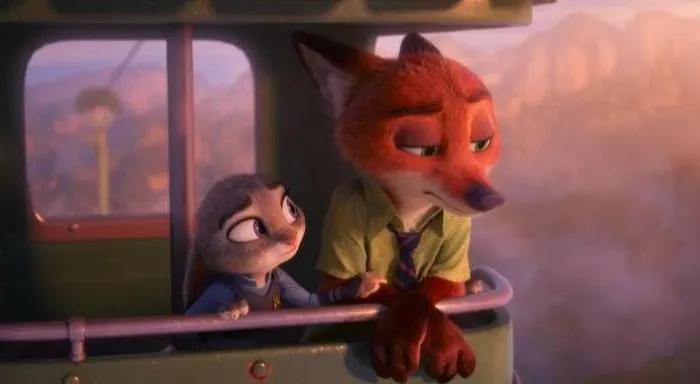
The story changes when Judy takes responsibility for a missing-mammal case and reluctantly partners with Nick Wilde, a fox and professional scam artist. Their investigation begins with one disappearance and gradually reveals a larger crisis involving predators who have started behaving violently.
That mystery gives the film momentum, but the relationship between Judy and Nick gives it emotional meaning. Both characters have been shaped by stereotypes. Judy believes she can rise above prejudice through good intentions. Nick believes society will always reduce him to the worst thing it expects from a fox.
Zootopia is funny, visually inventive, and structured like a detective story. It is also unusually willing to let its optimistic protagonist make a serious moral mistake. That decision keeps the film from becoming a simple lecture about tolerance and turns it into a more complicated story about how prejudice survives even inside people who consider themselves fair.
Plot & Storytelling: From Parking Tickets to a Citywide Conspiracy
The film opens with Judy performing in a childhood school play about the history of predator and prey relations. The presentation is intentionally crude, but it establishes the central social idea: modern animals claim to have evolved beyond the violence and fear of the past.
Young Judy announces that she wants to become Zootopia’s first rabbit police officer. Her parents respond with nervous encouragement while clearly hoping she will choose a safer life.
A confrontation with Gideon Grey, a fox who bullies smaller animals, gives Judy an early lesson in fear. She stands up to him and is injured, but the experience strengthens rather than destroys her ambition.
Years later, Judy enters the police academy. Training sequences show her failing against exercises designed around larger bodies before learning how to use speed, intelligence, and environmental awareness.
Her graduation appears to confirm the city’s promise. A rabbit has entered a profession once considered impossible for her species.
Reality becomes less inspiring. Chief Bogo dismisses her ability and assigns her to parking enforcement. Judy responds by treating the work with extreme seriousness, issuing hundreds of tickets and attempting to prove that no task is beneath her.
During this assignment, she meets Nick Wilde and Finnick. Judy initially believes Nick is a father trying to buy an ice pop for his son. After helping him, she discovers that the pair are running a resale scheme.
The scene establishes both characters effectively. Judy wants to believe the best about others, but her optimism makes her easy to manipulate. Nick understands social expectations and uses them as tools.
Their relationship changes when Judy volunteers to investigate the disappearance of Emmitt Otterton. She is given a short deadline and warned that failure will end her career.
Evidence leads her back to Nick, whose knowledge of the city and its less official networks becomes essential. Judy blackmails him into helping, beginning a partnership built on irritation rather than trust.
The investigation moves through several districts and social environments. A limousine connected to crime boss Mr. Big leads them into Tundratown. A visit to the Mystic Spring Oasis introduces Yax and a naturalist community. A traffic stop involving Flash turns a simple records request into a long joke about sloths.
These sequences are entertaining, but they also demonstrate the city’s scale. Zootopia is not one neighborhood enlarged to animal size. It is a collection of environments adapted to different bodies and climates.
Judy and Nick eventually find missing predators confined inside a secret facility. The animals have become uncontrollably aggressive, and Mayor Lionheart has hidden them to prevent panic.
At first, the discovery appears to solve the case. Lionheart is arrested, Judy becomes publicly celebrated, and Nick considers joining the police. Then Judy speaks at a press conference and suggests that biology may explain why predators are becoming dangerous. Her words trigger fear across the city.
This is the film’s most important turning point. Judy has solved the immediate case but misunderstands its meaning. Under pressure, she repeats assumptions about predators that she has not examined fully. Nick hears the statement not as an abstract scientific possibility but as confirmation that Judy still sees him as potentially dangerous.
The conspiracy is later revealed to involve Bellwether, the assistant mayor, who has used toxic night howler flowers to target predators and create fear among the prey majority.
Her plan depends on political division. If prey animals believe predators are biologically unstable, they will support leaders who promise protection.
The final reveal is effective as a mystery, though Bellwether’s transformation into the central villain happens quickly. The broader social conditions behind her plan are more interesting than the character herself.
Judy Hopps: Optimism Without Self-Awareness
Judy is an appealing protagonist because her determination is real and her flaws are meaningful. She is brave, hardworking, intelligent, and genuinely committed to helping others.
She is also impatient, self-righteous, and too confident that wanting equality makes her incapable of prejudice. Her dream of becoming an officer is inspiring because it challenges assumptions about size and social role. Judy refuses to accept the life others have prepared for her.
The academy sequence demonstrates her ability to adapt. She does not become physically stronger than a rhinoceros or polar bear. She learns how to solve the same problems differently.
That distinction matters. The film does not claim equality requires everyone to possess identical abilities. It argues that institutions often confuse one traditional form of ability with the only valid form. Judy’s early police work also reveals her need for recognition. She wants to help, but she also wants proof that she belongs.
This pressure contributes to her mistakes. Volunteering for the missing-mammal case is courageous, yet she does so without understanding the risk or complexity. Her treatment of Nick is similarly mixed. She sees past some stereotypes about foxes, but she still carries fox-repellent spray given to her by her parents.
When Nick notices the spray, Judy attempts to explain it away rather than confronting what it represents. The press conference exposes the gap between her self-image and her assumptions. Judy does not intend to encourage fear, but intention cannot erase consequence.
Ginnifer Goodwin gives Judy energy without making her endlessly cheerful. The performance includes stubbornness, embarrassment, panic, and genuine remorse. Judy’s apology to Nick is one of the strongest scenes because she does not demand immediate forgiveness. She admits that she was ignorant and hurtful.
Her tears are not presented as proof that Nick must comfort her. The scene works because Judy accepts responsibility without turning herself into the victim. She ultimately becomes a better officer not simply by solving the conspiracy, but by recognizing that fairness requires continued self-examination.
Nick Wilde: A Cynic Who Learned to Become the Stereotype
Nick is introduced as confident, funny, and completely in control of his scams. He reads people quickly and knows how to make their assumptions useful. His cynicism is not natural. It is learned. As a child, Nick wanted to join the Junior Ranger Scouts. He believed wearing the uniform would allow him to belong to a group that valued loyalty and bravery.
Instead, the other children restrained him, placed a muzzle over his face, and mocked him for believing a fox could ever be trusted. The flashback is short but emotionally devastating. Nick’s adult identity becomes understandable immediately.
He decided that if society would always see him as dishonest, he would stop trying to prove otherwise. Becoming a scam artist gives him control over the stereotype. Jason Bateman’s performance fits the character perfectly. His relaxed delivery makes Nick sound as though he is always slightly ahead of the conversation.
The humor hides vulnerability. Nick rarely raises his voice because emotional distance is part of his protection. His partnership with Judy gradually weakens that distance. She frustrates him, but she also treats his knowledge as valuable and eventually sees his potential beyond the scams.
The moment when Judy suggests he could become a police officer matters because she imagines a future for him that he stopped imagining for himself. Her press conference therefore feels like a betrayal rather than a simple disagreement. Nick had begun to trust that Judy’s view of him was different.
The film does not make Nick forgive her immediately. Their reconciliation happens after Judy accepts responsibility and asks for help without entitlement. Nick’s eventual decision to join the police completes his emotional arc. He does not become someone entirely new. He chooses to stop allowing the cruelty of others to define the limits of his identity.
Judy and Nick: The Partnership at the Heart of the Film
Zootopia works because Judy and Nick are not simply opposites placed together for comedy. Their differences reveal each other’s blind spots.
Judy believes systems can improve if determined individuals participate in them. Nick believes systems protect their existing assumptions and punish anyone who expects fairness. Both views contain truth.
Judy needs Nick’s skepticism because optimism without awareness makes her vulnerable to manipulation. Nick needs Judy’s persistence because cynicism has become another kind of prison. Their dialogue develops through teasing, arguments, observation, and gradually earned respect. The film does not force immediate affection.
Judy initially treats Nick as a source of information. Nick treats Judy as an inexperienced officer who can be manipulated. As the case becomes more dangerous, they begin protecting one another without discussing it. Trust appears through action before either character names it.
Their chemistry is often compared with a classic detective partnership. Judy pushes forward, while Nick notices social details she misses. The relationship remains officially platonic within the film, which supports the central story. Their bond does not require a romantic resolution to feel significant.
The final police partnership shows that both characters have changed. Judy has become less certain of her own moral perfection. Nick has become willing to invest in an institution he once distrusted. Their banter remains intact, preventing the ending from making either character overly serious.
Supporting Characters & Voice Performances: A City Full of Memorable Personalities
Chief Bogo is voiced by Idris Elba with commanding irritation. He initially dismisses Judy, but his skepticism is not presented as simple cruelty.
Bogo is responsible for a department facing serious cases, and Judy arrives through a political initiative he does not fully respect. His error lies in assuming she cannot contribute before allowing her to prove herself. Jenny Slate gives Bellwether a nervous, overlooked quality during the early story. Her small body and assistant role encourage both characters and viewers to underestimate her.
The villain reveal uses that expectation effectively. Bellwether has learned how to present herself as harmless while building political power through fear. The character’s motivation is clear but underdeveloped. She resents predator dominance and wants prey animals to control the city, yet the film gives limited detail about her personal history.
J.K. Simmons voices Mayor Lionheart with public confidence and private anxiety. Lionheart’s decision to hide the affected predators is unethical, but he is not responsible for causing the crisis. His behavior demonstrates how leaders may conceal information because they fear social consequences, creating conditions that make the eventual panic worse.
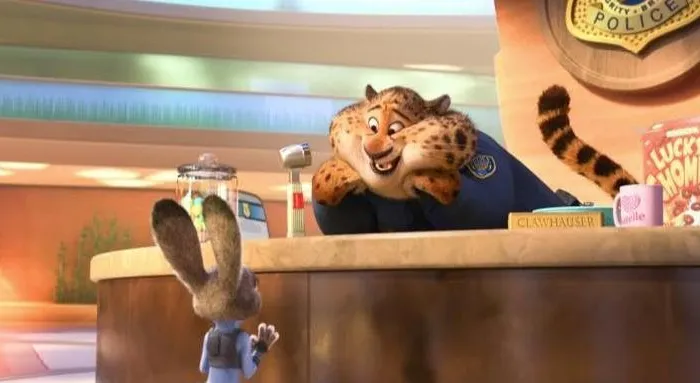
Octavia Spencer brings warmth and desperation to Mrs. Otterton. Her limited screen time establishes the emotional cost of the disappearances. Nate Torrence voices Clawhauser, the cheerful cheetah receptionist whose friendliness contrasts with Bogo’s severity. His love of pop star Gazelle provides recurring humor.
Tommy Chong’s Yax is relaxed and completely unconcerned by Judy’s discomfort at the naturalist club. Maurice LaMarche gives Mr. Big the voice and mannerisms of a classic crime boss despite the character’s tiny size. The contrast is obvious, but the film commits to it with excellent timing.
Raymond S. Persi voices Flash, whose slow speech creates one of the film’s most famous sequences. The joke is simple and extended almost to the point of frustration, which is precisely why it works.
Shakira voices Gazelle, a pop star who functions as a public symbol of unity. The role is less a developed character than a representation of the city’s aspirational identity. The ensemble succeeds because most characters are visually and vocally distinct within seconds. Even small roles contribute to the feeling that Zootopia is a functioning society.
Humor & Comedy Style: Animal Behavior Meets Social Observation
Zootopia uses animal traits as both visual jokes and parts of its world-building. Sloths work at the motor vehicle department, hamsters travel through miniature tubes, and giraffes receive drinks through vertical delivery systems.
These jokes are effective because they emerge from the city’s design rather than feeling added after the fact.
The scale differences provide constant visual opportunities. Judy can move through spaces inaccessible to larger officers, while tiny characters require entirely different infrastructure. The film also uses genre parody. Mr. Big references crime cinema, the investigation follows detective-story conventions, and the secret laboratory resembles a conspiracy thriller.
Nick’s verbal humor is especially strong. His sarcasm often exposes Judy’s inexperience without stopping the story. Judy produces comedy through determination. She treats parking enforcement as though she is saving the city, creating a contrast between the importance of the job and the intensity of her performance.
Some jokes depend on stereotypes within the animal world. The film is aware of this and frequently turns the assumptions back on the characters.
However, not every joke supports the larger message. Repeated humor about body size, species habits, or occupational roles occasionally relies on the same quick categorization the story wants viewers to question.
That contradiction is difficult to avoid in a film whose entire world is built from animal differences. My first major criticism is the sloth sequence’s length. It is funny, but the joke continues well beyond the point when the audience understands it.
My second concern is that several supporting characters exist almost entirely as species-based punchlines. They make the city entertaining, but they rarely complicate the assumptions attached to them.
Visual Design & Animation: A City Engineered for Every Species
Zootopia’s visual design is one of its greatest achievements. The city is divided into districts with different climates, architecture, transportation, and population needs. Sahara Square uses warm colors, tall buildings, and desert conditions. Tundratown is covered in snow and ice. The Rainforest District is vertical, wet, and filled with plant life.
Little Rodentia is built for tiny mammals, turning Judy into a giant when she enters it. Bunnyburrow uses farmland, trains, and open fields to contrast with the density of the city. These environments are not only backgrounds. They shape movement, jokes, investigations, and social behavior.
Transportation systems are designed around extreme differences in size. Doors, trains, pathways, and service counters must function for mice, rabbits, elephants, and giraffes. The level of detail gives the city credibility. Zootopia feels planned rather than randomly populated with animals.
Character animation also balances human expression with species behavior. Judy’s ears communicate emotion constantly. Nick’s tail and relaxed posture reinforce his controlled personality. Clawhauser moves with a softness that matches his friendly demeanor. Bogo’s size and stillness create authority before he speaks.
Fur technology was a major visual challenge, and the film uses it to distinguish species without sacrificing expressive faces. The animation remains polished, though the strongest visual work is conceptual rather than purely technical. The city’s design communicates the film’s social themes.
Zootopia presents itself as inclusive because every environment has been engineered for different bodies. Yet access to buildings does not automatically eliminate prejudice. That distinction gives the visual world meaning beyond spectacle.
Music, Direction & Pacing: A Detective Story Inside a Family Film
Michael Giacchino’s score supports the film’s movement between comedy, mystery, action, and emotional reflection. The music gives the city scale during Judy’s arrival and becomes more restrained during Nick’s childhood story.
Detective sequences use rhythm and suspense without making the film feel too dark for younger audiences. “Try Everything,” performed by Shakira as Gazelle, serves as the film’s central pop song. Its message about failure and persistence matches Judy’s ambition.
The song is direct and commercially polished, but it works within the story because Judy listens to it during her journey toward the city. Byron Howard and Rich Moore direct the film with strong control over genre. The opening resembles a social fable, the middle becomes a buddy detective story, and the final act moves into political conspiracy.
These elements remain connected through Judy and Nick. Even when the mystery grows larger, their relationship provides continuity. The pacing is generally excellent. Judy’s childhood, training, first assignment, partnership with Nick, investigation, mistake, and redemption all receive clear stages.
The film slows down at important moments, especially Nick’s flashback and Judy’s apology. The mystery itself is accessible without becoming completely obvious. Younger viewers can follow the clues, while adults may recognize the political structure earlier.
The final reveal and confrontation are somewhat conventional. Once Bellwether is exposed, the story moves quickly toward recording her confession and restoring order. A more complex ending might have acknowledged that removing one conspirator cannot immediately repair the fear spread across the city.
Themes & Emotional Meaning: Prejudice Is More Than Open Hatred
Zootopia’s central theme is prejudice, but the film approaches it through several different forms. Some discrimination is direct. Judy is told rabbits cannot become police officers. Nick is physically attacked because foxes are considered untrustworthy. Other prejudice appears as protection, tradition, humor, professional judgment, or supposedly neutral science.
Judy’s parents love her and want her to be safe. Their gift of fox-repellent spray comes from fear rather than conscious cruelty. That fear still carries a message: foxes are dangerous, and Judy should treat them accordingly.
Judy considers herself open-minded because she rejects obvious discrimination against rabbits. She does not initially recognize that she has absorbed assumptions about predators. This is one of the film’s strongest insights. Experiencing one form of prejudice does not automatically make a person aware of every other form.
Nick responds to prejudice by performing the identity expected of him. His experience shows how stereotypes can become self-reinforcing. When opportunities are closed and distrust is constant, cynicism begins to look rational.
Bellwether weaponizes fear because it is politically useful. She does not need every prey animal to hate predators personally. She needs them to believe separation and control are necessary for safety.
The film also explores institutional bias. Judy enters the police force through an inclusion program but receives work that prevents her from demonstrating her ability.
Formal access exists, yet informal attitudes continue limiting her. Zootopia’s metaphor is powerful but imperfect. Predator and prey differences involve biological history in ways that do not map cleanly onto human identities.
The film sometimes risks implying that social groups possess natural tendencies connected to violence. Its plot ultimately rejects that conclusion, but the metaphor remains complicated. The story works best when treated as an introduction to examining bias rather than a complete explanation of real-world discrimination.
Critical Reception & Lasting Reputation: A Family Film That Started Serious Conversations
Zootopia received widespread critical praise for its animation, voice cast, humor, world-building, mystery structure, and willingness to address prejudice within a family adventure.
Reviewers frequently highlighted the chemistry between Ginnifer Goodwin and Jason Bateman. Judy and Nick were seen as a strong central partnership capable of carrying both comedy and emotional material. The city itself received significant attention. Critics praised the detailed design and the way animal scale influenced architecture, transportation, and jokes.
The film’s social themes were generally considered ambitious and accessible. Many reviewers appreciated that Judy was allowed to make a serious mistake rather than functioning as a flawless moral guide.
Some criticism focused on the limitations of the predator-and-prey metaphor. Real social prejudice cannot be reduced neatly to biological categories, and the film occasionally mixes several different forms of discrimination.
Bellwether also received criticism as a relatively simple villain attached to a more complicated social issue. The film won the Academy Award for Best Animated Feature and became one of Disney Animation’s most commercially and critically successful modern releases.
Its reputation has remained strong because it works on several levels. Children can follow the mystery and enjoy the animal city. Adults can recognize workplace discrimination, political fear, media panic, and social performance.
The film also generated discussion beyond ordinary animation reviews. Educators, parents, and commentators used it as a starting point for conversations about stereotypes and bias.
That educational use should not be mistaken for perfect social analysis. Zootopia simplifies difficult subjects because it remains a mainstream family movie. Its lasting value comes from encouraging questions rather than resolving every issue completely.
Final Verdict: A Clever Animated Mystery With Something Real to Say
Zootopia is one of Disney Animation’s strongest modern films because it combines entertainment with meaningful character failure. Judy is not heroic because she begins with perfect beliefs. She becomes heroic because she recognizes the harm she caused and chooses to change.
Nick is not simply the charming criminal who helps the police. He is someone who learned to survive by accepting society’s worst expectations and eventually decides to risk hope again.
Their partnership gives the film warmth, humor, and emotional credibility. Each character sees something the other misses. The mystery moves efficiently through several parts of the city, allowing the world-building to support rather than interrupt the plot. The animation remains excellent. Districts, transportation, character movement, scale, fur, and environmental details create a city that feels both fantastical and functional.
The supporting cast gives nearly every location personality. Chief Bogo, Clawhauser, Flash, Mr. Big, Bellwether, Lionheart, and Judy’s parents are memorable even when their roles are brief.
The social themes are ambitious for a mainstream family film. Zootopia recognizes that prejudice can exist through fear, kindness, institutions, language, and assumptions rather than open hatred alone.
Its metaphor is not perfect. Predator and prey biology cannot represent real human inequality without producing uncomfortable implications. The ending is also too clean. One villain is exposed, but the fear spread across the city would require more than a public confession to repair.
Those limitations do not erase the film’s achievement. Zootopia offers children an exciting detective story and gives older viewers enough complexity to question the city’s optimistic slogans. I recommend Zootopia to families, animation fans, viewers who enjoy buddy mysteries, and anyone interested in stories about ambition, bias, trust, and social identity.
Personal rating: 9/10.
Zootopia earns that score for its outstanding central partnership, intelligent screenplay, detailed world-building, strong performances, polished animation, effective mystery, and willingness to let its heroine fail morally. It loses one point for an imperfect metaphor, a thin villain, prolonged jokes, and a resolution that repairs social division too quickly.
Zootopia begins by promising that anyone can become anything. Its wiser conclusion is that making such a promise true requires more than repeating it.
Pros

- Engaging and layered narrative that appeals to both children and adults
- Vibrant visual aesthetics with detailed artistry in every scene
- Effective humor that balances lighter moments with thoughtful themes
- Dynamic character development that allows for personal connections
- Thought-provoking exploration of social issues presented in a subtle manner
- Impressive sound design and musical score that enhances the overall experience
Cons

- Some transitions between the humorous and serious elements feel abrupt at times
- A few subplots may appear underdeveloped relative to the main storyline
- The extensive cast of characters occasionally leads to narrative clutter


Leave a comment
Your comment is awaiting moderation. We save your draft here
0 Comments